https://twitter.com/ianbremmer/status/620570062538309632/photo/1
Greek Depression vs US Depression:
Unemployment http://t.co/81efYi5Ajy—
ian bremmer (@ianbremmer) July 13, 2015
Celebrating humanity's flourishing through the spread of capitalism and the rule of law
14 Jul 2015 Leave a comment
in business cycles, currency unions, economic growth, economic history, Euro crisis, global financial crisis (GFC), great depression, great recession, job search and matching, labour economics, macroeconomics, unemployment Tags: Greece
https://twitter.com/ianbremmer/status/620570062538309632/photo/1
Greek Depression vs US Depression:
Unemployment http://t.co/81efYi5Ajy—
ian bremmer (@ianbremmer) July 13, 2015
10 Jul 2015 Leave a comment
in business cycles, currency unions, economic history, economics of regulation, Euro crisis, financial economics, global financial crisis (GFC), law and economics, macroeconomics, monetary economics, property rights Tags: bank runs, banking crises, banking panic, financial crises, Greece, sovereign default
Financial crises surprisingly common, but few countries close their banks pewrsr.ch/1NQyz2P #Greece http://t.co/pK0sfB49Ka—
PewResearch FactTank (@FactTank) July 09, 2015
06 Jul 2015 Leave a comment
in applied price theory, applied welfare economics, budget deficits, business cycles, comparative institutional analysis, constitutional political economy, currency unions, economic growth, economic history, Euro crisis, fiscal policy, fisheries economics, global financial crisis (GFC), international economics, macroeconomics, Public Choice, rentseeking Tags: Euro sclerosis, Greece, insurance attacks, sovereign defaults, speculative attacks
The roots of Greece’s crisis are simple. Before Greece joined the Eurozone, investors treated it as a middle-income country with poor governance — which is to say, a credit risk.
After Greece joined the Eurozone, investors thought that Greece was no longer a credit risk — they figured, if push came to shove, other Eurozone members like Germany would bail Greece out. They were wrong.

Michael Dooley put forward a theory of speculative attacks on currencies as insurance attacks on currencies for emerging markets after the East Asian financial crisis:
First generation models of speculative attacks show that apparently random speculative attacks on policy regimes can be fully consistent with rational and well-informed speculative behaviour.
Unfortunately, models driven by a conflict between exchange rate policy and other macroeconomic objectives do not seem consistent with important empirical regularities surrounding recent crises in emerging markets. This has generated considerable interest in models that associate crises with self-fulfilling shifts in private expectations.
In this paper we develop a first generation model based on an alternative policy conflict. Credit constrained governments accumulate reserve assets in order to self-insure against shocks to national consumption. Governments also insure poorly regulated domestic financial markets.
Given this policy regime, a variety of internal and external shocks generate capital inflows to emerging markets followed by successful and anticipated speculative attacks.
We argue that a common external shock generated capital inflows to emerging markets in Asia and Latin America after 1989. Country specific factors determined the timing of speculative attacks. Lending policies of industrial country governments and international organizations account for contagion, that is, a bunching of attacks over time.
His model was not within the context of a currency union but his basic theory is correct.
There are speculative attacks on a currency or a bank run after foreign markets revises their estimates of the available central bank reserves and international lines of credit to bail out the banking systems and/or foreign debt.
Michael Dooley was dealing with the emerging economies of Southeast Asia and their official lines of credit that insure their foreign exchange liabilities and domestic banking system. Greece is about lines of credit for similar purposes to other European union member states.
via 12 charts and maps that explain the Greek crisis – Vox and The Most Important Graphs of 2011 – The Atlantic.
06 Jul 2015 Leave a comment
in budget deficits, business cycles, currency unions, economic growth, Euro crisis, financial economics, fiscal policy, global financial crisis (GFC), macroeconomics Tags: bank runs, banking panics, Eurosclerosis, Germany, Greece, sovereign defaults
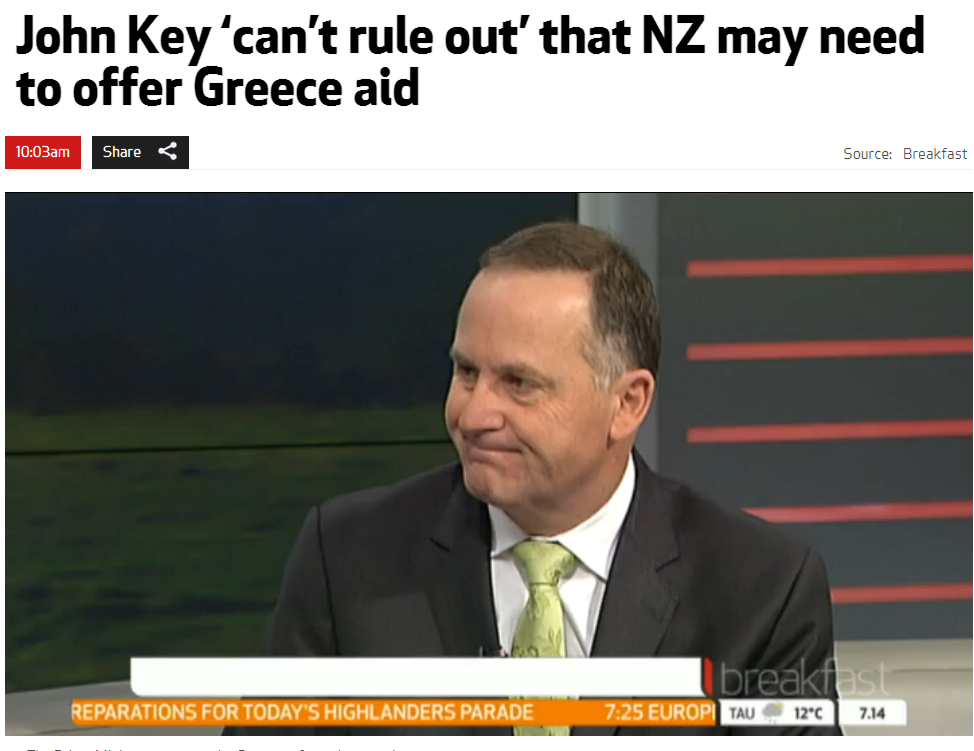
Greece is a tiny part of the European economies so it doesn’t matter that much to the rest of the European Union what happens to Greece. The only people will notice the sovereign default of Greece once the breathless journalism has died down are Greeks themselves as they rebuild their banking and monetary system against a background of a government run by coffee shop Marxists.

06 Jul 2015 3 Comments
in budget deficits, business cycles, currency unions, economic growth, Euro crisis, fiscal policy, labour economics, labour supply, macroeconomics, unemployment Tags: Eurosclerosis, Greece
The extreme economic outlier that is Greece, in 7 charts: 53eig.ht/1GMgIFU http://t.co/gb3zkgUqqJ—
(@FiveThirtyEight) July 04, 2015
29 Jun 2015 Leave a comment
in business cycles, currency unions, economic growth, Euro crisis, fiscal policy, global financial crisis (GFC), international economic law, international economics, macroeconomics Tags: game theory, Greece, Patrick Kehoe, sovereign default
19 Jun 2015 Leave a comment
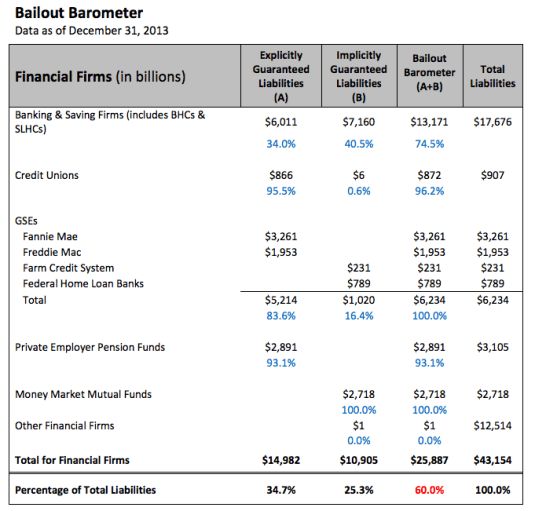
in business cycles, financial economics, monetary economics, Public Choice, rentseeking Tags: bailouts, deposit insurance, implicit guarantees, lender of last resort
17 Jun 2015 Leave a comment
in business cycles, economic history, great depression, labour economics, macroeconomics, unemployment Tags: Euro sclerosis, measurement error, Michael Darby
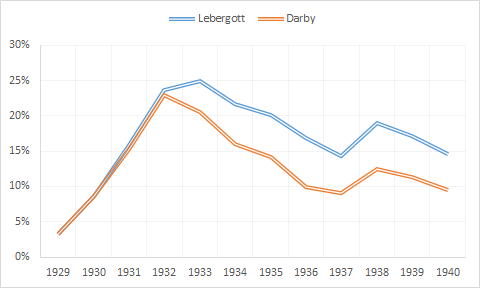
The graph below shows two different series for unemployment in the 1930s in the USA: the official BLS level by Lebergott; and a data series constructed famously by Michael Darby.
Figure 1: US unemployment rate, 1929 – 40: Darby and Lebergott estimates
Source: Robert Margot (1993).
Darby includes workers in the emergency government labour force as employed – the most important being the Civil Works Administration (CWA) and the Works Progress Administration (WPA). Once these workfare programs are accounted for, the level of U.S. unemployment fell from 22.9% in 1932 to 9.1% in 1937, a reduction of 13.8%.
For 1934-1941, the corrected unemployment levels are reduced by two to three-and-a half million people and the unemployment rates by 4 to 7 percentage points after 1933.
Not surprisingly, Darby titled his 1976 Journal of Political Economy article Three-and-a-Half Million U.S. Employees Have Been Mislaid: Or, an Explanation of Unemployment, 1934-1941. The corrected data by Darby shows stronger movement toward the natural unemployment rate after 1933.
From about 1935, the unemployment rate in the Great Depression in the USA is not much different from what it is in Europe in recent decades under Eurosclerosis.
In the 1930s in the USA, many unemployed were employed by the Civil Works Administration and the Works Progress administration. In contemporary Europe, the unemployed are simply paid not to work under their welfare state arrangements.
14 Jun 2015 Leave a comment
in business cycles, fiscal policy, labour economics, macroeconomics, minimum wage Tags: Bryan Caplan, economic fallacies, involuntary unemployment, Keynesian macroeconomics, methodology of economics, wage rigidity
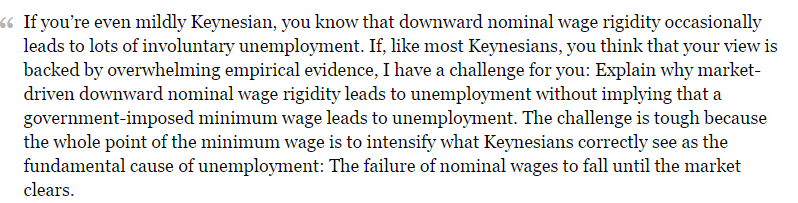
Via If You’re A Keynesian Then You Must Believe The Minimum Wage Increases Unemployment and The Myopic Empiricism of the Minimum Wage, Bryan Caplan | EconLog | Library of Economics and Liberty.
10 Jun 2015 Leave a comment
in business cycles, economic growth, economic history, entrepreneurship, financial economics, macroeconomics Tags: active investing, efficient market hypothesis, entrepreneurial alertness, passive investing
Here’s how Warren Buffett sees the stock market read.bi/1HsUe1p http://t.co/Zm6fDTYpf9—
BI Chart of the Day (@chartoftheday) April 23, 2015
10 Jun 2015 Leave a comment
in business cycles, currency unions, economic growth, Euro crisis, global financial crisis (GFC), great recession, macroeconomics Tags: Eurosclerosis, France, Germany, Italy, Spain
Spain's economic growth is being touted as a success story. Don't tell the Spaniards: on.wsj.com/1M45yzI http://t.co/pm4DAd1qkF—
Nick Timiraos (@NickTimiraos) June 03, 2015
05 Jun 2015 Leave a comment
in business cycles, economic growth, macroeconomics Tags: world economy
The entire global economy. In one chart. bloom.bg/1FrXQ1A http://t.co/H07P9n2LkL—
Bloomberg VisualData (@BBGVisualData) May 22, 2015
05 Jun 2015 Leave a comment
in business cycles, economic growth, economic history, great depression, macroeconomics Tags: great depression, growth accounting, real business cycles
Notice how productivity recovers but hours worked per working age adults does not.

via The Current Financial Crisis in Spain: What Should We Learn from the ….
03 Jun 2015 Leave a comment
in business cycles, economic history, macroeconomics, monetary economics Tags: monetary policy, The Fed
02 Jun 2015 Leave a comment
in business cycles, economics of education, human capital, job search and matching, labour economics, labour supply, macroeconomics, occupational choice, unemployment Tags: education premium, graduate premium
Don't listen to naysayers. College is worth it, even for so-so students. nyti.ms/1JC1ZiN http://t.co/Wnr5BnwumM—
The Upshot (@UpshotNYT) April 24, 2015
Celebrating humanity's flourishing through the spread of capitalism and the rule of law
Celebrating humanity's flourishing through the spread of capitalism and the rule of law
Celebrating humanity's flourishing through the spread of capitalism and the rule of law
Celebrating humanity's flourishing through the spread of capitalism and the rule of law
Celebrating humanity's flourishing through the spread of capitalism and the rule of law
Celebrating humanity's flourishing through the spread of capitalism and the rule of law
Celebrating humanity's flourishing through the spread of capitalism and the rule of law
Celebrating humanity's flourishing through the spread of capitalism and the rule of law
Celebrating humanity's flourishing through the spread of capitalism and the rule of law
Celebrating humanity's flourishing through the spread of capitalism and the rule of law
Celebrating humanity's flourishing through the spread of capitalism and the rule of law
Celebrating humanity's flourishing through the spread of capitalism and the rule of law
A History of the Alt-Right
Econ Prof at George Mason University, Economic Historian, Québécois
Celebrating humanity's flourishing through the spread of capitalism and the rule of law
Scholarly commentary on law, economics, and more
Beatrice Cherrier's blog
Celebrating humanity's flourishing through the spread of capitalism and the rule of law
Celebrating humanity's flourishing through the spread of capitalism and the rule of law
Celebrating humanity's flourishing through the spread of capitalism and the rule of law
Why Evolution is True is a blog written by Jerry Coyne, centered on evolution and biology but also dealing with diverse topics like politics, culture, and cats.
Celebrating humanity's flourishing through the spread of capitalism and the rule of law
A rural perspective with a blue tint by Ele Ludemann
DPF's Kiwiblog - Fomenting Happy Mischief since 2003
Celebrating humanity's flourishing through the spread of capitalism and the rule of law
The world's most viewed site on global warming and climate change
Tim Harding's writings on rationality, informal logic and skepticism
A window into Doc Freiberger's library
Let's examine hard decisions!
Commentary on monetary policy in the spirit of R. G. Hawtrey
Thoughts on public policy and the media
Celebrating humanity's flourishing through the spread of capitalism and the rule of law
Politics and the economy
A blog (primarily) on Canadian and Commonwealth political history and institutions
Reading between the lines, and underneath the hype.
Economics, and such stuff as dreams are made on
"The British constitution has always been puzzling, and always will be." --Queen Elizabeth II
Celebrating humanity's flourishing through the spread of capitalism and the rule of law
Celebrating humanity's flourishing through the spread of capitalism and the rule of law
WORLD WAR II, MUSIC, HISTORY, HOLOCAUST
Undisciplined scholar, recovering academic
Celebrating humanity's flourishing through the spread of capitalism and the rule of law
Res ipsa loquitur - The thing itself speaks
In Hume’s spirit, I will attempt to serve as an ambassador from my world of economics, and help in “finding topics of conversation fit for the entertainment of rational creatures.”
Researching the House of Commons, 1832-1868
Reflections on books and art


Recent Comments