Spain's economic growth is being touted as a success story. Don't tell the Spaniards: on.wsj.com/1M45yzI http://t.co/pm4DAd1qkF—
Nick Timiraos (@NickTimiraos) June 03, 2015
The Spanish economic recovery compared
10 Jun 2015 Leave a comment
in business cycles, currency unions, economic growth, Euro crisis, global financial crisis (GFC), great recession, macroeconomics Tags: Eurosclerosis, France, Germany, Italy, Spain
Hours worked per worker varies greatly across industrialised countries
20 May 2015 Leave a comment
Monday morning blues? Compare the avg number of #working hours in yr country per year. More: bit.ly/1JPVYQu http://t.co/r5MsELJr1n—
(@OECD) April 19, 2015
Where has all the productivity gone?
11 May 2015 Leave a comment
in business cycles, economic growth, Euro crisis, fiscal policy, global financial crisis (GFC), great depression, great recession, macroeconomics Tags: labour productivity, prosperity and depression, TFP
Britain has led most of the rich world in job creation, but badly lagged in productivity. on.wsj.com/1IiEjli http://t.co/URIFuFS9Il—
Sudeep Reddy (@Reddy) May 07, 2015
Maybe joining Euroland isn’t that bad after all
08 May 2015 Leave a comment
in business cycles, currency unions, development economics, Euro crisis, global financial crisis (GFC), growth miracles, international economics, macroeconomics, monetary economics Tags: Eastern Europe, Euroland, European Union, Eurosclerosis, transitional economies
#Dailychart: How "New Europe" has fared on its tenth birthday econ.st/1fwOg33 http://t.co/AvkCqHmzAf—
The Economist (@ECONdailycharts) May 01, 2014
Real GDP Portugal, Italy, Greece and Spain (PIGS) – 1955 to 2013
06 May 2015 Leave a comment
in currency unions, economic growth, Euro crisis, macroeconomics Tags: Eurosclerosis, Greece, Italy, PIGS, Portugal, Spain
Figure 1: Real GDP per Portuguese, Italian, Greek and Spaniard aged 15-64, converted to 2013 price level with updated 2005 EKS purchasing power parities, 1955-2013
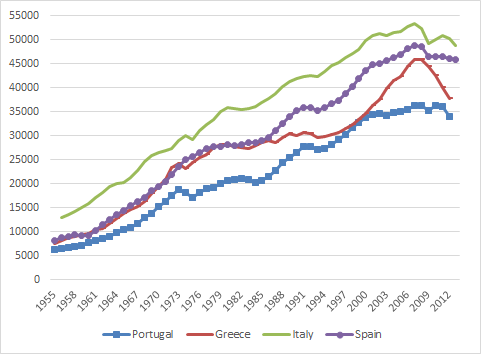
Source: Computed from OECD Stat Extract and The Conference Board, Total Database, January 2014, http://www.conference-board.org/economics
Figure 2: Real GDP per Portuguese, Italian, Greek an Spaniard aged 15-64, converted to 2013 price level with updated 2005 EKS purchasing power parities, 1.9 per cent detrended, 1955-2013
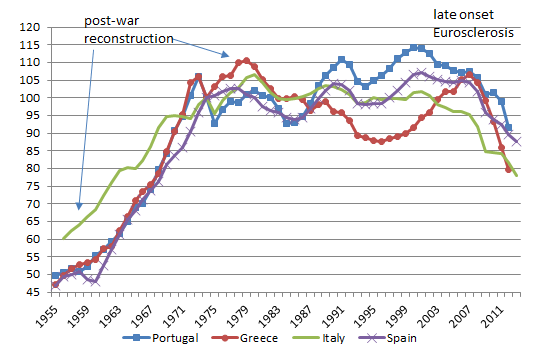
Source: Computed from OECD Stat Extract and The Conference Board, Total Database, January 2014, http://www.conference-board.org/economics
Note that a flat line in figure 2 is growth in real GDP for that year at 1.9%; a rising line is above trend rate of growth; and a falling line is below trend rate growth for that year.
The PIGS had three distinct phases in their post-war growth. Rapid growth up until about the mid 70s. Growth at about the trend rate of growth of 1.9% until about 2000 in the case of Italy. This was followed by slow decline then rapid decline after the global financial crisis.
Figure 3: Real GDP per Italian aged 15-64, converted to 2013 price level with updated 2005 EKS purchasing power parities, 1.9 per cent detrended, 1955-2013
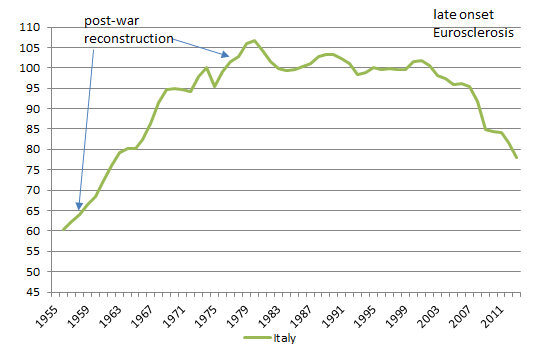
Source: Computed from OECD Stat Extract and The Conference Board, Total Database, January 2014, http://www.conference-board.org/economics
Greece had a different story with the long decline between 1979 to 1995. This was followed by 10 good years of growth followed by sharp decline with the onset of the global financial crisis.
Figure 4: Real GDP per Greek aged 15-64, converted to 2013 price level with updated 2005 EKS purchasing power parities, 1.9 per cent detrended, 1955-2013
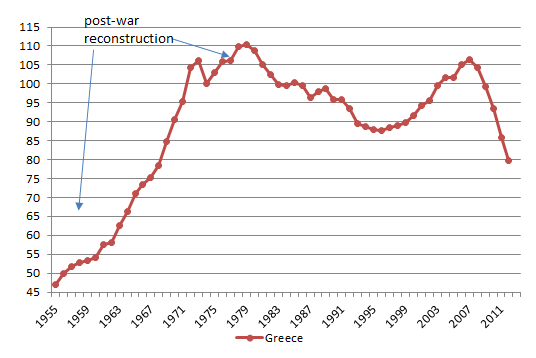
Source: Computed from OECD Stat Extract and The Conference Board, Total Database, January 2014, http://www.conference-board.org/economics
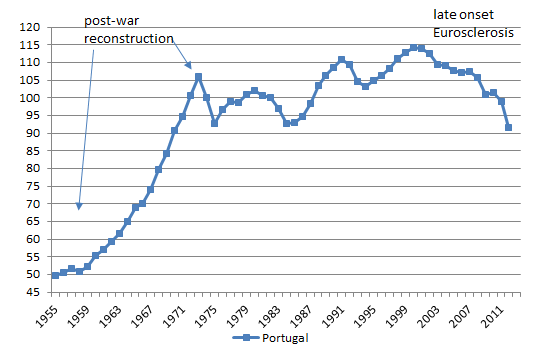
Portugal was in a boom In the 1980s and 1990s followed by what borders on a depression since about 2000.
Figure 5: Real GDP per Portuguese aged 15-64, converted to 2013 price level with updated 2005 EKS purchasing power parities, 1.9 per cent detrended, 1955-2013
Source: Computed from OECD Stat Extract and The Conference Board, Total Database, January 2014, http://www.conference-board.org/economics
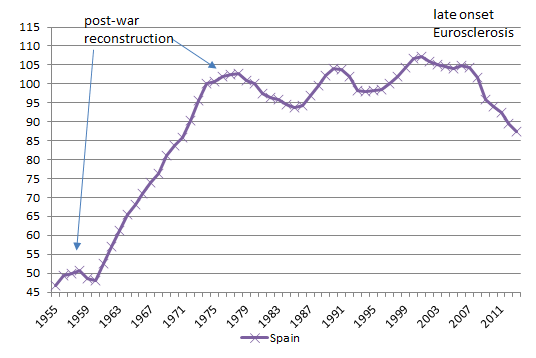
Spain had a pretty good run from the mid-1980s until the eve of the global financial crisis with somewhat above trend growth after a period of decline in the 1970s.
Figure 6: Real GDP per Spaniard aged 15-64, converted to 2013 price level with updated 2005 EKS purchasing power parities, 1.9 per cent detrended, 1955-2013
Source: Computed from OECD Stat Extract and The Conference Board, Total Database, January 2014, http://www.conference-board.org/economics
What is left of Greece
05 May 2015 Leave a comment
Greece.
(Source: wsj.com/article_email/…) http://t.co/ZWYwiKt9W1—
Justin Wolfers (@JustinWolfers) May 02, 2015
Post-war reconstruction then Eurosclerosis – Germany, Italy and France 1950-2013
04 May 2015 Leave a comment
in currency unions, economic growth, economic history, Euro crisis, macroeconomics Tags: Eurosclerosis, France, Germany, Italy, post-war reconstruction
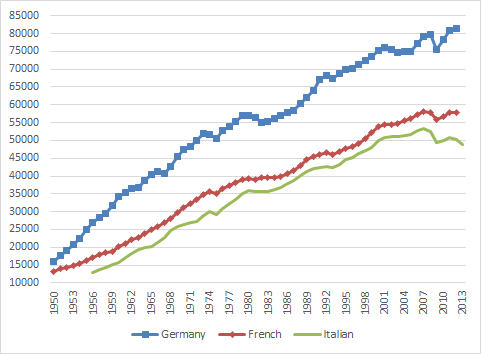
Figure 1: Real GDP per German, Italian and French aged 15-64, converted to 2013 price level with updated 2005 EKS purchasing power parities, 1950-2013
Source: Computed from OECD Stat Extract and The Conference Board, Total Database, January 2014, http://www.conference-board.org/economics
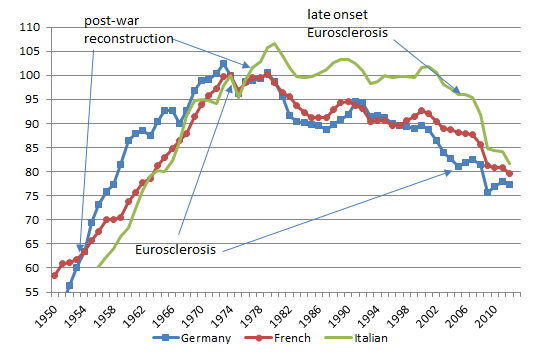
Figure 2: Real GDP per German, Italian and French aged 15-64, converted to 2013 price level with updated 2005 EKS purchasing power parities, 1.9 per cent detrended, 1950-2013
Source: Computed from OECD Stat Extract and The Conference Board, Total Database, January 2014, http://www.conference-board.org/economics
A flat line in figure 2 means real GDP growth of 1.9% per year, which is trend growth. A rising line means growth that is higher than trend rate; a falling line means growth at below the trend rate of 1.9%. 1.9% is the trend rate of growth of the USA in the 20th century. Figure 2 shows that:
- Germany, Italy and France all boomed until the mid-1970s;
- the French and German economies went into a long-term decline from that time; and
- the Italian economy stopped growing at anything more than the trend rate of growth between the mid-1970s and the mid-1990s and then went into a sharp decline that borders on the depression.
Recoveries from recessions across the G-7
28 Apr 2015 Leave a comment
in business cycles, economic growth, Euro crisis, global financial crisis (GFC), great recession, macroeconomics, politics - USA Tags: British economy, Canada, Eurosclerosis, France, Germany, Italy, Japan, recoveries from recessions
UK recovery: stronger than Italy, weaker than US & Canada. http://t.co/C0TEsbzMm3—
Jonathan Portes (@jdportes) April 28, 2015
The rest of Europe can’t expect Germany to keep bailing them out
22 Apr 2015 Leave a comment
in Euro crisis, macroeconomics, population economics Tags: ageing society, European Union, Eurosclerosis, France, Germany, labour demographics
BofA-ML: Working age population projections, a serious problem for Germany http://t.co/eStgQePoVP—
Fabrizio Goria (@FGoria) March 30, 2015
Levels of output are nowhere near returning to pre-crisis trends
21 Apr 2015 Leave a comment
in business cycles, economic growth, Euro crisis, global financial crisis (GFC), great recession, macroeconomics Tags: Eurosclerosis

Why are Europe’s strong employment protection laws still popular with the Left?
17 Apr 2015 Leave a comment
in economics of regulation, Euro crisis, global financial crisis (GFC), great recession, job search and matching, labour economics, macroeconomics, unemployment Tags: employment law reform, employment protections laws, Eurosclerosis, Germany
#Unemployment rate in #OECD area fell to 7.0% in Feb, w/42.9mn people jobless bit.ly/1FNK0W5 #stats http://t.co/RPUqvlR3mQ—
(@OECD) April 13, 2015
The countries with the more liberal labour markets are recovering fastest from the Great Recession and the Global Financial Crisis.
EZ unemployment rates http://t.co/vnfti1hhqe—
(@cigolo) March 31, 2015
This includes Germany where there were major labour market reforms a couple of years before the onset of the Global Financial Crisis. For that reason, German unemployment rates didn’t rise much in 2008 and after and are now falling quite rapidly because of their labour market liberalisations. Germany has the lowest unemployment rate in Europe.
UK youth unemployment high but lower than 20 other EU member states. #Budget2015 http://t.co/eBa8W9rr6C—
RBS Economics (@RBS_Economics) March 18, 2015

Annual hours worked, USA, West Germany, Germany and France, 1950-2013
15 Apr 2015 Leave a comment
in economic growth, Euro crisis, fiscal policy, labour economics, labour supply, macroeconomics, politics - USA Tags: annual hours worked, Eurosclerosis, taxation and the labour supply, welfare state
The French and Germans work much less than the Americans
(via: bit.ly/1b2DfWo) http://t.co/S8XwIeLNBr—
Max Roser (@MaxCRoser) April 15, 2015
Max Roser tweeted this chart today showing that French and Germans work far fewer hours than Americans. His measure is annual hours worked divided by the number of persons engaged. Max Roser’s starter shows that French and German annual hours worked in a steady decline since 1950.
My measure below is annual hours worked per American, French, West Germany and German aged 15 to 64. My data shows a different picture. There are stable hours worked per working age American. European hours per worked per working age European fell rapidly up until 1986 or so and then stabilised. Each set of data, my data and Max Roser’s data, requires its own explanation. My explanation is the sharp rises in taxes Europe in the 1970s and 80s.
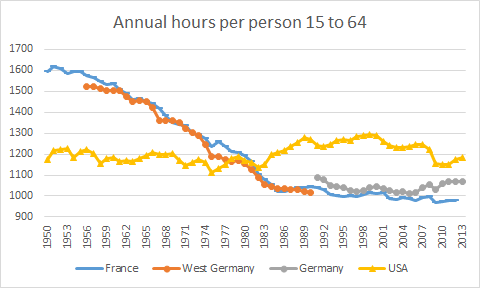
Source:OECD StatExtract and The Conference Board Total Economy Database, January 2014.
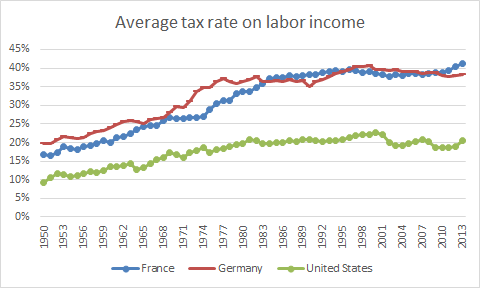
Each set of data, my data and Max Roser’s data, requires its own explanation. My explanation is the sharp rises in taxes net welfare state transfers in Europe in the 1970s and 80s.
Source: caramcdaniel.com
As an illustration, average tax rates on American labour incomes doubled between 1950 in 1980 and then was stable. Labour supply started recover after this point in time as well.
Average tax rates on French and German labour income more than doubled between 1950 to about 1990 and then stopped rising by much after that. At the same time, the fall in hours worked per working age German and French stopped. The average tax rate by that time in Europe was twice that of the USA.
The ease of enforcing contractual rights in Europe
11 Apr 2015 Leave a comment
in Euro crisis, law and economics, macroeconomics, property rights Tags: ease of doing business, European Union, Eurosclerosis, Greece, rule of law
Employment losses after recent financial crises
09 Apr 2015 Leave a comment
in business cycles, economic history, Euro crisis, global financial crisis (GFC), great depression, great recession, job search and matching, macroeconomics Tags: financial crises, global financial crisis, great recession, recessions and recoveries
@TimDuy @profsufi Compared to other financial crisis, this recovery is OK. http://t.co/eGU5lOxKnu—
Bill McBride (@calculatedrisk) December 24, 2014
 Utopia, you are standing in it!
Recent Comments