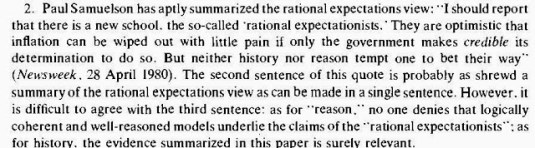
Source: Tom Sargent "The Ends of Four Big Inflations
Celebrating humanity's flourishing through the spread of capitalism and the rule of law
02 Feb 2015 Leave a comment
in business cycles, fiscal policy, inflation targeting, macroeconomics, monetary economics Tags: new classical macroeconomics, Paul Samuelson, policy credibility, rational expectations, regime uncertainty, Stephen Williamson, time inconsistency, Tom Sargent
31 Jan 2015 8 Comments

27 Jan 2015 Leave a comment
in budget deficits, currency unions, development economics, economic growth, economic history, Euro crisis, fiscal policy, global financial crisis (GFC), growth disasters, law and economics, macroeconomics, poverty and inequality Tags: currency unions, Euroland, Greece, optimal currency area, sovereign default
24 Jan 2015 Leave a comment
in business cycles, fiscal policy, great depression, great recession, history of economic thought, macroeconomics, monetary economics, Robert E. Lucas Tags: Paul Samuelson, prosperity and depression, The fatal conceit, The pretence to knowledge
19 Dec 2014 1 Comment
in applied welfare economics, fiscal policy, macroeconomics Tags: broken window fallacy, fiscal stimulus, Henry Hazlett

17 Dec 2014 Leave a comment
in budget deficits, business cycles, economic growth, fiscal policy, global financial crisis (GFC), great depression, great recession, macroeconomics, monetarism, monetary economics Tags: bank runs, GFC, great depression, great recession, Robert E. Lucas
15 Dec 2014 Leave a comment
in fiscal policy, transport economics
My first trip on the bullet train was zipping from Tokyo to Kyoto and Osaka and then to Hiroshima. A great experience was my trip to Japan in 1993. An excellent tourist destination. I recommend Japan to anyone as a tourist destination. The language barrier is not a problem – there are plenty of English signs.

When I returned to Japan as a student in 1995, the last of my bullet train trips was into the Japanese mountains.
The class field trip travelled on a spur on the Bullet train to the Yamagata city in Yamagata prefecture.
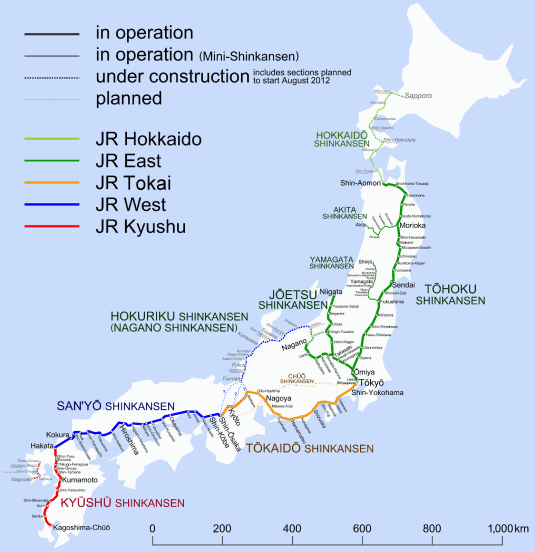
This bullet train line weaved its way through the mountains and rarely hit any sort of speed. The bullet train was no faster than the ordinary Japanese trains I have taken through the mountains in Japan.
When I asked my Professor of Land Transport when we are heading back from our field trip at an isolated rural train station waiting for the Bullet train, why was the Bullet train to such a remote place, he said that the Secretary General of the Liberal Democratic party always wanted the Bullet train to come to his home district.
Yamagata prefecture has a population of about 1 ½ million. Yamagata city has a population of about a quarter of 1 million. That is smaller than Greater Wellington.
The final station in this spur into Yamagata prefecture has a population of 40,000. Perhaps a Bullet train should come to my suburb in the eastern suburbs of Wellington?
12 Dec 2014 1 Comment
in economic growth, fiscal policy, macroeconomics, Robert E. Lucas Tags: ideas and growth, Robert E. Lucas
11 Dec 2014 Leave a comment
in fiscal policy, labour economics, labour supply, macroeconomics, public economics Tags: taxation and the labour supply, Tom Sargent
08 Dec 2014 Leave a comment
in fiscal policy, income redistribution, labour economics, labour supply, politics - USA, public economics, welfare reform Tags: effective marginal tax rates, Obama care, poverty traps, welfare reform

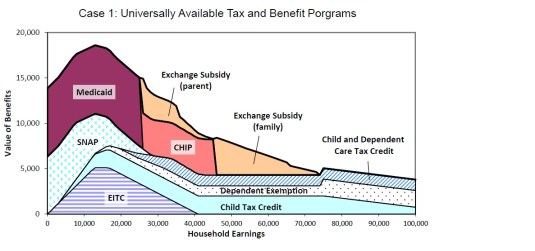
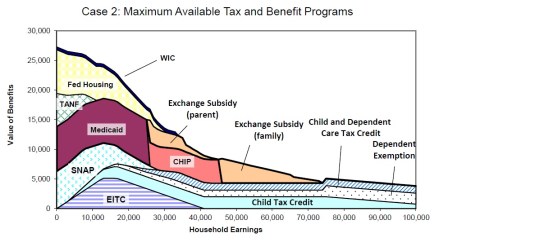
One in five Americans on Medicaid; this image does not include those on Medicare –those over 65 who get their healthcare paid by the government.




06 Dec 2014 Leave a comment
in business cycles, fiscal policy, global financial crisis (GFC), great recession, macroeconomics, monetary economics, politics - USA Tags: Macroeconomics
18 Nov 2014 Leave a comment
in applied welfare economics, business cycles, economic growth, fiscal policy, global financial crisis (GFC), great depression, great recession, macroeconomics Tags: Edward Prescott, real business cycle theory
The extension of recursive methods to dynamic equilibrium modelling spawned a revolution in aggregate economics.
This revolution has resulted in aggregate economics becoming, like physics, a hard science and not exercises in storytelling.
Operations research played a major role in the development of practical methods to model dynamic aggregate economic phenomena and to predict the consequences of policy regimes.
Subsequently recursive methods were used to develop a quantitative theory of aggregate fluctuations and other aggregate phenomena.
07 Nov 2014 Leave a comment
in applied price theory, fiscal policy, politics - New Zealand Tags: Marginal tax rates, public economics, public finance

Note: Average marginal tax rate calculations exclude the impact of ACC levies, the Benefit system and the Family Tax Credit (FTC) system which, at various times since the 1970s, involved lump sum transfers to lower income families with children that were withdrawn at higher income levels at rates of up to 30c/$, thereby adding to effective MTRs.
Comment: The average marginal tax rate has been pretty stable in New Zealand since about 1990 excepting for a drop in the late 1990s and then an increase in 1999.
via http://www.treasury.govt.nz/publications/research-policy/wp/2012/12-04
Celebrating humanity's flourishing through the spread of capitalism and the rule of law
Celebrating humanity's flourishing through the spread of capitalism and the rule of law
Celebrating humanity's flourishing through the spread of capitalism and the rule of law
Celebrating humanity's flourishing through the spread of capitalism and the rule of law
Celebrating humanity's flourishing through the spread of capitalism and the rule of law
A History of the Alt-Right
Econ Prof at George Mason University, Economic Historian, Québécois
Celebrating humanity's flourishing through the spread of capitalism and the rule of law
Scholarly commentary on law, economics, and more
Beatrice Cherrier's blog
Celebrating humanity's flourishing through the spread of capitalism and the rule of law
Celebrating humanity's flourishing through the spread of capitalism and the rule of law
Celebrating humanity's flourishing through the spread of capitalism and the rule of law
Why Evolution is True is a blog written by Jerry Coyne, centered on evolution and biology but also dealing with diverse topics like politics, culture, and cats.
Celebrating humanity's flourishing through the spread of capitalism and the rule of law
A rural perspective with a blue tint by Ele Ludemann
DPF's Kiwiblog - Fomenting Happy Mischief since 2003
Celebrating humanity's flourishing through the spread of capitalism and the rule of law
The world's most viewed site on global warming and climate change
Tim Harding's writings on rationality, informal logic and skepticism
A window into Doc Freiberger's library
Let's examine hard decisions!
Commentary on monetary policy in the spirit of R. G. Hawtrey
Thoughts on public policy and the media
Celebrating humanity's flourishing through the spread of capitalism and the rule of law
Politics and the economy
A blog (primarily) on Canadian and Commonwealth political history and institutions
Reading between the lines, and underneath the hype.
Economics, and such stuff as dreams are made on
"The British constitution has always been puzzling, and always will be." --Queen Elizabeth II
Celebrating humanity's flourishing through the spread of capitalism and the rule of law
Celebrating humanity's flourishing through the spread of capitalism and the rule of law
WORLD WAR II, MUSIC, HISTORY, HOLOCAUST
Undisciplined scholar, recovering academic
Celebrating humanity's flourishing through the spread of capitalism and the rule of law
Res ipsa loquitur - The thing itself speaks
In Hume’s spirit, I will attempt to serve as an ambassador from my world of economics, and help in “finding topics of conversation fit for the entertainment of rational creatures.”
Researching the House of Commons, 1832-1868
Articles and research from the History of Parliament Trust
Reflections on books and art
Posts on the History of Law, Crime, and Justice
Celebrating humanity's flourishing through the spread of capitalism and the rule of law
Exploring the Monarchs of Europe
Cutting edge science you can dice with
Small Steps Toward A Much Better World
“We do not believe any group of men adequate enough or wise enough to operate without scrutiny or without criticism. We know that the only way to avoid error is to detect it, that the only way to detect it is to be free to inquire. We know that in secrecy error undetected will flourish and subvert”. - J Robert Oppenheimer.


 Utopia, you are standing in it!
Recent Comments