Unemployment rates across OECD member countries
14 Jul 2015 Leave a comment
in Euro crisis, global financial crisis (GFC), great recession, job search and matching, labour economics, macroeconomics, unemployment Tags: unemployment rates
Was the Chinese share market crash rational asset-price movements without news?
14 Jul 2015 1 Comment
in business cycles, entrepreneurship, financial economics, macroeconomics Tags: competition as a discovery procedure, dot.com bubble, entrepreneurial alertness, event studies, learning by doing, sharemarket bubbles, sharemarket crashes
Large share market crashes such as over the recent months in China and the 1987 Wall Street crash do not necessarily imply an economic slowdown.
As the stock market gets rocked, let's remember this one thing about the crash of 1987 businessinsider.com/lets-remember-… http://t.co/BDgy5h5UN0—
Elena Holodny (@elenaholodny) August 21, 2015
The majority of major share market movements occur without any particular news hitting the market. Studies of the 50 largest share market movements in the US stock market between 1946 and 1987 found that the majority of them could not be explained by news. That includes the 1987 share market crash. In October 1987, shares fell by 20% in one day for no obvious reason.
China's stock market selloff explained in 6 charts bloom.bg/1HStJSe http://t.co/0CpoU21RpY—
Bloomberg Business (@business) July 13, 2015
David Romer explained these booms and busts, including the 1987 share market crash in two ways: investor uncertainty about the quality of other investors’ information; and dispersion of information and small costs to trading:
Asset prices can change because initially the market does an imperfect job of revealing the relevant information possessed by different investors and because developments within the market can then somehow cause more of that information to be revealed…
The possibility of imperfect aggregation implies an alternative to external news and irrationality as a potential source of asset-price movements: some price changes may be caused by “internal” news.
That is, asset prices can change because initially the market does an imperfect job of revealing the relevant information possessed by different investors and because developments within the market can then somehow cause more of that information to be revealed.
Either of these models are perfectly plausible. Investors learn from each other through trading and improve their estimations of the value of various shares.
#China Reality Check: #Stocks Are Still Too Expensive for @MarkMobius bloom.bg/1Monzct via @business @frostyhk http://t.co/e3Lv3KwgTZ—
Fion Li (@fion_li) July 13, 2015
As such, through internal learning and discovery within the share market there can be booms and crashes despite no new information, no communication, and no coordination among the participants in trading. Underneath the surface, there is a gradual updating of information by the participants and at a certain point in time, this causes a sudden change of behaviour.
Dow and Gorton made similar points to David Romer about how share market learning is a process of learning, judgement and error correction rather than an instant adjustment:
Strategic interaction and the complexity of the information result in a protracted price response.
Indeed, equilibrium price paths of the model may display reversals in which the two traders rationally revise their beliefs, first in one direction, and then in the opposite direction, even though no new information has entered the system.
A piece of information which is initially thought to be bad news may be revealed, through trading, to be good news.
Bubbles and crashes are consistent with private information held by a few slowly dispersing among market participants until this knowledge was reflected in stock prices as in Hayek’s (1945) analysis of the price mechanism as a means of communicating information.
HT: The one thing you should remember about the stock market crash of 1987 | Business Insider.
Greek and US great depressions compared
14 Jul 2015 Leave a comment
in business cycles, currency unions, economic growth, economic history, Euro crisis, global financial crisis (GFC), great depression, great recession, job search and matching, labour economics, macroeconomics, unemployment Tags: Greece
https://twitter.com/ianbremmer/status/620570062538309632/photo/1
Greek Depression vs US Depression:
Unemployment http://t.co/81efYi5Ajy—
ian bremmer (@ianbremmer) July 13, 2015
Greece’s possible currency outcomes, from today’s euro to the drachma
13 Jul 2015 Leave a comment
in currency unions, economic history, macroeconomics Tags: currency reforms, EU, Euroland, Greece, sovereign defaults
Greece’s possible currency outcomes, from today's euro to the drachma (and several in between) on.wsj.com/1ew3Yvs http://t.co/nEWtz84WTG—
Sudeep Reddy (@Reddy) July 05, 2015

Major sovereign bond defaults in recent history
11 Jul 2015 Leave a comment
in currency unions, economic history, Euro crisis, international economics, law and economics, macroeconomics Tags: Argentina, Greece, Russia, sovereign defaults

via Defaulting Debtors.
Financial crises surprisingly common, but few countries close their banks
10 Jul 2015 Leave a comment
in business cycles, currency unions, economic history, economics of regulation, Euro crisis, financial economics, global financial crisis (GFC), law and economics, macroeconomics, monetary economics, property rights Tags: bank runs, banking crises, banking panic, financial crises, Greece, sovereign default
Financial crises surprisingly common, but few countries close their banks pewrsr.ch/1NQyz2P #Greece http://t.co/pK0sfB49Ka—
PewResearch FactTank (@FactTank) July 09, 2015
The left-wing solution to Greek bankruptcy
10 Jul 2015 Leave a comment
in applied price theory, applied welfare economics, comparative institutional analysis, constitutional political economy, currency unions, fiscal policy, global financial crisis (GFC), income redistribution, liberalism, macroeconomics, Marxist economics, Public Choice, public economics, rentseeking Tags: Eurosclerosis, expressive voting, Greece, rational ignorance, rational irrationality, sovereign default
Real and Pseudo-Financial Crises, the Chinese share market crash and Anna Schwartz
09 Jul 2015 Leave a comment
in economic history, financial economics, fiscal policy, international economics, macroeconomics, monetarism, monetary economics Tags: Anna Schwartz, bank runs, banking panics, China, contagion, evidence-based policy, financial crises, financial stability, inflation targeting, international systemic risk, Michael Bordo, monetary history, pseudo financial crises, pseudo international systemic risk
If we could take time out from the breathless journalism about the Chinese stock market, which some people may have heard of before this week, it’s crash should be seen through the lens that Anna Schwartz developed in 1987 of a pseudo financial crisis and a financial crisis.
This is why so many Chinese companies are suspended bloom.bg/1UA7TbA http://t.co/5awEt6B23u—
Bloomberg Business (@business) July 08, 2015
Her paper is written at the same time as the 1987 stock market crash. On financial crises, Anna Schwartz said:
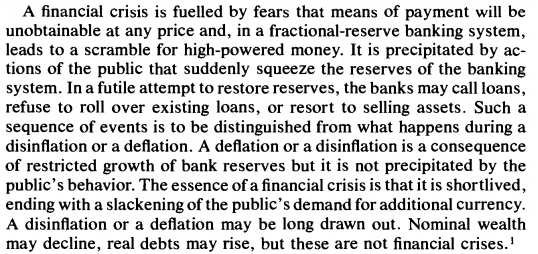
As for those pseudo financial crises, she said:
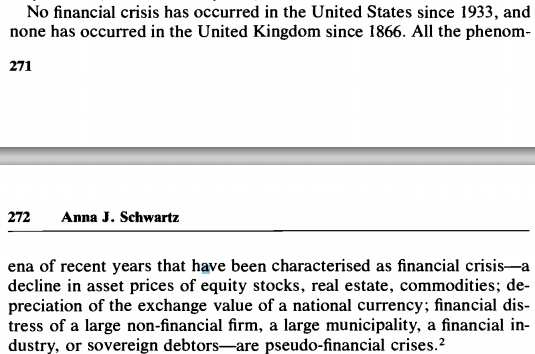
Schwartz’s principal concern with regard to pseudo financial crisis was:
proposals to deal with pseudo-financial crises is the perpetuation of policies that promote inflation and waste of economic resources
As we are talking about the Chinese stock market, Anna Schwartz also wrote about the concepts of real systemic international risk and and pseudo international systemic risk.
Once again, and as with pseudo financial crises and real financial crises, what distinguishes real systemic international risk and pseudo international systemic risk is a threat to the payment system. The threat of bank runs, which can easily be eliminated through lender of last resort facilities:
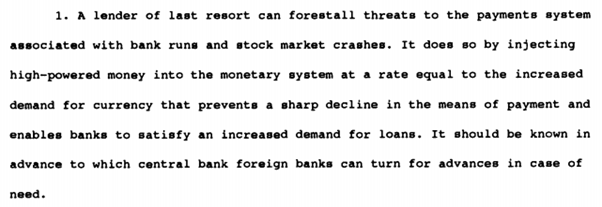
As always it is about the security of the payments system – of avoiding bank runs, not private losses:
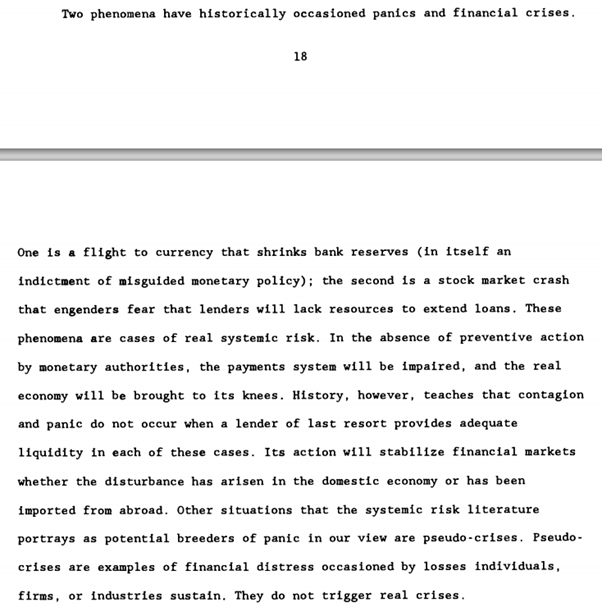
The lesson for the day is that when people start panicking about the economy or the stock market or international markets, don’t go to a macroeconomist for advice, go to a monetary historian. They have seen it all before.

A tale of Italy’s two economies
08 Jul 2015 Leave a comment
in economic history, macroeconomics Tags: Eurosclerosis, Italy
A tale of Italy's two economies econ.st/1L0EqAX http://t.co/Yhvpd4d6Fz—
The Economist (@EconEconomics) May 18, 2015
Richer is greener: environmentalists are Environmental Kuznets Curve deniers
07 Jul 2015 Leave a comment
in applied price theory, applied welfare economics, development economics, economic growth, economic history, energy economics, environmental economics, growth disasters, growth miracles, health and safety, industrial organisation, international economics, labour economics, law and economics, liberalism, property rights, public economics Tags: healthier is wealthier, Japan, Kuznets environmental curve, richer is greener, richer is safer
The Kuznets environmental curve describes an empirical regularity between environmental quality and economic growth. Outdoor water, air and other pollution first worse and then improves as a country first experiences economic growth and development.

While many pollutants exhibit this pattern in the Kuznets environmental curve, peak pollution levels occur at different income levels for different pollutants, countries and time periods. John Tierney explains:
In dozens of studies, researchers identified Kuznets curves for a variety of environmental problems.
There are exceptions to the trend, especially in countries with inept governments and poor systems of property rights, but in general, richer is eventually greener.
As incomes go up, people often focus first on cleaning up their drinking water, and then later on air pollutants like sulphur dioxide.
As their wealth grows, people consume more energy, but they move to more efficient and cleaner sources — from wood to coal and oil, and then to natural gas and nuclear power, progressively emitting less carbon per unit of energy.
When I was living in Japan in the mid 1990s, they just completed a period of rapid operation of the Kuznets environmental curve. I was told by my professors at Graduate School that in the 1960s, cities and prefectures welcomed polluting industries because of the better paid jobs they offered. At that time, shipping companies used like to go to Tokyo because the pollution in Tokyo Bay was so bad that it would clean all the barnacles off their ships. That made them sail faster.

Japanese incomes and wages doubled over the course of the 1960s. The Japanese voter was now prepared to support stricter pollution standards and environmental controls.
Life expectancy is at an all time high: buff.ly/1ICraAi http://t.co/jgRqKy8LfQ—
HumanProgress.org (@humanprogress) June 28, 2015
In the early 1970s, the ruling LDP stole the long-standing environmental policies of their opponents in a big crack down on pollution because the country could now afforded them.
Poverty has plummeted in East Asia and the world. buff.ly/1NtIDyY http://t.co/SsY3sf3kyH—
HumanProgress.org (@humanprogress) July 01, 2015
Plenty of developing countries are democracies now. Their people could demand through the ballot box higher environmental standards and clean tap water but they don’t because of its cost to economic development.
These 4 nations are 50% of mankind. That's 3.5 billion people who are living longer. buff.ly/1Kle6mU #health http://t.co/949oqisMsL—
HumanProgress.org (@humanprogress) June 30, 2015
The environmental movement lives in a state of denial regarding the relationship between economic growth and environmental quality.
OECD Better Life Index correlates with GDP
But US lower than poorer countries
& NZL higher than richer countries http://t.co/yrTCnO1B0l—
Max Roser (@MaxCRoser) June 26, 2015
Why does 1% of history have 99% of the wealth?
07 Jul 2015 Leave a comment
in applied price theory, applied welfare economics, comparative institutional analysis, economic growth, economic history, liberalism Tags: Deidre McCloskey, The Great Enrichment, The Great Escape, The Great Fact
Scotland already has its own currency ripe for a currency board?
07 Jul 2015 Leave a comment
in currency unions, economic history, macroeconomics, monetary economics Tags: British economy, British politics, currency boards, free banking, Ireland, Scotland, Scottish independence
Since 1844, the Bank of Scotland, Clydesdale Bank and The Royal Bank of Scotland have been allowed to issue banknotes in denominations of £5, £10, £20, £50 and £100. Only the Royal Bank of Scotland continues to issue a small volume of £1 notes. Two Northern Irish banks have similar prerogatives.

These Scottish banknotes are not legal tender in England. No banknotes have legal tender status in Scotland, whether issued by Scottish banks or the Bank of England. The Bank of England says:
Scottish and Northern Ireland banknotes are fully backed at all times by ring-fenced backing assets partly held in Bank of England notes and UK coin, and partly as balances on accounts maintained by the issuing banks at the Bank of England.
Consequently, holders of genuine Scottish and Northern Ireland banknotes have the same level of protection as that available to holders of genuine Bank of England notes.
The acceptability of any means of payment, including banknotes, is essentially a matter for agreement between the parties involved in a transaction in Scotland.

Bank of England keeps control Scottish bank notes in issue by stipulating that the issuing bank hold in their reserves the same amount of UK money (either in cash or on deposit at the Bank of England) as the Scottish notes they issue. These reserves could easily be converted to a currency board.
- A currency board issues local notes and coins anchored to a foreign currency (e.g. Sterling) backed by government bonds with 1 pound sterling pound sterling and British government bonds for every Scottish pound currency note issued.
- A currency board issues domestic notes and coins only when there are foreign-exchange reserves to back it. In the case of a Scottish currency board, there would be pounds Sterling reserves to back any Scottish pounds and currency notes on issue.
The Hong Kong currency board has operated successfully through 30 years of financial turbulence and radical constitutional change. There is no reason why a Scottish currency board could not do likewise, guaranteeing the convertibility of a Scots pound, initially at parity with the English pound sterling.

After independence, Ireland acted effectively as a currency board until the 1970s. Currency boards were commonplace throughout the British Empire and were highly successful.
- On the independence of the Irish Free State in 1922, the introduction of an independent currency was a low priority because 98% of exports and 80% of imports were with the UK.
- British banknotes and notes issued by Irish banks circulated (but only the first were legal tender) and coins remained in circulation.
Under the Currency Act 1927, the Saorstát Pound (Free State Pound) was created at parity with the British Pound Sterling. A Currency Commission kept British government securities, sterling cash, and gold to keep a 1:1 relationship between the two currencies.
Although a Central Bank of Ireland was created in 1943, the Irish punt remained linked to sterling with the central bank operated as a de facto currency board policy until joining the European Exchange Rate Mechanism in 1979.
A currency board has no capacity to act as a lender of last resort to a Scottish banking system.


Recent Comments