

Why is anybody still living in East Germany (or New Zealand)?
14 Jan 2015 1 Comment
in economic history, macroeconomics, politics - Australia, politics - New Zealand Tags: East Germany, Germany, immigration, Trans-Tasman income gap
When I pointed to Jennifer Hunt’s so titled paper freshly released in 2000 on why does anyone still live in East Germany, none of my New Zealand colleagues understood the parallel with their own country.
The wage gap between East and West Germany is about the same as the wage gap between Australia and New Zealand.
- East Germans have the advantage of being able to getting their car to go to the west. Some do commute from the east to jobs in the West; and
- New Zealanders have to get into a plane and commuting done a daily basis is really out of the question – the air flight time alone is three hours.
There are in fact bigger language, or more correctly dialect differences between Germany than there are across the Tasman Sea between New Zealanders and Australians. Educational standards are similar between New Zealanders and Australians.
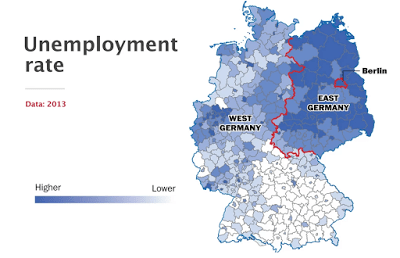

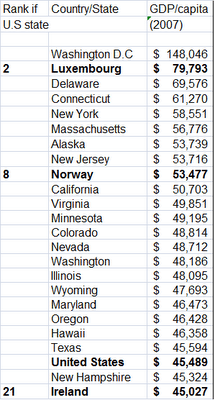
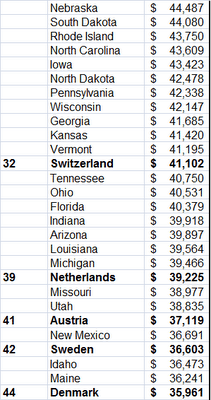
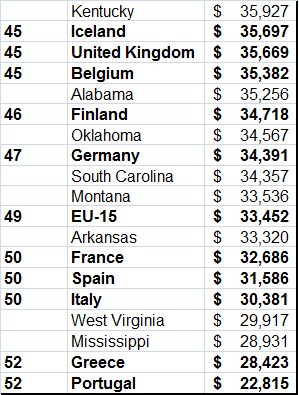
In 1997 GDP per capita in East Germany was 57% of that of West Germany, wages were 75% of western levels, and the unemployment rate was at least double the western rate of 7.8%.
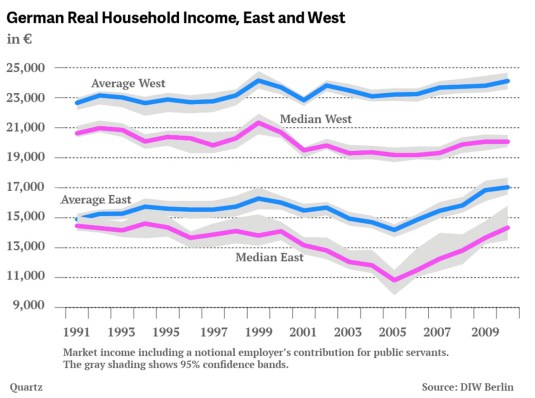
The wage gap across the Tasman between New Zealand and Australia is about one third. Wage gaps between East and West Germany and between Australia and New Zealand are about the same.

Australia and New Zealand have a single integrated labour market. Any New Zealander Australian is free to work in the other country.
New Zealanders are not eligible for social security benefits if they first arrived in Australia after mid-2001. Prior to 2001, New Zealanders have the same rights as Australians for social security benefits.
One would expect that if capital flows and trade in goods failed to bring convergence between East and West Germany, labour flows should respond, enhancing overall efficiency.
Same goes between Australia and New Zealand. About 35,000 New Zealanders used to move to Australia each year, but that’s recently dried up to about zero. Funnily enough, by the late 1990s net emigration from East Germany has fallen from high levels in 1989-1990 to close to zero.

Jennifer Hunt found through her analysis of the eastern sample of the German Socio-Economic Panel for 1990-1997 that commuting is unlikely to substitute substantially for emigration.
Wage convergence between the East and the West was a main factor that stemmed immigration. The individual-level data further indicate that emigrants are disproportionately young and skilled, and that individuals suffering a layoff or non-employment spell are also much more likely to emigrate. This is all as predicted by the Roy model of immigration self-selection.
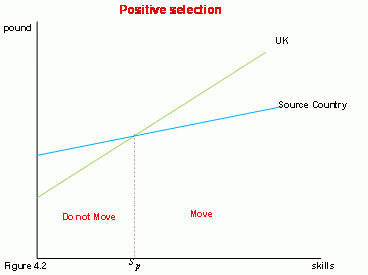
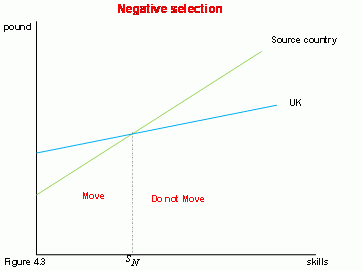
Like all human capital investments, both international and within country migration is based on the comparison of the present value of lifetime earnings in all available employment opportunities. Individuals compare the potential incomes and the destination country with the income in the home countries, and make the migration decision based on these income differentials (net of mobility costs).
How does the standard of living compare across the EU?
13 Jan 2015 Leave a comment
in macroeconomics Tags: European Union
Super-Economy: Dynamic America, Poor Europe
13 Jan 2015 Leave a comment
in economic growth, liberalism, macroeconomics Tags: Eurosclerosis
The role of the introduction of a five day working week in Japan’s Lost Decade
13 Jan 2015 2 Comments
in business cycles, economic growth, economic history, labour economics, labour supply, macroeconomics, monetarism Tags: Japan, Japanese banking system, Lost Decade
When I lived in Japan between 1995 and 1997, they are undergoing the transition from a six-day week to a five day week. At the time, workers at my University had to show up on Saturday morning. They then went home at lunchtime. Saturday morning at the office was phased out a few years later.
In explanations of the Lost Decade of growth in Japan dating from the early 1990s, with the exception of Ed Prescott, the explanation that the Japanese simply chose to produce less per worker over the course of the 1990s does not figure highly.
The Japanese working week was reduced by law from 48 to 44 hours per week in 1988 and further reduced by the same labour standards law to 40 hours per week from 1993 (Prescott 1999; Hayashi and Prescott 2002). The Japanese stopped routinely working on Saturdays over the 1990s. The number of national holidays was increased by three and an extra day of annual leave was also prescribed by law.
Figure 1 shows this regulatory change about the length of the standard working week that started in 1987 was followed by a sharp drop in hours worked per working per working age Japanese over the period 1988 to 1993. The Japanese working age population is defined as those aged 20 to 69 (Hayashi and Prescott 2002).
Figure 1: Weekly hours worked per Japanese aged 20 to 69, 1970-2000

Source: Hayashi and Prescott 2002.
The regulatory process to end the standard six day working week in Japan straddled the start of the Lost Decade. This major change in the regulation of the supply of labour per week in the number of hours worked and the stagnation of GDP growth soon after could be more than a coincidence (Prescott 1999; Hayashi and Prescott 2002).
Americans work more hours a year than workers in Japan. But both work less than before. Data: buff.ly/1LhU5gH http://t.co/7oaGYKLRmk—
HumanProgress.org (@humanprogress) August 18, 2015
More employment did not fill the short-fall in weekly labour supply per worker after the introduction of the 44 hour week and then the 40 hour week in Japan. Many offices and factories closed on Saturday rather than employ more to make up the hours. The regulatory change was a clear cut constraint on the length of the working week that was hard to get around because of the need to recruit a separate set of workers to come in on Saturday afternoon and then all day Saturday.
During the transition to a five day working week, Japanese real GDP growth should slow down because output levels must taper during a transitional period because one day per week less in labour is supplied in production and capital is being worked for one day a week less than before (Prescott 1999; Hayashi and Prescott 2002).
Output per working age person depends on capital-labour ratios, on hours worked per week and on changes in total factor productivity due to factors such as technological progress and changes in institutions and economic policies.
The effects of the change in the length of the working week on output per working age Japanese will persist for a significant time because investment plans and the capital stock must also adjust to a shorter working week. This is another example of a highly persistent shock that can partly account for the Lost Decade. As Prescott (1999) observed:
Given the change in Japanese law and the resulting drop in normal market hours, growth theory predicts the almost stagnant output of the Japanese economy in the 1990s. This reduction in market hours lowered the marginal product of capital, making investment unprofitable.
Given the lack of profitable domestic investment opportunities, the Japanese began saving by investing abroad. This explains Japan’s large trade surpluses
…The Japanese economy in the 1990s is not as depressed as the U.S. economy was in the 1930s. Market hours in Japan in the 1990s have fallen only half as much as market hours fell in the United States during the Great Depression.
More importantly, the reduction in market hours in Japan in the 1990s was the stated objective of policy.
The reduction in weekly hours worked will also reduce the working week of capital because labour and capital are usually complementary inputs. The reduced length of the working week will see some existing capital producing less, some capital will go spare, and the rate of wear and depreciation will fall.
The drop in weekly hours worked will lower the marginal productivity of existing and new capital which will make new capital investments in Japan less profitable than before. Net investment will be less while the Japanese capital stock is adjusting down to the reduced working week for capital and labour.
Measured total factor productivity will fall because of an under-utilisation of a capital stock that is now larger than required for the available labour force. Net investment will decline by a large amount because investment demand is a small yearly addition to the capital stock.
For example, if annual investment demand is 5 per cent of the capital stock, and the desired capital stock becomes 1 per cent smaller than previous, annual net investment will fall 20 per cent. GDP growth will resume at the trend rate once the lower level of output per working age person is reached.
For those that still doubt, consider the contrary, what would you expect to happen in your country moved from five day week before day working week? Do you expect workers to produce as much as before? Britain was on a three day working week during the coal miners’ strike. As expected, output fell because the working week was shorter.
The main gap in the English language literature about the reduction in the working week in Japan is a lack of publications I can find by Japanese economists discussing what predictions of a made about the likely consequences for output, investment and productivity before the reduction in the length of working week was legislated. Did the reduction in the length of the working week in Japan turn out as planned and predicted before it was implemented?
France introduced a 35 hour week some years ago. Although there were various options for over time, albeit strictly regulated, a uniform prediction was that the 35 hour week would reduce productivity. The new workweek was phased in slowly, with large firms adopting it in February 2000 and smaller firms doing so only in January 2002.
French employees were expected to bear only a small part of the cost of the working-time reduction, continuing to earn roughly the same monthly income – in line with the unions’ slogan ’35 hours pays. To ease that transition, the law reduced the overtime premium for small firms and increased their annual limit on overtime work compared with large firms.
The reduction in the length of the French working week failed as work sharing strategy and reduced productivity. This was a fair summary by the IMF:
The 35-hour workweek appears to have had a mainly negative impact. It failed to create more jobs and generated a significant—and mostly negative—reaction both from companies and workers as they tried to neutralize the law’s effect on hours of work and monthly wages.
While it cannot be ruled out that individuals who did not change their behaviour because of the law became more satisfied with their work hours, simple survey measures do not show increased satisfaction.
Between 1997 and 2000, Quebec reduced its standard workweek from 44 to 40 hours to stimulate jobs growth – the old work sharing ideal. The Quebec policy contained no suggestion or requirement that employers provide wage increases to compensate workers for lost hours.
Despite a 20% reduction among full-time workers in weekly hours worked beyond 40, the policy failed to raise employment at the provincial level or within industries. If anything, there were job losses.
Japan was the only case where a reduction in the length of the working week met with wide approval by the public and people simply stopped working on Saturdays. The law succeeded simply because it did but it was designed to do: reduce the number of days existing workers worked. Japan was undergoing mild deflation at the time, so the need to reduce wages was minimal.

Annual hours worked per employed Japanese has continued to slowly taper down since the late 1990s, which may be a further explanation of its continual slow growth.

David Andolfatto wrote a nice paper explaining the consequences for the financial and monetary sectors of this reduction in the length of the Japanese working week:
- a steady decline in bank lending;
- the money multiplier declines;
- nominal interest rates that are close to zero; and
- massive infusions of liquidity by the Bank of Japan that seem to have no effect at all.
In his analysis, David Andolfatto referred generally to a productivity slowdown as discussed by Prescott rather than to the specifically to the reduction in the length of the Japanese working week. Nothing detracts in his analysis, as Andolfatto said, that Japan has a problem: lagging productivity growth and as Andolfatto concluded:
…monetary and fiscal policies, or reforms directed exclusively at the banking sector, are unlikely to re-establish productivity growth. What is likely needed are economy-wide reforms that enhance the willingness and ability of individuals to adopt potentially disruptive technological advancements and work practices.
For those who are job-hunting after the holidays
12 Jan 2015 Leave a comment
in job search and matching, personnel economics Tags: search and matching

I find the biggest mistake made at job interviews at the interview panel forget that you are interviewing them as prospective employer.
If they can’t even be polite and friendly to you before you work for them, imagine what they’re like every day.
About 20% of the people I’ve met at job interviews I would never want to work with, much less work for.


Real business cycles, the declining clarity of information and learning by waiting
22 Dec 2014 Leave a comment
in business cycles, entrepreneurship, job search and matching, macroeconomics Tags: real business cycles
Willems and van Wijnbergen (2013) identified reduced clarity in information about business cycle fluctuations as a factor that is the lengthening the lag in the response of employment to output changes in recent US recessions.
Willems and van Wijnbergen (2013) – ungated – found that the trough in employment in the 1991 and 2001 recessions was much later than the troughs for earlier US recessions.
- There was a stronger immediate reduction in employment in pre-1990 US recessions and a faster recovery, so the 1991 and 2001 recessions were initially job-preserving – the rate at which workers were laid off was less than in prior recessions.
- Employment in the 1991 and 2001 recessions continued to fall for another year after the trough in output.
- The job-preserving recessions in 1991 and 2001 were then followed by this delayed recovery in employment growth.
- There is a lengthening labour adjustment lag that slows the loss of jobs at the start of recessions and delays the renewal of recruitment at the end of recessions.
Willems and van Wijnbergen (2013) attributed this combination of job-preserving recessions and delayed employment recoveries in 1991 and 2001 to the interaction of rising labour adjustment costs and a reduction in the clarity of entrepreneurial information about the business cycle.
The rising labour adjustment costs arose from the capital losses to employers of laying off employees who are increasingly rich in firm-specific human capital. The risks of laying off and investing precipitously have increased in recent decades because output growth subsequent to the great moderation in real output growth volatility is less predictable.
The US economy experienced a 50% reduction in volatility for many leading macroeconomic variables as well as low inflation since the early to mid-1980s. Similar declines in the real volatility and inflation rates occurred at about the same time in other industrial countries.
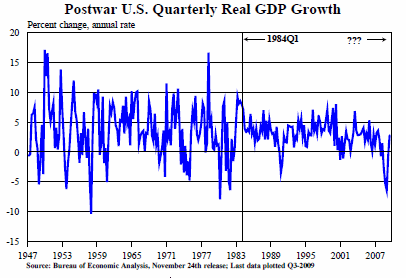
Prior to the mid-1980s, US real output growth was more variable, but this variation was more predictable. Frequent recessions were soon followed by recoveries. Since the early to mid-1980s in the US, major variations in real GDP growth have come increasingly as genuine surprises – 1983–2007 was one long boom punctuated by two mild recessions in 1991 and 2001.
The delay in the official dating of the peaks and troughs in business cycles in the US has increased from an average of 7½ months before 1990 to about 15 months in the post-1990 period (Willems and van Wijnbergen 2013).

With recessions more of a surprise – and the scope and depth of the panic of 2008 is an example of such a surprise in New Zealand and abroad – the value of waiting for better market information has increased.

Less certain information makes it more profitable than before for entrepreneurs to invest in waiting before laying off increasingly human capital-rich employees, making new investments and undertaking fresh recruitment. The impact of the business cycle on employment will be more muted.
Modern recessions can be initially job-preserving – layoffs are postponed for longer because the rising cost of laying off experienced labour is higher and because of the increased value of waiting to see. Recoveries in employment can be more sluggish as investors wait to be sure about the latest trends. These employers can use the employees they hoarded in larger numbers in the downswing to fill orders in the early days of the upswing in business:
We have presented evidence that the lag with which labour input reacts to structural economic shocks went up in the 1980s, thereby bringing jobless recoveries and recessions that were relatively job preserving to the US economy.
Using a real option model, this lagged response is shown to be optimal in a setting where labour input is costly to adjust and where employers are uncertain about the persistence of shocks that drive the business cycle


Recent Comments