
Doing bad when trying to do good: the cost of employment protection laws
10 Jul 2014 Leave a comment
in labour economics, macroeconomics Tags: employment protection laws, offsetting behaviour, unintended consequences

A policy designed to protect workers from unemployment, over time, will increase the duration of unemployment spells through a chilling effect on job creation. Employment protection laws are a tax on job creation. With fewer vacancies posted, the unemployed will take longer to find jobs.
Robert Lucas explained his support for U.S. monetary policy in 2008 as follows
10 Jul 2014 Leave a comment
in global financial crisis (GFC), great recession, macroeconomics, Robert E. Lucas Tags: fiscal policy, GFC, monetary policy, Robert Lucas

- There are many ways to stimulate spending, but monetary policy was the most helpful counter-recession action because it was fast and flexible.
- There is no other way that so much cash could have been put into the system as fast, and if necessary it can be taken out just as quickly. The cash comes in the form of loans.
- There is no new government enterprises, no government equity positions in private enterprises, no price fixing or other controls on the operation of individual businesses, and no government role in the allocation of capital across different activities. These were important virtues.

Keynesian macroeconomics as a form of juvenile real business cycle theory (RBC)
09 Jul 2014 1 Comment
in business cycles, Edward Prescott, macroeconomics Tags: Keynesian macroeconomics, real business cycle theory

Keynesian macroeconomics postulated that the economy slips into recessions for all sorts of reasons such as shifts and turns in the animal spirits and a loss of consumer confidence leading to a fall in autonomous investment and autonomous consumption. A collapse in autonomous investment and autonomous consumption is the Keynesian explanation for the great depression.

Both Keynesian macroeconomics and real business cycle theories, at least at the outset couldn’t explain why there were recessions. Both attributed to them to causes they were yet to explain. Keynesian macroeconomics could not explain what drove the waves of optimism and pessimism that either sharply increased or reduced investment.
Real business cycle theorists attributed recessions and booms to productivity drops in productivity surges, which initially were not explained in themselves. This theory sees productivity shocks as the cause of economic fluctuations. For example, if productivity falls, current returns to working and investing decline, so workers and firms choose to work and invest less and take more leisure. Real business-cycle theory views a recession as the optimal response by households and firms to a shift in productivity.
At least Prescott and other real business cycle theorists accepted that they must eventually unpack productivity drops and name causes that can be explored further and perhaps found persuasive or perhaps wanting.

Keynesian macroeconomics was quite happy to live with the waves of optimism and pessimism of the animal spirits that drove investors to push the economy into recessions. In his General Theory of Employment Interest and Money) Keynes puts it this way,
Most, probably, of our decisions to do something positive, the full consequences of which will be drawn out over many days to come, can only be taken as the result of animal spirits – a spontaneous urge to action rather than inaction, and not as the outcome of a weighted average of quantitative benefits multiplied by quantitative probabilities.
A far better explanation of the animal spirits is there is a productivity drop in one sector of the economy that leads that sector to reduce its demand for inputs supplied by the rest of the economy. This reduction in demand spreads across the economy. The slowdown in the economy is attributed to this reduction in demand, rather than the forces behind it, which is a fall in productivity in one sector of the economy.
Long and Plosser in 1983 wrote a famous article where they were able to generate business cycles in an economy with rational expectations, complete current information, stable preferences, no technical change, no long-lived commodities, no frictions and adjustments cost, no government, no money and no serial dependence in the stochastic elements of the environment.
In response to a productivity disturbance in one sector this economy, consumers will smooth a change in their consumption possibilities and production possibilities over a number of quarters by saving and dissaving and varying the amount of time they devote to work and leisure and they will invest more or less in light of the changing situation.
This consumption smoothing is enough to generate a slowdown in the economy from changes in one sector. Laid-off workers in the sector subject to a disturbance will take time to find jobs in other sectors of the economy and will be unemployed in this interim period of job search. Other workers who were previously employed in the sector subject to the productivity decline might wait for prospects to improve in that sector rather than search for a job in another occupation or location.
As research progressed, real business cycles were viewed as recurrent fluctuations in an economy’s incomes, products, and factor inputs—especially labour—due to changes in technology, tax rates and government spending, tastes, government regulation, terms of trade, and energy prices. In his Nobel lecture Ed Prescott explained that:
We learned that business cycle fluctuations are the optimal response to real shocks.
The cost of a bad shock cannot be avoided, and policies that attempt to do so will be counterproductive, particularly if they reduce production efficiency.
During the 1981 and current oil crises, I was pleased that policies were not instituted that adversely affected the economy by reducing production efficiency. This is in sharp contrast to the oil crisis in 1974 when, rather than letting the economy respond optimally to a bad shock so as to minimize its cost, policies were instituted that adversely affected production efficiency and depressed the economy much more than it would otherwise have been.
By the time Keynesian macroeconomics papered over the flaws mighty exposed by the 1970s stagflation, it rebranded itself New Keynesian macroeconomics. This is no more than becoming monetarist macroeconomists without having to admit all of your previous criticisms of Friedman were wrong.
At bottom, Keynesian macroeconomics makes an unjustified assumption that technological progress unfolds at a relatively smooth rate, and changes in government regulation, terms of trade, and energy prices were not important sources of economic fluctuations. As for tax rates and government spending, Keynesian macroeconomists saw these is a solution to recessions rather than their cause.
In time, real business cycles theory and Schumpeterian theories of business cycles will merge. new inventions and processes that are, by the nature of research and development, stochastically discovered. Part of this randomness in discovery will be that the emergence from time to time of great interventions – general purpose technologies -that result in economy wide changes and a wave of secondary inventions and the retraining of the workforce and reallocation of many workers into new sectors of the economy. These great inventions can be anything from electricity to information and computer technology and the Internet
Every time the Fed tightens the money supply, interest rates rise (or fall); every time the Fed expands the money supply, interest rates rise (or fall).
08 Jul 2014 Leave a comment
in macroeconomics, Murray Rothbard Tags: inflation, interest rates, Murray Rothbard

The problem is that… there are several causal factors operating on interest rates and in different directions.
If the Fed expands the money supply, it does so by generating more bank reserves and thereby expanding the supply of bank credit and bank deposits. The expansion of credit necessarily means an increased supply in the credit market and hence a lowering of the price of credit, or the rate of interest. On the other hand, if the Fed restricts the supply of credit and the growth of the money supply, this means that the supply in the credit market declines, and this should mean a rise in interest rates.
And this is precisely what happens in the first decade or two of chronic inflation. Fed expansion lowers interest rates; Fed tightening raises them.
But after this period, the public and the market begin to catch on to what is happening. They begin to realize that inflation is chronic because of the systemic expansion of the money supply.
When they realize this fact of life, they will also realize that inflation wipes out the creditor for the benefit of the debtor. As creditors begin to catch on, they place an inflation premium on the interest rate, and debtors will be willing to pay it.
Hence, in the long run anything which fuels the expectations of inflation will raise inflation premiums on interest rates; and anything which dampens those expectations will lower those premiums. Therefore, a Fed tightening will now tend to dampen inflationary expectations and lower interest rates; a Fed expansion will whip up those expectations again and raise them.
There are two, opposite causal chains at work. And so Fed expansion or contraction can either raise or lower interest rates, depending on which causal chain is stronger.
Which will be stronger? There is no way to know for sure. Will In the early decades of inflation, there is no inflation premium; in the later decades, such as we are now in, there is. The relative strength and reaction times depend on the subjective expectations of the public, and these cannot be forecast with certainty
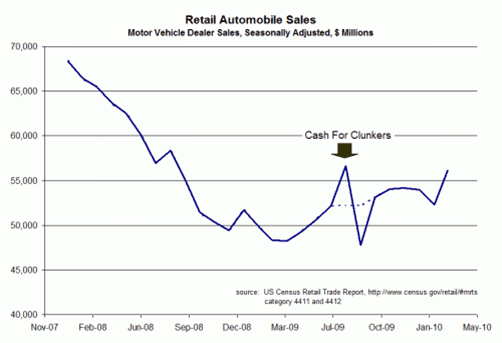
Did “Cash for Clunkers” work?
07 Jul 2014 Leave a comment
in great recession, macroeconomics Tags: cash for clunkers, intertemporal consumption smoothing, permanent income hypothesis
Economic policy uncertainty and political polarisation in the USA
07 Jul 2014 Leave a comment
in macroeconomics, Public Choice Tags: policy uncertianty, political polarisation
John van Reenen, Nicholas Bloom, Scott Bakerand Steven Davis produced these nice charts for the LSE blog:


The 90th Congress of 1967-68 showed a considerable overlap in voting patterns between Democrats and Republicans along liberal and conservative issues allowing the possibility of more compromise. But there was essentially no voting overlap by the 100th Congress of 2007-08.
The Reserve Bank Governor (2013) versus the Labour Party on whether its monetary policy upgrade will increase the inflation rate and destabilise the exchange rate
07 Jul 2014 Leave a comment
in inflation targeting, macroeconomics, politics - New Zealand Tags: exchange rate intervention, exchange rate targeting, inflation targeting
Attempts to keep the dollar from going “too high” would have ruinous domestic consequences as the Governor of the Reserve Bank explained last year:
If New Zealand decided to cap the NZ dollar, depending on where the cap is enforced, similar levels of intervention might be required as global foreign exchange turnover in NZ dollars relative to GDP is similar to that in Swiss francs.
The OCR would need to drop to zero first in order to eliminate the interest arbitrage motivation for NZ dollar inflows. Any attempt to retain non-zero interest rates by “sterilising” such massive intervention would be very difficult.
In effect therefore a Swiss type operation to cap the value of the NZ dollar through large scale FX intervention would also amount to quantitative easing. As I mentioned, this would be highly inflationary in the NZ context.
Graeme Wheeler, Governor of the Reserve Bank of New Zealand
20 February 2013
Sterilised interventions in the foreign exchange market are a fool’s errand
If exchange rate manipulation had any chance of working, the U.S. Fed, the Bank of England, the European Central Bank and the Bank of Japan would be all over it already. Their mutual efforts to depreciate their own currencies would cancel out.
Most central banks gave up on exchange rate interventions in the mid-1990s because attempts to manipulate exchange rates without loosening monetary policy rarely worked. Brute experience taught them that they were on fool’s errand.
These exchange rate interventions, known as sterilised interventions, become an independent source of exchange rate instability and invite counter-speculation by currency traders and hedge funds. Every hint that a central bank might intervene in the exchange rate invites currency speculation. As Milton Friedman said:
The central problem is not designing a highly sensitive [monetary] instrument that offsets instability introduced by other factors [in the economy], but preventing monetary arrangements becoming a primary source of instability…
By trying to move the value of the dollar, the Reserve Bank of New Zealand will add its own element of currency instability and invite counter speculation by currency traders and hedge funds. This is a dangerous game for a small Reserve Bank to play.

As stated by Paul Krugman in 1999 on the concept of the impossible trinity: free capital movement, a fixed exchange rate, and an effective monetary policy –
The point is that you can’t have it all: A country must pick two out of three.
It can fix its exchange rate without emasculating its central bank, but only by maintaining controls on capital flows (like China today); it can leave capital movement free but retain monetary autonomy, but only by letting the exchange rate fluctuate (like Britain – or Canada); or it can choose to leave capital free and stabilize the currency, but only by abandoning any ability to adjust interest rates to fight inflation or recession (like Argentina today or for that matter most of Europe).
Exchange rate manipulation by the Reserve Bank cannot alter the competiveness of exporters. The looser monetary policy will inevitably lead to higher CPI inflation that will erode any temporary advantage to exporters from the initial depreciation of the NZ dollar.
What did the Swiss do to keep their exchange rate down in the GFC?
Labour’s Monetary Policy Upgrade referred to the efforts of the Swiss National Bank to cap a massive appreciation of the Swiss Franc after 2009 and the Euroland sovereign debt crisis:
The Swiss have actively protected their currency from appreciating to the detriment of their tradeable sector (p.16)
 The Swiss National Bank stemmed the rise of Swiss franc by loosening their monetary policy as they say so themselves:
The Swiss National Bank has successfully maintained its exchange-rate floor against the euro, often through heavy nonsterilized purchases of foreign exchange (Swiss National Bank Annual Report, 2012, p. 34).
These non-sterilised exchange rate interventions were a loosening of Swiss monetary policy. The Swiss National Bank happens to be one of a number of central banks that conduct their monetary policies by buying and selling in the foreign exchange markets.
Labour’s aim of a positive external balance through a tightening of monetary policy is a repeat of the fool-hardy policies of the Hawke-Keating government in the late 1980s.
1988 witnessed a major monetary policy tightening in Australia. The tightening was motivated by a current account deficit rather than double-digit inflation:
- The inflation rate fell to below 3% in 1991.
- The current account did not change much as a result of the deep recession and 10%+ unemployment rate designed to bring it under control.
The current account deficit as a major policy problem was then quietly forgotten in Australia.
Three conflicting monetary policy objectives
The New Zealand Labour Party wants the Reserve Bank to do three impossible things before breakfast:
- Loosen monetary policy to bring the dollar down such as in Switzerland after 2009;
- Tighten monetary policy to reduce the current account deficit such as in Australia after 1988; and
- Loosen and tighten monetary policy as required to stay within the inflation target.
The best contribution of monetary policy to the competitive positions of exporters is low inflation.
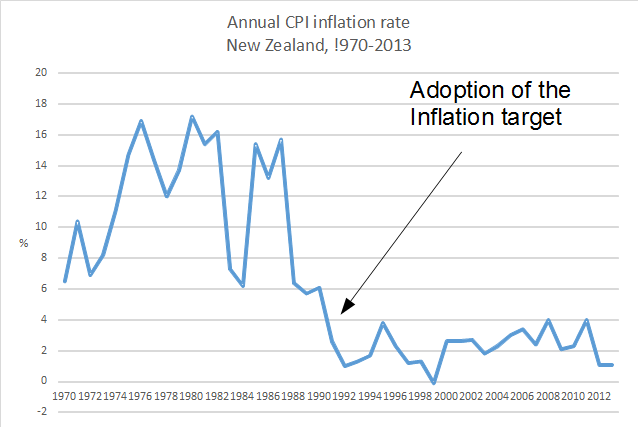
Inflation targeting removes monetary policy as in independent source of exchange rate instability. Attempts to manipulate the exchange rate undermines the inflation target that has been such a great success since 1989, and reduces the commitment of public policy to a stable, predictable business climate. Bordo and Humpage add:
…sterilised foreign-exchange intervention can sometimes affect exchange-rate movements, but sterilised intervention does not provide central banks with a mechanism for systematically altering exchange rates independent of their monetary policies.
Attempts to stabilise or undervalue exchange rates necessarily weaken a country’s control of its monetary policy and ultimately leave the real exchange rate unaffected.
What really matters?
Labour’s monetary policy upgrade is a distraction from the only game in town for the future prosperity of New Zealanders:
Productivity isn’t everything, but in the long run it is almost everything. A country’s ability to improve its standard of living over time depends almost entirely on its ability to raise its output per worker.
Paul Krugman
The Age of Diminishing Expectations (1994)
David Hume on the long and variable lags on monetary policy
05 Jul 2014 Leave a comment
in macroeconomics, monetary economics Tags: David Hume, lags on monetary policy, monetary neutrality

The Keynesian vision of macroeconomic policy
05 Jul 2014 Leave a comment
in macroeconomics, Milton Friedman, organisational economics Tags: forecasting errors, Keynesian macroeconomics, leads and lags on monetary policy, The fatel conceit, The pretence to knowledge

A market economy is subject to fluctuations which need to be corrected, can be corrected, and therefore should be corrected
Franco Modiglani
Milton Friedman’s vision is far more circumspect because of the limits on the information people have and their ability to update that information. His critique has nothing to do with his views on macroeconomics:
The central problem is not designing a highly sensitive [monetary] instrument that offsets instability introduced by other factors [in the economy], but preventing monetary arrangements becoming a primary source of instability…
Keynesians have a host of metaphors in their rhetorical arsenal; one frequently voiced is that a wise government should “lean against the wind” when choosing policy. Friedman jumped on this:
We seldom know which way the economic wind is blowing until several months after the event, yet to be effective, we need to know which way the wind is going to be blowing when the measures we take now will be effective, itself a variable date that may be a half year or a year or two from now. Leaning today against next year’s wind is hardly an easy task in the present state of meteorology
Friedman’s remarks, as even his strong critics admit, strike at the heart of any activist stabilisation policy. By meeting Keynesians on their own theoretical turf and scrutinising their practice, Friedman manages to produce objections that both Keynesians and non-Keynesians must take seriously.
A key part of any response to Friedman rests on the ability of forecasters to do their jobs with tolerable accuracy. After reading the annual reports of the Fed, Milton Friedman noticed the following pattern:
In the years of prosperity, monetary policy is a potent weapon, the skilful handling of which deserves the credit for the favourable course of events; in years of adversity, other forces are the important sources of economic change, monetary policy had little leeway, and only the skilful handling of the exceedingly limited powers available prevented conditions from being even worse
Central banks pay due to the implications of the leads and lags on monetary policy only as an ex-post facto rationalisation for disappointment.
Brad Delong and Larry Summers on the ineffectiveness of fiscal policy in stimulating the economy
05 Jul 2014 3 Comments

If there is such a thing as a liquidity trap, bring it on!
04 Jul 2014 Leave a comment
in business cycles, fiscal policy, macroeconomics, Milton Friedman, monetary economics Tags: Allan Meltzer, JM Keynes, liquidity trap, Milton Friedman
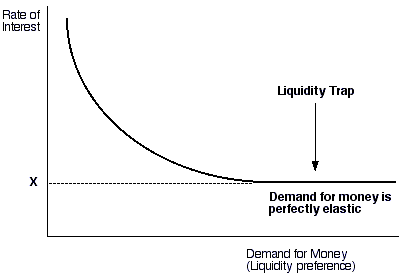
In the Keynesian pipedream, in a liquidity trap, there is perfect substitutability of money and bonds at a zero short-term nominal interest rate. This renders monetary policy ineffective.
Keynesians claim that the demand for money may be so persistently high that the rate of interest could not fall low enough to stimulate investment sufficiently to raise the economy out of the depression. Allan Meltzer explains:
A liquidity trap means that increases in money by the central bank (monetary base) cannot affect output, prices, interest rates or other variables. Changes in the money stock are entirely matched by changes in the demand to hold money.
With a liquidity trap, the public simply hoards the money the central bank creates rather than attempting to run down additions to their cash balances with increased consumer expenditure. This limitless accumulation of money by the public is not a real world phenomenon. The public will not forever accumulate money.
Auerbach and Obstfeld noted in "The Case for Open-Market Purchases in a Liquidity Trap" that to the extent that long-term interest rates are positive short-term interest rates are expected to be positive in the future, trading money for interest-bearing public debt through open market operations reduces future debt-service requirements.
- A massive monetary expansion during a liquidity trap should improve social welfare by reducing the taxes required in the future to service the now much smaller national debt!!!!
- A quantitative easing during a liquidity trap is, in effect, as good as or even better than a lump sum tax.
Central banks perhaps should contrive liquidity traps because they can then buy back the public debt because of the unlimited demand for money.
The logic of the liquidity trap is people will without limit give up bonds for non-interest bearing cash. If monetary policy is impotent near the zero bound, the central bank should buy trillions of dollars of federal bonds and payoff the public debt. This is a logical implication of liquidity traps for an optimal fiscal policy!!!! Is my reasoning wrong?
In addition to D.H. Robertson, Jacob Viner, Milton Friedman, Philip Cagan, Don Patinkin, Auerbach and Obstfeld, Robert H. Lucas, Greg Mankiw, and Bernanke and Blinder as sceptics about a liquidity trap, Keynes wrote in 1936:
Whilst the limiting case might become practically important in future, I know of no example of it hitherto. Indeed, owing to the unwillingness of most monetary authorities to deal boldly in debts of long term, there has not been much opportunity for a test.
Meltzer, who wrote A History of the Federal Reserve, Vol. 1: 1913-1951 points to several periods when interest rates were at or close to zero:
“In 1954, interest rates were 0.5 percent or below, and we had no problem recovering,” he says. “In 1948 to 1949, we had zero interest rates. Also in 1937 to 1938. We had no problem recovering.”
The Pigou effect states that when there is deflation of prices, employment (and output) will be increased due to an increase in wealth (and thus consumption). The deflation increases the value of cash balances and therefore the wealth of consumers. They spend some of this additional wealth.
After reading the annual reports of the Fed in the 1920s and 1930s, Milton Friedman noticed the following pattern:
In the years of prosperity, monetary policy is a potent weapon, the skilful handling of which deserves the credit for the favourable course of events; in years of adversity, other forces are the important sources of economic change, monetary policy had little leeway, and only the skilful handling of the exceedingly limited powers available prevented conditions from being even worse
Repeat after me: fiscal policy is ineffective when there is a flexible exchange rate!
04 Jul 2014 2 Comments
in fiscal policy, macroeconomics Tags: exchange rate crowding out, fiscal policy, Mundell Fleming model
New Zealand, Australia, and most other economies are small open economies. Any expansion in the budget deficit will drive up the exchange rate because of the higher interest rates. This appreciation of the local currency in response to the capital inflow will make imports cheaper. Any increase in so-called aggregate demand will simply result in an decrease in net exports. There will be no increase in local production or employment.

- a fiscal expansion puts upward pressure on the domestic interest rate
- But this immediately invites a massive capital inflow.
- This appreciates the nominal exchange rate.
- This will decrease net exports, since we are able to import more goods and services with less money because of the currency appreciation, while foreigners will import less of our products because of our appreciated domestic currency
- The exchange rate appreciates and the trade balance worsens until the initial increase in government spending is completely offset.
Under a floating exchange rate and high capital mobility, fiscal policy is ineffective in stimulating the economy because of exchange rate crowding out. The appreciating exchange rate will increase imports and reduce exports to render fiscal policy impotent or at least to shadow of its former closed economies self.
Euroland is presented by progressives as the type of mixed economies they prefer and larger governments they want
03 Jul 2014 Leave a comment
in applied welfare economics, economic growth, macroeconomics Tags: Eurosclerosis, progressive politics

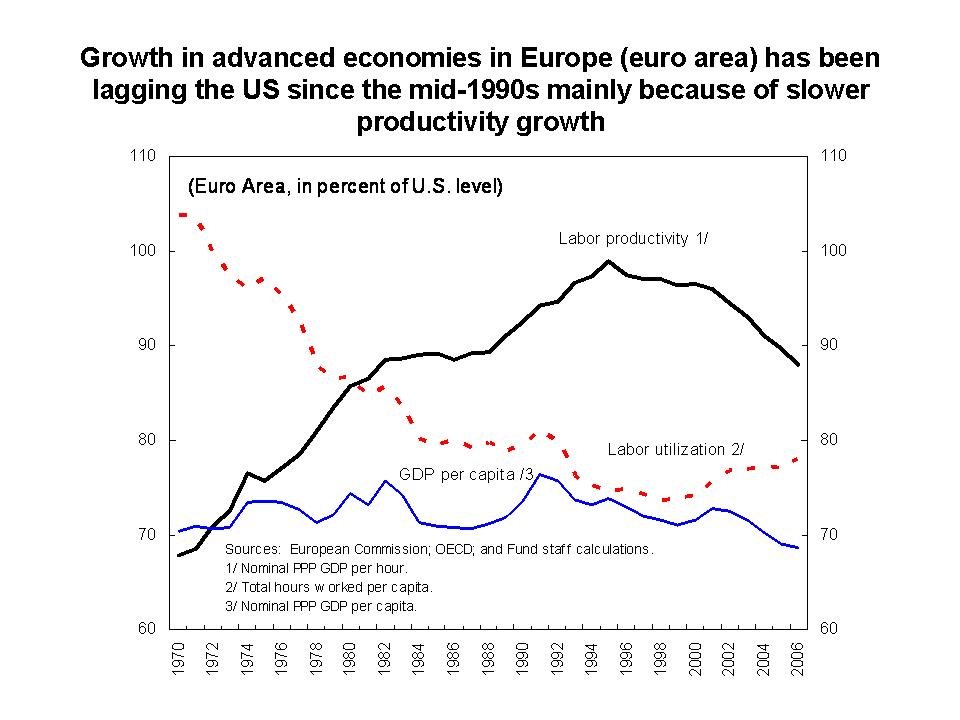
The OECD countries with persistently high unemployment rate are the European welfare states – about double figures for 2 decades or more now. The reality is progressive politics pits workers against worker, and the middle-class against the poor and rich with the progressives cheering for the middle-class.
Euroland has a labour aristocracy – a two-tier system with ultra-secure workers with the permanent jobs and vulnerable temporary workers. The prime-age workers with the permanent jobs are pitted against the young, the unemployed and the older workers – these three groups are either locked-out or pushed-out. It took the equally worse recession in U.S. post-war history for their unemployment rates to reach the levels in Euroland in most any year out of the last 20.

Progressive solutions have been tried and they failed: a new word had to be invented to capture the resulting high unemployment rates and stagnant productivity growth from adopting progressive policies: Eurosclerosis!


Recent Comments