The rise of the Swedish welfare state, Swedosclerosis and Director’s Law

Sweden is a common example of a generous welfare state that is compatible with a prosperous society. One interpretation of the UN Development Index is you improve your national ranking by becoming more like Sweden.

Assar Lindbeck has shown time and again in the Journal of Economic Literature and elsewhere that Sweden became a rich country before its highly generous welfare-state arrangements were created

Sweden moved toward a welfare state in the 1960s, when government spending was about equal to that in the United States – less that 30% of GDP.

Sweden could afford this at the end of the era that Lindbeck labelled ‘the period of decentralization and small government’. Sweden was one of the fastest growing countries in the world between 1870 and 1960.

Swedes had the third-highest OECD per capita income, almost equal to the USA in the late 1960s, but higher levels of income inequality than the USA.

By the late 1980s, Swedish government spending had grown from 30% of gross domestic product to more than 60% of GDP. Swedish marginal income tax rates hit 65-75% for most full-time employees as compared to about 40% in 1960.

Swedish economists named the subsequent economic stagnation Swedosclerosis:

  • Economic growth slowed to a crawl in the 1970s and 1980s.
  • Sweden dropped from near the top spot in the OECD rankings to 18th by 1998 – a drop from 120% to 90% of the OECD average inside three decades.
  • 65% of the electorate receive (nearly) all their income from the public sector—either as employees of government agencies (excluding government corporations and public utilities) or by living off transfer payments.
  • No net private sector job creation since the 1950s, by some estimates!

In 1997, Lindbeck suggested that the Swedish Experiment was unravelling.


Sweden is a classic example of Director’s Law of Public Expenditure. Once a country becomes rich because of capitalism, politicians look for ways to redistribute more of this new found wealth.

Studies starting from Sam Peltzman (1980) showed that government grew in line with the growth in the size and homogeneity of the middle class that became organised and politically articulate enough to implement a version of Director’s law. Director’s law augmented by Gary Becker’s 1983 model of competition among pressure groups for political influence explain much of modern public policy.

Government spending grew in many countries in the mid-20th century because of demographic shifts, more efficient taxes, more efficient spending, shifts in the political power from those taxed to those subsidised, shifts in political power among taxed groups, and shifts in political power among subsidised groups.

The Swedish economic reforms from after 1990 economic crisis and depression are an example of a political system converging onto more efficient modes of income redistribution as the deadweight losses of taxes on working and investing and subsidies for not working both grew. Improvements in the efficiency of taxes or spending reduce political pressure to suppress the growth of the welfare state and thus increase or prevent cuts to both total tax revenue and spending.

After the rise of Swedosclerosis, the taxed, regulated and subsidised groups had an increased incentive to converge on new lower cost modes of redistribution. More efficient taxes, more efficient spending, more efficient regulation and a more efficient state sector reduced the burden of taxes on the taxed groups. Most subsidised groups benefited as well because their needs were met in ways that provoked less political opposition.

Reforms ensued led by parties on the Left and Right, with some members of existing political groupings benefiting from joining new political coalitions.

The Nordic median voter was alive to the power of incentives and to not killing the goose that laid the golden egg. The deadweight losses of taxes, transfers and regulation limit inefficient policies and the sustainability of redistribution.

For example, while tax rates are high in Sweden and the rest of Scandinavia, hours worked in Scandinavia are significantly higher than in Continental Europe.

Richard Rogerson found in Taxation and market work: is Scandinavia an outlier? that how the government spends tax revenues imply different rates of labour supply with regard to tax rate increases.

Rogerson considered that differences in the composition of government spending can potentially account for the high rate of labour supply in Sweden and elsewhere in Scandinavia. Specifically, examining the conditions on which how tax revenue is returned to Swedes as income transfers or other conditional payments is central to understanding the labour supply effects of taxes:

  • If higher taxes fund disability payments which may only be received when not in work, the effect on hours worked is greater relative to a lump-sum transfer with no conditions; and
  • If higher taxes subsidise day care for individuals who work, then the effect on hours of work will be less than under the lump-sum transfer with no conditions.

A much higher rate of government employment and greater expenditures on child and elderly care explain the high rates of Swedish labour supply.

Swedes are taxed heavily, but key parts of this tax revenue are then given back to them conditionally if they keep working. Policies that significantly cut the total wealth available for redistribution by Swedish governments were avoided relative to the germane counter-factual, which are other even costlier modes of income redistribution.

Why do recessions cheer the Left up?

Why is it that the further to the Left that people go, the more cheerful they seem to be in recessions and economic crises? They are miserable when times are good.

The Left supported the discretionary fiscal, monetary and regulatory policies that caused the recession and then supported crisis management policies that deepen the recession. The Left always wants to tax and regulate their way out of every recession.

Most crisis management policies distort the incentives to hire and invest and reduce competition and efficiency. While different sorts of shocks lead to ordinary downturns, it is overreactions by governments to stem the crisis that prolong and deepen economic downturns, turning them into depressions.

One in three EU unemployed are Spanish because of employment protection laws. Cahuc et al. 2012 estimated that Spanish unemployment would be 45% lower if Spain adopted the less strict French laws! Differences in their employment protection laws accounted for nearly half of the dramatic rise in Spanish unemployment since 2007. Who is for and against these terrible laws?

Lee Ohanian: Hoover, Roosevelt and the Great Depression

Individual tradable birth licences – ecological economics’ finest hour?

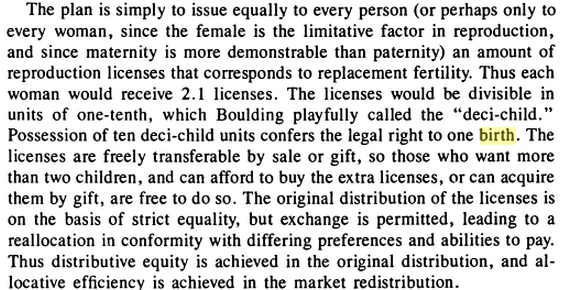
A mate suggested that I look into ecological economics. The self-appointed visionaries of ecological economics were so concerned about the population bomb that they proposed a “choice-based, marketable, birth license plan” or “birth credits” for population control. The Earth’s carrying capacity is a central issue in ecological economics.

Birth credits were promoted by urban designer and environmental activist Michael E. Arth since the 1990s and earlier by economist Kenneth Boulding (1964) and ecological economist Herman Daly (1991). I am not making this up.

Birth credits would allow any woman to have as many children as she wants, as long as she buys a license for any children beyond an average allotment that would result in zero population growth (ZPG). Birth credits are similar to individual tradable quotas for fishing.

  • If the allotment was determined to be 1.1 children, then the first child would be free, and the market would determine the cost of the license or birth credit for each additional child.
  • The units could be sold in units of 1/10th of a credit with each of us getting 1.1 credits each for free, under some proposals.

Being nice members of the middle class, the penalty proposed for an illegal baby would be community service for the parents. I am sure most parents would welcome the time out of the house and the free child care. Obviously, these nice family unfriendly educated middle class ZPG types do not seem to appreciate the seas and oceans that some with cross to have a child.

daly birth licences

Arth, Dally and his fellow prophets were smug enough to think they could see the future and a looming population bomb and food riots, but plainly they got the sign of the demographic crisis wrong.

Sub-replacement fertility is now the demographic crisis. Over half of the world’s population lives in countries with fertility rates at or below replacement level, and nearly all countries will reach low fertility levels in the next decade or two.

A larger population can, as Gary Becker has pointed out, increase the rate of technological progress by increasing the number of creative people working away at inventing new products and ideas. More people means more markets that will reach a critical mass for which people can then profitably invent new products, which further increase innovation and economic growth.

The price of these birth credits would be now lower than an EU carbon credit. You could not give them away.

HT: Steady-State Economics: Second Edition With New Essays – Herman E. Daly – Google Books.

Lee Ohanian: The Economic Crisis: A Comparison Across Time and Countries


“The Recession of 2007–?” by Robert E. Lucas

Robert Lucas in this speech noted that the implicit assumption is that the US economy will get back to old trend growth rate and the only question is how long it will take

Lucas asked whether this is really the case? He noted that:

  • We know that European economies have larger government role and 20-30% lower income level than the US; and
  • Is it possible that by imitating European policies on labor markets, welfare, and taxes U.S. has chosen a new, lower GDP trend?

If so, Lucas said that it may be that the weak recovery the USA has had so far is all the recovery it will get.

Ed Prescott also considers that tax rates are being increased in the USA. These increases lower amount of capital a firm chooses to have. The reason for low investment is not problem of getting loans – it is expected future high tax rates in the USA.

Ed Prescott also considers that investment suddenly became depressed beginning early in 2008 – because of a policy regime change. Business owners feared higher tax rates with the regime change and rationally cut investment, rationally cut employment ad rationally took more cash out of business.

Lessons from how Australia came out of the Great Depression-updated

How Australia got out of the Great Depression in the 1930s could have lessons for today, for the global financial crisis and the Great Recession. In Australia, the massive fiscal contraction from late 1930 onwards was called the Premiers’ Plan. In 1931, unemployment rates was 25% or more.

The Premiers’ Plan required the federal and state governments to cut spending by 20%, including cuts to wages and pensions and was to be accompanied by tax increases, reductions in interest on bank deposits and a 22.5% reduction in the interest the government paid on internal loans.

The Premiers’ Plan was complementary to the Arbitration Court’s 10 per cent nominal wage cut in January 1931 and the devaluation of the Australian pound. Most countries had abandoned the gold standard by 1931 and 1932 and devalued by about 10% including the UK. These competitive devaluations were called currency wars. Most countries below started to recovery before they left the gold standard, a year or two before they left the cross of gold.

Real GDP and dates of exit from gold standard

clip_image002

Sources: GGDC‑Maddison International Historical Database (http://www.ggdc.net/Maddison/), Bernanke et al. 1990; Gruen and Clark 2009.

The New Zealand Government also cut everything that could be cut by 20% in 1931.

Maclaren (1936) dated the Australian economic recovery from the last months of 1932. It was to take another three years before unemployment rates fell below 10 per cent — the rate it had been during most of the 1920s.

The June 1931 Premiers’ Plan of fiscal consolidation had time by late 1932 to become credible and take hold given the usual leads and lag on fiscal policy.

Unemployment data in the 2001 Australian yearbook of the Australian Bureau of Statistics graphed below shows a rapid fall in the high twenties unemployment rate in 1932 to be below 10 per cent by 1937. This fall started just after the 1931 Premiers’ Plan of fiscal consolidation.

Australian unemployment was 7.5 per cent in 1938, which is the long-term average for the period 1906 to 1929. The USA had an unemployment rate twice that in 1938 and was coming out of a double dip great depression.

Australia and New Zealand came out of the Depression earlier than most other countries because of the fiscal austerity under the Premiers’ Plan. The New Deal prolonged the great depression in the USA.

For those that doubt, how much lower would have been the Australian unemployment rate between 1932 and 1937 but for the fiscal contraction? What is your counter-factual? The role of fiscal policy in Australia in the 1930s is rather under-studied in Keynesian macroeconomics. Why?

The fiscal consolidation in the Premiers’ Plan removed fears of even harsher future taxes, stabilised expectations, increased consumers’ expected disposable incomes, and increased investor confidence and therefore stimulated private investment. See Keynes’ 1932 letter where he says

I am sure the Premiers’ Plan last year saved the economic structure of Australia.

How to Restore US Prosperity – Prof. Edward C. Prescott

Euro Crisis: Sources and Its Global Implications – Tom Sargent updated

Sargent said: “A government can be said to be ambiguous when decision makers can’t yet agree what to do and decide to postpone making a decision.” He also raised questions over whether a country should join a currency union, whether it should pay its debts, and whether the central government in a federal system should pay the debts of subordinate government.

Public policy fallacies and Stigler’s law of scientific epiphany-corrected

Economics under-supplies new ideas because it spends a lot of time rediscovering old ones.

Under Stephen Stigler’s law of scientific epiphany, the inventor of an idea is not the first to discover it, but the first to make sure that the idea stayed discovered and was not forgotten again and reinvented and recycled as new. Mentioning an under-developed idea in passing is not enough.

Stephen Stigler attributed his law to Robert Merton’s law of multiples, acknowledging that Stigler’s law obeys Stigler’s law.

His father, George Stigler gave his Noble Prize lecture was on how and when new ideas were slowly adopted by the body of knowledge of the economics profession.

Stigler said that Adam Smith founded economics because:

  • A considerable number of economists, and a few considerable economists, have emphasised the fact that Smith had many gifted predecessors and almost all or perhaps exactly all of his ideas are to be found expressed, and sometimes well expressed, by these predecessors.
  • Some economists therefore wish to give the title of founder of economics to earlier writers such as Cantillon. This line of argument, in my view, misses the point.
  • It was Smith who provided so broad and authoritative an account of the known economic doctrine that, henceforth, it was no longer permissible for any subsequent writer on economics to advance his own ideas while ignoring the state of general knowledge.

Knight’s 1937 scathing review of Keynes’ general theory was:

Many of Mr. Keynes’s own doctrines are, as he would proudly admit, among the notorious fallacies to combat which has been considered a main function of the teaching of economics.

Under Stigler’s rule of scientific epiphany, Keynes still deserves credit because he made sure that these old scattered fallacies stayed discovered, and they certainly did.

Another reason for the lack of new ideas – Stigler argued – is that if the problems of economic life changed frequently and radically, and lacked a large measure of continuity, there could not be a science of economics.

Stigler argued that an essential element of any science is a cumulative growth of knowledge. That cumulative character could not arise, in Stigler’s view, if each generation of economists faced fundamentally new problems that called for new methods of analysis. Stigler concluded that without the base of persistent theory and a set of fundamental and durable problems, there would be no body of slowly evolving knowledge to constitute a science. Without the challenges of unsolved, important problems handed down from economists in the past, the science of economics would become sterile.

An example of Stigler’s law of scientific epiphany is The Early History of the Phillips Curve by Thomas M. Humphrey (1985).

Humphrey found prototypal Phillips curve analysis in the writings of David Hume (1752), Henry Thornton (1801), and John Stuart Mill. Irving Fisher’s 1926 statistical analysis was republished, as I discovered the Phillips curve in 1973. Jan Tinbergen estimated the wage-change version of the Phillips Curve in 1936. Phillips was seen as the discoverer because, Humphrey concluded, he provided:

A ready-made justification for discretionary intervention and activist fine tuning, this interpretation helped make the Phillips curve immensely popular among Keynesian policy advisors.

Thomas Humphrey later wrote an excellent 250-year long literature survey of the rules versus discretion debate in the 1999 Richmond Fed Quarterly. He wanted to know if macroeconomics was a progressive science in the sense that superior new ideas relentlessly supplanted inferior old ones.

Humphrey found that:

  • Keynesian ideas about a lack of demand and their many antecedents gain currency when unemployment was the main concern.
  • Monetarist ideas tended to reign when price stability was the main problem.

The policy debate keeps being recycled because:

  • People forget the lessons of the past; and
  • For better or worse, politicians and the public have tended to believe that central banks – the focus of his studies – have the power to boost output, employment, and growth permanently.

Humphrey showed that stable policy rules are popular in good times to contain inflation. And when unemployment was rising, discretionary monetary policies became in vogue, once again.

A key role of economists in public policy is remembering that few policy ideas are new and they were often found wanting in a sufficiently distant past; those who knew these refutations have moved on. Humphrey concluded that:

The doctrinal historian knows that much of what passes for novelty and originality in monetary theory and policy is ancient teaching dressed up in modern guises…

Preoccupied by the pressing problems of the day, [policy-makers and the public] have neither the time, inclination, or training, nor indeed the duty to trace the history of the ideas they employ or endorse.

They have no reason to be aware of earlier policy debates in which sound theories were distinguished from fallacious ones.

The result is that policymakers may subscribe to old theories under the mistaken impression that those theories are new. Worse, they may unwittingly deploy policies whose underlying theory has been challenged and found wanting in earlier policy debates.

Every new idea needs both a market as well as alert intellectual entrepreneurs who seize the right moment to put their ideas forward.

What is neoliberalism? Please tell me – show me one.

I want to meet someone who believes neoliberalism was the leading light of the economic reforms since 1980. They can then tell me what neoliberalism is. Please, tell me.

The prefix “neo-” makes “neoliberalism” sound like something that morphed into something bad. Is neoliberalism something more than a sustained sneer – a personal attack as a way of avoiding debate?

Not only is there no single definition of neoliberalism, there is no one who identifies himself or herself as a neoliberal. At least communists and socialists were proud to be called so.

In Neoliberalism: From New Liberal Philosophy to Anti-Liberal Slogan, Taylor Boas & Jordan Gans-Morse went in search of anyone who identifies one’s self as a neoliberal:

  • They did not uncover a single contemporary instance in which an author used the term self-descriptively, and only one – an article by New York Times columnist Thomas Friedman (1999) – in which neoliberal was applied to the author’s own policy recommendations.
  • Digging into the archives, they did find that while Milton Friedman (1951) embraced the neoliberal label and philosophy in one of his earliest political writings, he soon distanced himself from the term, trumpeting “old-style liberalism” in later manifestoes (Friedman 1955). See “Neo-liberalism and its Prospects”, Milton Friedman Papers, Box 42, Folder 8, Hoover Institution Archives. 1951. Hardly a smoking gun?

What Boas and Gans-Morse found, based on a content analysis of 148 journal articles published from 1990 to 2004, was that the term is often undefined. It is employed unevenly across ideological divides; it is used to characterise an excessively broad variety of phenomena.

That is academic speak for neoliberalism is an empty slogan.

Neoliberalism was supposed to rule the roost under Reagan, Thatcher, Hawke and Lange-Douglas. The local branches of neoliberalism were Thatchernomics, Rogernomics, and Reaganomics.

Milton Friedman is said to have mesmerised several countries with a flying visit. The Friedman Monday Conference on ABC in 1975 and by Hayek in 1976 are still ruling the Australian policy roost, if some serious public commentators are to be believed.

In the 1980s and up to the mid-1990s, despite all the neo-liberal deregulation and Milton Friedman taking over monetary policy, mentioning Friedman’s name at job interviews would have been extremely career limiting, and that was at the Australian Treasury.

Back then, the much less radical Friedman was just graduating from being a wild man in the wings to just a suspicious character.

If you name dropped Hayek in the early 1990s, any sign of name recognition would have indicated that you were being interviewed by educated people.

When the Left gets on its high horse and goes on about Hayek and Friedman running neoliberalism, with Hayek as Friedman’s mentor, it is refreshing to remind all how little they had in common on macroeconomics. The University of Chicago Department of Economics did not offer Hayek a job in the late 1940s despite his outstanding record at LSE as Keynes’ principal critic in the 1930s.

While working at the next desk to a monetary policy section in the late 1980s, when mortgage rates were 18%, I heard not a word of Friedman’s Svengali influence:

  • The mantra for several years was that the market determined interest rates, not the Reserve Bank. Joan Robinson would have been proud that her 1975 Monday conference was still holding the reins.
  • Monetary policy was targeting the current account. Read Edwards’ biography of Paul Keating’s time as Treasurer and Prime Minister and his extracts from very Keynesian treasury briefings to Keating signed by David Morgan that reminded me of Keynesian Macro 101.

As a commentator on an Australian Treasury seminar paper in 1986, Peter Boxhall – freshly educated from the 1970s Chicago School – suggested using monetary policy to reduce the inflation rate quickly to zero. David Morgan and Chris Higgins almost fell off their chairs. These Treasury Deputy CEOs had never heard of such radical ideas.

In their breathless protestations, neither Morgan nor Higgins were sufficiently in tune with their Keynesian education to remember the role of sticky wages or even the need for monetary growth reductions to be gradual and, more importantly, credible, as per Milton Friedman.

By the way, Friedman’s presidential address to the AEA in 1967 is now recognised as perhaps the single most influential journal article of the 20th century. That article is the essence of good communication and empirical testing of competing hypotheses as was his 1976 Noble Prize lecture. No wonder both were hidden from impressionable undergraduates such as me a few years after.

Beware of Greeks bearing debts

The Greeks initially did a fine job in squeezing huge subsidies and debt write-offs! The Irish played by the rules, guaranteeing bank bond holders to which they had no obligation, but got screwed.

Arellano, Conesa, and Kehoe explain in Chronic Sovereign Debt Crises in the Eurozone, 2010–2012 that the post-GFC recession in many Eurozone countries created an incentive to gamble for redemption.

This gamble for redemption is betting that the post-2008 recession will soon end.

  • If Greece sold more bonds to smooth government spending in the interim, and if the Greek and EU economies recover, the stronger revenue growth will pay off the enlarged Greek government debt.
  • Under some circumstances, this policy is the best that a government can do for its country, but it carries a risk!
  • If the recession goes on for too long (and it did in southern Eurozone), a government will either have to stop increasing its debt or default on its bonds.

The global bond markets will anticipate this prospect of default as a country’s government debt accumulates and will seek higher and higher interest for new bonds, and importantly, to roll over existing Greek Government bonds.

EU policies that result in higher interest rates on government bonds and high costs of default provide incentives for a national government to reduce its debts and avoid sovereign default.

EU policies that result in lower interest rates and lower the cost of a sovereign default provide incentives for a government to gamble for redemption.

The interventions taken to date by the EU and the IMF – lowering the cost of borrowing and reducing default penalties, the bailouts and the 50% write-off of the existing Greek government debts – encourage southern Eurozone governments to gamble for redemption.

Greece and a few others are gambling for redemption by betting that the recession will end soon, selling more bonds to smooth government spending in the interim, and reducing the enlarged debt if their economies recover.

If the recession continues for too long, the government will have to stop increasing debt or default on its bonds. Greece has been in default in more than 50% of the time since it became independent in 1822.

A 2014 paper by Kehoe argued that if Germany and France start to get tough with Greece and charge it penal interest rates on further loans and debt rollovers, it will make it optimal for Greece to just default on its government debts and leave the Eurozone.

A resumption in economic growth is one of the few solutions that avoid these calamities.

Greece’s problem is that it is 119th in the 2014 index of economic freedom, just ahead of India. The World Bank ranks Greece 161st in the world for ease of registering property and 91st for enforcing contracts; it takes an average of 1,300 days to enforce a contract through the Greek courts. This low base says something about how Greek politics works and will work for some time to come.

The lengthy shortcomings of the Eurozone were well-known before it was formed. As Michael Bordo pointed out in 1999:

the absence of a central lender of last resort function for EMU, the lack of a central authority supervising the financial systems of EMU, unclear and inconsistent policy guidelines for the ECB, the absence of central co-ordination of fiscal policies within EMU, unduly strict criteria for domestic debt and deficits, as set out in the Maastricht rules, in the face of asymmetric shocks, and Euroland is not an optimal currency area.

Milton Friedman predicted that the Euro would not survive its first major recession.

I told you so is never a solution.

Europe has extensive experience with currency union break-ups:

  • The Latin Monetary Union joined Belgium, Italy, and Switzerland with France in 1867. The arrangement held together until the generalized breakdown of global monetary relations during World War I.
  • The Scandinavian Monetary Union was formed in 1873 by Sweden and Denmark and Norway joined two years later. This was disrupted by the suspension of convertibility and floating of the three currencies at the start of World War I. The agreement was abandoned during the global financial crisis of 1931.
  • Following the start of the Zollverein (the German customs union) in 1834, members established a German Monetary Union. A full merger of all the currencies did not arrive until after consolidation of modern Germany in 1871.
  • The only truly successful monetary union in Europe came in 1922 with the birth of the Belgium-Luxembourg Economic Union (BLEU), which remained in force until 1999.
  • After the Austro-Hungarian Empire was dismembered by the Treaty of Versailles, in an abrupt and quite chaotic manner, new five currencies were introduced.

Rather than saying the Euro cannot fail, the discussion should be about how the dissolution of currency unions is common, especially where Greece is a member. What happened? What can we learn from the past to prepare for a possible Greek departure from the Eurozone?

Sargent, Prescott, Taylor and Kydland on the Global Financial Crisis and the Great Recession

Many of the key issues about what modern macroeconomics has to say on global financial crises are discussed in a 2010 interview with Thomas Sargent where he says that two polar models of bank crises and what government lender-of-last-resort and deposit insurance do to arrest or promote them were used to understand the GFC. They are polar models because:

  • in the Diamond-Dybvig and Bryant model of banking runs, deposit insurance and other bailouts are purely a good thing stopping panic-induced bank runs from ever starting; and

  • In the Kareken and Wallace model, deposit insurance by governments and the lender-of-last-resort function of a central bank are purely a bad thing because moral hazard encourages risk taking unless there is regulation or there is proper surveillance and accurate risk-based pricing of the deposit insurance.

In the Diamond-Dybvig and Bryant model, if there is government-supplied deposit insurance, people do not initiate bank runs because they trust their deposits to be safe. There is no cost to the government for offering the deposit insurance because there are no bank runs! A major free lunch.

Tom Sargent considers that the Bryant-Diamond-Dybvig model has been very influential, in general, and among policy makers in 2008, in particular.

Governments saw Bryant-Diamond-Dybvig bank runs everywhere. The logic of this model persuaded many governments that if they could arrest the actual or potential runs by convincing creditors that their loans were insured, that could be done at little or no eventual cost to taxpayers.

In 2008, the Australian and New Zealand governments announced emergency bank deposit insurance guarantees. In Bryant-Diamond-Dybvig style bank panics, these guarantees ward off the bank run and thus should cost nothing fiscally because the deposit insurance is not called upon. These guarantees and lender of last resort function were seen as key stabilising measures. These guarantees were called upon in NZ to the tune of $2 billion.

  • The Diamond-Dybvig and Bryant model makes you sensitive to runs and optimistic about the ability of deposit insurance to cure them.
  • The Kareken and Wallace model’s prediction is that if a government sets up deposit insurance and doesn’t regulate bank portfolios to prevent them from taking too much risk, the government is setting the stage for a financial crisis.
  • The Kareken-Wallace model makes you very cautious about lender-of-last-resort facilities and very sensitive to the risk-taking activities of banks.

Kareken and Wallace called for much higher capital reserves for banks and more regulation to avoid future crises. This is not a new idea. Sam Peltzman in the mid-1960s found that U.S. banks in the 1930s halved their capital ratios after the introduction of federal deposit insurance. FDR was initially opposed to deposit insurance because it would encourage greater risk taking by banks.

Sargent also said that it is just wrong to say that the GFC caught modern macroeconomists by surprise: Allen and Gale’s 2007 book Understanding Financial Crises compiles many of the dynamic models of the causes of financial crises and government policies that can arrest or ignite them.

Front Cover

Stern and Feldman’s Too Big to Fail uses insights from the formal economic literature to warn in 2004 about the time bomb for a financial crisis set by current banking regulations and government promises.

In Great Depressions of the Twentieth Century (2007) written by a team of 24 economists, Kehoe and Prescott and others concluded that bad government policies are responsible for causing depressions. In particular, while different sorts of shocks can lead to ordinary business cycle downturns, it is overreactions by governments that can prolong and deepen the downturn, turning it into a depression. Depressions and great recessions, such as currently the case in the USA, are caused by crisis management policies that turn garden-variety recessions into something much worse. Crisis management policies distort the incentives to hire and invest and reduce competition and efficiency.

As an example, one in three unemployed in the EU are Spanish mainly because of Spanish employment protection laws.

Cahuc et al. 2012 estimated that Spanish unemployment would be 45% lower if Spain adopted the less strict French laws! About ten years ago, under French employment law, the contestants on the French version of Survivor sued successfully for wrongful dismissal by the Tribal Council! French workers cannot be laid off just to improve business profits. They can be laid off to avoid bankruptcy.

John Taylor argues that we should consider macroeconomic performance since the 1960:

  • There was a move toward more discretionary policies in the 1960s and 1970s;
  • A move to more rules-based policies in the 1980s and 1990s; and
  • Back again toward discretion in recent years.

These policy swings are correlated with economic performance—unemployment, inflation, economic and financial stability, the frequency and depths of recessions, the length and strength of recoveries. Less predictable, more interventionist, and more fine-tuning type macroeconomic policies have caused, deepened and prolonged the current recession.

Finn Kydland considers fiscal policy to be at the heart of current problems. Instead of restructuring and investing more prudently, Western countries faced with budget shortfalls will seek to increase taxes:

  • The U.S. economy isn’t recovering from the Great Recession of 2008-2009 with the anticipated strength.
  • A widespread conjecture is that this weakness can be traced to perceptions of an imminent switch to a regime of higher taxes.
  • The fiscal sentiment hypothesis can account for a significant fraction of the decline in investment and labor supply in the aftermath of the Great Recession, relative to their pre-recession trends.
  • The perceived higher taxes must fall almost exclusively on capital income. People must suspect that the tax structure that will be implemented to address large fiscal imbalances will be far from optimal.

Those who disagree with the policy-based explanation for the depth and length of the Great Recession must explain why the US and EU economies have not recovered after the worst of the global financial crisis passed in November 2008?! The case that there were intervening government policies that prolonged and deepened each national recession is strong.

Renegade liberals and the withering away of the proletariat

George Orwell, in his proposed preface of Animal Farm, wrote of the “renegade liberal”. Renegade liberals glorify socialist experiments and disdain middle-class life despite their own pleasant circumstances.

Renegade liberals search the globe for outlaw states and revolutionary movements to support, who, of course, would ship their local versions of these renegade liberals straight to the camps as soon as they won power. Iran, Castro and Hugo Chávez are their latest rebels without a clue.

The revolutionary excesses of the new socialist or Anti-American regimes are excused as the misadventures of ‘liberals in a hurry’, who understandably lost patience with the slow pace of democratic reform. It is all in the name of liberating the proletariat from their misery or throwing off the dead hand of colonial rule.

How is the immiseration of the proletariat going these days?

  • The immiseration of the proletariat is the central prediction of Marxism, the driver of class conflict, and this growing misery and poverty is what will finally push workers to wage a revolution against the capitalists.
  • It is a bit hard to argue that workers are poorer today than in 1848 when the Communist Manifesto was written. The central Marxist prediction is falsified by history.

I agree with G.A. Cohen when he argues that there is no group in advanced industrial societies united by:

  1. being the producers on which society depends;
  2. being exploited;
  3. being, in conjunction with their families, the majority of society; and
  4. being in dire need.

To avoid the inconvenient truth of modern affluence and the move of so many of the proletariat into the middle class, renegade liberals search endlessly for under-developed countries so they can blame their poverty on capitalism.

When they visit them in solidarity, these renegade liberals should read the visa stamp: ‘people’s republic’ or ‘socialist republic’ is so frequently on it. It is still mandatory for all political parties in India to be committed to socialism.

fidel.JPG

Nearly all of Asia (where much of the world’s population lives) has undergone rapid and sustained economic and social progress because they became market economies, starting with the Asian Tigers and recently in previously socialist India and communist China. Latin America adopted the inward economic polices of the mid-20th century that renegade liberals praise so much and they became development disasters.

As the world embraced free market policies in the late 20th century, living standards rose sharply; life expectancy, education and democracy improved and absolute poverty declined. Xavier Sala-I-Martin and Maxim Pinkovskiy (2010) found that between 1970 and 2006, poverty fell by 86% in South Asia, 73% in Latin America, 39% in the Middle East and 20% in Africa. The percentage of people living on less than $1 a day (in PPP-adjusted 2000 dollars) fell from 26.8% in 1970 to 5.4% in 2006.

To go further, P.T. Bauer disputed the lack of development in British colonies. Bauer argued that much of British colonial Africa was transformed in the colonial period.

Peter Bauer

Before British rule, there were no rubber trees in Malaya, no cocoa trees in West Africa, no tea in India:

“…Much of British colonial Africa was transformed during the colonial period. In the Gold Coast there were about 3000 children at school in the early 1900s, whereas in the mid-1950s there were over half a million. In the early 1890s there were in the Gold Coast no railways or roads, but only a few jungle paths…

Before colonialism, Sub-Saharan Africa was a subsistence economy, because of colonialism it became a monetized economy.

Before colonialism, the absence of public security made investment impossible.

After it, investment flowed. So too was scientific agriculture introduced by colonial administrations, or by “foreign private organizations and persons under the comparative security of colonial rule, and usually in the face of formidable obstacles…

In British West Africa public security and health improved out of all recognition… peaceful travel became possible; slavery and slave trading and famine were practically eliminated, and the incidence of the worst diseases reduced..” (P.T. Bauer)

Some colonial powers were better than others. After 500 years of Portuguese rule in East Timor, in 1975, there was one road – to the governor’s house – and the phone number of the Australian consulate was 7! Portugal itself may have not been much better at that time too. Colonial masters are like parents. You must choose them well.

Next Newer Entries

David Andolfatto

Celebrating humanity's flourishing through the spread of capitalism and the rule of law

Monetary Non-Neutrality

Celebrating humanity's flourishing through the spread of capitalism and the rule of law

Reason Magazine

Celebrating humanity's flourishing through the spread of capitalism and the rule of law

Coyote Blog

Celebrating humanity's flourishing through the spread of capitalism and the rule of law

Thoughts from the North

Celebrating humanity's flourishing through the spread of capitalism and the rule of law

Fardels Bear

A History of the Alt-Right

Vincent Geloso

Econ Prof at George Mason University, Economic Historian, Québécois

Bassett, Brash & Hide

Celebrating humanity's flourishing through the spread of capitalism and the rule of law

Truth on the Market

Scholarly commentary on law, economics, and more

The Undercover Historian

Beatrice Cherrier's blog

Matua Kahurangi

Celebrating humanity's flourishing through the spread of capitalism and the rule of law

Temple of Sociology

Celebrating humanity's flourishing through the spread of capitalism and the rule of law

Velvet Glove, Iron Fist

Celebrating humanity's flourishing through the spread of capitalism and the rule of law

Why Evolution Is True

Why Evolution is True is a blog written by Jerry Coyne, centered on evolution and biology but also dealing with diverse topics like politics, culture, and cats.

NoTricksZone

Celebrating humanity's flourishing through the spread of capitalism and the rule of law

Homepaddock

A rural perspective with a blue tint by Ele Ludemann

Kiwiblog

DPF's Kiwiblog - Fomenting Happy Mischief since 2003

The Dangerous Economist

Celebrating humanity's flourishing through the spread of capitalism and the rule of law

Watts Up With That?

The world's most viewed site on global warming and climate change

The Logical Place

Tim Harding's writings on rationality, informal logic and skepticism

Doc's Books

A window into Doc Freiberger's library

The Risk-Monger

Let's examine hard decisions!

Uneasy Money

Commentary on monetary policy in the spirit of R. G. Hawtrey

Barrie Saunders

Thoughts on public policy and the media

Liberty Scott

Celebrating humanity's flourishing through the spread of capitalism and the rule of law

Point of Order

Politics and the economy

James Bowden's Blog

A blog (primarily) on Canadian and Commonwealth political history and institutions

Science Matters

Reading between the lines, and underneath the hype.

Peter Winsley

Economics, and such stuff as dreams are made on

A Venerable Puzzle

"The British constitution has always been puzzling, and always will be." --Queen Elizabeth II

The Antiplanner

Celebrating humanity's flourishing through the spread of capitalism and the rule of law

Bet On It

Celebrating humanity's flourishing through the spread of capitalism and the rule of law

History of Sorts

WORLD WAR II, MUSIC, HISTORY, HOLOCAUST

Roger Pielke Jr.

Undisciplined scholar, recovering academic

Offsetting Behaviour

Celebrating humanity's flourishing through the spread of capitalism and the rule of law

JONATHAN TURLEY

Res ipsa loquitur - The thing itself speaks

Conversable Economist

In Hume’s spirit, I will attempt to serve as an ambassador from my world of economics, and help in “finding topics of conversation fit for the entertainment of rational creatures.”

The Victorian Commons

Researching the House of Commons, 1832-1868

The History of Parliament

Articles and research from the History of Parliament Trust

Books & Boots

Reflections on books and art

Legal History Miscellany

Posts on the History of Law, Crime, and Justice

Sex, Drugs and Economics

Celebrating humanity's flourishing through the spread of capitalism and the rule of law

European Royal History

Exploring the Monarchs of Europe

Tallbloke's Talkshop

Cutting edge science you can dice with

Marginal REVOLUTION

Small Steps Toward A Much Better World

NOT A LOT OF PEOPLE KNOW THAT

“We do not believe any group of men adequate enough or wise enough to operate without scrutiny or without criticism. We know that the only way to avoid error is to detect it, that the only way to detect it is to be free to inquire. We know that in secrecy error undetected will flourish and subvert”. - J Robert Oppenheimer.