Many people are far too smart to save for their retirements

Which is better? Save for your retirement through the share market or save to own your own home and then present yourself at the local social security office to collect your taxpayer funded old-age pension?

Under this fine game of bluff, you bleed the taxpayer in your old age and pass on your debt-free home to your children.

This strategy is rational for the less well-paid. The family home is exempt from Income and asset testing for social security. If you lose you bet, sell your house and live off the capital.

For ordinary workers, this is a good bet. The middle class might prefer to live in a more luxurious retirement.

For ordinary workers, whose wages are not a lot more than their old age pension from the government, a government funded pension is a good political gamble. The old-age pension for a couple in New Zealand is set at no less that 60% of average earnings.

Compulsory savings for retirement requires the middle class to do what they can afford to do and would have done anyway.

Compulsory savings for retirement requires the working class to do what they can less afford to do.

Instead compulsory retirement savings deprives them of an old-age pension paid for by the taxes of the middle class.

In Australia, ordinary workers are required by law to save 9% of their wages for their retirements at 65 before they have had a chance to save for a car or a house or the rest of the condiments of life the middle class take for granted.

Edward Prescott argues for compulsory retirement savings account albeit with important twists because it is otherwise irrational for many to save for their retirement:

The reason we need to have mandatory retirement accounts is not because people are irrational, but precisely because they are perfectly rational — they know exactly what they are doing.

If, for example, somebody knows that they will be cared for in old age — even if they don’t save a nickel — then what is their incentive to save that nickel? Wouldn’t it be rational to spend that nickel instead?

…Without mandatory savings accounts we will not solve the time-inconsistency problem of people under-saving and becoming a welfare burden on their families and on the taxpayers. That’s exactly where we are now.

Prescott’s proposals are age specific. Those younger than 25 are not required to save anything because they are more pressing priorities such as buying cars and other consumer durables:

  • Before age 25, workers would have no mandatory government retirement savings.
  • Beginning at age 25, workers would contribute 3% vis-à-vis the current 10.6%.
  • At age 30, that rate would increase to 5.3 percent.
  • At 35, the rate would equal the full 10.6 percent.
  • Upon retirement, there would be an annuity over the remaining lives of the individual and spouse

clip_image001

Most of all, the retirement savings must go into private savings accounts. These savings remain assets of the individual and therefore the compulsory savings requirements is not a tax and does not discourage labour supply, as Prescott explains:

Any system that taxes people when they are young and gives it back when they are old will have a negative impact on labour supply. People will simply work less.

Put another way: If people are in control of their own savings, and if their retirement is funded by savings rather than transfers, they will work more.

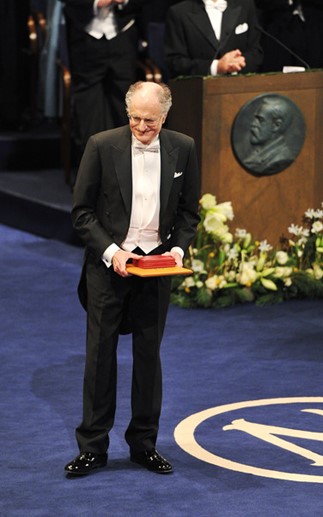
Prescott’s Nobel Prize jointly with Finn Kydland was for showing that policies are often plagued by problems of time inconsistency. They demonstrated that society could gain from prior commitment to economic policies.

Of course, as Tyler Cowen observed, forced savings schemes are easily offset by people rearranging their affairs, and they have their entire adult life to do so:

How much can our government force people to save in the first place?

You can make them lock up funds in an account, but they can respond by borrowing more on their credit cards, taking out a bigger mortgage, and in general investing less in their future.

People do not save for their retirements not because they are short-sighted, but because they are far-sighted. They know that governments will not carry out their threats and other big talk about not providing an adequate old-age pension.

The only way that governments can commit to not bailing people out who retire with no savings is to make them save for their own retirements over their working lives.

Some will be against this compulsion. Their opposition to compulsion cannot be based on opposition to the nanny state because that is faulty reasoning.

These opponents of compulsion and everyone else in the retirement income policy debate are playing in a far more complicated, decades long dynamic political game where ordinary people time and again out-smart conceited governments who pretend they know better:

The government has strategies.

The people have counter-strategies.

Ancient Chinese proverb

Why I am not reviewing Thomas Piketty’s Capital in the Twenty-First Century – updated again

It’s 700 pages long and goes on about Marx. Some people were watching the other channel when the Berlin Wall fell.

thomas-piketty-economist-will-hutton

My 1 o’clock lecture at ANU in 1990 was next to a room rented out ironically from 12 to 1 to the Campus Trots and then to the Campus Christians for an hour of prayer to another saviour.

The Twitter summary of Piketty is this:

Karl Marx wasn’t wrong, just early. Pretty much. Sorry, capitalism. #inequalityforevah

The only Marxist I bother with is Jon Elster. He is a leading proponent of Analytical Marxism and one of the last polymaths. Brian Barry once wrote that to review one of Elster’s books one:

would either have to have taken off several years to master the many fields which fall within Elster’s purview or would be a consortium of at least twenty carefully-chosen experts.

All of Elster’s books and writings are worth reading, including

  • Ulysses and the Sirens (1979);
  • Sour Grapes: Studies in the Subversion of Rationality (1983);
  • Making Sense of Marx (1985); and
  • An Introduction to Karl Marx (1986).

As Jon Elster noted:

Marxian economics is, with a few exceptions, intellectually dead

and Marx’s labour theory of value is:

useless at best, harmful and misleading at its not infrequent worst.

To go on with my non-review, I will quote Tyler Cowen:

The crude seven-word version of Piketty’s argument is “rates of return on capital won’t diminish.”

Piketty’s reasons why rates of return on capital won’t diminish are fairly specific and restricted to only a small share of capital.

.. In any case this is pure speculation and Piketty’s entire argument depends upon it.

… Piketty converts the entrepreneur into the rentier.

To the extent capital reaps high returns, it is by assuming risk…

Yet the concept of risk hardly plays a role in the major arguments of this book.

Once you introduce risk, the long-run fate of capital returns again becomes far from certain.

In fact the entire book ought to be about risk but instead we get the rentier…

Overall, the main argument is based on two (false) claims.

First, that capital returns will be high and non-diminishing, relative to other factors.

Second, that this can happen without significant increases in real wages.

Piketty’s advocacy of a top marginal income tax rate of 80% and a an international treaty for a wealth tax are wildly impractical and destructive of economic growth and entrepreneurship. His advocacy of 60% marginal tax rates on incomes above $200,000 strike at the heart of the professional and managerial occupations that are the backbone of day-to-day capitalism. Piketty’s wealth tax would tax the homes and the retirement savings of the ordinary middle class:

  • wealth below 200,000 euros be taxed at a rate of 0.1 percent,
  • wealth between 200,000 and one million euros at 0.5 percent,
  • wealth between one million and five million euros at 1.0 percent, and
  • wealth above five million euros at 2.0 percent.

Piketty’s reason for these high top tax rates is not to bring in more revenue or to redistribute wealth to poor and the downtrodden but simply “to put an end to such incomes.” Harsanyi argues that:

Like many progressives, Piketty doesn’t really believe that most people deserve their wealth anyway, so confiscating it presents no real moral dilemma.

He also argues that we can measure a person’s productivity and the value of a worker (namely, low-skilled labourers) while arguing that other groups of workers (namely, the kind of people he doesn’t admire) are bequeathed undeserved, “arbitrary” salaries. What tangible benefit does a stockbroker or a kulak or an explanatory journalist offer society, after all?

This takes me back to Jon Elster who had this to say on socialism:

Optimism and wishful thinking have been features of socialist thought from its inception.

In Marx, for instance, two main premises appear to be that whatever is desirable is possible, and that whatever is desirable and possible is inevitable.

…It has become clear that classical socialism massively underestimated the importance of economic incentives.

Greg Mankiw is less harsh, but still to the point:

Like President Obama and others on the left, Piketty wants to spread the wealth around.

Another philosophical viewpoint is that it is the government’s job to enforce rules such as contracts and property rights and promote opportunity rather than to achieve a particular distribution of economic outcomes.

No amount of economic history will tell you that John Rawls (and Thomas Piketty) offers a better political philosophy than Robert Nozick (and Milton Friedman).

John Rawls was actually very much alive to the importance of incentives in a just and prosperous society.

Unequal incomes might turn out to be to the advantage of everyone. Work effort and entrepreneurial alertness respond to incentives; incentives channel people into the occupations and jobs where they produce more.

Rawls lent qualified support to the idea of a flat-rate consumption tax because these taxes:

impose a levy according to how much a person takes out of the common store of goods and not according to how much he contributes.

A simple way to have a progressive consumption tax is to exempt all savings from taxation.

With his emphasis on fair distributions of income, Rawls’ initial appeal was to the Left. Left-wing thinkers then started to dislike his acceptance of capitalism and his tolerance of large discrepancies in income and wealth.

It’s impossible to make the workers better off by taxing capital. The optimal rate of tax on income from capital is zero. This is why the Mirrlees Review of the UK taxation system argued for zero taxation of the returns to capital.

Robert Lucas estimated in 1990 that eliminating all taxes on income from capital would increase the U.S. capital stock by about 35% and consumption by 7%.

Hans Fehr, Sabine Jokisch, Ashwin Kambhampati, and Laurence J. Kotlikoff (2014) found that eliminating the corporate income tax completely would raise the U.S. capital stock (machines and buildings) by 23%, output by 8% and the real wages of unskilled and skilled workers each by 12%.

Book reviews serve the same purpose as film reviews. They are filters for our time. Do you agree?

I made a time management decision to not read a long book plenty of others reviewed and some even understood.

As for the growing income inequality, there is a long literature dating back 25-years arguing that skill-biased technological change is increasing the returns to investing in education as Gary Becker blogged in 2011:

Earnings inequality in the United States and many other countries has increased greatly since the late 1970s, due in large measure to globalization and technological progress that raised the productivity of more educated and more skilled individuals.

While the average American college graduate earned about a 40% premium over the average high school graduate in 1980, this premium increased to over 70% in 2000.

The good side of this higher education-based earnings inequality is that it induced more young men, and especially more young women, to go to and finish college.

The bad side is that many sufficiently able children could not take advantage of the greater returns from a college education because their parents did not prepare them to perform well in school, or they went to bad schools, or they lacked the financing to attend college.

As a result, the incomes of high school dropouts and of many high school graduates stagnated while incomes boomed for many persons who graduated college, and even more so for those with post graduate education.

There is nothing new under the sun.

Inequality as a Barrier to Growth? Invented Out of Thin Air | e21

Error 1: Use of Pre-Tax, Pre-Transfer Income to Measure Inequality. Throughout the report, the IMF uses the concept of “market income” to measure inequality. Market income is defined as income before taxes are paid to the government, and before transfers from the government to low-income individuals…

Error 2: More Inequality Leads to Lower Mobility. … Data from University of Ottawa professor Miles Corak on the United States, Canada, and Sweden suggest that more inequality is associated with higher mobility, not less mobility. Winship’s findings echo those of Harvard University economist Raj Chetty, who found little association between the share of income of the top one percent and mobility, either in the United States or between different countries…

Error 3: Tax Increases Lead to Higher Economic Growth… If transfers of income from one group to another succeeded in creating economic growth, the fastest-growing countries would be those with the highest top tax rates. As Nobel Prize-winning economist Edward Prescott has shown, the reverse is true.

via Inequality as a Barrier to Growth? Invented Out of Thin Air | e21 – Economic Policies for the 21st Century.

Tom Sargent on the Fundamentals of Currency Union Crises

Tom Sargent at Hong Kong University in April 2013 in four parts


Paul Krugman, Tom Sargent and Me

Paul Krugman seems to be implying that I am the double-secret ring-leader of a vast right-wing conspiracy.

clip_image001

Today in his blog at the New York Times, Krugman said:

…why the sudden attention to Sargent’s 2007 speech?

I think it’s fairly obvious: it’s essentially stealth anti-Keynesian propaganda, cloaked in the form of a widely respected and liked economist uttering what sound like eternal truths.

But they aren’t, and the real goal here is to undermine the case for fighting unemployment in the here and now. There are virtues to that 2007 talk, but right now is no time for 2007 Sargent.

In my reply at his blog, I said that I originally posted the link to Sargent’s speech to make a point that most economic analysis is free of politics because the average economist is a moderate Democrat. Tom Sargent is a life-long Democrat.

To add to my reply at Krugman’s blog, Krugman said earlier in his blog that:

It’s not so much that what Sargent said is wrong, although some of his principles are by no means universally agreed upon, even in normal times.

What’s so striking about Sargent’s points is that it’s hard to think of a worse time to cite them.

And the people citing that old speech clearly have ulterior motives.

I live in New Zealand. Not everything is about U.S. domestic politics.

I rather prophetical said on Marginal Revolution on the 20th that “Too many on social media such as Reddit responded by smearing Sargent as a right-winger and neo-liberal. He is a life-long Democrat.”

My conspiratorial minions span the globe to include initially Newmark’s Door and then Marginal Revolution,  Stephen WilliamsonVox.com, the American Enterprise Institute, Catallaxyfiles and the Business Insider to name but a few. There are other unindicted co-conspirators.

Karl Popper argued that conspiracy theories overlook the pervasive unintended consequences of political and social action; conspiracy theorists assume that all consequences must have been intended by someone.

Krugman agrees that Sargent’s 12-points are not that controversial in themselves. Krugman then plays the man rather than the ball:

“How to discredit an unwelcome report:

… Stage Four: Discredit the person who produced the report. Explain (off the record) that
1. He is harbouring a grudge against the Department.
2. He is a publicity seeker.
3. He is trying to get a Knighthood/Chair/Vice Chancellorship.
4. He used to be a consultant to a multinational.
5. He wants to be a consultant to a multinational.

Sir Humphrey, The Greasy Pole

Institutional Economics: Robert Shiller, Ex-Ante and Ex-Post

In his 2009 book with George Ackerlof, Robert Shiller, who shared a Nobel  Prize in economics for his work developing behavioural finance wrote:

there has been one way, at least in the past, in which almost everyone could become at least moderately rich

… Invest it for the long term in the stock market, where the rate of return after adjustment for inflation has been 7% per year’

Shiller’s ex-post observations on stock market returns in 2009 do not sit well with his ex-ante prediction in 1996:

long run investors should stay out of the market for the next decade.

via Institutional Economics: ‘Light Reading It’s Not’ – Forbes.

The joint advice of both the efficient market advocates such as Eugene Fama and the behavioural finance theorists on how to manage your retirement and other long-term savings are the same:

Buy and hold. Diversify. Put your money in index funds.

Pay attention to the one thing you can control–costs–and keep them as low as possible.

Index-linked or passive investment funds minimise their trading of shares and do not hire research departments so their costs and fees are far lower than investments funds that trade actively in the market trying to beat the market.

About 97% of these active funds fail to beat the market. The rest may just have been lucky.

  • The average actively managed investment must underperform the indexed investment when all costs are deducted.
  • The actively managed investments that beat the indexed investments this year fail to consistently beat the index in the future.

Investors can win higher returns by shouldering more risk and all that entails, and the reward for bearing risk vary over time and across assets.

Old macroeconomic fallacies never die, they just wait for the next recession

Thomas Kuhn’s Structure of Scientific Revolutions showed that sciences do not march onwards and upwards towards the light. Kuhn found that once a central paradigm is selected, there is no testing or sifting, and tests of basic assumptions only take place after accumulated failures and anomalies in the ruling paradigm plunge the science into a crisis.

Scientists do not give up the failing paradigm until a new paradigm arrives, which resolves the failures and anomalies that caused the crisis. It takes a theory to beat a theory.

Murray Rothbard, when discussing Kuhn, pointed to economics is an example of a science which moves in a zigzag fashion, with old fallacies sometimes elbowing aside earlier but sounder paradigms.

Thomas Humphrey wrote an excellent 250-year long literature surveys of both the rules versus discretion debate and the cost-push theories of inflation in the 1998 and 1999 Richmond Fed Quarterly.

Humphrey wrote the reviews to see if economics was a progressive science in the sense that superior new ideas relentlessly supplant inferior old ones.

Humphrey showed that policy rules were popular in good times to contain inflation, and when unemployment was rising, discretionary policies returned to vogue. The policy debate keeps recycling because

  1. people forget the lessons of the past; and
  2. For better or worse, politicians and the public have tended to believe that central banks, the focus of his studies, have the power to boost output, employment, and growth permanently.

Mercantilists, with their fears of hoarding and scarcity of money together with their prescription of cheap (low interest rates) and plentiful cash as a stimulus to real activity, tend to gain the upper hand when unemployment is the dominant problem.

Classicals, chanting their mantra that inflation is always and everywhere a monetary phenomenon, tend to prevail when price stability is the chief policy concern.

Cost-push fallacies about inflation were even more resilient against repeated refutations.

There is nothing new under the sun in macroeconomics. The same issues that divided twentieth-century monetarists and non-monetarists as well as current macroeconomists were discussed by everyone from David Hume (1752) to Knut Wicksell (1898) and in the Bullionist-Anti-Bullionist and the Currency School-Banking School controversies:

  • rules v. discretion,
  • inflation as a monetary v. real cost push phenomenon,
  • direct v. inverse money-to-price causality,
  • central bank-determined v. market demand-determined money stocks,
  • exogenous v. endogenous money, and
  • backing v. supply-and-demand theories of money’s value

Current macroeconomists and monetary economists often unaware of the eighteenth and nineteenth-century origins of the ideas they employ.

Barro (1989) “New Classicals and New Keynesians, or the Good Guys and the Bad Guys”, made the point that Keynesian macroeconomics does not seek out new theoretical results for testing; rather the aim is to provide respectability for the basic viewpoints and policy stances of the old Keynesian models.

Bellante (1992) likewise, noted that the search in Keynesian economics for microeconomic foundations is to blunt criticism, rather than because it is otherwise useful. The analytical apparatus may change, but the policy conclusions remain the same.

Policy Consistency and the Growth of Nations Finn Kydland


Favourite Lucas and Sargent quotes

Lucas and Sargent from After Keynesian Macroeconomics (1979):

For policy, the central fact is that Keynesian policy recommendations have no sounder basis, in a scientific sense, than recommendations of non-Keynesian economists or, for that matter, non-economists

Thomas J. Sargent

Robert Lucas from Tobin and Monetarism: A Review Article (1981):

Keynesian theory is in deep trouble, the deepest kind of trouble in which an applied body of theory can find itself: It appears to be giving seriously wrong answers to the most basic questions of macroeconomic policy.

Proponents of a class of models which promised 3 to 4 per cent unemployment to a society willing to tolerate annual inflation rates of 4 to 5 per cent have some explaining to do after a decade such as we have just come through.

A forecast error of this magnitude and central importance to policy has consequences, as well it should.

We got the high-inflation decade, and with it as clear-cut an experimental discrimination as macroeconomics is very likely to see, and Friedman and Phelps were right.

Haberler, Jacob Viner, Robertson, Pigou and Frank Knight pointed out in their reviews of the General Theory that it lacked originality, and presented old ideas often incorrectly in confusing new vocabularies that made the book difficult to read. These reviews are worth reading today such as this by Frank Knight:

Many of Mr. Keynes’s own doctrines are, as he would proudly admit, among the notorious fallacies to combat which has been considered a main function of the teaching of economics.

Tom Sargent’s 12 lessons from economics for public policy

Tom Sargent is a life-long Democrat who is old enough to remember when Democrats were fiscal conservatives.

At a graduation speech at Berkeley, Sargent listed these lessons:

    1. Many things that are desirable are not feasible.
    2. Individuals and communities face trade-offs.
    3. Other people have more information about their abilities, their efforts, and their preferences than you do.
    4. Everyone responds to incentives, including people you want to help. That is why social safety nets don’t always end up working as intended.
    5. There are trade-offs between equality and efficiency.
    6. In an equilibrium of a game or an economy, people are satisfied with their choices. That is why it is difficult for well-meaning outsiders to change things for better or worse.
    7. In the future, you too will respond to incentives. That is why there are some promises that you’d like to make but can’t. No one will believe those promises because they know that later it will not be in your interest to deliver. The lesson here is this: before you make a promise, think about whether you will want to keep it if and when your circumstances change. This is how you earn a reputation.
    8. Governments and voters respond to incentives too. That is why governments sometimes default on loans and other promises that they have made.
    9. It is feasible for one generation to shift costs to subsequent ones. That is what national government debts and the U.S. social security system do (but not the social security system of Singapore).
    10. When a government spends, its citizens eventually pay, either today or tomorrow, either through explicit taxes or implicit ones like inflation.
    11. Most people want other people to pay for public goods and government transfers (especially transfers to themselves).
    12. Because market prices aggregate traders’ information, it is difficult to forecast stock prices and interest rates and exchange rates

Uncertainty and Ambiguity in American Fiscal and Monetary Policies – Tom Sargent

Macroeconomic forecasting has had a turbulent history

Most early discussions argued against econometric forecasting in principle:

  • Forecasting was not properly grounded in statistical theory,
  • It presupposed that causation implies predictability, and
  • The forecasts themselves were invalidated by the reactions of economic agents to them.

A long tradition argued that social relationships were too complex, too multifarious and too infected with capricious human choices to generate enduring, stable relationships that could be estimated.

These objections came before Hayek’s point that much of all social knowledge is not capable of summation in statistics or even language.

The limitations of forecasting are well-known. Forecasts are conditional on a number of variables; there are important unresolved analytical differences about the operation of the economy; and large uncertainties about the size and timing of responses to macroeconomic changes. Shocks to the output, prices, employment and other variables are partly permanent and partly transitory.

At the practical level, forecasting requires that there are regularities on which to base models, such regularities are informative about the future and these regularities are encapsulated in the selected forecasting model.

We have very little reliable information about the distribution of shocks or about how the distributions change over time. Forecast errors arise from changes in the parameters in the model, mis-specification of the model, estimation uncertainty, mis-measurement of the initial conditions and error accumulation.

In the 1980s, data mining and publications bias were so strong and statistical inferences were so fragile that Ed Leamer’s 1983 Let’s Take the Con out of Econometrics paper made up-and-coming applied economists despair for their professional field and for their own careers:

The econometric art as it is practiced at the computer terminal involves fitting many, perhaps thousands, of statistical models. One or several that the researcher finds pleasing are selected for reporting purposes.

This search for a model is often well intentioned, but there can be no doubt that such a specification search invalidates the traditional theories of inference….

[A]ll the concepts of traditional theory…utterly lose their meaning by the time an applied researcher pulls from the bramble of computer output the one thorn of a model he likes best, the one he chooses to portray as a rose.

… This is a sad and decidedly unscientific state of affairs we find ourselves in.

Hardly anyone takes data analyses seriously.

Or perhaps more accurately, hardly anyone takes anyone else’s data analyses seriously.

Like elaborately plumed birds who have long since lost the ability to procreate but not the desire, we preen and strut and display our t-values [which measure statistical significance].

Leamer still doubts the progress towards techniques that separate sturdy from fragile inferences. Economists by and large simply do not want to hear that they cannot make major conclusions from the data sets. But not that they really do, but that is for a forthcoming post.

Before the great moderation spread wide, Brunner and Meltzer found that in the 1970s and 1980s, the 95% confidence intervals on next year’s forecasts for Gross Domestic Product and the Consumer Price Index are such that government and private forecasters in the USA and Europe could not distinguish between a recession and a boom, nor say whether inflation will be zero or ten per cent.

A review this week by Ahir and Lounganishows found that recent forecasting by the private and public sector has not improved:

none of the 62 recessions in 2008–09 was predicted as the previous year was drawing to a close.

Figure 1. Number of recessions predicted by September of the previous year

Source: Ahir and Loungani 2014, “There will be growth in the spring”: How well do economists predict turning points?” http://www.voxeu.org/

A policy-maker who adjusts policy based on forecasts for the following year has little reason to be confident that he has changed policy in the right direction.

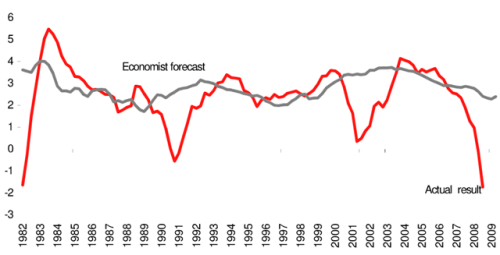
While at graduate school, I wrote what was published as Official Economic Forecasting Errors in Australia 1983-96.

Australian Treasury forecasting errors were so large relative to the mean annual rate of change in real GDP and the inflation rate that, on average, forecasters could not distinguish slow growth from a deep recession or stable prices from moderate inflation.

The biography of Paul Keating by Edwards suggested that the Government of the day was well aware of the poor value of forecasts. So much so that forecasts may not have actually played a significant role in monetary policy making in Australia in the late 1980s onwards. John Stone said this to Keating when he assumed office as Treasurer in 1983:

As you know, we (and I in particular) have never had much faith in forecasting.

Not infrequently, our forecasts turn out to be seriously wrong.

… We simply do the best we can, in as professional manner as we can — and, if it is any consolation, no one seems to be able to do any better, at least in the long haul.

We always emphasize the uncertainties that attach to the forecasts — but we cannot ensure that such qualifications are heeded and plainly they often are not

To cast my results in Milton Friedman’s nomenclature for monetary lags, the recognition lag on a forecasting based monetary policy appears to be infinite because forecasters do not know if there will be a recession or 10% inflation afoot when their monetary policy changes take hold in 18 to 24 months.

Was the global economic crisis unforeseen?

Plenty of people warned of dark days ahead. An essay anyone can read with profit is Ross Levine’s "An Autopsy of the U.S. Financial System: Accident, Suicide, or Negligent Homicide?"

The paper studies five important policies:

  • Securities and Exchange Commission (SEC) policies toward credit rating agencies,
  • Federal Reserve policies concerning bank capital and credit default swaps,
  • SEC and Federal Reserve policies about over-the-counter derivatives,
  • SEC policies toward the consolidated supervision of major investment banks, and government policies toward Fannie Mae and Freddie Mac.

Levine concludes that

  • The evidence is inconsistent with the view that the collapse of the financial system was caused only by the popping of the housing bubble ("accident") and the herding behaviour of financiers rushing to create and market increasingly complex and questionable financial products ("suicide").
  • Rather, the evidence indicates that senior policymakers repeatedly designed, implemented, and maintained policies that destabilized the global financial system in the decade before the crisis.
  • Moreover, although the major regulatory agencies were aware of the growing fragility of the financial system due to their policies, they chose not to modify those policies, suggesting that "negligent homicide" contributed to the financial system’s collapse
  • Although influential policymakers presumed that international capital flows, euphoric traders, and insufficient regulatory power caused the crisis, the paper shows that these factors played only a partial role.
  • Current reforms represent only a partial and incomplete step in establishing a stable and well-functioning financial system.
  • Since systemic institutional failures helped cause the crisis, systemic institutional reforms must be a part of a comprehensively effective response.

The most interesting morsels are:

  • The New York Times warned in 1999 that Fannie Mae was taking on so much risk that an economic downturn could trigger a “rescue similar to that of the savings and loan industry in the 1980s,” and again emphasized this point in 2003; and
  • Alan Greenspan testified before the Senate Banking Committee in 2004 that the increasingly large and risky GSE portfolios could have enormously adverse ramifications! A rare occasion on which Greenspan did not talk in riddles.


Stern and Feldman’s Too Big to Fail in 2004 used insights gleaned from the formal economic literature to frame warnings in 2004 about the time bomb for a financial crisis set by current regulations and government promises.

The prediction of the Kareken and Wallace moral hazard model of deposit insurance is if a government sets up deposit insurance and doesn’t regulate bank portfolios to prevent them from taking too much risk, the government is setting the stage for a financial crisis. If financial intermediaries do not bear the full consequences of their actions (because they are insured) then profit maximising portfolios will be too risky. The Kareken-Wallace model makes you very cautious about lender-of-last-resort facilities and very sensitive to the risk-taking activities of banks.

Tom Sargent said that Jose Scheinkman made a list of the ten academic papers that the Reagan administration should have looked at. Number one on his list was Kareken and Wallace.

The idea that deposit insurance leads to more financial crises even troubled FDR before he signed the 1934 U.S. bill to introduce deposit insurance.

Robert Lucas and Edward Prescott discuss the future of economic growth, 2014

On 21 March, Robert E. Lucas Jr., and Edward C. Prescott participated in a roundtable on “The Wealth of Nations in the 21st Century” in Barcelona.


via Chong-En Bai, Robert Lucas, Edward Prescott discuss economic growth in Barcelona – Barcelona GSE.

Previous Older Entries Next Newer Entries

David Andolfatto

Celebrating humanity's flourishing through the spread of capitalism and the rule of law

Monetary Non-Neutrality

Celebrating humanity's flourishing through the spread of capitalism and the rule of law

Reason Magazine

Celebrating humanity's flourishing through the spread of capitalism and the rule of law

Coyote Blog

Celebrating humanity's flourishing through the spread of capitalism and the rule of law

Thoughts from the North

Celebrating humanity's flourishing through the spread of capitalism and the rule of law

Fardels Bear

A History of the Alt-Right

Vincent Geloso

Econ Prof at George Mason University, Economic Historian, Québécois

Bassett, Brash & Hide

Celebrating humanity's flourishing through the spread of capitalism and the rule of law

Truth on the Market

Scholarly commentary on law, economics, and more

The Undercover Historian

Beatrice Cherrier's blog

Matua Kahurangi

Celebrating humanity's flourishing through the spread of capitalism and the rule of law

Temple of Sociology

Celebrating humanity's flourishing through the spread of capitalism and the rule of law

Velvet Glove, Iron Fist

Celebrating humanity's flourishing through the spread of capitalism and the rule of law

Why Evolution Is True

Why Evolution is True is a blog written by Jerry Coyne, centered on evolution and biology but also dealing with diverse topics like politics, culture, and cats.

NoTricksZone

Celebrating humanity's flourishing through the spread of capitalism and the rule of law

Homepaddock

A rural perspective with a blue tint by Ele Ludemann

Kiwiblog

DPF's Kiwiblog - Fomenting Happy Mischief since 2003

The Dangerous Economist

Celebrating humanity's flourishing through the spread of capitalism and the rule of law

Watts Up With That?

The world's most viewed site on global warming and climate change

The Logical Place

Tim Harding's writings on rationality, informal logic and skepticism

Doc's Books

A window into Doc Freiberger's library

The Risk-Monger

Let's examine hard decisions!

Uneasy Money

Commentary on monetary policy in the spirit of R. G. Hawtrey

Barrie Saunders

Thoughts on public policy and the media

Liberty Scott

Celebrating humanity's flourishing through the spread of capitalism and the rule of law

Point of Order

Politics and the economy

James Bowden's Blog

A blog (primarily) on Canadian and Commonwealth political history and institutions

Science Matters

Reading between the lines, and underneath the hype.

Peter Winsley

Economics, and such stuff as dreams are made on

A Venerable Puzzle

"The British constitution has always been puzzling, and always will be." --Queen Elizabeth II

The Antiplanner

Celebrating humanity's flourishing through the spread of capitalism and the rule of law

Bet On It

Celebrating humanity's flourishing through the spread of capitalism and the rule of law

History of Sorts

WORLD WAR II, MUSIC, HISTORY, HOLOCAUST

Roger Pielke Jr.

Undisciplined scholar, recovering academic

Offsetting Behaviour

Celebrating humanity's flourishing through the spread of capitalism and the rule of law

JONATHAN TURLEY

Res ipsa loquitur - The thing itself speaks

Conversable Economist

In Hume’s spirit, I will attempt to serve as an ambassador from my world of economics, and help in “finding topics of conversation fit for the entertainment of rational creatures.”

The Victorian Commons

Researching the House of Commons, 1832-1868

The History of Parliament

Articles and research from the History of Parliament Trust

Books & Boots

Reflections on books and art

Legal History Miscellany

Posts on the History of Law, Crime, and Justice

Sex, Drugs and Economics

Celebrating humanity's flourishing through the spread of capitalism and the rule of law

European Royal History

Exploring the Monarchs of Europe

Tallbloke's Talkshop

Cutting edge science you can dice with

Marginal REVOLUTION

Small Steps Toward A Much Better World

NOT A LOT OF PEOPLE KNOW THAT

“We do not believe any group of men adequate enough or wise enough to operate without scrutiny or without criticism. We know that the only way to avoid error is to detect it, that the only way to detect it is to be free to inquire. We know that in secrecy error undetected will flourish and subvert”. - J Robert Oppenheimer.