Bob, this is the way labour markets works, Ed

Robert Lucas Edward C. Prescott

Bob,
This is the way labour markets work: v(s, y, λ) max{λ, R(s, y) min[ λ, β ∫ v(s′, y, λ) f(s′, s)ds′]}.
Ed

Robert Lucas went on to explain in his professional memoir about this exchange in the early 1970s that:

we had agreed on notation: s stood for the state of product demand at a particular location, y stood for the number of workers who were already at that location, R(s, y) was the marginal product of labour implied by these two numbers, and v(s, y) stood for the present value of earnings that one of these workers could obtain if he made his decision whether to stay at this location or leave optimally.

Other features of the equation were as novel to me as they are (I imagine) to you…

a single parameter—Ed’s λ—stood for two different things: the present value of earnings that all searching workers would have to expect in order to leave a location and the present value that a particular location would need to offer to receive new arrivals…

If I had to pick a single day to represent what I like about a life of research, it would be this one.

Ed’s note captures exactly why I think we value mathematical modelling: it is a method to help us get to new levels of understanding the ways things work.

Piketty: A Wealth of Misconceptions by Don Boudreaux

Piketty’s method of doing economics involves frequent grand proclamations about "social justice" and economic "evolutions," but he offers no analyses of the dynamics of individual decision-making, often referred to as "microeconomics," that should be central to the issues he raises…

Revealingly, Piketty writes of income and wealth as being claimed or "distributed," never as being earned or produced. The resulting statistics are too aggregated—too big-picture—to reveal what is happening to individuals on the ground…

He imagines that such aggregates interact in robotic fashion through a logic of their own, unmoved by individual human initiative, creativity, or choice…

If we follow the advice of Adam Smith and examine people’s ability to consume, we discover that nearly everyone in market economies is growing richer…

THE U.S. IS THE bête noir of Piketty and other progressives obsessed with monetary inequality.

But middle-class Americans take for granted their air-conditioned homes, cars, and workplaces—along with their smartphones, safe air travel, and pills for ailments ranging from hypertension to erectile dysfunction…

At the end of World War II, when monetary income and wealth inequalities were narrower than they’ve been at any time in the past century, these goods and services were either available to no one or affordable only by the very rich.

So regardless of how many more dollars today’s plutocrats have accumulated and stashed into their portfolios, the elite’s accumulation of riches has not prevented the living standards of ordinary people from rising spectacularly…

Piketty’s disregard for basic economic reasoning blinds him to the all-important market forces at work on the ground—market forces that, if left unencumbered by government, produce growing prosperity for all. Yet, he would happily encumber these forces with confiscatory taxes.

via Piketty: A Wealth of Misconceptions – Barron’s.

Robert Lucas on the role of income redistribution in economic development

clip_image002

Of the tendencies that are harmful to sound economics, the most seductive, and in my opinion the most poisonous, is to focus on questions of distribution.

In this very minute, a child is being born to an American family and another child, equally valued by God, is being born to a family in India.

The resources of all kinds that will be at the disposal of this new American will be on the order of 15 times the resources available to his Indian brother.

This seems to us a terrible wrong, justifying direct corrective action, and perhaps some actions of this kind can and should be taken.

But of the vast increase in the well-being of hundreds of millions of people that has occurred in the 200-year course of the industrial revolution to date, virtually none of it can be attributed to the direct redistribution of resources from rich to poor.

The potential for improving the lives of poor people by finding different ways of distributing current production is nothing compared to the apparently limitless potential of increasing production.

via The Industrial Revolution: Past and Future 2003 Annual Report Essay by Robert E. Lucas, Jr

Edward C Prescott – Restoring U.S. Prosperity – Brazil, 10 May 2014


Can New Zealand blame its small size for its economic woes?

The median national population size is not much more than New Zealand’s current population.

  • Controlling for location, Easterly and Kraay (2002) found that smaller states were richer than other states in per capita real GDP.
  • Rose (2006) reviewed the impact of size on the level of income, inflation, material well-being, health, education, and the quality of a country’s institutions and found that small countries are more open to trade than large countries, but are not systematically different otherwise.

As I argued in my previous post on distance, New Zealand were prosperous from the time of European settlement despite a small population and their great distance from the main markets of the world on each side of the Atlantic.

Of the ten richest countries in terms of GDP per capita, only four have populations above one million people (Alesina 2003). These countries are the USA (290 million people), Switzerland (7 million people), Norway (4 million people) and Singapore (3 million people). Of these four nations, two are below the global national population median of six million (Alesina 2003).

New Zealand’s population is similar and often larger in size than most of the richest countries in the world. Singapore and Hong Kong were initially far from the global Trans-Atlantic economic hubs before their respective development miracles unfolded in the mid and late 20th century.

Something must have happened recently for either small population size or distance to have become important when it was not important for most of the history of New Zealand. New Zealand has been on the same place on the map for all its history.

Transport costs on exports to England and the rest of Europe did not hold back New Zealand’s economic development in the 19th century and for most of the 20th century despite far more primitive and more expensive forms of transport.

New Zealand specialised in commodities that could be produced at a low cost because land and water was plentiful and exported them in bulk to large markets on the other side of the world because of falling transport costs. The invention of refrigeration in 1881 was a major boost to meat exports to England.

The main economic difference between smaller and larger nation-states around the globe is smaller nations are more open to international trade and foreign investment (Alesina et al. 2005).

In a world of freer overseas trade, small countries can extend the size of their markets by trade and sidestep many of the costs of small internal markets. As long as political borders do not greatly limit international trade, economic success is increasingly independent of national size (Alesina 2003; Alesina et al. 2000).

A leading economic advantage of large national size in more isolationist times was a large marketplace free of trade and investment barriers and fewer national borders and different legal systems to parry. As more nations open up to the world, the single market benefits of large size for a country start to melt away quickly (Alesina 2003; Alesina and Spolaore 2003; Alesina et al. 2000).

As countries become larger, administration costs and the growing heterogeneity in the political preferences of larger and more diverse populations counterbalance the benefits of size and scale (Alesina et al. 2003, 2004, 2006; Spolaore 2006). More nation-states and freer trade increase the degree that governments must compete for citizens and investment. Inter-jurisdictional competition increases the incentives for governments to adopt institutions and policies that promote efficiency and productivity and serve their peoples better (Friedman 2005).

Foreigners Are Our Friends | Bryan Caplan | Learn Liberty – YouTube

Can New Zealand blame distance for its economic woes?

Distance is common in many discussions of the relative growth performance of New Zealand. New Zealand is said to be small and remote and poorer for it. The figure below from a Productivity Commission report is an example.
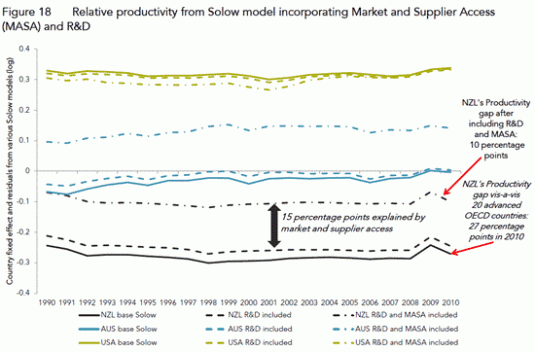
The Productivity Commission put it this way:

New Zealand firms face reduced access to large markets and limited participation in global value chains, where the transfer of advanced technologies now often occurs.

Indeed, global value chains – which can require intensive interaction and just-in-time delivery across borders – may have worsened the impact of New Zealand’s geographic isolation on trade in goods.

The Commission continues on to say that:

These limits on trade and the diffusion of new ideas into New Zealand may explain as much as 15 percentage points of the 27% productivity gap between New Zealand and the average of 20 OECD countries.

This 15 per cent claim is a daring claim. Physical location does not change over time.

New Zealand, Australia and the other European offshoots such as Canada and the USA all prospered for most to all their histories despite their distances from their mother country. Canada cannot blame distance for its weak productivity performance because it is next door to the USA.

Figure 1 below using OECD data suggests that New Zealand and Australian real GDP per capita are both about 10 percentage points lower than they otherwise would be because of distance. A bounty of natural resources gives a less than a two per cent boost to Australia’s real GDP per capita, see Figure 1.

Figure 1: Estimated impact of proximity to markets and natural resources on real GDP per capita, OECD members, average for 2000-2004
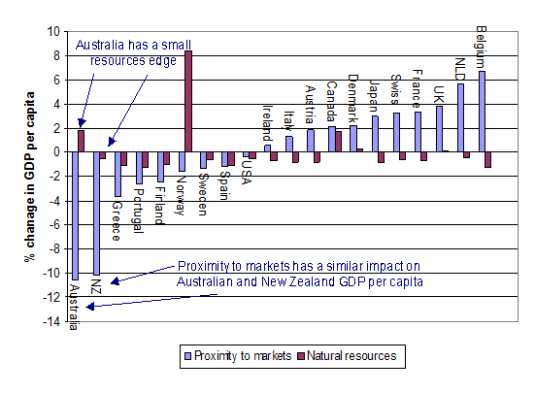
Source: OECD.

The burden of geography is about distance from large agglomerations of production, consumption and supply. There is from the extra cost of exporting to distant markets and the cost penalty from ordering from major suppliers who are far way. Geography can also affect the international flow of ideas and the diffusion of new technologies.

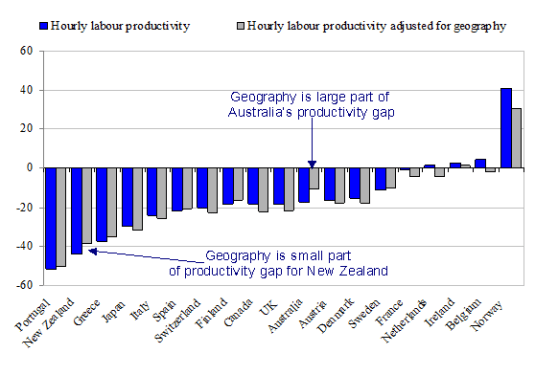
Figure 2 shows that most of the labour productivity gap of New Zealand and many others with the USA is not explained by geography – by access to major markets and any natural resource bounty.

Figure 2: Apparent and geography adjusted hourly labour productivity relative to the USA, 2006

Source: OECD (2008).

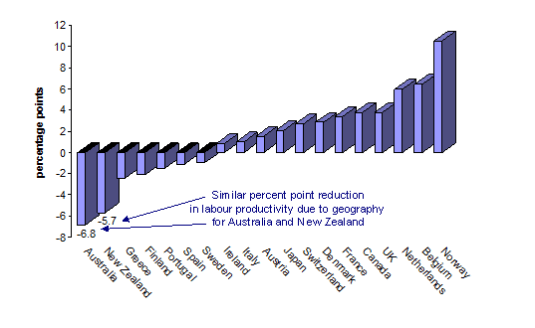
New Zealand’s apparent and geography adjusted productivity gaps with the USA are not far apart. In contrast, the OECD (2009c), geography cuts in half the gap in hourly labour productivity between the USA and Australia – see Figure 3.

Figure 3: Percentage point change in hourly labour productivity relative to the USA due to geography, 2006
Source: OECD.

The labour productivity gap of New Zealand with the USA is over four times larger than what could be reasonably attributed to geographic burdens. Other factors must account for the bulk of New Zealand’s productivity gap.

More to the point, distance and remoteness explain none of the productivity and income gaps across the Tasman and why this gap suddenly appeared in the 1970s and 1980s to NZ’s disadvantage.

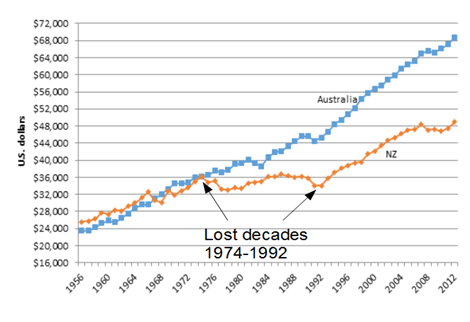
New Zealand lost almost two decades of growth between 1974 and 1992 as shown in Figure 4.

Figure 4: Real GDP per New Zealander and Australian aged 15-64, converted to 2013 price levels with updated 2005 EKS purchasing power parities, 1956-2012
Source: Computed from OECD StatExtract and The Conference Board, Total Database, January 2014.

The Trans-Tasman gap is the income and productivity gap that concerns Kiwis and is the relevant policy yardstick everyone uses or should use.

The emergence of the Trans-Tasman income gap from initial income parity in 1974 – see Figure 4 – cannot be because of distance because both NZ and Australia suffer equally from a 10% productivity burden because of distance.

This common 10% productivity burden due to distance does not explain real GDP per working age person in Australia and NZ dropping from parity in 1974 to a 35% gap inside 20 years and then suddenly stabilising.

Figure 4 showed that NZ started growing again in 1992 after the Ruth Richardson horror budget stabilised economic policy sentiments. There was to be no going back on the economic reforms.

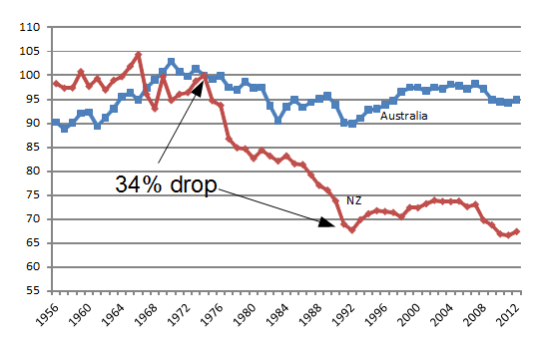
Figure 5 below shows that NZ’s labour productivity growth dropped like a stone between 1974 and 1992 then stabilised at 1.85% growth per year from 1992 to 2005. GDP per working age person in Figure 5 is based to 100 in 1974 and then detrended by 1.85% per year – the trend growth rate of the USA in the 20th century. A flat line in Figure 5 is annual growth in real GDP per working age person of 1.85%. Australia’s growth rate is pretty flat since 1970 bar the odd recession and recovery from the same.

Figure 5: Real GDP per New Zealander and Australian aged 15-64, converted to 2013 price levels with updated 2005 EKS purchasing power parities, base 100 in 1974, 1.85 per cent detrending, 1956-2012
Source: Computed from OECD StatExtract and The Conference Board, Total Database, January 2014.

This 34% productivity drop in NZ from 1974 to the mid-1980s was too rapid to be explained by distance and global value chains suddenly becoming more important than was the case for most of NZ’s history. Australian GDP growth rates was not affected in the slightest by these trends in the geography of trade and input markets.

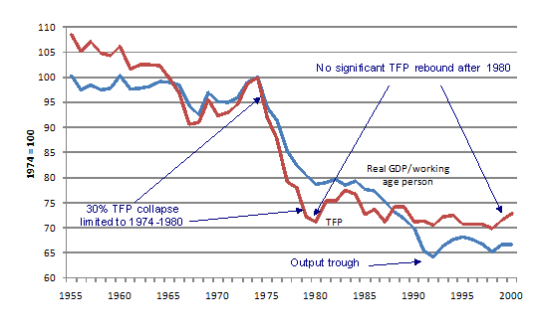
The Productivity Commission looked at the wrong data to ask the wrong questions. The data analysis undertaken on behalf of the Productivity Commission started in 1980. Figure 6 below shows at all the action and excitement regarding total factor productivity in New Zealand occurred before 1980.

Figure 6: New Zealand total factor productivity and real GDP per New Zealander aged 15-64, 2 per cent detrended, 1955-2000
Source: Kehoe and Ruhl (2003).

Kehoe and Ruhl (2003) attributed the decline in the growth of GDP per working age New Zealander after 1974 to 1992 to a sharp decline in total factor productivity from 1974 to 1980.

Figure 6 plots detrended data constructed by Kehoe and Ruhl (2003) to show that total factor productivity fell rapidly in New Zealand between 1974 and 1980, by 30 per cent in all, and then levelled out to grow again at the trend rate of two per cent.

There was no subsequent total factor productivity recovery to make up the lost ground. If this were so, Figure 4 would have had to include a strongly rising line for total factor productivity over many years after 1980 to recover the 30 per cent fall in the level of total factor productivity between 1974 and 1980.

Kehoe and Ruhl (2003) suggested that the identification of the factors that permanently reduced total factor productivity levels in New Zealand between 1974 and 1980 may have great contemporary policy relevance.

The total factor productivity drop identified by Kehoe and Ruhl (2003) occurred before the 1978 start of the Statistics New Zealand productivity data series.

The great value of the Kehoe and Ruhl (2003) data is the drawing out of the major decline in total factor productivity on the eve of the Statistics New Zealand data series.

Kehoe and Ruhl (2003) attributed the 1970s total factor productivity collapse to a massive change in trade patterns after the entry of the UK into the then European Economic Community in 1973.

All discussions of income gaps should be against Australia and any additional burden of distance that New Zealand faces in addition to Australia since 1974 when the Trans-Tasman income gap emerged.

When New Zealand catches-up with Australia in labour productivity that will be the time to start worrying about the burden of geography – a burden that holds back relative productivity equally in both countries. You cannot explain the difference between Australia’s and NZ’s relative productivity by geographic factors they have in common.

Everything’s Amazing and Nobody’s Happy | Bryan Caplan

Margaret Thatcher, Hayek & Friedman | Margaret Thatcher Foundation

Thatcher read Hayek’s Road to Serfdom as an undergraduate at Oxford. She took away two key lessons for her life: you cannot compromise with socialism, even the mild social democratic forms; and she saw her own party was doing just that, which put her deeply at odds with its leadership.

After she became Leader of the Opposition, Thatcher cut short a leftish member of her own  Conservative Party Research Department by showing him a copy of The Constitution of Liberty, slamming it down on the table declaring “this is what I believe”.

Thatcher’s relationship with Milton Friedman was different to that of Hayek and not as long standing. Friedman met Thatcher for the first time at a dinner in 1978.

After Thatcher came to office in 1979, Friedman was a critic of the monetary regime of the Thatcher government, questioning her monetary policy targets,  questioning the raising of the value added tax to finance income tax cuts,  and urging deeper spending cuts in the 1979 budget. Friedman was also a strong critic of the monetary policies of the Fed at that time as well, arguing that they lacked credibility, transparency and were very erratic.

In a letter to the Times on 3 March 1980 Friedman stated that he opposed “fine-tuning” and strongly preferred:

a steady monetary and fiscal policy announced long in advance and strictly adhered to

Hayek disagreed with Friedman about the role of gradualism in a letter to the Times on 26 March 1980:

The chief practical issue today is how fast inflation can be and ought to be stopped.

On this, I am afraid, my difference from Friedman makes me take an even more radical position.

The reason is that I believe that the artificial stimulus which inflation gives to business and employment lasts only so long as inflation accelerates, that is, so long as prices turn out to be higher than expected.

Inflation clearly cannot accelerate indefinitely, but as soon as it ceases to accelerate, all the windfalls due to prices turning out higher than expected, which kept unprofitable businesses and employment going, disappear.

Every slowing down of inflation must therefore produce temporary conditions of extensive failures and unemployment.

No inflation has yet been terminated without a “stabilization crisis”.

To advocate that inflation should be slowed down gradually over a period of years is to advocate a long period of protracted misery. No government could stand such a course.

Milton Friedman’s general views on Britain when Thatcher first came to office were clear-cut and were also stated in his letter to the Times on 3 March 1980:

…while monetary restraint is a sufficient condition for controlling inflation, it is a necessary but not sufficient condition for improving Britain’s productivity – the fundamental requirement for restoring Britain to full economic health.

That requires measures on a broader front to restore and improve incentives, promote productive investment, and give a greater scope for private enterprise and initiative.

Both Hayek and Friedman wrote privately about the Thatcher policies of the early 1980s, decrying them as gradualism. So much for the retired professors as the ring masters of neo-liberalism and Thatcher as their pawn.

Friedman and Hayek disagreed with each other, in important respects, about both gradualism in monetary policy and  macroeconomics in general.

Thatcher did not follow their conflicting policy advice to her. At best, Thatcher was a wayward disciple of squabbling prophets.

Friedman was a strong critic of Austrian macroeconomics and its supposed role in the 1930s policy response or lack of a response to the Great Depression:

I think the Austrian business-cycle theory has done the world a great deal of harm.

If you go back to the 1930s, which is a key point, here you had the Austrians sitting in London, Hayek and Lionel Robbins, and saying you just have to let the bottom drop out of the world.

You’ve just got to let it cure itself. You can’t do anything about it. You will only make it worse. You have Rothbard saying it was a great mistake not to let the whole banking system collapse.

I think by encouraging that kind of do-nothing policy both in Britain and in the United States, they did harm.

Hayek was equally critical of the macroeconomics of Milton Friedman and his methodology in general:

I do indeed regard the abandonment of the whole macroeconomics nonsense as very important, but it is for me a very delicate matter and I have for some time avoided stating my views too bluntly and would not have time to state them adequately.

The source of the difficulty is the constant danger that the Mont Pelerin society might split into a Friedmanite and a Hayekian wing.

 I have long regretted my failure to take time to criticise Friedman’s Positive Economics almost as much as my failure to return to the critique of Keynes General Theory after I had dealt with his Treatiese.

It still seems to me paradoxical that Keynes, who was rather contemptuous of econometrics, should have become the main source of the revival of macroeconomics – which incidentally was also the reason why Milton was for a time a Keynesian.

I believe a good and detailed critical analysis of macroeconomics would be very desirable.

Brad Delong pointed out in 2000 that the New Keynesian macroeconomic research program was developed in the 20th century monetarist tradition mostly in the work of Milton Friedman.

Tom Sargent argued in 1981 that Thatcher’s medium term economic strategy was gradualism, and the sustained budget deficits would result in unpleasant monetarist arithmetic:

…In order that the current British plan be viewed as credible it is necessary that the large prospective government deficits over the next several years be counterbalanced by prospective surpluses further down the line.

It is difficult to point to much either in current legislation,  or equally importantly, in the general British political climate that could objectively support such an outlook.

…Gradualism invites speculation about future reversals with U-turns in policy.

Large contemporary government deficits unaccompanied by concrete prospects for future government surpluses promote realistic doubts about whether monetary restraint must be abandoned sooner or later to help finance the deficits.

Such doubts not only call into question the likelihood that the plan can successfully permanently reduce inflation, but also can  induce high real cost in terms of depressed industry and lengthened unemployment in response to what may be viewed as only temporary downward movements in nominal aggregate demand that the monetary restraint induces.

What did Thatcher actually do?

by discrediting socialism so thoroughly, she prompted in due course the adoption by the Labour Party of free market economics, and so, as she wryly confessed in later years, “helped to make it electable”.

The archives of the Margaret Thatcher foundation has released extensive correspondence and other documents about Thatcher, Hayek and Friedman.

via MT, Hayek & Friedman | Margaret Thatcher Foundation.

Marginal tax rates and labour supply

Americans now work 50 per cent more than do the Germans, French, and Italians. This was not the case in the early 1970s, when the Western Europeans worked more than Americans.

Edward Prescott found that taxes accounted for these differences in labour supply across time and across countries; in particular, the effective marginal tax rate on labour income. The population of countries considered is the G-7 countries, which are major advanced industrial countries. Prescott concluded that

virtually all of the large differences between U.S. labour supply and those of Germany and France are due to differences in tax systems.

Prescott and many that followed him were truly puzzled by the lack of a role for employment mandates, employment protections and product market regulation in Europe’s poor economic performance

Richard Rogerson is a very sharp fellow who built on Prescott’s work. Most anything Rogerson writes is worth a look.

A non-technical note by Rogerson made these key points:

  1. Europe’s taxes punish working outside the home, so Europeans don’t work as much as they would otherwise;

  2. Dramatic differences in the overall change in hours worked per person aged 16 to 64 across countries between 1960 and 2000;

  3. at one extreme the U.S., with an increase of 10 per cent between these two dates;

  4. At the other extreme are Germany and France, with declines of more than 30 per cent;

  5. For the U.S. and France, the difference is staggering—more than 45 per cent;

  6. Richard Freeman and Ronald Schettkat (2001) studied time allocation by married couples in Germany and the United States.

  7. Their striking finding is about total time devoted to work (i.e., market work plus home production) turns out in the two countries is virtually the same.

In The Impact of Labor Taxes on Labor Supply: An International Perspective (AEI Press, 2010) Rogerson finds that:

• a 10 percentage point increase in the tax rate on labour leads to a 10 to 15 per cent decrease in hours of work.

• Even a 5 per cent decrease in hours worked would mean a decline in labour output equating to a serious recession.

• While recessions are temporary, permanent changes in government spending patterns have long-lasting repercussions.

• Although government spending provides citizens with important benefits, such benefits must be weighed against the disincentive effects of increased labour taxes.

• Policymakers who fail to account for the decrease in labour output risk expanding government programs beyond their optimal scale.

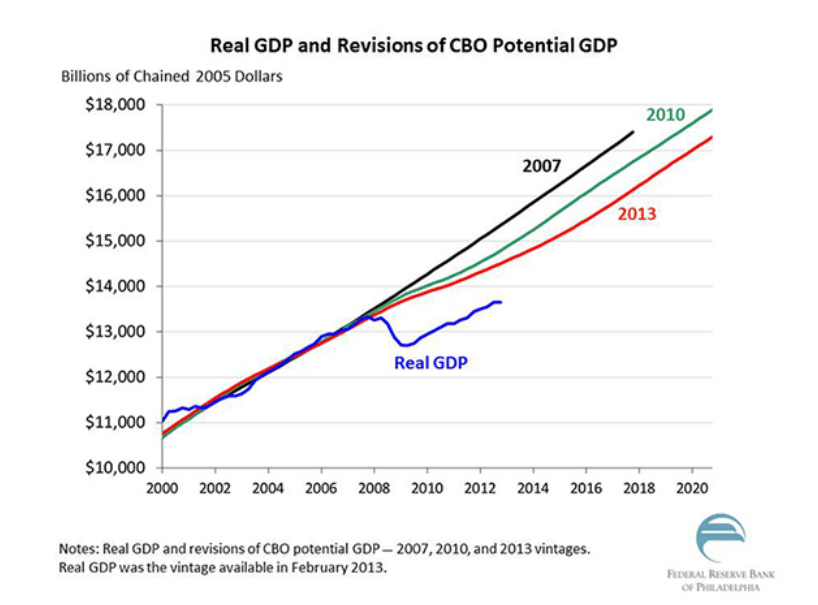
A Great Recession or a permanent move to a lower U.S. growth path?

Philadelphia Fed President Charles Plosser made this nice graph on official views of potential GDP and trends in actual GDP.

via The Grumpy Economist: Declining expectations.

Supply-Side Economics in Iceland

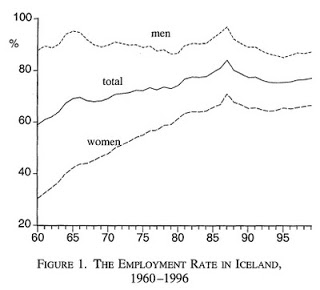
The move to a pay-as-you-earn income tax system in Iceland in 1988 made income earned in 1987 tax-free.
  • Icelandic GDP increased by 4.16% in 1987.
  • Total labour supply rose by 6.7% in 1987 over the average of 1986 and 1988.
  • This included an 8.6% increase in weeks of work supplied by those already in the labour market in 1986.
Notice in the graph the big kink in employment in 1987. A spike just for the year of no taxes. Labour supply then fell away.
Iceland in 1987 was a unique opportunity to study the labour supply response of individuals who were temporarily faced with a zero marginal-and average-income tax rate.

via Corrections: Page One: Supply-Side Economics.

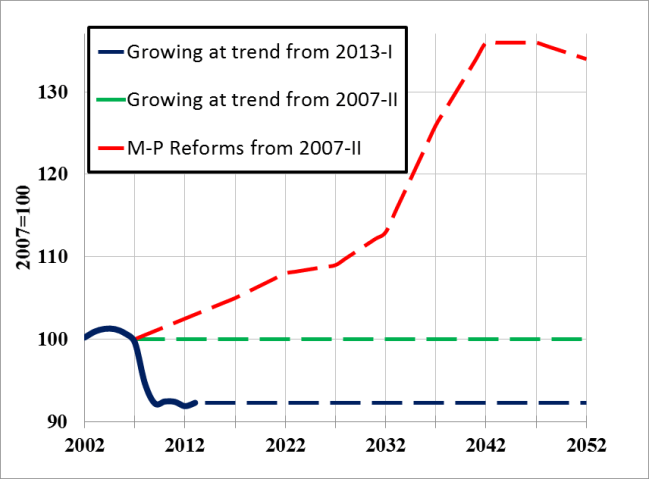
The path to higher U.S. prosperity

Suppose the USA:

  1. Had mandatory savings for retirement
  2. Eliminated capital income taxes
  3. Broadened tax base and lowered the marginal tax rate
  4. Phased in reforms so all birth-year cohorts are made better off
  5. Left welfare programs and local public good shares the same
  6. Savings not part of taxable income, saving withdrawals part of taxable income – with these changes U.S. income tax would be a consumption tax

US Detrended GDP per Capita

Source: Edward Prescott and Ellen McGrattan 2013.

The Rawlsian social justice case for super-entrepreneurs and many more billionaires

The report SuperEntrepreneurs shows that:

  • SuperEntrepreneurs founded half the largest new firms created since the end of the Second World War
  • There is a strong correlation between high rates of SuperEntrepreneurship in a country and low tax rates
  • a low regulatory burden and high rates of philanthropy both correlate strongly with high rates of SuperEntrepreneurship
  • Active government and supranational programmes to encourage entrepreneurship – such as the EU’s Lisbon Strategy – have largely failed.
  • Yet governments can encourage entrepreneurialism by lowering taxes (particularly capital gains taxes which have a particularly high impact on entrepreneurialism while raising relatively insignificant revenues); by reducing regulations; and by vigorously enforcing property rights.
  • High rates of self-employment and innovative entrepreneurship are both important for the economy.
  • Yet policy makers should recognise that they are not synonymous and should not assume policies which encourage self-employment necessarily promote entrepreneurship.
  • Policy makers should use a definition of entrepreneurship which is based on innovation.

SuperEntrepreneurs examined about 1,000 self-made men and women who have earned at least $1 billion dollars and who appeared in Forbes magazine list of the world’s richest people between 1996 and 2010.

Hong Kong has the most, with around three SuperEntrepreneurs per million inhabitants, followed by Israel, the US, Switzerland and Singapore.

The US is roughly four times more super-entrepreneurial than Western Europe and three times more super-entrepreneurial than Japan.

Super-entrepreneurs tend to be well-educated – 84% have a university degree.

Many started their own company but there is no clear relationship between self-employment and successful entrepreneurship

Steven Kaplan and Joshua Rauh’s “It’s the Market: The Broad-Based Rise in the Return to Top TalentJournal of Economic Perspectives 2013 found that those in the Forbes 400 richest are less likely to have inherited their wealth or grown-up wealthy.

Today’s super-rich are self-made rich because they produce new and better products and services that people wanted and are willing to pay for.

John Rawls was alive to the importance of incentives in a just and prosperous society.

With his emphasis on fair distributions of income, Rawls’ initial appeal was to the Left. Left-wing thinkers then started to dislike his acceptance of capitalism and his tolerance of large discrepancies in income and wealth.

Rawls excluded envy when we are behind his veil of ignorance designed the social contract about how the society will be organised. He believed that principles of justice should not be affected by individual inclinations, which are mere accidents.

Rawls also argued that the liberties and political status of equal citizens encourage self-respect even when one is less well off than others; and background institutions (including a competitive economy) make it likely that excessive inequalities will not be the rule. He supposes that

the main psychological root of our liability to envy is a lack of self-confidence in our own worth combined with a sense of impotence

Then there is the old Russian joke that tells the story of a peasant with one cow who hates his neighbour because he has two. A sorcerer offers to grant the envious farmer a single wish any thing he wants: “Shoot my neighbour’s cow!” he demands.

via http://www.kiwiblog.co.nz/2014/04/entrepreneurship.html

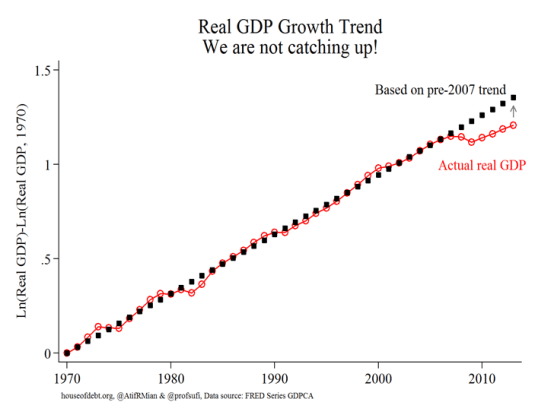
A Great Recession or dropping to a lower long-term growth path

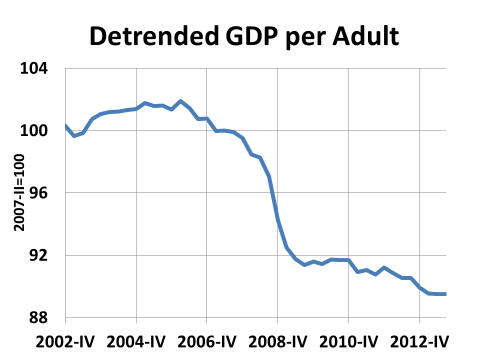
Ed Prescott and Robert Lucas are several of many who use variations of the chart below to show that the USA has moved to a lower long-term growth path.

Source: House of Debt

The chart below for output per working age American (ages 15 to 64) is just as depressing.

Source: Edward Prescott

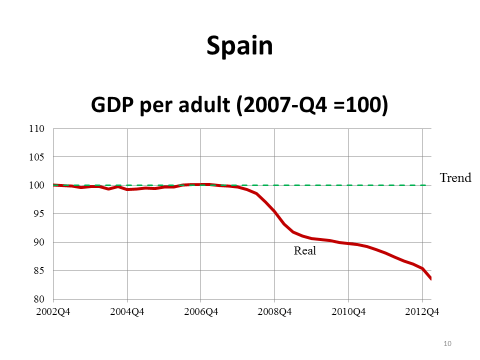
At least Spain with its 25% unemployment rate is doing a little worse.

Source: Edward Prescott

Previous Older Entries Next Newer Entries

David Andolfatto

Celebrating humanity's flourishing through the spread of capitalism and the rule of law

Monetary Non-Neutrality

Celebrating humanity's flourishing through the spread of capitalism and the rule of law

Reason Magazine

Celebrating humanity's flourishing through the spread of capitalism and the rule of law

Coyote Blog

Celebrating humanity's flourishing through the spread of capitalism and the rule of law

Thoughts from the North

Celebrating humanity's flourishing through the spread of capitalism and the rule of law

Fardels Bear

A History of the Alt-Right

Vincent Geloso

Econ Prof at George Mason University, Economic Historian, Québécois

Bassett, Brash & Hide

Celebrating humanity's flourishing through the spread of capitalism and the rule of law

Truth on the Market

Scholarly commentary on law, economics, and more

The Undercover Historian

Beatrice Cherrier's blog

Matua Kahurangi

Celebrating humanity's flourishing through the spread of capitalism and the rule of law

Temple of Sociology

Celebrating humanity's flourishing through the spread of capitalism and the rule of law

Velvet Glove, Iron Fist

Celebrating humanity's flourishing through the spread of capitalism and the rule of law

Why Evolution Is True

Why Evolution is True is a blog written by Jerry Coyne, centered on evolution and biology but also dealing with diverse topics like politics, culture, and cats.

NoTricksZone

Celebrating humanity's flourishing through the spread of capitalism and the rule of law

Homepaddock

A rural perspective with a blue tint by Ele Ludemann

Kiwiblog

DPF's Kiwiblog - Fomenting Happy Mischief since 2003

The Dangerous Economist

Celebrating humanity's flourishing through the spread of capitalism and the rule of law

Watts Up With That?

The world's most viewed site on global warming and climate change

The Logical Place

Tim Harding's writings on rationality, informal logic and skepticism

Doc's Books

A window into Doc Freiberger's library

The Risk-Monger

Let's examine hard decisions!

Uneasy Money

Commentary on monetary policy in the spirit of R. G. Hawtrey

Barrie Saunders

Thoughts on public policy and the media

Liberty Scott

Celebrating humanity's flourishing through the spread of capitalism and the rule of law

Point of Order

Politics and the economy

James Bowden's Blog

A blog (primarily) on Canadian and Commonwealth political history and institutions

Science Matters

Reading between the lines, and underneath the hype.

Peter Winsley

Economics, and such stuff as dreams are made on

A Venerable Puzzle

"The British constitution has always been puzzling, and always will be." --Queen Elizabeth II

The Antiplanner

Celebrating humanity's flourishing through the spread of capitalism and the rule of law

Bet On It

Celebrating humanity's flourishing through the spread of capitalism and the rule of law

History of Sorts

WORLD WAR II, MUSIC, HISTORY, HOLOCAUST

Roger Pielke Jr.

Undisciplined scholar, recovering academic

Offsetting Behaviour

Celebrating humanity's flourishing through the spread of capitalism and the rule of law

JONATHAN TURLEY

Res ipsa loquitur - The thing itself speaks

Conversable Economist

In Hume’s spirit, I will attempt to serve as an ambassador from my world of economics, and help in “finding topics of conversation fit for the entertainment of rational creatures.”

The Victorian Commons

Researching the House of Commons, 1832-1868

The History of Parliament

Articles and research from the History of Parliament Trust

Books & Boots

Reflections on books and art

Legal History Miscellany

Posts on the History of Law, Crime, and Justice

Sex, Drugs and Economics

Celebrating humanity's flourishing through the spread of capitalism and the rule of law

European Royal History

Exploring the Monarchs of Europe

Tallbloke's Talkshop

Cutting edge science you can dice with

Marginal REVOLUTION

Small Steps Toward A Much Better World

NOT A LOT OF PEOPLE KNOW THAT

“We do not believe any group of men adequate enough or wise enough to operate without scrutiny or without criticism. We know that the only way to avoid error is to detect it, that the only way to detect it is to be free to inquire. We know that in secrecy error undetected will flourish and subvert”. - J Robert Oppenheimer.