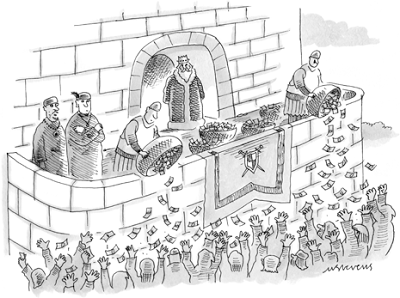
To avert a financial panic, central banks should lend early and freely to solvent banks against good collateral but at penal rates

First. That these loans should only be made at a very high rate of interest. This will operate as a heavy fine on unreasonable timidity, and will prevent the greatest number of applications by persons who do not require it. The rate should be raised early in the panic, so that the fine may be paid early; that no one may borrow out of idle precaution without paying well for it; that the Banking reserve may be protected as far as possible.

Secondly. That at this rate these advances should be made on all good banking securities, and as largely as the public ask for them. The reason is plain. The object is to stay alarm, and nothing therefore should be done to cause alarm. But the way to cause alarm is to refuse some one who has good security to offer… No advances indeed need be made by which the Bank will ultimately lose. The amount of bad business in commercial countries is an infinitesimally small fraction of the whole business…

The great majority, the majority to be protected, are the ‘sound’ people, the people who have good security to offer. If it is known that the Bank of England is freely advancing on what in ordinary times is reckoned a good security—on what is then commonly pledged and easily convertible—the alarm of the solvent merchants and bankers will be stayed. But if securities, really good and usually convertible, are refused by the Bank, the alarm will not abate, the other loans made will fail in obtaining their end, and the panic will become worse and worse.

Walter Bagehot Lombard Street: A Description of the Money Market (1873).

The classical theory of the lender of last resort stressed

(1) protecting the aggregate money stock, not individual institutions,

(2) letting insolvent institutions fail,

(3) accommodating sound but temporarily illiquid institutions only,

(4) charging penalty rates,

(5) requiring good collateral, and

(6) preannouncing these conditions in advance of crises so as to remove uncertainty.

Did anyone follow these rules in the global financial crisis? The Fed violated the classical model in at least seven ways:

  1. Emphasis on Credit (Loans) as Opposed to Money
  2. Taking Junk Collateral
  3. Charging Subsidy Rates
  4. Rescuing Insolvent Firms Too Big and Interconnected to Fail
  5. Extension of Loan Repayment Deadlines
  6. No Pre-announced Commitment
  7. No Clear Exit Strategy

…{the Fed’s} policies are hardly benign, and that extension of central bank assistance to insolvent too-big-to-fail firms at below-market rates on junk-bond collateral may, besides the uncertainty, inefficiency, and moral hazard it generates, bring losses to the Fed and the taxpayer, all without compensating benefits. Worse still, it is a probable prelude to a severe inflation and to future crises dwarfing the current one.

Thomas Humphrey (2010)

2014 Homer Jones Memorial Lecture – Robert E. Lucas Jr.

The first part of his lecture discusses how the Fed can influence inflation and financial stability.

Central banks can control inflation. Can central banks maintain economic stability’s financial stability? This is still an open question as to whether central banks can do that. The quantity theory of money makes certain sharp predictions about monetary neutrality which are well borne out by the cross country evidence.

In the second part of this lecture, Lucas discusses how central banks around the world have used inflation targeting to keep inflation under control.

What is the Fed to do with the stable relationship between money and prices? Inflation targeting is superior to a fixed growth monetary supply growth rule. This always pushes policy in the direction of the inflation rate you want. Central banks around the world have succeeded in keeping inflation low by explicitly or implicitly targeting the inflation rate.

In the last part of his lecture, Lucas discusses financial crises. he agrees with Gary Gordon’s analysis that 2008 financial crisis was a run on Repo. A run on liquid assets accepted as money because they can be so quickly changed into money. The effective money supply shrank drastically when there was a run on these liquid assets.

Lucas favoured the Diamond and Dybvig of bank runs as panics. The logic of that model applies to the Repo markets now was well as to the banking system. How to extend Glass–Steagall Act type regulation of bank portfolios to the Repo market is a question for future research.

Inflation targeting is working well but the lender of last resort function is yet to be fully understood.

Note: The Diamond-Dybvig view is that bank runs are inherent to the liquidity transformation carried out by banks. A bank transforms illiquid assets into liquid liabilities, subject to withdrawal.

Because of this maturity mismatch, if depositors suspect that others will run on the bank, it is optimal for each depositor to run to the bank to withdraw his or her deposit before the assets are exhausted. The bank run is not driven by some decline in the fundamentals of the bank. Depositors are spooked for some reason, panic, and attempt to withdraw their funds before others get in first. In this case, the provision of deposit insurance and lender of last resort facilities reassures depositors and stems the bank run

In the Kareken and Wallace model of bank runs, deposit insurance is problematic because of the incentives it gives to deposit taking institutions that are insured to take much greater risks. When there is deposit insurance, depositors don’t care about the greater risk in the portfolios of their banks. The greater risk taking leads to higher returns at no extra cost because if these risky investments do fail, the deposit insurance covers their losses

It is therefore necessary to regulate the portfolio of insured banks to ensure that they do not do this. That is the great dilemma for banking regulation because quasi-banks and other liquidity transformation intermediaries such as a Repo market spring up just outside the regulatory net.

Image

Lee Ohanian: Economic Priorities and Restoring Prosperity

Video

Austrian economics, labour economics and the economics of unemployment

Austrian economists seem not to be as thorough as they could be in applying the concepts of dispersed knowledge, tendency to equilibrium and entrepreneurial appraisal, discovery and learning to the labour market.

In a nutshell, the position of Mises and Rothbard is the problem of unemployment is not jobs being fewer than workers. On some terms, a job is always available in an open market. But a wage and the hours of labour required to earn it can be so unrewarding that a person is rational to decline the job offer and remain unemployed. Of course, they acknowledge institutional unemployment that results from are laws and arrangements which inhibit adjustment of prices of labour services.

Kirzner and Rothbard argue that the market is a process that is always in disequilibrium. Does this disequilibrium not imply some unemployment in the labour market? Why should the tendency toward equilibrium be any stronger in the labour market that elsewhere?  Bill Allen explained search unemployment this way:

…many officially counted as unemployed are heavily and rationally investing their resources in looking for work. They are sampling the market, seeking information on employment alternatives. That information is valuable, but it is not obtained either freely or instantaneously, and generally, the faster it is to be acquired, the more costly it will be…

as output falls [because of a demand or supply shock], there will be some rise in unemployment, for the economy’s adjustment to the new circumstances of supply and prices will not be made instantaneously, without frictions and lags.

Rothbard was well aware of search unemployment:

It might be objected that workers often do not know what job opportunities await them. This, however, applies to the owner of any goods up for sale. The very function of marketing is the acquisition and dissemination of information about the goods or services available for sale.

Except to those writers who posit a fantastic world where everyone has “perfect knowledge” of all relevant data, the marketing function is a vital aspect of the pro­duction structure.

The marketing function can be performed in the labour market, as well as in any other, through agencies or other means for the discovery of who or where the potential buyers and sellers of a particular service may be. In the labour market this has been done through “want ads” in the newspa­pers, employment agencies used by both employer and employee, etc.

Mises also spoke of search unemployment:

Unemployment is a phenomenon of a changing economy. The fact that a worker discharged on account of changes occurring in the arrangement of production processes does not instantly take advantage of every opportunity to get another job but waits for a more propitious opportunity is not a consequence of the tardiness of the adjustment to the change in conditions, but is one of the factors slowing down the pace of this adjustment.

It is not an automatic reaction to the changes which have occurred , independent of the will and the choices of the job-seekers concerned, but the effect of their intentional actions. It is speculative, not frictional

These are good discussions of search unemployment. But when discussing mismatch unemployment as identified by Hayek after a shortening of the produc­tion structure on the market where there might be temporary unemployment of workmen in the higher stages, lasting until the workers can be reabsorbed in the shorter proc­esses of the later stages, Rothbard’s repost to this possible case of involuntary unem­ployment on the free market is:

It is also true that the shortening of the structure means that there is a transition period when, at final wage rates, there will be un­employment of the men displaced from the longer processes. How­ever, during this transition period there is no reason why these workers cannot bid down wage rates until they are low enough to enable the employment of all the workers during the transi­tion. This transition wage rate will be lower than the new equilibrium wage rate. But at no time is there a necessity for unem­ployment.

The labour market is a process just as is any other market: it is a communication network that mobilises dispersed knowledge to overcoming ignorance. Why should knowledge unfold in the labour market process through entrepreneurial discovery any faster than elsewhere? There should be disequilibrium wages, entrepreneurial errors, unemployed and mispriced resources, and a process of entrepreneurial learning and error correction. Hayek held that unemployment is always a pricing problem:

The normal cause of recurrent waves of widespread unemployment is … a discrepancy between the way in which demand is distributed between products and services, and the proportions in which resources are devoted to producing them.

Unemployment is the result of divergent changes in the direction of demand and the techniques of production. If labour is not deployed according to demand for products, there is unemployment…

It is the continuous change of relative market prices and particularly wages which can alone bring about that steady adjustment of the proportions of the different efforts to the distribution of demand, and thus a steady flow of the stream of products.

True, but the correction of erroneous wage rates and the reallocation of labour and other resources to new jobs, new firms and new industries is neither instantaneous nor a free process. Kirzner explains:

The entrepreneurial forces acting on the market for any one commodity are thus continually pushing that market toward the market-clearing point—that is, to where (a) the quantity produced is such that (only) all units “worth producing” are indeed produced, and (b) the market price for this commodity is just high enough to make it, as a practical matter, worthwhile for producers to produce this quantity, and is just low enough to make it worthwhile for consumers to buy it…

The process through which the market tends to generate the “right” quantity of a commodity, and the “right” price for it, can be seen as a series of steps during which market participants gradually tend to discover the gaps or errors in the information on which they had previously been basing their erroneous production and/or buying decisions…

The market process is one in which, driven by the entrepreneurial sense for grasping at pure profit opportunities (and for avoiding entrepreneurial losses), market participants, learning more accurate assessments of the attitudes of other market participants, tend toward the market-clearing price-quantity combination.

Alchian, Demsetz and Barzel were on the mark when they pointed out that too frequently the process of change and reaching a new equilibrium is assumed to be a free good, having no resource costs. Hayek also spoke of the time that is takes to reach a new equilibrium because the new constellation of prices and wages must emerge through the free-play of the market:

The primary cause of the appearance of extensive unemployment, however, is a deviation of the actual structure of prices and wages from its equilibrium structure. Remember, please: that is the crucial concept. The point I want to make is that this equilibrium structure of prices is something which we cannot know beforehand because the only way to discover it is to give the market free play; by definition, therefore, the divergence of actual prices from the equilibrium structure is something that can never be statistically measured.

As Kirzner has well argued, entrepreneurs thrive on alertness to disequilibrium prices and they buy and sell to profit from their discoveries, thereby correcting the mispricing, but this takes time. The knowledge and intentions of the different members of society both across all markets and in the labour market about how to match workers to new jobs must come into agreement through a process of discovery and mutual learning that takes time. Phelps (1969) put forward a fine metaphor for how this process of learning and discovery takes place:

I have found it instructive to picture the economy as a group of islands between which information flows are costly: to learn the wage paid on an adjacent island, the worker must spend the day travelling to that island to sample its wage instead of spending the day at work.

Beveridge has similar views of a multiplicity of markets in 1912:

Why should it be the normal condition of the labour market to have more sellers than buyers, two men to every job and at least as often two jobs for every man? The explanation of the paradox is really a very simple one … that there is no one labour market but only an infinite number of separate labour markets.

Gary Becker drew a parallel between the theory of marriage and the theory of job search and matching. In both cases, it takes time to sort among the options and find a suitable pairing. Some are clearly unacceptable.  Good  matches will often take a long time to find unless people are just plain lucky. Involuntary unemployment is like saying you are involuntarily unmarried. You could marry the first person you meet, if they will have you, but few would say that is wise.

Workers must search for and discover each other. Both are entrepreneurs. The information, knowledge and forecasts of future wages and prices each needs to improve co-ordination of supply and demand will not be discovered immediately:

  • The behavioural responses of employers and workers to change are so pronounced because the cost of acquiring new information is profound (Alchian 1969). Many such costs impede wages from instantly fluctuating to rebalance labour supply with demand.
  • A job seeker does not initially know the location of suitable vacancies, the wages for various skills, differences in job security and other factors. Job seekers must search for this information, keep this knowledge current and forecast whether better vacancies may open soon.
  • Employers must search to learn the location, availability and asking wages of applicants.

The time consumed in labour market search is why Rothbard’s views below that wages just adjust to clear the market has been over taken by developments in economic thinking:

To talk of unemployment or employment without reference to a wage rate is as meaningless as talking of “supply” or “de­mand” without reference to a price. And it is precisely analogous. The demand for a commodity makes sense only with reference to a certain price.

In a market for goods, it is obvious that what­ever stock is offered as supply, it will be “cleared,” i.e., sold, at a price determined by the demand of the consumers…

Whatever supply of labour service is brought to market can be sold, but only if wages are set at what­ever rate will clear the market…

We conclude that there can never be, on the free market, an unemployment problem. If a man wishes to be employed, he will be, provided the wage rate is adjusted according.

Mises in the quote below treated unemployment as a investment in prospecting for a better wage offer very much along the lines of W.H. Hutt:

If a job-seeker cannot obtain the position he prefers, he must look for another kind of job. If he cannot find an employer ready to pay him as much as he would like to earn, he must abate his pretensions. If he refuses, he will not get any job. He remains unemployed.

What causes unemployment is the fact that–contrary to the above-mentioned doctrine of the worker’s inability to wait–those eager to earn wages can and do wait. A job-seeker who does not want to wait will always get a job in the unhampered market economy in which there is always unused capacity of natural resources and very often also unused capacity of produced factors of production. It is only necessary for him either to reduce the amount of pay he is asking for or to alter his occupation or his place of work.

Alchian (1969) lists three ways to adjust to unanticipated demand fluctuations:
• output adjustments;
• wage and price adjustments; and
• Inventories and queues (including reservations).

Alchian (1969) suggests that there is no reason for wage and price changes to be used regardless of the relative cost of these other options:
• The cost of output adjustment stems from the fact that marginal costs rise with output;
• The cost of price adjustment arises because uncertain prices and wages induce costly search by buyers and sellers seeking the best offer; and
• The third method of adjustment has holding and queuing costs.

There is a tendency for unpredicted price and wage changes to induce costly additional search. Long-term contracts including implicit contracts arise to share risks and curb opportunism over sunken investments in relationship-specific capital such as firm-specific human capital and specialised machinery. These factors lead to queues, unemployment, spare capacity, layoffs, shortages, inventories and non-price rationing in conjunction with wage stability. Alchian and Woodward in their 1987 paper ‘Reflections on a theory of the firm’ say that :

… the notion of a quickly equilibrating market price is baffling save in a very few markets. Imagine an employer and an employee. Will they renegotiate price every hour, or with every perceived change in circumstances? If the employee is a waiter in a restaurant, would the waiter’s wage be renegotiated with every new customer? Would it be renegotiated to zero when no customers are present, and then back to a high level that would extract the entire customer value when a queue appears?

… But what is the right interval for renegotiation or change in price? The usual answer ‘as soon as demand or supply changes’ is uninformative.

Alchian and Woodward then go on to a long discussion of the role of protecting composite quasi-rents from dependent resources as the decider of the timing of wage and price revisions. Alchian and Woodward explain unemployment to the side effect of the purpose of wage and price rigidity, which is the prevention of hold-ups over dependent assets. They note that unemployment cannot be understood until an adequate theory of the firm that explains the type of contracts the members of a firm contract with one another.

Walter Oi has also written on slack capacity as being productive and he included references back to W.H. Hutt. Oi’s work on retailing and supermarkets spends a lot of time explaining how an empty store is efficient because the owners are waiting for a mass of customers to arrive at unpredictable time. Oi redeveloped the term the economies of massed reserves to describe this. Oi thought that this was a better term than Hutt’s pseudo-idleness. Oi argued that all resource idleness could, in principle, be eliminated, but to accomplish this, the synchronization of the arrival rates of customers, sales clerks, and just-in-time inventories would be prohibitively expensive.

Benjamin Klein’s theory of rigid wages in American Economic Review in 1984 is one of the few that explored rigid wages as an industrial organisation issue. Klein treated rigid wages as a response to opportunism and hold-up problems over specialised assets and are forms of exclusive dealership or take-or-pay contracts.

The labour market is better understood by forgetting it is the labour market and treating it as a market for long-term contracts for relationship-specific services, firm-specific human capital and mutually dependent assets owned by multiple parties.

Labour is more heterogeneous than capital. The notion that buyers and sellers in the labour market can pair up instantly contradicts the Austrian traditions that markets only tend to equilibrium and entrepreneurs are needed to move things along.

Morgan O. Reynolds makes a good point in his labour economics textbook about how labour markets are different from other markets because there are no speculators and no forward markets in labour to quickly clear the market and allow entrepreneurs to drive the market towards equilibrium through arbitrage as quickly as they do elsewhere.
The U.S. Economic Growth Gap Revisited

Robert Lucas has asked:

Is it possible that by imitating European policies on labor markets, welfare, and taxes that the U.S. has chosen a new, lower GDP trend?

If so, it may be that the weak recovery we have had so far is all the recovery we will get.

via The Economic Growth Gap Revisited.

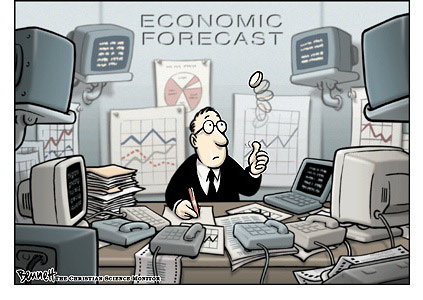
The limitations of forecasting are well-known

  • Forecasts are conditional on a number of variables; there are important unresolved analytical differences about the operation of the economy; and large uncertainties about the size and timing of responses to macroeconomic changes. Shocks to the output, prices, employment and other variables are partly permanent and partly transitory.
  • We have very little reliable information about the distribution of shocks or about how the distributions change over time. The same is true for the distribution of real and nominal shocks, of shocks to aggregate demand relative to aggregate supply and so on.
  • Forecast errors arise from changes in the parameters in the model; mis-specification of the model, estimation uncertainty, mis-measurement of the initial conditions and error accumulation.
  • Forecasting has had a turbulent history. Most early discussions argued against the forecasting in principle. Forecasting was not properly grounded in statistical theory, it presupposed that causation implies predictability and the forecast themselves were invalidated by the reactions of economic agents to them

The voter as a fiscal conservative

Now that every election policy must be fully costed, and every major party promises a return to surplus in a few years, the Ricardian theory of budget deficits is now an optimistic view of the power of fiscal policy.

By running a budget deficit, it shifts from collecting taxes today to collecting them tomorrow and fund the intervening shortfall was selling government bonds to the private sector. A finance minister may choose to lower taxes today (thereby increasing the deficit), but without any planned changes in the government’s expenditure program, such a policy must imply higher taxes at some point in the future.

The Ricardian theory of budget deficits is people are smart enough to recognise that today’s fiscal deficits mean tomorrow’s taxes must increase to to repay the debt so taxpayers cut back consumption dollar for dollar to save for those future taxes.

If you know your taxes will go up in the future, the right thing to do is save to  pay those higher taxes. A fiscal stimulus is then completely offset by the reduction in private consumption. The stimulus has no effect on spending, prices, production, or interest rates  because households know that deficit spending means future taxes: to smooth consumption, they save more now.

To make things worse, the lower taxes today and the higher taxes tomorrow encourage intertemporal substitution of labour. People will work more now because taxes  are low but work less in the future when taxes are high. Investors also take into account that taxes on their investment income will be higher in the future so they will invest less now.

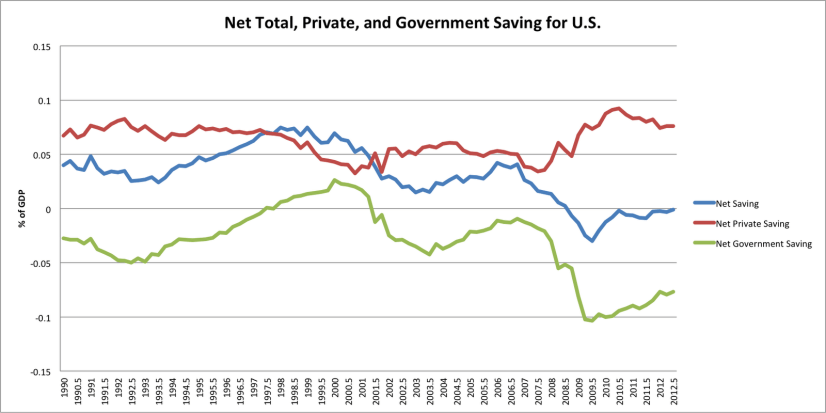
Notice below the mirror trends of net private and government savings as a per cent of U.S. GDP. Financing U.S. government consumption through deficits or through taxation is equivalent:  households know net present value of taxation will rise and save to offset that.

HT: correctionspageone.blogspot

If you think a fiscal stimulus works by fooling people into ignoring the future tax hikes or spending cuts, then loudly announcing in an election campaign those  tax hikes and spending cuts in a few year’s time that will pay for the current fiscal stimulus must undermine that stimulus even more!

When Robert Barro wrote in the 1970s and 1980s, he pointed out that there is no reason to assume that forecasting errors about future taxes are always biased in the direction of under-estimating the future taxes. People can over-estimate the future taxes. Individual uncertainty about their future tax liabilities does not normally induce them to save less, it induces them to save more.

The fact that much political debate surrounds government budget deficits clearly suggests that the voters understand the government budget constraint  and that  high budget deficits today signal higher taxes in the future and they change their behaviour accordingly.

Robert Barro likes to refer to Israel as a natural experiment in the Ricardian budget deficit theory. In 1983, the national saving rate of 13% of GDP corresponded to a private saving rate of 17% and a public saving rate of -4%.  In 1984, the dramatic rise in the budget deficit reduced the public saving rate to -11%.  Private saving rate rose to 26%, so that the national saving rate changed little.  Then a stabilisation program in 1985 eliminated the budget deficit, so that the public saving rate rose to 0% in 1985-86 and -2% in 1987.  The private saving rate declined dramatically to 19% in 1985 and 14% in 1986-87.  The national saving rate remained relatively stable, going from 15% in 1984 to 18% in 1985, 14% in 1986, and 12% in 1987.

The best evidence that people do take future taxes into account is the method in which old age pensions are financed in different countries.  An expansion of social security pensions for the retired is analogous to a deficit-financed tax cut. People respond to more social security by shifting private intergenerational transfers, rather than by consuming more.

In the US, the growth of social security strongly diminished the tendency of children to support their aged parents because they are paying taxes now and in the future to support them.  In countries were weak social security,  children spend more  of their money looking after their parents.

It is certainly the case that most younger people think they have to provide for their own retirement and that government will not tax enough to support them in 20 to 30 years time.

People have relatively sophisticated views of both long-run  government spending and taxing in an ageing society and that deficits must be paid for. The voter is a fiscal conservative.

Robert Lucas on the causes of business cycles

I was [initially] convinced by Friedman and Schwartz that the 1929-33 down turn was induced by monetary factors…

I concluded that a good starting point for theory would be the working hypothesis that all depressions are mainly monetary in origin. Ed Prescott was sceptical about this strategy from the beginning…

I now believe that the evidence on post-war recessions (up to but not including the one we are now in) overwhelmingly supports the dominant importance of real shocks.

But I remain convinced of the importance of financial shocks in the 1930s and the years after 2008. Of course, this means I have to renounce the view that business cycles are all alike!

Robert Lucas Jr.

Europe has extensive experience with currency union break-ups

  • The Latin Monetary Union (LMU) joined Belgium, Italy, and Switzerland together with France in 1867. The arrangement managed to hold together until the generalized breakdown of global monetary relations during World War I.
  • The Scandinavian Monetary Union (SMU) formed in 1873 by Sweden and Denmark and two years later by Norway. This was disrupted by the suspension of convertibility and floating of individual currencies at the start of World War I. the agreement was finally abandoned in 1931.
  • The Austro-German Monetary Union was dissolved in less than a decade following Austria’s defeat in the 1866 Austro-Prussian War.
  • The only truly successful monetary union in Europe came in 1922 with the birth of the Belgium-Luxembourg Economic Union (BLEU), which remained in force for more than seven decades until 1999.
  • Europe in the twentieth century has also seen the disintegration of several monetary unions, usually as a by-product of political dissolutions.
  • A celebrated instance is after the Austro-Hungarian Empire was dismembered by the Treaty of Versailles. Almost immediately, in an abrupt and quite chaotic manner, new five currencies were introduced.
  • There also have been British and French currency unions with and between colonies.

Since World War II, economies have exited currency unions at an average rate of one per year.

Andrew Rose found

…that countries leaving currency unions tend to be larger, richer, and more democratic; they also tend to experience somewhat higher inflation.

Most strikingly, there is remarkably little macroeconomic volatility around the time of currency union dissolutions, [emphasis added] and only a poor linkage between monetary and political independence.

Indeed, aggregate macroeconomic features of the economy do a poor job in predicting currency union exits.

Rather than saying Euroland cannot fall, the discussion should be dissolutions of currency unions are common, especially when Greece is a member. What happened? How was it done?

HT: Monetary Unions.

The U.S. and Euro-zone non-recoveries

Screen_shot_2014-06-13_at_11.50.26_am

HT: Vox.com from oecd.org

How Does The U.S. Jobs Recovery Compare?

US comparison

Image

Employment losses after financial crises

FinanacialCrises0514

HT: oregoneconomicanalysis.com

Why Robert Lucas disagreed with Keynesian macroeconomics

Proponents of a class of models which promised 3 1/2 to 4 1/2 per cent unemployment to a society willing to tolerate annual inflation rates of 4 to 5 per cent have some explaining to do after a decade such as we have gone through [i.e., the 1970s, when inflation rose to 16 per cent and unemployment to 8 per cent in the United States, and to 30 per cent and 6 per cent in the U.K. Inflation rose as high as 25 per cent in Japan and 7 per cent in Germany, though unemployment remained relatively low].

A forecast error of this magnitude and central importance to policy has consequences, as well it should.

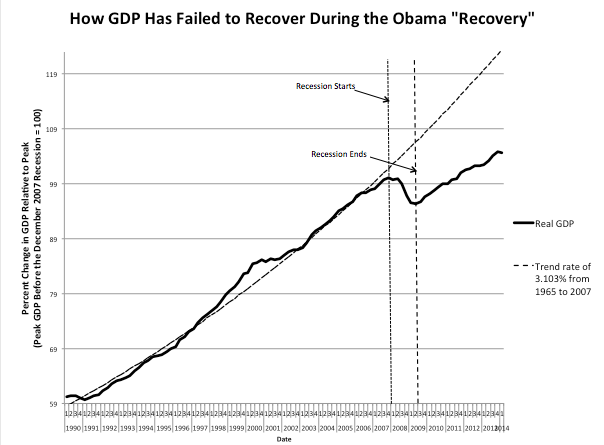
The Obama recovery

image

The deviation from trend is widening.

HT: John Lott

The Shadow Fed – documenting the road not take since 1973

The Shadow Open Market Committee was founded in 1973 by Karl Brunner and Allan Meltzer.

The Committee was founded because many monetarist economists believed the Federal Reserve (The Fed) caused a recession by failing to keep money supply growth steady. Its members were academics and from private organisations.

The original objective was to evaluate the policy choices and actions of the Fed’s Open Market Committee, the arm of the Fed which ran monetary policy in the USA.

The  Shadow Open Market Committee meets semi-annually. A number of papers are prepared by  Shadow Open Market Committee members on macroeconomic and public policy topics.

Based on these papers and the Committee’s deliberations, a policy statement summarises the policy recommendations of the Committee. 

These papers are organised by year and downloadable at ShadowFed | Official Site of the Shadow Open Market Committee.

Previous Older Entries Next Newer Entries

David Andolfatto

Celebrating humanity's flourishing through the spread of capitalism and the rule of law

Monetary Non-Neutrality

Celebrating humanity's flourishing through the spread of capitalism and the rule of law

Reason Magazine

Celebrating humanity's flourishing through the spread of capitalism and the rule of law

Coyote Blog

Celebrating humanity's flourishing through the spread of capitalism and the rule of law

Thoughts from the North

Celebrating humanity's flourishing through the spread of capitalism and the rule of law

Fardels Bear

A History of the Alt-Right

Vincent Geloso

Econ Prof at George Mason University, Economic Historian, Québécois

Bassett, Brash & Hide

Celebrating humanity's flourishing through the spread of capitalism and the rule of law

Truth on the Market

Scholarly commentary on law, economics, and more

The Undercover Historian

Beatrice Cherrier's blog

Matua Kahurangi

Celebrating humanity's flourishing through the spread of capitalism and the rule of law

Temple of Sociology

Celebrating humanity's flourishing through the spread of capitalism and the rule of law

Velvet Glove, Iron Fist

Celebrating humanity's flourishing through the spread of capitalism and the rule of law

Why Evolution Is True

Why Evolution is True is a blog written by Jerry Coyne, centered on evolution and biology but also dealing with diverse topics like politics, culture, and cats.

NoTricksZone

Celebrating humanity's flourishing through the spread of capitalism and the rule of law

Homepaddock

A rural perspective with a blue tint by Ele Ludemann

Kiwiblog

DPF's Kiwiblog - Fomenting Happy Mischief since 2003

The Dangerous Economist

Celebrating humanity's flourishing through the spread of capitalism and the rule of law

Watts Up With That?

The world's most viewed site on global warming and climate change

The Logical Place

Tim Harding's writings on rationality, informal logic and skepticism

Doc's Books

A window into Doc Freiberger's library

The Risk-Monger

Let's examine hard decisions!

Uneasy Money

Commentary on monetary policy in the spirit of R. G. Hawtrey

Barrie Saunders

Thoughts on public policy and the media

Liberty Scott

Celebrating humanity's flourishing through the spread of capitalism and the rule of law

Point of Order

Politics and the economy

James Bowden's Blog

A blog (primarily) on Canadian and Commonwealth political history and institutions

Science Matters

Reading between the lines, and underneath the hype.

Peter Winsley

Economics, and such stuff as dreams are made on

A Venerable Puzzle

"The British constitution has always been puzzling, and always will be." --Queen Elizabeth II

The Antiplanner

Celebrating humanity's flourishing through the spread of capitalism and the rule of law

Bet On It

Celebrating humanity's flourishing through the spread of capitalism and the rule of law

History of Sorts

WORLD WAR II, MUSIC, HISTORY, HOLOCAUST

Roger Pielke Jr.

Undisciplined scholar, recovering academic

Offsetting Behaviour

Celebrating humanity's flourishing through the spread of capitalism and the rule of law

JONATHAN TURLEY

Res ipsa loquitur - The thing itself speaks

Conversable Economist

In Hume’s spirit, I will attempt to serve as an ambassador from my world of economics, and help in “finding topics of conversation fit for the entertainment of rational creatures.”

The Victorian Commons

Researching the House of Commons, 1832-1868

The History of Parliament

Articles and research from the History of Parliament Trust

Books & Boots

Reflections on books and art

Legal History Miscellany

Posts on the History of Law, Crime, and Justice

Sex, Drugs and Economics

Celebrating humanity's flourishing through the spread of capitalism and the rule of law

European Royal History

Exploring the Monarchs of Europe

Tallbloke's Talkshop

Cutting edge science you can dice with

Marginal REVOLUTION

Small Steps Toward A Much Better World

NOT A LOT OF PEOPLE KNOW THAT

“We do not believe any group of men adequate enough or wise enough to operate without scrutiny or without criticism. We know that the only way to avoid error is to detect it, that the only way to detect it is to be free to inquire. We know that in secrecy error undetected will flourish and subvert”. - J Robert Oppenheimer.