
Why some bastard will always cheat on the agreement. Get your retaliation in first too.
17 Jul 2019 Leave a comment
in applied price theory, economics of information, industrial organisation, law and economics Tags: cartel enforcement, cartel theory, competition law, game theory, oligopoly
How Kim Jong-un Gets His $500,000 Mercedes | Visual Investigations @nytimes
17 Jul 2019 Leave a comment
in defence economics, international economics, International law, Public Choice Tags: North Korea
Science 101: Null Test All Claims
17 Jul 2019 Leave a comment


Francis Menton provides some essential advice for non-scientists in his recent essay at Manhattan Contrarian You Don’t Need To Be A Scientist To Know That The Global Warming Alarm “Science” Is Fake. Excerpts in italics with my bolds.
When confronted with a claim that a scientific proposition has been definitively proven, ask the question: What was the null hypothesis, and on what basis has it been rejected?
As Menton explains, you don’t need the skills to perform yourself the null test, just the boldness to check how they dismissed the null hypothesis.
Consider first a simple example, the question of whether aspirin cures headaches. Make that our scientific proposition: aspirin cures headaches. How would this proposition be established? You yourself have taken aspirin many times, and your headache always went away. Doesn’t that prove that the aspirin worked? Absolutely not. The fact that you took aspirin 100 times and the…
View original post 601 more words
Bryan Caplan: “The Case Against Education”
17 Jul 2019 Leave a comment
in economics of education, economics of information, human capital, labour economics, labour supply, occupational choice Tags: signalling
Ten Minute History – Westward Expansion and the American Civil War
17 Jul 2019 Leave a comment
in economic history, economics of crime, income redistribution, labour economics, labour supply, law and economics, politics - USA, property rights, Public Choice, rentseeking Tags: American Civil War
Climate Change: What Do Scientists Say?
17 Jul 2019 Leave a comment
in economic history, energy economics, environmental economics, global warming, politics - New Zealand, politics - USA Tags: climate alarmism, pessimism bias, regressive left
No wage premium for bilingualism. Lack of fluency in dominant language carries a wage penalty for migrants and indigenous peoples.
17 Jul 2019 Leave a comment
in applied price theory, discrimination, economics of education, human capital, labour economics, labour supply, poverty and inequality Tags: economics of languages

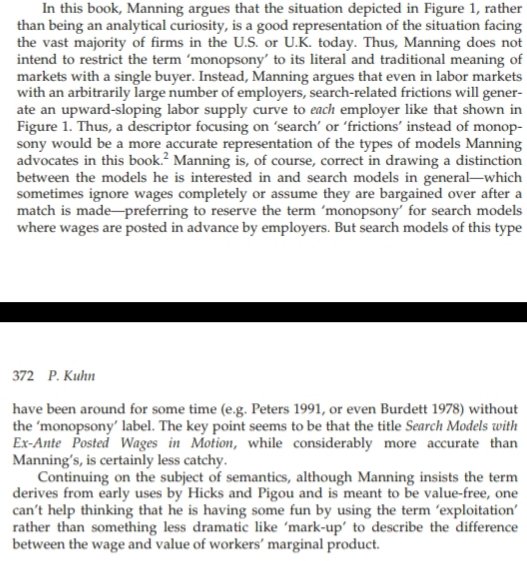
I’d go beyond Kuhn to argue Manning’s excellent book should be titled “Random matching with ex-ante wage posting in motion”
17 Jul 2019 Leave a comment
in labour economics, labour supply Tags: job search, labour market search, monopsony, search and matching
Global and Korean economic forecasts by Edward Prescott
17 Jul 2019 Leave a comment
in budget deficits, business cycles, development economics, economic growth, Edward Prescott, Euro crisis, fiscal policy, global financial crisis (GFC), great recession, growth miracles, macroeconomics, monetary economics Tags: real business cycles

@SenSanders @SenWarren say ordinary workers are no better off than in 1979
17 Jul 2019 Leave a comment
in economic growth, economic history, macroeconomics Tags: The Great Enrichment

Good list
17 Jul 2019 Leave a comment
in development economics, economic history, economics of natural disasters, energy economics, environmental economics, growth miracles, health economics, international economics Tags: The Great Enrichment

A Hamas ‘Great Return March’ speech the BBC is unlikely to report
16 Jul 2019 Leave a comment

Back in May 2017 BBC audiences were told that Hamas had abandoned “anti-Jewish language” with the publication of a new policy document.

“It also says Hamas’s struggle is not with Jews but with “occupying Zionist aggressors”. The 1988 charter was condemned for its anti-Jewish language.
The text is seen as an effort by Hamas, which rules Gaza, to soften its image.
“The document gives us a chance to connect with the outside world,” spokesman Fawzi Barhoum said.
“To the world, our message is: Hamas is not radical. We are a pragmatic and civilized movement. We do not hate the Jews. We only fight who occupies our lands and kills our people. […]
For years there has been criticism of Hamas over the language of its charter, in particular articles which were branded anti-Semitic.
The charter speaks of the need to fight “warmongering Jews” and cites a hadith – a report of what…
View original post 400 more words
Can’t cope with the pressure of international cricket? Put things in perspective by taking advice from Keith Miller
16 Jul 2019 Leave a comment

Psychologists, psychotherapists and what-have-you seem to be doing good business from helping players cope with something that – when all is said and done – is sport.
They are helping nerve-shattered fans, too, after the tense Cricket World Cup final between England and New Zealand, a game ultimately decided by the number of boundaries scored by each side.
On the strength of this, England won the cup.
Would the toss of a coin have been fairer? Or should the title have been shared?
No matter. The fact is a lot of Black Cap fans found their stress levels raised and the NZ Herald fretted:
“Kiwis have been left emotionally bruised today after New Zealand came just centimetres from winning the Cricket World Cup.”
View original post 724 more words
Is there an upper limit for #Fightfor15 logic for further pay rises? What if they are wrong?
16 Jul 2019 Leave a comment
in applied price theory, industrial organisation, labour economics, labour supply, minimum wage, poverty and inequality, survivor principle
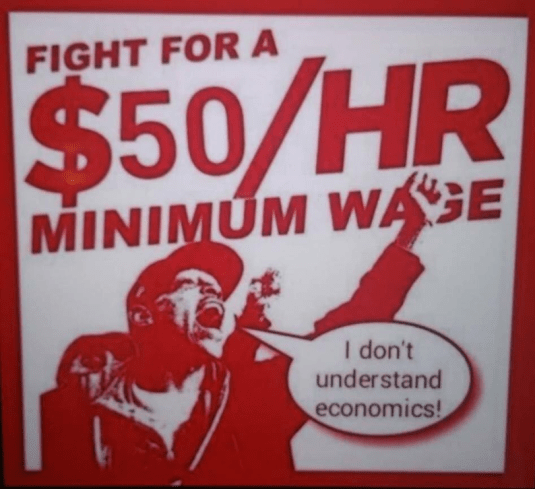
If wages go up under the minimum wage increase but employment does not fall, where does the extra output and revenue come from to cover the greater payroll bill?


Recent Comments