The death tax presumably is the most destructive tax on a per-dollar-collected basis, but I suspect the capital gains tax is in second place. Like the death tax, the capital gains tax is pure double taxation, thus exacerbating the tax code’s bias against saving and investment. And the capital gains tax is particularly foolish since […]
New Zealand was the first Western developed country to sign a free trade agreement with China, and it came into force in 2008. At the time, the New Zealand government estimated an increase in exports to China of between NZ$225 million and NZ$350 million (between US$180 million and US$280 million), and Ministry of Foreign Affairs…
Jan. 24 marked the 20th anniversary of the release of Al Gore’s alarmist global warming movie “An Inconvenient Truth.” Gore has surfed the movie and climate alarmism to a net worth estimated at $300 million and a Nobel Peace Prize.
One of the predictions made by economists when President Trump announce the start of his freewheeling tariff policies in April 2025 was that the costs of the tariffs would ultimately be passed through to consumers, leading to overall higher inflation. Well, President Trump has been tossing out tariff threats, keeping some and withdrawing others. However,…
About this time a week ago, the New Zealand Police released a statement to report that two people had died in a helicopter crash north of Wellington earlier in the day. Work was under way to recover the deceased and to examine the crash scene, near the Battle Hill regional park. The statement included: Police […]
Germany approaching energy state of emergency…shutdown of heavy industries. The consequence: another economic body blow the country cannot afford…gross policy negligence
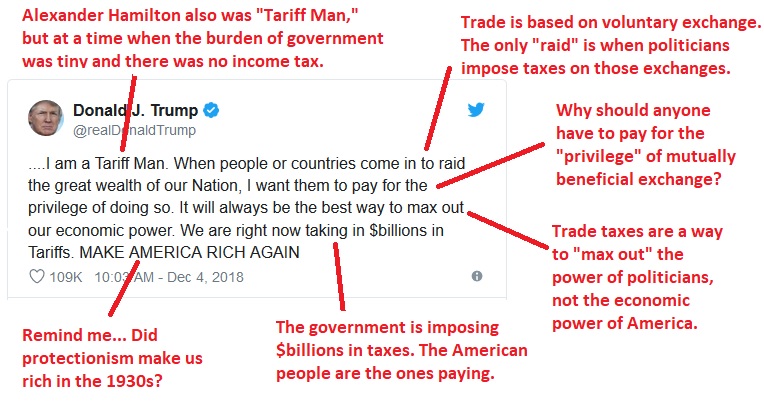
Donald Trump, who describes himself as “Tariff Man,” recently wrote a column in defense of his protectionist trade policy for the Wall Street Journal. After reading the column, my first thought was that Trump was trying to show he is more economically illiterate than Joe Biden (a big challenge, as seen here and here). And […]
That the radical right calls itself “conservative” is one of the most successful acts of political re-branding in modern history. The label has stuck so firmly that many people now treat the two as interchangeable. Yet historically, philosophically, and temperamentally, they are opposites. This confusion is not confined to the uninformed. Journalists who ought to know better […]
The proposed acquisition of Warner Bros. Discovery (WBD) assets by Netflix is already being cast as a landmark antitrust “test case.” If past deals are any guide, the critiques will follow a familiar script: narrow market definitions, selective data points, and headline-friendly market-share claims designed to trigger alarm. Yet in a video ecosystem defined by…
One way of looking at the a policy of increased ICE enforcement of US border security is as a debate over decision error costs. The expressed goal is to remove the worst of the worst criminals. Few would disagree with this goal. However, in this dragnet, immigrants without criminal backgrounds have also been detained. The…
Germany approaching energy state of emergency…shutdown of heavy industries. The consequence: another economic body blow the country cannot afford…gross policy negligence As Germany’s heating gas supply becomes increasingly tense and nears emergency low levels, policymakers will likely blame a “colder than normal winter.” But that claim will not hold. The real reason: It is what…
Eddie Slovik was executed on January 31, 1945, becoming the only American soldier put to death for desertion since the Civil War. Of approximately 40,000 U.S. service members who deserted during World War II, only several thousand were court-martialed. Forty-nine received death sentences, but Slovik was the only one whose sentence was executed. Private Eddie […]
Matt Ridley writes: I first wrote a doom–laden article for the Economist about carbon dioxide emissions trapping heat in the air in 1987, nearly 40 years ago. I soon realised the effect was real but the alarm was overdone, that feedback effects were exaggerated in the models. The greenhouse effect was likely to be a moderate inconvenience…
Why Evolution is True is a blog written by Jerry Coyne, centered on evolution and biology but also dealing with diverse topics like politics, culture, and cats.
“We do not believe any group of men adequate enough or wise enough to operate without scrutiny or without criticism. We know that the only way to avoid error is to detect it, that the only way to detect it is to be free to inquire. We know that in secrecy error undetected will flourish and subvert”. - J Robert Oppenheimer.






 Utopia, you are standing in it!
Recent Comments