That is the new book by John H. Cochrane, Luis Garicano, and Klaus Masuch, and the subtitle is Challenges, Evolution, and Future of the Euro. Excerpt: Our main theme is not actions taken in crises, but that member states and EU institutions did not clean up between crises. They did not reestablish a sustainable framework […]
*Crisis Cycle*
*Crisis Cycle*
02 Jun 2025 Leave a comment
in budget deficits, business cycles, currency unions, Euro crisis, fiscal policy, global financial crisis (GFC), great recession, history of economic thought, international economic law, international economics, macroeconomics, monetarism, monetary economics, Public Choice Tags: European Union
Counting the Cost
01 Jun 2025 Leave a comment
in applied price theory, discrimination, gender, human capital, income redistribution, labour economics, labour supply, occupational choice, politics - New Zealand, poverty and inequality, Public Choice, rentseeking Tags: constitutional law, gender wage gap, sex discrimination
For all the gravitas which Dame Marilyn’s involvement has conferred upon PSCPE, it is important not to lose sight of the fact that it represents a deliberate attempt to morally overpower what is now the law of the land. Chris Trotter writes – The People’s Select Committee on Pay Equity (PSCPE) is looking for evidence. […]
Counting the Cost
MPC members speaking
31 May 2025 Leave a comment
in budget deficits, business cycles, economic growth, economics of bureaucracy, macroeconomics, monetary economics, politics - New Zealand, Public Choice Tags: monetary policy

In both The Post and the Herald this morning there are reports of interviews with executive members of the Reserve Bank’s Monetary Policy Committee: the Bank’s chief economist Paul Conway in The Post and his boss, and the deputy chief executive responsible for monetary policy and macroeconomics, Karen Silk in the Herald. In a high-performing […]
MPC members speaking
Dane Luo: There is ‘Advice’ and then there is ‘advice’: The Constitutional Conventions on the Appointment of the Prime Minister
31 May 2025 1 Comment
in constitutional political economy, Public Choice Tags: British constitutional law

On 23 May 2025, the Court of Appeal held that the Conservative Party was not exercising a ‘public function’ for the purposes of s 6 of the Human Rights Act 1998 when it elected Liz Truss as party leader, who would go on to be appointed as the Prime Minister: R (Tortoise Media Ltd) v […]
Dane Luo: There is ‘Advice’ and then there is ‘advice’: The Constitutional Conventions on the Appointment of the Prime Minister
Liability for Climate Change: An Inequitable Economic Disaster
29 May 2025 Leave a comment
in economics of climate change, economics of regulation, energy economics, environmental economics, environmentalism, global warming, law and economics, politics - USA, property rights, Public Choice, rentseeking Tags: climate alarmism, nuisance suits
What is already clear are the serious and senseless economic consequences that will follow if states are allowed to punish fossil fuel companies for their lawful past production.
Liability for Climate Change: An Inequitable Economic Disaster
New medicine approvals plan an exercise in not solving the problem
28 May 2025 Leave a comment
in applied price theory, economics of bureaucracy, economics of regulation, health economics, politics - New Zealand, Public Choice Tags: drug lags
Eric Crampton writes – New medicines are slow to be authorised for the New Zealand market. Even if a medicine has already been approved by many other trustworthy overseas regulators like those in Canada, the UK, Australia, and the EU, Medsafe can take a very long time to evaluate a medicine.
New medicine approvals plan an exercise in not solving the problem
Some more post-Budget thoughts
27 May 2025 Leave a comment
in budget deficits, business cycles, economic growth, fiscal policy, macroeconomics, politics - New Zealand, Public Choice, public economics Tags: taxation and investment

On two separate themes; aggregate fiscal policy, and the Investment Boost initiative. Aggregate fiscal policy Over the weekend for some reason I was prompted to look up the Budget Responsibility Rules that Labour and the Greens committed to in early 2017 (my commentary on them here). At the time, the intention seemed to be to […]
Some more post-Budget thoughts
The Latest Affordability Numbers
26 May 2025 Leave a comment
in economics of regulation, income redistribution, Public Choice, rentseeking, urban economics Tags: housing affordability, land supply, zoning
Housing in Canada, Hong Kong, New Zealand, and Singapore was slightly more affordable in 2024 than it had been in 2023. Wendell Cox’s latest assessment of housing affordability, when compared with last year’s assessment, shows that housing became slightly less affordable in Ireland and the United Kingdom, while affordability remained … Continue reading →
The Latest Affordability Numbers
Updates on the Reform Act and Fixed-Date Elections
26 May 2025 Leave a comment
in constitutional political economy, politics, Public Choice Tags: Canada, constitutional law

Nova Scotia Shows a Better Way In February, I outlined a government bill tabled by Tim Houston, Premier of Nova Scotia, which contained a line to repeal the province’s fixed-date elections law, amongst other things. The omnibus Government Organization and Administration Act received Royal Assent on 26 March 2025, and thus makes Nova Scotia both […]
Updates on the Reform Act and Fixed-Date Elections
Dutch Cancel Offshore Wind Auction Due To Lack Of Interest
26 May 2025 Leave a comment
in economics of climate change, energy economics, environmental economics, environmentalism, global warming, Public Choice, rentseeking Tags: Netherlands, wind power

By Paul Homewood Now the Dutch are having trouble finding anyone willing to build offshore wind farms without massive subsidies, as Reuters report: The Netherlands will postpone tenders for two offshore wind farms with a total capacity of 2 gigawatts (GW) due to a lack of interest from potential bidders, the Dutch government […]
Dutch Cancel Offshore Wind Auction Due To Lack Of Interest
The 3.5 percent remittance tax
25 May 2025 1 Comment
in development economics, financial economics, Public Choice, public economics Tags: remittances
Trump has been talking about this. I am not sure what version of the idea we might end up with, but let’s consider the idea in its abstract form. Let’s also put aside money laundering issues, and talk about “simple remittances.” The United States has a partial monopsony power over Latino (and often other) migrants, […]
The 3.5 percent remittance tax
Deficits forever?
24 May 2025 Leave a comment
in budget deficits, fiscal policy, macroeconomics, politics - New Zealand, Public Choice, public economics
Eric Crampton writes – This week’s budget projected no return to balanced books. It is difficult to see how recent budgets from National and Labour comply with the Public Finance Act’s fiscal responsibility provisions. It is a problem.
Deficits forever?
Prepping for the Next Pandemic
24 May 2025 Leave a comment
in applied price theory, economics of bureaucracy, economics of natural disasters, health economics, Public Choice Tags: economics of pandemics
If you are like me, you spend a certain amount of time trying not to remember the pandemic experience. But COVID-19 pandemic did cause more than one million American deaths. In a world of sane and sensible prioritizing and policy-making, spending some time and effort focused on how to reduce the risks and costs of…
Prepping for the Next Pandemic
The (deeply underwhelming) Budget
23 May 2025 Leave a comment
in applied price theory, budget deficits, economic growth, economics of regulation, entrepreneurship, fiscal policy, macroeconomics, politics - New Zealand, Public Choice, public economics

Michael Reddell writes – There were good things in the Budget. There may be few/no votes in better macroeconomic statistics and, specifically, a monthly CPI but – years late (for which the current government can’t really be blamed) – it is finally going to happen.
The (deeply underwhelming) Budget
Excusing the Government
22 May 2025 Leave a comment
in applied price theory, applied welfare economics, comparative institutional analysis, constitutional political economy, economics of bureaucracy, economics of regulation, history of economic thought, income redistribution, international economics, labour economics, law and economics, property rights, Public Choice, public economics, rentseeking, urban economics
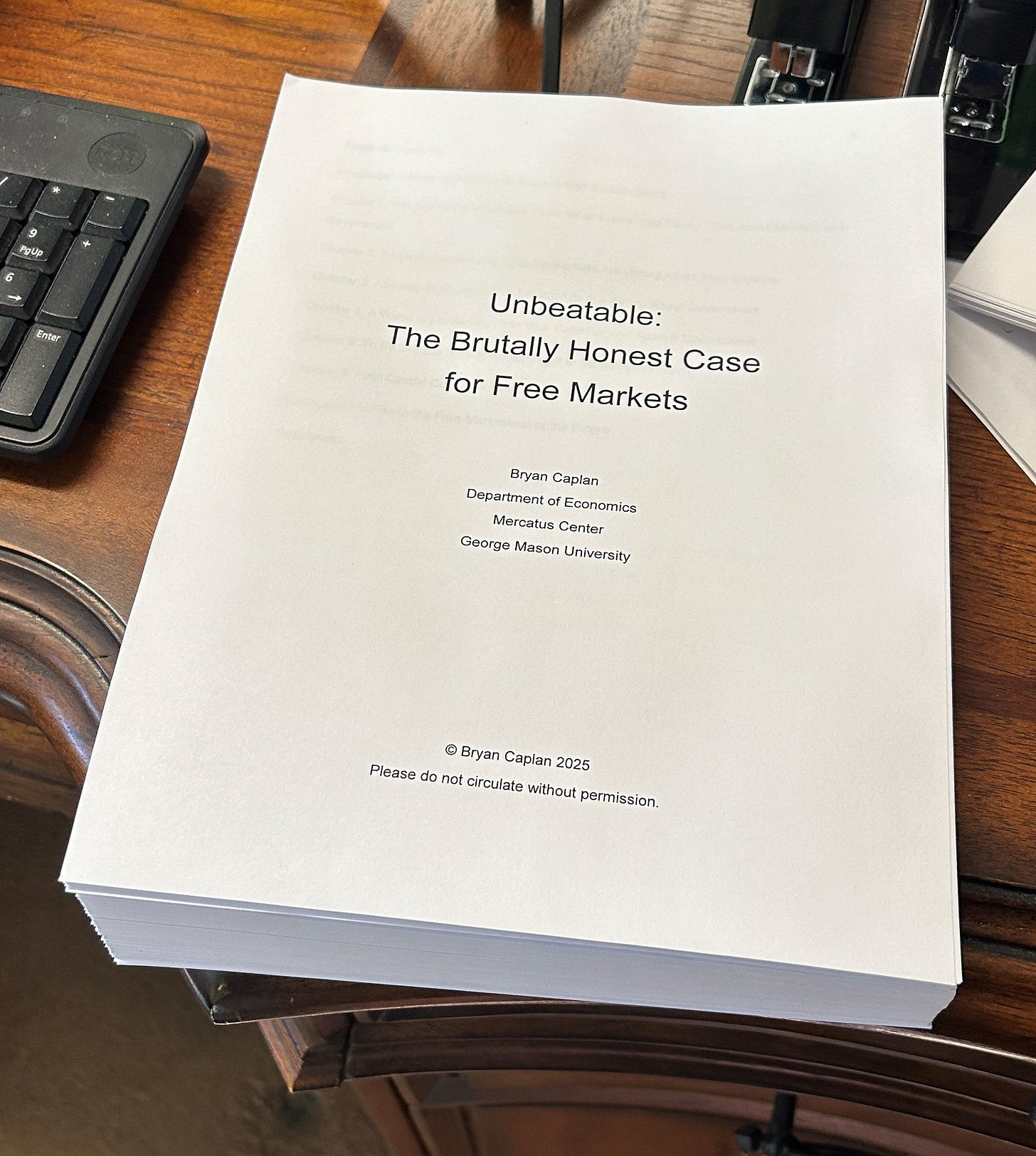
An excerpt from Chapter 3 of *Unbeatable*
Excusing the Government
 Utopia, you are standing in it!
Recent Comments