Regulating Monopolies: A History of Electricity Regulation
09 Feb 2016 Leave a comment
in applied price theory, economic history, economics of bureaucracy, economics of religion, industrial organisation, law and economics, Public Choice, rentseeking, survivor principle Tags: competition law, electricity industry, natural monopolies, network industries
Why Do Politicians All Sound the Same? @BernieSanders
08 Feb 2016 Leave a comment
in constitutional political economy, politics - Australia, politics - New Zealand, politics - USA, Public Choice Tags: 2016 presidential election, median voter theorem
Here’s where Republicans and Democrats differ on the role of government
08 Feb 2016 Leave a comment
in defence economics, economics of bureaucracy, economics of education, economics of information, economics of media and culture, economics of regulation, energy economics, entrepreneurship, environmental economics, income redistribution, politics - USA, Public Choice, rentseeking Tags: 2016 presidential election Republican Party, Democratic Party, votor demographics
@jacindaardern wrong to say Australia is last place to follow in race relations
07 Feb 2016 Leave a comment
in constitutional political economy, discrimination, economic history, law and economics, politics - Australia, politics - New Zealand, property rights, Public Choice Tags: Aboriginal land rights, Maori economic development, native title, racial discrimination
From 1965 onwards, 1/3rd of terrestrial Australia – 2.5 million sq kms of land – was returned to indigenous owners, with half of that since the Native Title decision in 1993. Tasmania pioneered aboriginal land rights with the Cape Barron Island Act 1912.
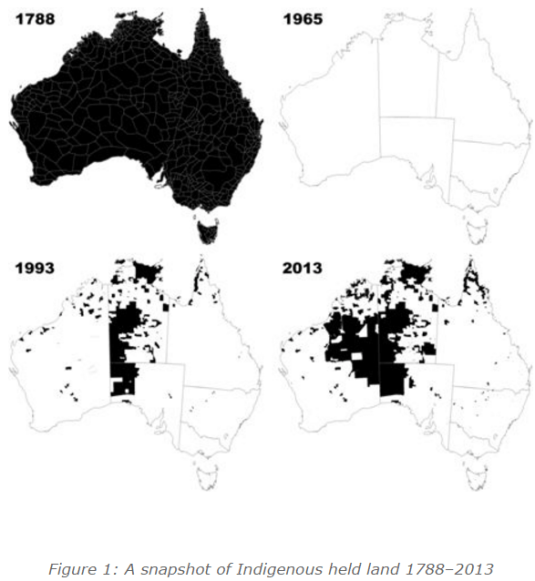
Source: Jon Altman, The political ecology and political economy of the Indigenous land titling ‘revolution’ in Australia, March 2014 Māori Law Review.
New Zealand extinguished native title twice in its history with the 2nd of these takings of Māori land by the last Labour government with the foreshore and seabed legislation. In her op-ed today, has Jacinda Ardern forgotten why the Māori party came into being?
Unlike New Zealand, Australia welcomed migrants from a wide range of ethnicities after the Second World War. It abolished the White Australia policy in the 1960s along with any discrimination in its Constitution against aboriginals.
Australia takes 8 times as many refugees as New Zealand on a per capita basis.
Sweden – the OECD's highest per capita recipient of asylum seekers bit.ly/1vfFEUh http://t.co/y6DmdJjAsE—
Guardian Data (@GuardianData) December 02, 2014
This redress of indigenous grievances was done out of the generosity of the Australian heart. Aboriginals are a tiny minority in Australia with little independent political pull.
Inflation targeting explained
06 Feb 2016 Leave a comment
in economics of bureaucracy, macroeconomics, monetary economics
A bizarre Finnish amateur racing car practice for redistributing winning
06 Feb 2016 Leave a comment
in economics of media and culture, fiscal policy, income redistribution, labour economics, labour supply, law and economics, poverty and inequality, property rights, public economics, rentseeking Tags: basic income, car racing, Finland, guaranteed minimum income, negative income tax
@billshortenMP Why @TurnbullMalcolm will back Kevin Rudd for UN Secretary General
05 Feb 2016 1 Comment
in economics of bureaucracy, International law, politics - Australia, Public Choice

What a splendid opportunity! In an Australian election year, Kevin Rudd will be back in the Australian news, frequently front page.
This re-emergence of Kevin747 will remind Australian voters of how dysfunctional he was and how dysfunctional the last Labour government was.
Most of the reporting of Kevin Rudd in the Australian media be about how that control freak and social cripple will bring his dysfunctionality to United Nations and international relations generally.
Bill Shorten must hate the idea. The last thing he wants as an unpopular opposition leader is for the last Labour Prime Minister, who he stabbed in the back as prime minister first time round, to be back in the news.

Mark Latham uses to say that the only reason Kevin Rudd was popular with the Australian people was that never met him.
Why @HelenClarkUNDP will not be UN Secretary General
04 Feb 2016 2 Comments
in economics of bureaucracy, International law, personnel economics, politics - New Zealand
Back in the day, I was having a beer in Bob Hawke’s office along with the rest of the economic division staff from his department. We were told to avoid discussing racing as Hawke would never stop talking about it.
Somehow the conversation got on to Malcolm Fraser becoming secretary general of the Commonwealth Secretariat. He had recently lost the race.
Bob Hawke told us a story about a conversation he had with Margaret Thatcher on the candidature of Malcolm Fraser.
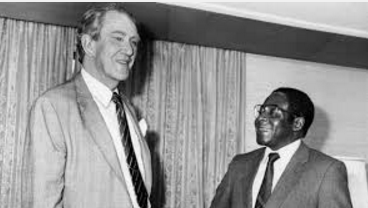 Hawke said that Thatcher said do you really want Malcolm Fraser beating down your door every day about apartheid. She had a point.
I took that remark by Hawke to mean that Fraser had independent stature as a former prime minister. He could annoy powerful people because he had nothing to lose and everything to gain.
The Nigerian chief who got the job will be so grateful for the appointment that he would not upset his sponsors. That is why Helen Clark will not become UN Secretary General. She is overqualified.
UN Secretary General is not the best job Clark has ever had. She has independent gravitas and everything to gain and nothing to lose by being an activist secretary general.
All previous Secretary Generals were obscure foreign ministers who will be just so grateful for the big promotion. They did not have independent gravitas.
If you look at positions such as president of the European commission, managing director of the IMF or president of the World Bank and other international appointments, they do not go to statesman.
Agricultural subsidies as a % of gross farm receipts in USA, Canada, Japan, Australia and New Zealand since 1986
02 Feb 2016 1 Comment
in economic history, politics - Australia, politics - New Zealand, politics - USA, Public Choice, rentseeking Tags: agricultural subsidies, Australia, Canada, cultural economics, Japan
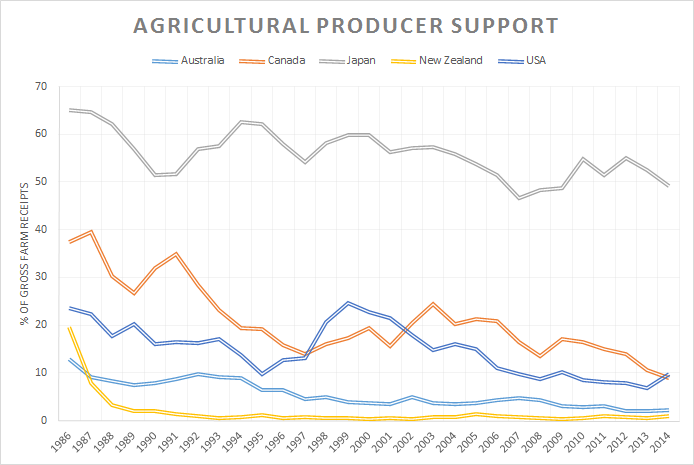
Source: Agricultural policy – Agricultural support – OECD Data.
Agricultural support is defined as the annual monetary value of gross transfers to agriculture from consumers and taxpayers arising from government policies that support agriculture, regardless of their objectives and economic impacts.
#climatechange & #globalwarming job trends @GreenpeaceNZ @NZGreens
02 Feb 2016 Leave a comment
in environmental economics, global warming, rentseeking
A lot of jobs depend upon action to fight climate change and global warming. Perhaps they should be little bit easier about accusing others of being on the payroll to criticise or advocate for a particular position in those debates.
There has been a recession in the climate change and global warming industry in the last few years. Then there was a bit of a rebound after the Paris climate talks and subsequent agreement to promise to do something but whatever that was is up to you and your domestic political constituencies.
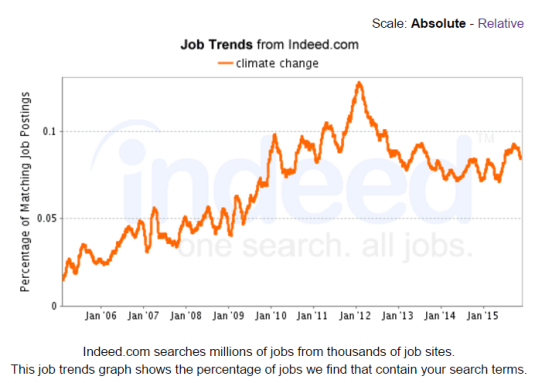
Source: climate change Job Trends | Indeed.com.
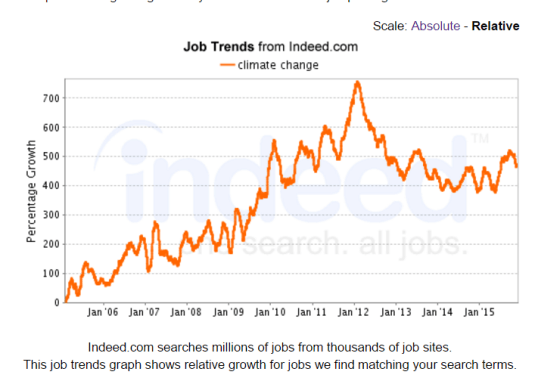
Source: climate change Job Trends | Indeed.com.
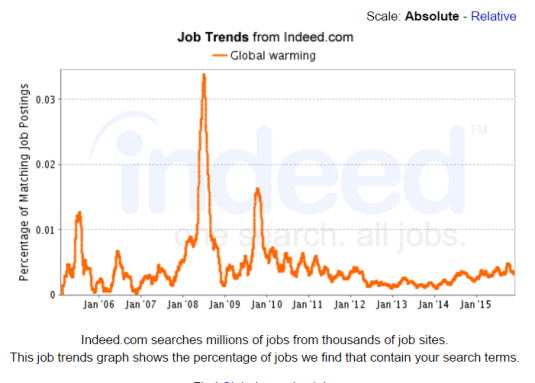
Source: Global warming Job Trends | Indeed.com.
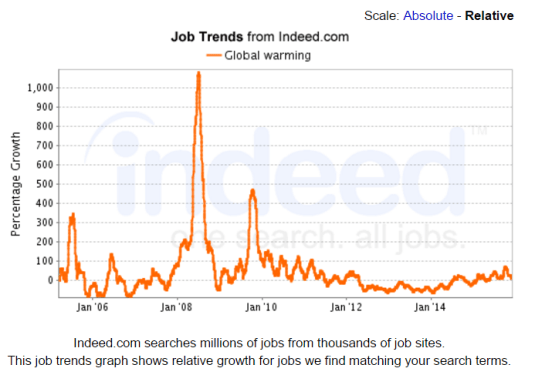
@GreenpeaceUSA I must photoshop this #TPPANoWay 4 climate treaties
02 Feb 2016 Leave a comment
in environmental economics, global warming, international economic law, international economics, rentseeking

Political activists for all their activism are bone lazy
02 Feb 2016 Leave a comment
in constitutional political economy, economics of information, Public Choice
The rise of Jeremy Corbyn has reminded me of how lazy political activists happen to be. For all their lifelong agitating, they think that as soon as they get a degree of prominent, their work is done. Suddenly, everyone who has disagreed with accidentally prominent activists for all that life will flock to their side and they will win the next election.

The thing about being a political fringe dwelling is you are a political fringe dweller. Only a tiny percentage of the population support you. To get anything above that requires hard work and a considerable amount of compromise to expand your base.
Those that already agree with you already agree with you. If you want more to agree with you, you have to start agreeing with those that disagree with you rather than they agree with you. It is a slow laborious process of compromise.
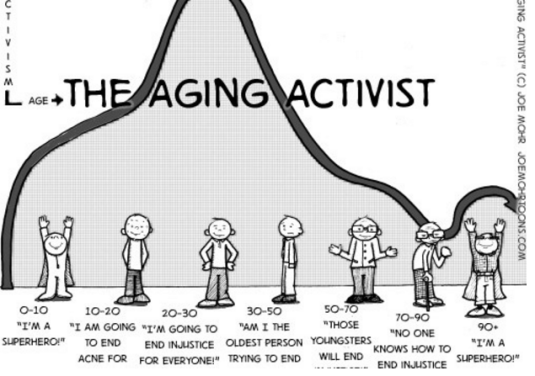
Occasionally, parties rush to prominence. Left-wing and right-wing populists are examples of these as are the anti-immigration parties. Their support is soft and can quickly disappear. Trump, Corbyn and Sanders should remember this.
Most of all, political activists who slip into prominence forget that voters tend to vote retrospectively: on past performance and out of anger than voting for a particular agenda of the alternative parties.
Because of this political ignorance and apathy, Richard Posner championed Schumpeter’s view of democracy. Schumpeter disputed the widely held view that democracy was a process by which the electorate identified the common good, and that politicians carried this out:
- The people’s ignorance and superficiality meant that they were manipulated by politicians who set the agenda.
- Although periodic votes legitimise governments and keep them accountable, their policy programmes are very much seen as their own and not that of the people, and the participatory role for individuals is limited.
Schumpeter’s theory of democratic participation is that voters have the ability to replace political leaders through periodic elections. Citizens do have sufficient knowledge and sophistication to vote out leaders who are performing poorly or contrary to their wishes.
The power of the electorate to turn elected officials out of office at the next election gives elected officials an incentive to adopt policies that do not outrage public opinion and administer the policies with some minimum honesty and competence.
That lack of competence and judgement are what will bring Trump, Corbyn and Sanders down. They are just not up to the job. There are better left-wing and right-wing populists and firebrands about.
The outcome of Schumpeterian democracy in the 20th century, where governments are voted out rather than voted in, is most of modern public spending is income transfers that grew to the levels they are because of support from the average voter.
Political parties on the Left and Right that delivered efficient increments and stream-linings in the size and shape of government were elected, and then thrown out from time to time, in turn, because they became tired and flabby or just plain out of touch.
There is considerable excitement about how popular and elite preferences seem to have equal chances are being implemented.
If Americans at different income levels agree on a policy, they are equally likely to get what they want. But what about the other half of the time? What happens when preferences across income levels diverge?
When preferences diverge, the views of the affluent make a big difference, while support among the middle class and the poor has almost no relationship to policy outcomes. Policies favored by 20 percent of affluent Americans, for example, have about a one-in-five chance of being adopted, while policies favored by 80 percent of affluent Americans are adopted about half the time. In contrast, the support or opposition of the poor or the middle class has no impact on a policy’s prospects of being adopted.
These patterns play out across numerous policy issues. American trade policy, for example, has become far less protectionist since the 1970s, in line with the positions of the affluent but in opposition to those of the poor. Similarly, income taxes have become less progressive over the past decades and corporate regulations have been loosened in a wide range of industries.
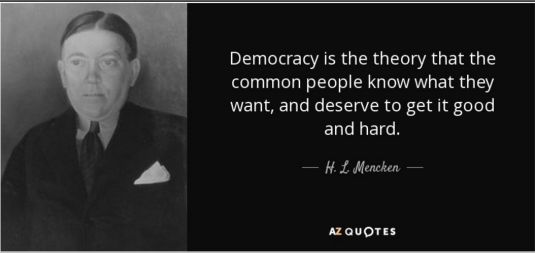
This is a dewy eyed view of democracy that would make HL Mencken proud. The notion of a democracy is governed by the rule of law, checks and balances and the protection of minority rights is lost in these dewy eyed conception is a democracy. As Matthew Yglesias said:
…the idea that the point of democracy is to implement legislative outcomes that are supported by broad-based surveys seems almost like a straw man dreamed up by an eighteenth-century monarchist.
Gilens concedes that other values—the protection of minority rights, for example—may also be important, but this misses the forest for the trees. The purpose of a political system is to resolve political questions in a satisfactory way….
The watchword of democracy should not be responsiveness but rather accountability.
In a well-functioning system, voters should elect a team of politicians and then fire them if their performance is seen as unsatisfactory. Seen in this light, the problem with American democracy today is that the intersection of counter-majoritarian legislative procedures and increased partisan polarization has blurred the lines of responsibility.
My confidence in the median voter theorem returned when Bryan Caplan and Sam Peltzman pointed out that it is difficult to point to a major government program in the 20th century that does not have majority support.
Director’s law is the bulk of public programmes are designed primarily to benefit the middle classes but are financed by taxes paid primarily by the upper and lower classes. Based on the size of its population and its aggregate wealth, the middle class will always be the dominant interest group in a modern democracy.
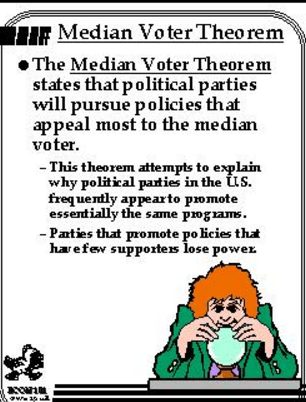
Within this framework of accountability and voting on the basis of performance rather than promise, there is considerable rotation of power. The fact that this particular activist or populists stumbled onto the treasury benches does not mean much. They usually got there because the previous administration was no longer seen as competent. Nothing more than that.
#TPPANoWay @janlogie @oxfamnz trade agreements and consolidating democracy
02 Feb 2016 Leave a comment
in constitutional political economy, development economics, economics of regulation, growth miracles, international economics, politics - New Zealand, Public Choice, rentseeking
The key reason why China joined the World Trade Organisation and other trade agreements is to bring some semblance of law to an authoritarian country. 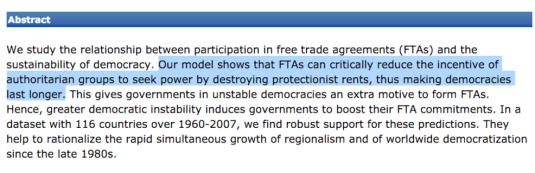
Source: AEAweb: AEJ: Macro (6,2) p. 29 – Free Trade Agreements and the Consolidation of Democracy via Max Roser.
Both the elites and ordinary people are prospering tremendously from the rise of capitalism in China, Vietnam and other places. A move away from this liberalisation to a more authoritarian setting would cost too many people too much money.
In the course of these economic liberalisations, China and Vietnam, for example, changed from totalitarian dictatorships to tin-pot dictatorships. As long as you keep out of politics in these countries, there is a fair degree of freedom and much more freedom compared to the days of communism.
Percentage employed in agriculture in the world's major economies over the last 50 years. https://t.co/UbaDnaE8Lr—
Robert Wilson (@CountCarbon) January 08, 2016
Republicans and Democrats have different priorities which is why they are Republican or Democrat primary voters
02 Feb 2016 Leave a comment
in politics - USA, population economics, Public Choice Tags: 2016 presidential election, Democratic Party, rational irrationality, Republican Party, votor demographics
@NZGreens gain the most from an independent costings unit @JulieAnneGenter
01 Feb 2016 1 Comment
in applied welfare economics, constitutional political economy, economics of regulation, income redistribution, politics - New Zealand, public economics
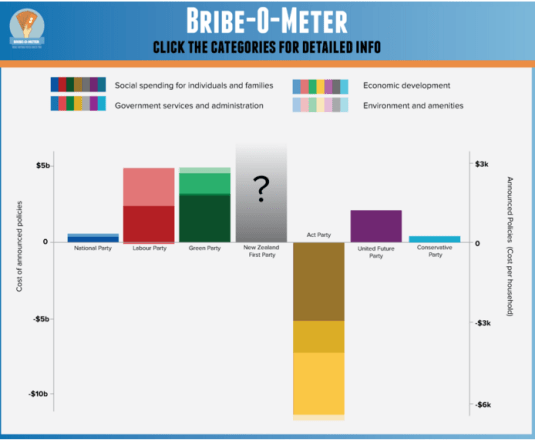
I am sure there will be lots of squabbling over parameters and assumptions of any tax, spending or regulation proposal submitted to the independent costings unit proposed recently by the New Zealand Greens.
The bigger problem is static and dynamic scoring. There is some history of doing this for taxes but little for spending and that is before you consider externalities. Imagine the squabbling over roading proposals and their externalities. The practical hurdles to dynamic scoring are:
- Economists do not know how to accurately measure the growth effects of most policies
- Dynamic scoring relies on less-than-accurate, theory-based macro models
- The macro models undergirding dynamic scoring have numerous controversial and unproven built-in assumptions
- The assumptions embedded in the macro models are not always carefully empirically based
- Macro models exclude theoretically and empirically supported evidence of supply-side effects of public investment
- Macro models exclude evidence-based effects of economic inequality
- Macro models exclude evidence-based effects of numerous policies
- Macro models provide different estimates of growth impacts of policy depending on guesses of how the policy may be finance
Against that is dynamic scoring removes the bias against pro-growth policies in current budgetary scoring:
[A] theoretical advantage of accurate dynamic scoring is that it is not biased against pro-growth policies compared to the current conventional scoring method. By ignoring macroeconomic effects, the conventional method overstates the true budgetary cost of pro-growth policies, such as infrastructure investments, and understates the cost of anti-growth policies.
The bigger problem is something I learnt when costing a tax proposal for an election campaign. There was an error because I did the costing on a spreadsheet while I had a bad head cold.
The advantage of the error was the policy, as a result of this minor error in the tabulations attracted considerable attention from the major parties.
I was advised by a very wise head that this tabulation error in the dynamic scoring was not so bad a problem. This was because the tabulation error gave our side a chance to have a go at them again in the media. The policy announcement stayed in the new cycles for longer than otherwise and attracted attention from the big parties.
If a policy is too good, too perfect, the other parties will kill it with silence. You get only one bite in the news cycle and that is it.
If your policy announcement is killed by silence, at least you are guaranteed a chance to go at it again when the proposed independent costings unit a week or so later in the election campaign. You might disagree of those costings just to attract attention in the next new cycle.
Given the size, ambition and nebulous externality content of Green party proposals, they will benefit considerably from getting another go by questioning the Parliamentary budget office costings. That guarantees at least two new cycles to every one of their budgetary and regulatory announcements. No wonder they have proposed this independent costings unit.
If the New Zealand Greens do not like the costing from their proposed independent costings unit, they can just rage against neoliberalism and the conservative bias of economists. They cannot lose in terms of another bite of the 24-hour news cycle.
As a starter to feigning disagreement with any independent costings of their tax, spending and regulation proposals, Milton Friedman argued that people agree on most social objectives, but they differ often on the predicted outcomes of different policies and institutions. This leads us to Robert and Zeckhauser’s taxonomy of disagreement:
Positive disagreements can be over questions of:
1. Scope: what elements of the world one is trying to understand?
2. Model: what mechanisms explain the behaviour of the world?
3. Estimate: what estimates of the model’s parameters are thought to obtain in particular contexts?
Values disagreements can be over questions of:
1. Standing: who counts?
2. Criteria: what counts?
3. Weights: how much different individuals and criteria count?
Any positive analysis tends to include elements of scope, model, and estimation, though often these elements intertwine; they frequently feature in debates in an implicit or undifferentiated manner. Likewise, normative analysis will also include elements of standing, criteria, and weights, whether or not these distinctions are recognised. There is a rich harvest for nit-picking to keep the story going.


Recent Comments