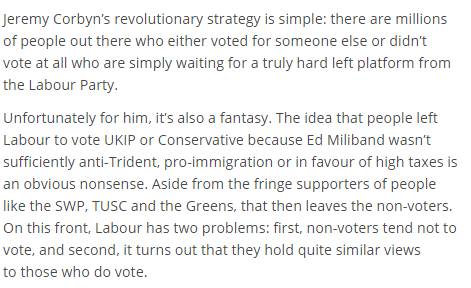
Sanders, Trump and the median voter theorem
16 Aug 2015 Leave a comment
in politics - USA, Public Choice Tags: 2016 presidential election, expressive voting, left-wing populists, Leftover Left, median voter theorem, rational ignorance, rational irrationality, right-wing populists
UK has the lowest company tax rate in the G20
16 Aug 2015 Leave a comment
in applied price theory, economic growth, fiscal policy, macroeconomics, politics - Australia, politics - New Zealand, politics - USA, Public Choice, public economics Tags: British economy, company tax rate, company taxation, optimal tax theory, race to the top, tax competition
IFS Friday Figure: UK has the lowest corporate tax rate in the G20 #Budget2015 announced a 2% cut by 2020 #IFSFriFig http://t.co/T4Oq6ZXYd4—
IFS (@TheIFS) July 24, 2015
India and Pakistan became independent today
16 Aug 2015 Leave a comment
in constitutional political economy, development economics, economic history, growth disasters, Public Choice Tags: age of empires, British empire, India, Pakistan
This day in 1947 | India and Pakistan independent after some 200 years of British rule: timesmachine.nytimes.com/timesmachine/1… http://t.co/VfbpKayExM—
NYT Archives (@NYTArchives) August 15, 2015
% of unemployment lasting longer than 12 months in Scandinavia since 1976
16 Aug 2015 Leave a comment
in applied welfare economics, business cycles, constitutional political economy, economic history, job search and matching, labour economics, labour supply, macroeconomics, Public Choice, unemployment Tags: borders, deployment subsidies, economics of borders, equilibrium unemployment rate, Finland, labour market programs, long-term unemployment, maps, natural unemployment rate, Norway, Scandinavia, search and matching, Sweden, unemployment durations
As I recall, most unemployed have been unemployed longer than 12 months in Sweden have to go on a labour market program. When they returned to unemployment after the program, the clock starts again. They are deemed to be freshly unemployed rather than adding to the previous spell with an interlude on a make work program. This makes Swedish long-term unemployment data rather unintelligible.
Source: OECD StatExtract.
Finland was recovering from its worst depression since the 1930s and the early 1990s when its data on long-term unemployment started to be continuous. This makes Finnish unemployment data rather difficult to interpret. Norway’s data for the long-term unemployed goes up and down a bit too much to be trustworthy without a background policy narrative.
Unexpected kind word for Parliament House protesters @GreenpeaceNZ @RusselNorman @NZGreens @greencatherine
15 Aug 2015 2 Comments
in constitutional political economy, economics of crime, environmental economics, global warming, law and economics, liberalism, politics - New Zealand, Public Choice, Rawls and Nozick, rentseeking Tags: civil disobedience, climate alarmism, expressive voting, Greenpeace, John Rawls, Justice Scalia, Leftover Left, rule of law
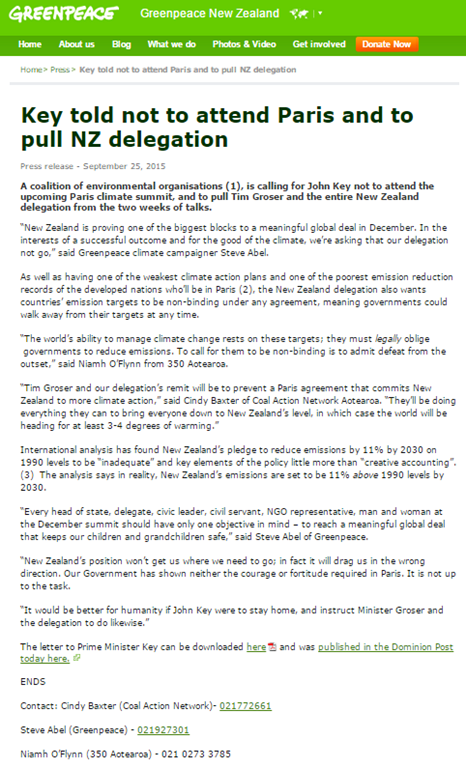
PRESS RELEASE: Greenpeace Parliament Climbers Convicted of Trespass bit.ly/1DRfKMG #realclimateaction http://t.co/sxRokpwRNk—
Greenpeace NZ (@GreenpeaceNZ) August 13, 2015
The Greenpeace vandals who trespassed at Parliament, climbing up to put signs down the front in flagrant disregard of the most ample possible options for peaceful protest right outside at least had the integrity to plead guilty. That shows some sort of fidelity to law and an acknowledgement that what they did was a criminal offence.
John Rawls makes the point that the purpose of civil disobedience is not to impose your will upon others but through your protest to implore them to reconsider their position and change the law or policy you are disputing.
Rawls argues that civil disobedience is never covert or secretive; it is only ever committed in public, openly, and with fair notice to legal authorities. Openness and publicity, even at the cost of having one’s protest frustrated, offers ways for the protesters to show their willingness to deal fairly with authorities. Rawls argues:
- for a public, non-violent, conscientious yet political act contrary to law being done (usually) with the aim of bringing about a change in the law or policies of the government;
- that appeals to the sense of justice of the majority;
- which may be direct or indirect;
- within the bounds of fidelity to the law; and
- whose protesters are willing to accept punishment. Although civil disobedience involves breaking the law, it is for moral rather than selfish reasons; the willingness to accept arrest is proof of the integrity of the act.
Rawls argues, and too many forget, that civil disobedience and dissent more generally contribute to the democratic exchange of ideas by forcing the champions of dominant opinion to defend their views.
Legitimate non-violent direct action are publicity stunts to gain attention and provoke debate within the democratic framework, where we resolve our differences by trying to persuade each other and convince the electorate.
Too many acts of non-violent direct action aim to impose their will on others rather than peaceful protests designed to bring about democratic change in the laws or policies of the incumbent government. That ‘might does not make right’ is fundamental to the rule of law. As United States Supreme Court Justice Antonin Scalia said
The virtue of a democratic system [with a constitutionally guaranteed right to free speech] is that it readily enables the people, over time, to be persuaded that what they took for granted is not so and to change their laws accordingly..
Both sides passionately but respectfully attempt to persuade their fellow citizens to accept their views. Win or lose, advocates for today’s losing causes can continued pressing their cases, secure in the knowledge that an electoral loss today can be negated by a later electoral win, which is democracy in action as Justice Kennedy explains:
…a democracy has the capacity—and the duty—to learn from its past mistakes; to discover and confront persisting biases; and by respectful, rationale deliberation to rise above those flaws and injustices…
It is demeaning to the democratic process to presume that the voters are not capable of deciding an issue of this sensitivity on decent and rational grounds.
The process of public discourse and political debate should not be foreclosed even if there is a risk that during a public campaign there will be those, on both sides, who seek to use racial division and discord to their own political advantage. An informed public can, and must, rise above this. The idea of democracy is that it can, and must, mature.
Freedom embraces the right, indeed the duty, to engage in a rational, civic discourse in order to determine how best to form a consensus to shape the destiny of the Nation and its people. These First Amendment dynamics would be disserved if this Court were to say that the question here at issue is beyond the capacity of the voters to debate and then to determine.
John Rawls’ view that fidelity to law and democratic change through trying to persuade each other is at the heart of civil disobedience reflects the difference between the liberal and the left-wing on democracy and social change as Jonathan Chait observed this week:
Liberals treat political rights as sacrosanct. The left treats social and economic justice as sacrosanct. The liberal vision of political rights requires being neutral about substance.
To the left, this neutrality is a mere guise for maintaining existing privilege; debates about “rights” can only be resolved by defining which side represents the privileged class and which side represents the oppressed…
Liberals believe that social justice can be advanced without giving up democratic rights and norms. The ends of social justice do not justify any and all means.
How the left-wing and liberal visions of democracy are different nymag.com/daily/intellig… http://t.co/Qk5vS9SaV4—
Jonathan Chait (@jonathanchait) August 13, 2015
Milton Friedman predicted this police calling card to competing drug gangs
15 Aug 2015 2 Comments
in applied price theory, economics of bureaucracy, economics of crime, history of economic thought, industrial organisation, law and economics, liberalism, Milton Friedman, Public Choice Tags: cartel theory, crime and punishment, criminal deterrence, organised crime, war on drugs
Shocker! EPA chief admits nature can ‘restore’ itself (but only if the EPA caused the problem)
15 Aug 2015 Leave a comment
in comparative institutional analysis, economics of bureaucracy, economics of media and culture, economics of regulation, environmental economics, industrial organisation, Public Choice, public economics Tags: constitutional law, sovereign immunity
Pope Francis Needs a Better Role Model for Economic Policy
15 Aug 2015 Leave a comment
in applied price theory, applied welfare economics, comparative institutional analysis, constitutional political economy, economics of bureaucracy, Public Choice Tags: Catholic Church, The fatal conceit, The pretense to knowledge
What’s the greatest economic tragedy in modern history?
The obvious answer is communism, which produced tens of millions of needless deaths and untold misery for ordinary people.
Just compare living standards in North Korea and South Korea, or Chile and Cuba.
But if there was a second-place prize for the world’s biggest economic failure, Argentina would be a strong contender.
Here’s one fact that tells you everything you need to know. In 1946, when Juan Perón came to power, Argentina was one of the 10-richest nations in the world. Economic policy certainly wasn’t perfect, but government wasn’t overly large are markets generally were allowed to function. Combined with an abundance of natural resources, that enabled considerable prosperity.
But Perón decided to conduct an experiment in statism.
Here’s how Wikipedia describes his economic policy.
Campaigning among workers with promises of land, higher wages, and social security, he won…
View original post 630 more words
Puerto Rico’s predicaments: Is its minimum wage the culprit?
15 Aug 2015 Leave a comment
in applied price theory, development economics, economic history, industrial organisation, politics - USA, public economics, rentseeking, survivor principle Tags: Puerto Rico
(Co-authored with Ben Zipperer. Posted at Washington Center for Equitable Growth)
Puerto Rico today faces a serious debt crisis, recently defaulting on a bond payment. The proximate cause is a slowdown in economic growth since the mid-2000s, which has reduced tax revenues, and a declining labor market, where employment growth has been mostly in the red since 2007.
There are many explanations for the economic downturn and the resulting fiscal crisis, but some commentators have incorrectly blamed the island’s high minimum wage. To be sure, the federal minimum wage—which has applied to Puerto Rico since 1983—is much more binding there than it is on the mainland. Because hourly wages are substantially lower in Puerto Rico compared to the U.S. mainland, the federal minimum wage policy affects more of the workforce there. In 2014, for example, the federal minimum wage stood at 77 percent of the median hourly wage in Puerto Rico…
View original post 117 more words
Donald Trump is a moderate Republican, which is why he was a registered Democrat recently
15 Aug 2015 Leave a comment
in politics - USA, Public Choice Tags: 2016 presidential election, expressive voting, political polarisation, rational ignorance, rational irrationality, right-wing popularism
Basically, Trump is a @jbarro Republican. nytimes.com/2015/08/18/ups… http://t.co/cZw63rjjiy—
Jonathan Chait (@jonathanchait) August 14, 2015
Director’s Law in New Zealand?
14 Aug 2015 Leave a comment
in applied price theory, income redistribution, labour economics, politics - New Zealand, poverty and inequality, Public Choice, public economics Tags: child poverty, Director's Law, family poverty, family tax credits, welfare state
One group with negative net tax liability is low- to middle-income households with dependent children. For example, single-earner families with two children can earn up to around $60,000 pa before they pay any net tax.
Around half of all households with children receive more in welfare benefits and tax credits than they pay in income tax.
@metiria @NZGreens 20,000 drop in children in hardship in 2014
13 Aug 2015 Leave a comment
in applied welfare economics, economic history, income redistribution, labour economics, politics - New Zealand, poverty and inequality, Public Choice, welfare reform Tags: child poverty, family poverty, family tax credits, Leftover Left, New Zealand Greens, Twitter left
The material hardship measure shows a falling child material hardship rate using a threshold equivalent to the ‘standard’ EU level, down from a peak of 21% immediately after the GFC to 14% in 2014.
Using the more severe threshold, there was a slight rise through the GFC to 10% and a small fall to 8%, the level it was at before the GFC.
Source: Bryan Perry, Household Incomes in New Zealand: trends in indicators of inequality and hardship 1982 to 2014 – Ministry of Social Development, Wellington (August 2015), p. 133.
@WJRosenbergCTU A brief history of rising equality in New Zealand
13 Aug 2015 Leave a comment
in applied price theory, applied welfare economics, economic history, economics of media and culture, income redistribution, labour economics, politics - New Zealand, poverty and inequality, Public Choice Tags: capitalism and freedom, Leftover Left, The Great Enrichment, The Great Fact, top 1%, Twitter left
Bill Rosenberg at the Council of Trade Unions was good enough to tweet a Treasury chart that shows next to no increases in inequality in New Zealand for at least 20 years.
A brief history of inequality-from Treasury paper Fig4. Note Employment Contracts Act,GST,income tax,benefit cuts,WFF http://t.co/y4w3cUsgjD—
Bill Rosenberg (@WJRosenbergCTU) June 27, 2015
Inequality in both market and disposable incomes has been stable for a good 20 years, as the above tweet shows, while inequality in consumption has been falling. To back this interpretation of mine up, coincidentally today Bryan Perry published his annual report on income and inequality under the banner of the Ministry of Social Development.
His report showed that there be no significant increase in New Zealand in at least 20 years.
Recent Comments