
Deirdre McCloskey on the Samaritan’s dilemma
30 Jul 2015 Leave a comment
in applied price theory, applied welfare economics, comparative institutional analysis, constitutional political economy, development economics, economic history, economics of regulation, entrepreneurship, growth disasters, growth miracles, history of economic thought, income redistribution, industrial organisation, liberalism, Public Choice, rentseeking, survivor principle Tags: Age of Innovation, bourgeoisie deal, capitalism and freedom, Deirdre McCloskey, The Great Enrichment, The Great Escape, The Great Fact
The first Paul Krugman (1997) on what trade negotiators negotiate about
29 Jul 2015 Leave a comment
in applied price theory, applied welfare economics, comparative institutional analysis, constitutional political economy, international economics, Public Choice, rentseeking Tags: customs unions, free trade agreements, free trade zones, game theory, Paul Krugman, preferential trading agreements, regional trade agreements, WTO

#TPPA The first Paul Krugman on trade agreements that level the playing field behind the border
29 Jul 2015 2 Comments

A map of countries Britain never invaded
29 Jul 2015 Leave a comment
in economic history, rentseeking, war and peace Tags: British empire, British imperialism, colonisation
A world map according to the countries Britain never invaded i100.io/8YNMkgK http://t.co/l5BO1hehEf—
i100 (@thei100) April 28, 2015
62 years ago North and South Korea signed a truce
28 Jul 2015 Leave a comment
in applied price theory, applied welfare economics, Austrian economics, comparative institutional analysis, constitutional political economy, development economics, economics of bureaucracy, growth disasters, growth miracles, income redistribution, liberalism, Marxist economics, Public Choice, rentseeking Tags: collapse of communism, economics of central planning, failed states, North Korea, South Korea
https://twitter.com/TheEconomist/status/625658259861598209/photo/1
Truce is signed and the fighting ends in Korea on this day in 1953. nyti.ms/1D1Yswe http://t.co/O9a8iJgE99—
NYT Archives (@NYTArchives) July 27, 2015
Hong Kong and Venezuela compared
27 Jul 2015 Leave a comment
in applied price theory, applied welfare economics, comparative institutional analysis, constitutional political economy, development economics, economics of bureaucracy, growth disasters, growth miracles, income redistribution, Public Choice, rentseeking Tags: capitalism and freedom, Hong Kong, Latin American crony capitalism, Venezuela
Socialism works -Venezuela twice as rich as Hong Kong!
No, wait, that was in 1960. http://t.co/sqwVnMc19t—
Screwed by State (@ScrewedbyState) July 26, 2015
I thought America’s poor never had health insurance cover!? I’ve watched too much American TV?
26 Jul 2015 1 Comment
in applied welfare economics, economic history, economics of media and culture, health economics, industrial organisation, politics - USA, Public Choice, rentseeking, survivor principle Tags: adverse selection, expressive voting, health insurance, Leftover Left, media bias, medicaid, Medicare, moral hazard, Obamacare, rational ignorance, rational irrationality
#Medicaid expands access to health coverage and supports work: bit.ly/1RKHQ2x #Medicaidat50 http://t.co/mydZMggcXg—
Center on Budget (@CenterOnBudget) July 20, 2015
6.4 million seniors get the vital support & care they need thanks to Medicaid: bit.ly/1HqYvNG #Medicaidat50 http://t.co/onWMiYj301—
Center on Budget (@CenterOnBudget) July 23, 2015
Reminder: #Medicaid helps millions of babies: bit.ly/1RS7ME5 #Medicaidat50 http://t.co/SeJ7MFPGWE—
Center on Budget (@CenterOnBudget) July 20, 2015
#Medicaid help millions of children across the country live healthier lives. #Medicaidat50: bit.ly/1RS7ME5 http://t.co/LT6rXhNzUg—
Center on Budget (@CenterOnBudget) July 16, 2015
50 years of coverage that every American deserves. #Medicare http://t.co/uRtERV2k9K—
American Progress (@amprog) July 30, 2015
Mann: Celebrating historic gains in coverage for kids CCF#2015 http://t.co/g7CYQ7DuwN—
Georgetown CCF (@GeorgetownCCF) July 22, 2015
#Medicare has been keeping seniors insured and healthy for 50 years. http://t.co/mXW4x12Rhi—
American Progress (@amprog) July 30, 2015
The majority of Americans of all ages don't recognize that gov subsidizes their health care: vox.com/2015/3/1/81257… http://t.co/ivq5eLThsi—
(@SocImages) April 22, 2015
A key reason why self-funded candidates often falter
26 Jul 2015 Leave a comment
in constitutional political economy, economics of bureaucracy, politics - USA, Public Choice, rentseeking Tags: 2016 presidential election, campaign finance reform, campaign finance regulation, congressional elections


via Sometimes, Money Can’t Buy You Votes | FiveThirtyEight and Four Ways To Fund A Presidential Campaign | FiveThirtyEight.
Murray Rothbard on the falling popularity of Pope Francis
25 Jul 2015 Leave a comment
in applied price theory, applied welfare economics, comparative institutional analysis, constitutional political economy, economic history, economics of bureaucracy, economics of education, economics of regulation, economics of religion, energy economics, environmental economics, income redistribution, industrial organisation, international economics, Murray Rothbard, politics - Australia, politics - New Zealand, politics - USA, Public Choice, rentseeking, survivor principle Tags: antiforeign bias, antimarket bias, Catholic social thought, climate alarmism, expressive voting, global warming, makework bias, Pope Francis, rational ignorance, rational irrationality, voter demographics


Do environmentalists oppose all energy subsidies?
22 Jul 2015 Leave a comment
in applied welfare economics, energy economics, environmental economics, global warming, Public Choice, rentseeking Tags: antimarket bias, Big Solar, Big Wind, expressive voting, green rent seeking, rational ignorance, rational irrationality, renewable energy, solar power, wind power
The cost of sports stadium races to the bottom and the cost of going to Pluto compared
20 Jul 2015 Leave a comment
in rentseeking, sports economics Tags: corporate welfare, expressive voting, NASA, Pluto, space, sports, sports stadiums, welfare
Why I loath consensus making and bipartisanship
19 Jul 2015 Leave a comment
in constitutional political economy, income redistribution, Public Choice, rentseeking Tags: bipartisanship, Margaret Thatcher, political polarisation
The Amtrak and KiwiRail bailouts compared
18 Jul 2015 1 Comment
in economic history, economics of bureaucracy, politics - New Zealand, politics - USA, Public Choice, rentseeking, transport economics Tags: Amtrak, corporate welfare, expressive voting, industry policy, KiwiRail, privatisation, rational ignorance, rational irrationality, state owned enterprises
Figure 1: Amtrak and KiwiRail bailouts, (exchange rate US$1:NZ$1.53), 2008 – 2015
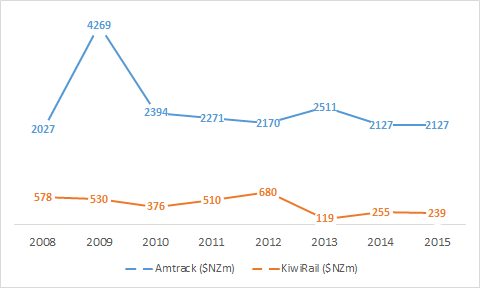
Sources: Federal Funding Received by Amtrak | Mercatus and New report: Corporate welfare in the 2015 budget – Taxpayers’ Union.
New Zealand with its KiwiRail does a good job of keeping up with the Amtrak bailout especially when you look at figure 2, which computes the bailouts on a per capita basis.
Figure 2: Amtrak and KiwiRail bailouts per capita (2014 populations), (exchange rate US$1:NZ$1.53), 2008 – 2015
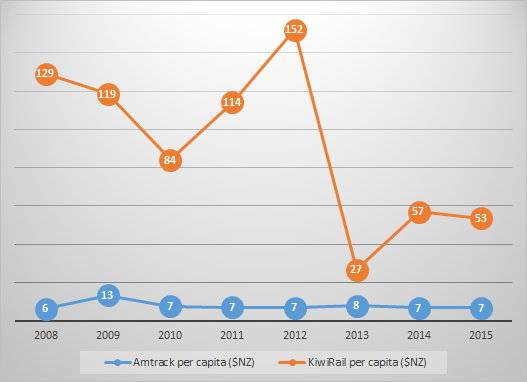
Sources: Federal Funding Received by Amtrak | Mercatus and New report: Corporate welfare in the 2015 budget – Taxpayers’ Union.


Recent Comments