Do Living Wage advocates realise it helps richer households more than poorer ones? My take: telegraph.co.uk/finance/budget… … http://t.co/YPTB6v7tSB—
Fraser Nelson (@FraserNelson) July 10, 2015
A living wage helps well-off households more!
10 Jul 2015 Leave a comment
in applied price theory, applied welfare economics, econometerics, income redistribution, politics - Australia, politics - New Zealand, politics - USA, Public Choice, rentseeking Tags: activists, British economy, British politics, do gooders, expressive voting, living wage, rational ignorance, rational irrationality, The fatal conceit, The pretence to knowledge, unintended consequences
Hopeless KiwiRail bailout reporting by Radio New Zealand
10 Jul 2015 Leave a comment
in applied welfare economics, economics of bureaucracy, economics of media and culture, politics - New Zealand, rentseeking, transport economics Tags: corporate welfare, KiwiRail, media bias, privatisation, public ownership, Radio New Zealand, state owned enterprises
This morning on 9 to noon on Radio New Zealand, Kathryn Ryan, the compere of the program, repeatedly claimed that the government pumped $1 billion into the KiwiRail Turnaround Plan between 2010 and 2014. I was so annoyed by this that I made a broadcasting standards complaint while the program was still being broadcast on my mobile as a one finger typist.
The report on 9 to Noon was in response to the government putting KiwiRail on notice, giving it two years to identify savings and reduce Crown funding required or risk the possibility of closure. Since KiwiRail was acquired in 2008 for $665 million as a commercial investment, Crown investments (taxpayers bailout) totalled $3.4 billion – see Figure 1.
Figure 1: State-owned enterprise welfare, Vote Transport and Vote Finance (KiwiRail), Budgets 08/09 to 15/16
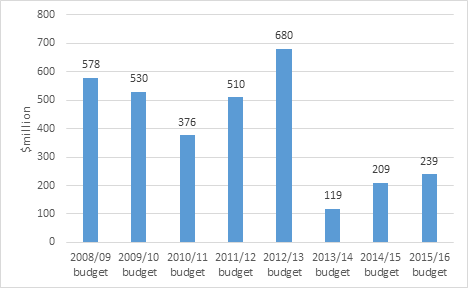
Source: New Zealand budget papers, various years.
Table 1 shows that the KiwiRail Turnaround plan of $1.272 billion since the 2009-10 Budget is only a small part of the bailout of KiwiRail. 9 to Noon simply ignored the $210 million in the 2015 budget for KiwiRail for no explicable reason and instead talked about a $1 billion Turnaround plan rather than the $1.272 billion Turnaround plan.
Table 1: State-Owned Enterprise welfare, Vote Transport and Vote Finance (KiwiRail), Budgets 2008/09 to 2015/16, $million
| 08/09 |
09/10 |
10/11 |
11/12 |
12/13 |
13/14 |
14/15 |
15/16 |
|
|
New Zealand Railways Corporation Loans |
405 |
55 |
250 |
108 |
11 |
|||
|
KiwiRail Turnaround Plan |
20 |
250 |
250 |
250 |
94 |
198 |
210 |
|
|
KiwiRail Equity Injection |
323 |
25 |
29 |
|||||
|
Rail Network and Rolling Stock Upgrade |
105 |
71 |
10 |
|||||
|
New Zealand Railways Corporation Loans |
55 |
|||||||
|
New Zealand Railways Corporation Increase in Capital for the Purchase of Crown Rail |
376 |
|||||||
|
Crown Rail Operator Loans |
140 |
|||||||
|
Crown Rail Operator Equity Injection |
7 |
|||||||
|
Total |
578 |
530 |
376 |
510 |
680 |
119 |
209 |
239 |
Source: New Zealand budget papers, various years.
Other parts of the bailout of KiwiRail include $405 million in loans to the New Zealand Railways Corporation in the 2009-10 budge – see table 1. There was a $323 million equity injection in the 2012-13 Budget – see table 1. KiwiRail has also caused write-downs in the Crown balance sheet of an incredible $9.8 billion since it was repurchased in 2008.
9 to Noon ignored at least two thirds of the cost to the taxpayer of bailing out KiwiRail by only limiting its reporting to part of the KiwiRail Turnaround Plan. It ignored the contribution in the most recent budget to that plan. That does not meet broadcasting standards of accuracy or professional responsibility.
Any reasonable listener will infer, as I did when listening, that the entire cost of the bailout of KiwiRail is represented by the Turnaround Plan of about $1 billion. If listeners were left with that impression, they were misled by 9 to Noon and Radio New Zealand.
The left-wing solution to Greek bankruptcy
10 Jul 2015 Leave a comment
in applied price theory, applied welfare economics, comparative institutional analysis, constitutional political economy, currency unions, fiscal policy, global financial crisis (GFC), income redistribution, liberalism, macroeconomics, Marxist economics, Public Choice, public economics, rentseeking Tags: Eurosclerosis, expressive voting, Greece, rational ignorance, rational irrationality, sovereign default
It’s Time to Name a Price on KiwiRail – how much more in losses before committing to shutting it down?
09 Jul 2015 1 Comment
in economics of bureaucracy, politics - New Zealand, Public Choice, public economics, rentseeking, transport economics Tags: corporate welfare, hard budget constraints, KiwiRail, privatisation, public ownership, state owned enterprises, state-owned enterprise welfare
In the finest public service traditions of free and frank advice, the New Zealand Treasury in its budget advice this year advised ministers to contemplate shutting down KiwiRail.
Treasury recommended the Government fund KiwiRail for one more year and undertake a comprehensive public study to look into closing the company. The study is public so that people were informed of the costs of running the rail network compared with any benefits it provided. The Government rejected the idea.
Figure 1: State-owned enterprise welfare, Vote Transport and Vote Finance (KiwiRail), Budgets 08/09 to 15/16
Source: New Zealand budget papers, various years.
KiwiRail has been a constant thorn in the taxpayers’ side. Since this rail business was acquired in 2008 for $665 million as a commercial investment, Crown investments have totalled $3.4 billion – see Figure 1.
Fortunately in the 2015 budget, the Minister of Finance signalled that the government’s patience with the KiwiRail deficits is not unlimited. KiwiRail has a 10-year Turnaround Plan to make its freight business commercially viable. The current network of 4,000 km must be reduced to 2,300 km for the company to even breakeven. The Treasury advised, to no avail, that this massive and painful restructuring was required before KiwiRail was purchased. The purchase went through.
The latest developments where Treasury advised ministers to contemplate shutting the network down is an opportunity for ministers, and the opposition spokesmen on finance and transport both to say how much is too much in accumulated KiwiRail losses.
The Minister of Finance and his Cabinet colleagues must say after the public review that there is only so much more left in the cupboard to bailout KiwiRail losses. After that fiscal cap is reached, KiwiRail is on its own. If that means bankruptcy and network closure, so be it.
In the interim, on the side of every KiwiRail train there should be advertising billboards with the following disclosure statements:
- KiwiRail losses adds one percentage point to the company tax rate each year;
- KiwiRail losses takes deny sick taxpayers X number of elective surgeries per year; and
- X number of doctors, nurses, and teachers could have been hired but for last year’s KiwiRail losses!
President Donald Trump? Just Say No
09 Jul 2015 Leave a comment
in politics - USA, Public Choice, rentseeking Tags: 2016 presidential election, antiforeign bias, antimarket bias, Donald Trump, expressive voting, rational ignorance, rational irrationality
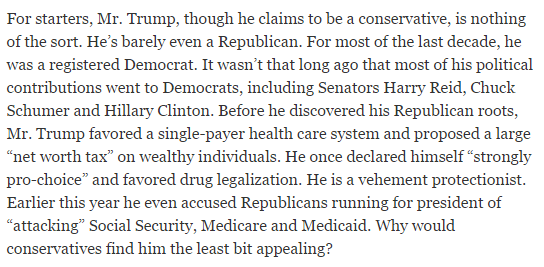
Can NZ double migrant investors and entrepreneurs from $3.5 billion to $7 billion at no cost to taxpayers!?
07 Jul 2015 Leave a comment
in applied price theory, applied welfare economics, comparative institutional analysis, economics of bureaucracy, entrepreneurship, income redistribution, industrial organisation, managerial economics, organisational economics, politics - New Zealand, Public Choice, public economics, rentseeking, survivor principle Tags: corporate welfare, entrepreneurial alertness, industry policy, industry targeting, The fatal conceit, The pretence to knowledge
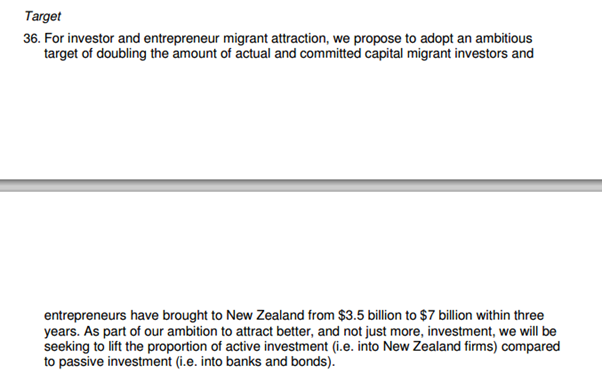

I didn’t notice any discussion in the Cabinet paper of a government doing this before and whether their investment promotion efforts succeeded or not. This latest policy proposal cannot even count as evidence-based policy dreaming, much less a serious contribution to public policy.

Hoping to double incoming foreign investor and entrepreneur migration from $3.5 billion to $7 billion inside three years without spending any extra public money is breathless public policy making. I am sure lots of governments previously tried to get something for nothing.

It will be helpful if ministers pointed to where overseas governments have been successful in doubling foreign investment by simply reprioritising existing investment promotion efforts.

There are at least 2,500 national, provincial and city investment promotion agencies out. Some of them must have been subject to some sort of evaluation as to their success.

This overseas literature review would be in addition to the recent findings of the Ministry of Economic Development about the poor performance and perhaps futility of the foreign direct investment promotion by New Zealand Trade and Enterprise.
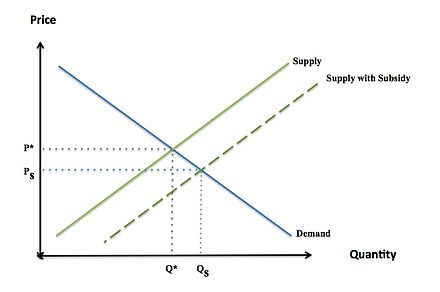
Imagine how much bigger a boost in foreign investor and entrepreneur migration lays before us if actual real new money was put on the table.
via beehive.govt.nz – Strategy targets international investors and Evaluation of NZTE investment support activities [929 KB PDF]
.
Fabian Society and Church of England caught out as hypocrites on London Living Wage of £18,000
06 Jul 2015 Leave a comment
in income redistribution, industrial organisation, labour economics, minimum wage, poverty and inequality, Public Choice, rentseeking, survivor principle Tags: British economy, British politics, Church of England, expressive voting, Fabian Society, hard budget constraints, Left-wing hypocrisy, living wage, market selection


Why Greece joined the Euro
06 Jul 2015 Leave a comment
in applied price theory, applied welfare economics, budget deficits, business cycles, comparative institutional analysis, constitutional political economy, currency unions, economic growth, economic history, Euro crisis, fiscal policy, fisheries economics, global financial crisis (GFC), international economics, macroeconomics, Public Choice, rentseeking Tags: Euro sclerosis, Greece, insurance attacks, sovereign defaults, speculative attacks
The roots of Greece’s crisis are simple. Before Greece joined the Eurozone, investors treated it as a middle-income country with poor governance — which is to say, a credit risk.
After Greece joined the Eurozone, investors thought that Greece was no longer a credit risk — they figured, if push came to shove, other Eurozone members like Germany would bail Greece out. They were wrong.

Michael Dooley put forward a theory of speculative attacks on currencies as insurance attacks on currencies for emerging markets after the East Asian financial crisis:
First generation models of speculative attacks show that apparently random speculative attacks on policy regimes can be fully consistent with rational and well-informed speculative behaviour.
Unfortunately, models driven by a conflict between exchange rate policy and other macroeconomic objectives do not seem consistent with important empirical regularities surrounding recent crises in emerging markets. This has generated considerable interest in models that associate crises with self-fulfilling shifts in private expectations.
In this paper we develop a first generation model based on an alternative policy conflict. Credit constrained governments accumulate reserve assets in order to self-insure against shocks to national consumption. Governments also insure poorly regulated domestic financial markets.
Given this policy regime, a variety of internal and external shocks generate capital inflows to emerging markets followed by successful and anticipated speculative attacks.
We argue that a common external shock generated capital inflows to emerging markets in Asia and Latin America after 1989. Country specific factors determined the timing of speculative attacks. Lending policies of industrial country governments and international organizations account for contagion, that is, a bunching of attacks over time.
His model was not within the context of a currency union but his basic theory is correct.
There are speculative attacks on a currency or a bank run after foreign markets revises their estimates of the available central bank reserves and international lines of credit to bail out the banking systems and/or foreign debt.
Michael Dooley was dealing with the emerging economies of Southeast Asia and their official lines of credit that insure their foreign exchange liabilities and domestic banking system. Greece is about lines of credit for similar purposes to other European union member states.
via 12 charts and maps that explain the Greek crisis – Vox and The Most Important Graphs of 2011 – The Atlantic.
The political bias of psychologists
05 Jul 2015 Leave a comment
in economics of bureaucracy, economics of education, economics of media and culture, politics - Australia, politics - New Zealand, politics - USA, Public Choice, rentseeking Tags: academic bias, bureaucratic bias, expressive voting, Leftover Left, media bias, occupational choice, political bias, rational ignorance, rational irrationality, social psychology, Twitter left
Why is it that the economics profession is the only profession questioned on the grounds of its political diversity?

1) Academic psychology once had considerable political diversity, but has lost nearly all of it in the last 50 years;
2) This lack of political diversity can undermine the validity of social psychological science via mechanisms such as the embedding of liberal values into research questions and methods, steering researchers away from important but politically unpalatable research topics, and producing conclusions that mischaracterize liberals and conservatives alike;
3) Increased political diversity would improve social psychological science by reducing the impact of bias mechanisms such as confirmation bias, and by empowering dissenting minorities to improve the quality of the majority’s thinking; and
4) The underrepresentation of non-liberals in social psychology is most likely due to a combination of self-selection, hostile climate, and discrimination.
via Psychology’s Political Diversity Problem | Psychology Today.
The evolution of global warming scepticism
05 Jul 2015 Leave a comment
in economics of education, environmental economics, global warming, rentseeking Tags: academic bias, climate alarmism, global warming, green rent seeking, publish or perish

Corruption index for south-east Asia
04 Jul 2015 Leave a comment
in development economics, growth disasters, growth miracles, rentseeking Tags: bribery and corruption, China, Indonesia, Philippines
Corruption in Indonesia: Jokowi’s arduous task in cleaning up the government econ.st/1FJ3sS0 http://t.co/1myuRbwoXK—
The Economist (@EconBizFin) June 11, 2015
Doing business in the PIGS (Portugal, Italy, Greece and Spain) – World Bank rankings
03 Jul 2015 Leave a comment
in applied price theory, applied welfare economics, currency unions, economic growth, economics of bureaucracy, economics of regulation, Euro crisis, health and safety, income redistribution, industrial organisation, labour economics, law and economics, minimum wage, occupational regulation, property rights, Public Choice, rentseeking, survivor principle, unions, welfare reform Tags: cost of doing business, Eurosclerosis, Greece, Italy, PIGS, Portugal, Spain
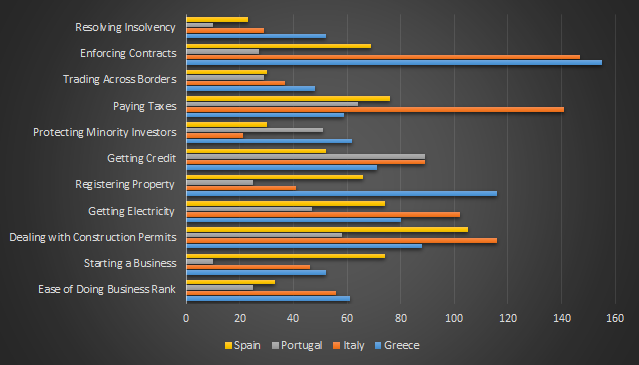
Figure 1: Doing Business rankings, PIGS, 2014
Source: World Bank Doing Business 2015.
All in all, Italy and Greece are a dog of a place to enforce a contract. The long-suffering taxpayer is better off paying taxes in Greece than in Italy! Not surprisingly, trading across borders is the greatest strength in doing business in the PIGS. The European Union does have some benefits.
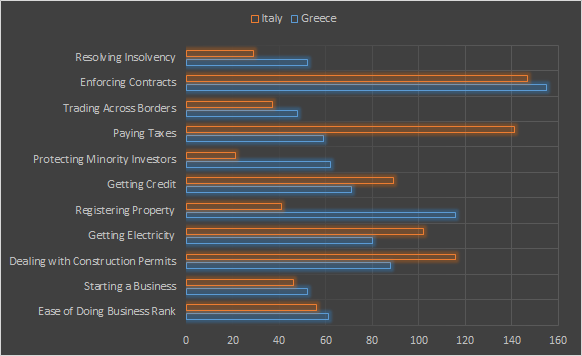
Figure 2: Doing Business rankings, Greece and Italy, 2014
Source: World Bank Doing Business 2015.
All in all, Italy and Greece are equally bad places to do business and Italy is much worse when it comes to taxes. About the only saving graces of Italy is the registration of property and the protection of minority interests in companies.
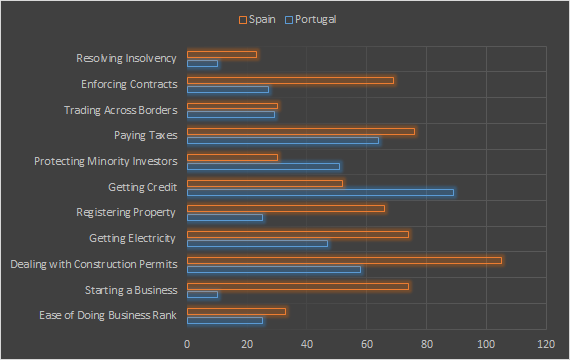
Figure 3: Doing Business rankings, Spain and Portugal, 2014
Source: World Bank Doing Business 2015.
Spain and in particular Portugal are much better places to do business than Italy and Greece.


Recent Comments