A firm with no employees is not a firm

Business demographic statistics in New Zealand include companies with zero employees and calls them a firm.

Source: Statistics New Zealand.

Every definition of a firm that I have seen refers to a firm as a relationship between employers, employees and others. There is team production or some sort of nexus of contracts or dependent assets, something social.

The notion is that transactions that normally take place in the market are taken out of the market and take place within the firm. Most profoundly, as Ronald Coase explained in 1937 in his seminal work The Nature of the Firm is what needs to be explained is the existence of the firm, with its

distinguishing mark … [of] the supersession of the price mechanism.

If there’s only one person in the firm, there is no one to transact with within the firm that the parties would normally have otherwise done in the market at arm’s length. There is no suppression of the price system, because all the dealings of the one person firm is with others. There are no transactions outside of the price system. As Barzel and Kochin explain when contrasting Ronald Coase’s theory of the firm with that of Alchian and Demsetz:

Even though they offer an alternative to Coase’s theory of the firm, their firm, nevertheless, is fundamentally a transaction cost phenomenon – it arises in response to the costs associated with measuring and policing various inputs and outputs.

Doug Allen, along with Eugene Fama, argue that all economic organisations are designed to maximise the gains from trade net of transaction costs. Other forms of organisation, forms of organisation that do not maximise the gains from trade net of transaction costs as well would not survive in market competition.

Transaction costs are defined by Allen as the costs of establishing and maintaining property rights. Yoram Barzel  defines (economic) property rights (in this paper, p. 394) as:

… an individual’s net valuation, in expected terms, of the ability to directly consume the services of the asset, or to consume it indirectly through exchange. A key word is ability: The definition is concerned not with what people are legally entitled to do but with what they believe they can do.

A property right, according to Alchian (1965, 1987) and Cheung (1969), is essentially the ability to enjoy a piece of property, but this ability to benefit from an asset or commodity, either directly, or indirectly through market exchange, is seldom unhindered. Eugene Fama observed that:

The striking insight of Alchian and Demsetz (1972) and Jensen and Meckling (1976) is in viewing the firm as a set of contracts among factors of production. In effect, the firm is viewed as a team whose members act from self-interest but realize that their destinies depend to some extent on the survival of the team in its competition with other teams.

If the firm consists only of the owner, there is no internal constraints on the establishment and maintenance of property rights because no one else is in the firm to cause any conflict. There is no nexus of contracts between different suppliers of production inputs whose destinies depend on the ability of them as a team to survive in competition with other teams.

Whatever constraints might arise about the ability of the owner to actually exercise property rights, none of these constraints arise internally to the firm because of the presence of employees or partners.

If there are no employees, if the firm only consist of the owner, the purpose of the firm, which is to make the incentives of workers compatible with those of owners is lost.

Firms, to be a firm, must have employees. If not employees, there must be at least more than one party involved, such as in a partnership.

Firms exist because it is cheaper to organize inputs within a firm than buy and sell in many different markets. This buying and selling requires a continual negotiation, renegotiation, enforcement and monitoring of contracts at arm’s length with independent suppliers of inputs. Barzel stressed this enforcement of property rights in an unpublished paper:

I hypothesize that the firm is organized for the express purpose of creating rights that are more economically enforced by non-state rather than by state means.

Many of these firms with zero employees in the New Zealand business demographic statistics, a classification that accounts for over 60% of all firms in New Zealand, are shelf companies or property investment companies.

There is no measuring and policing of inputs and outputs in a firm that has no employees and only an owner. These entities are not firms. They meet none of the criteria for a firm in the economics of industrial organisation.

This failure to distinguish between a firm and other forms of organisation leads the Minister of Economic Development to say unfortunate things such as:

97 per cent of enterprises in New Zealand are small businesses and have fewer than 20 employees.

Two thirds of that 97% of enterprises has no employees. Any discussion that pretends to know that there are too many or too few small and large firms in New Zealand should not be confused with other forms of organisation of capital that have nothing to do with the topic at hand, which is usually workplace productivity and entrepreneurial competence.

Many of these zero employee firms are not even economic organisations. They are legal mechanisms for exercising legal property rights. Including these property rights in business demographic statistics on business organisations is confusing.

Follies of Infrastructure: Why the Worst Projects Get Built, and How to Avoid It – Bent Flyvbjerg

I, Pencil versus Global Disinvestment Day in fossil fuels

I, Pencil is a 1958 classic economics polemic by Leonard Read explaining about how nobody knows how even the most basic items in a consumer society are made and more importantly, they don’t need to know.

The relevance of I, Pencil to environmental activists on Global Disinvestment Day is they pretend to know enough about the vast number of products made by the many companies within the average share portfolio to be out of work out whether these companies are investing in fossil fuels so they can sell their shares in them.

I, Pencil made the point that people simply don’t know how the most basic products are made, much less who made them, and with what. Even if they did know, this information would become rapidly out of date. The marvel of the market is the remarkably small amount of information that people need to go about their business. Prices summarise much of what people need to know.

The whole point of the separation of ownership and control in modern corporations such as those listed on share markets is shareholders simply have no chance of monitoring the day to day affairs of companies in which they invest.

Many shareholders have too small a stake to gain from monitoring managerial effort, employee performance, capital budgets, the control of costs and investment policies (Manne 1965; Fama 1980; Fama and Jensen 1983a, 1983b; Williamson 1985; Jensen and Meckling 1976). This lack of interest by small and diversified investors does not undo the status of the firm as a competitive investment.

Day-to-day management and risk bearing are split into separate tasks with various governance structures developed to ensure that the professional management teams serve the interests of the owners who invested in the company, along with their many other investments that compete for their attention. Large firms are run by managers hired by diversified owners because this outcome is the most profitable form of organisation to raise capital and then find the managerial talent to put this pool of capital to its most profitable uses (Fama and Jensen 1983a, 1983b, 1985; Demsetz and Lehn 1985; Alchian and Woodward 1987, 1988).

Firms who are not alert enough to develop cost effective solutions to incentive conflicts and misalignments will not grow to displace rival forms of corporate organisation and methods of raising equity capital and loans, allocating legal liability, diversifying risk, organising production, replacing less able management teams, and monitoring and rewarding employees (Fama and Jensen 1983a, 1983b; Fama 1980; Alchian 1950).

Indeed, our friends on the Left do go on about the power of boards of directors to set their own exorbitant salaries because shareholders lack of control them because they know so little about what they do.

That is, according to our friends on the Green Left, shareholders are not supposed to know enough about company performance and operations to work out if the salaries of top executives are justified. Top executive pay is always published in annual reports of companies.

Activist shareholders concerned about fossil fuel use nonetheless will be able to work out what the companies in their share portfolios are investing in and whether these investments are in fossil fuels. Details of these investments are much less public than the pay of top executives.

This continuous monitoring of corporate investment policies and associated buying and selling of shares will make investing in small parcels of shares in smaller companies listed on the share market rather expensive. Diversified share portfolios in index linked funds can have hundreds of companies in them. Some of these companies receive next to no media coverage that will simplify the cost to activist shareholders of monitoring their investments in fossil fuels.

A cheat sheet of 19 different business models

Measurement without theory alert: It’s Time For Companies To Fire Their Human Resource Departments – Forbes

Kyle Smith in Forbes today launched into human resource departments and called for their abolition. My hypothesis is he doesn’t understand why rigid, rule-bound human resource departments exist in the first place in large hierarchies. The fact that this form of organisation survives in competition with other forms of organisation and modern human resource management has been spreading rather the contracting in popularity over the recent decades is a test of its survival value in market competition.

Smith made the following claims:

  • 93 percent of the HR staffers deciding whether to call in someone for an interview were female, these tend to be young and single and hence still in the dating market for men so they’re jealous of beautiful women so they are less likely to call them in for an interviews because of their looks;
  • They speak gibberish: “Internal action learning.” “Being more planful in my approach.” “Human capital analytics.” “Result driven”;
  • HR employees are too absorbed in process and heedless of the big picture;
  • HR departments grossly overestimate the extent to which employees will recommend the company to a friend; and
  • HR places a disturbingly high premium on what it calls “communication skills”.

This is a classic example of measurement without theory. Of not having a theory to make sense of the facts and explain why this form of organisation – modern human resource departments – is survived and prospered in market competition.

The form of organisation that survives in competition with actual and potential market rivals is that specific form of organisation which allows the firm to deliver the products that customers want at the lowest price while covering costs (Alchian 1950; Fama and Jensen 1983a, 1983b).

Some larger firms may struggle with striking the most profitable balance between greater local managerial discretion and effective corporate governance of a large diverse organisation with professional managers and diffuse ownership structures. It will be shown that very large firms promulgate rigid personnel policies while smaller firms are much more flexible in their deals with individual employees.

Competition between different sizes, shapes and internal organisational forms of firms all vying for sales, cheaper sources of supply and investor support sifts out the keener priced, lower cost, and more innovative enterprises (Alchian 1950; Stigler 1958). These lower-cost firms will be able to under-sell their higher cost rivals. The winning size and shape is that configuration which meets any and all problems the firm is actually facing and seizes more of the entrepreneurial opportunities that are within its grasp (Stigler 1958; Alchian 1950).

As the size of a firm grows, important information is less likely to find its way up hierarchies and reach the appropriate decision-makers and be up-to-date and be comprehended if it does. The top of corporate hierarchies can be overwhelmed with information and much of what information they do receive can be old, incomplete, conflicting and garbled (Williamson 1967, 1975).

Larger firm respond to this loss of up-to-date knowledge of the local circumstances of time and place with a greater dependence on broad rules (Oi 1983a, 1983b, 1988, 1990). For this reason, larger employers will be less effective in assessing individual attributes of employees and assigning employees to the most productive task (Parsons 1997).

Larger firms offset this competitive disadvantage by specialising in the production of standardised goods with larger teams of more homogeneous, more highly trained workers; smaller firms produce more customised goods produced in smaller quantities by smaller teams of less specialised employees (Oi 1983a, 1983b; Oi and Idson 1999). Smaller firms can quickly adapt to changing circumstances of all kinds because top management are closer to and better informed about all operations, employees and customers.

If large firms are to survive in competition, the personnel policies of larger employers must adapt to offset the diseconomies of scale in idiosyncratic decisions by relying on broad inflexible rules. These top-down rules will leave far less discretion in the hands of local managers. This is because the higher layers in a large corporate hierarchy cannot control and direct lower layers that behave in an increasing diversity of ways to the same information and to local events that do not affect the rest of the firm.

Planning and coordination costs increase with organisational size. There will be errors in assigning tasks, deciding rewards, and monitoring performance. Information flows and co-ordination become problems that only increase with the size if the firm. It can be cheaper to monitor compliance with rules and issue general instructions that apply to all employees.

Limits on the degree of local managerial discretion over employment relations in large managerial firms can arise from restrictions on managerial delegations, divided decision making rights, hierarchical approval procedures, and the breath and content of wage and personnel policies. The discretion of supervisors in large firms may be limited to individual performance ratings (Gibbs and Hendricks 2004). Some large firms may have no process or policy to handle requests for a phased retirement.

Good evidence to illustrate the proposition that larger firms prefer rigid rules over discretion in personnel policies comes from the days of mandatory retirement. Mandatory retirements can be viewed as the wholesale substitution of local managerial discretion with a single company-wide rule because larger firms find idiosyncratic decisions to be more costly (Parsons 1997).

Mandatory retirements are near universal in very large workplaces, but in small to medium size firms, there were flexible retirement polices. Few very large firms reported flexible retirement polices.

Smaller firms provided for policies that allowed for exceptions to mandatory retirement rules while most of largest firm reported a policy of zero exceptions to mandatory retirement rules (Parsons 1997). This U.S. evidence from the time of mandatory retirements suggests that larger employers may find it more difficult to handle the idiosyncrasies of phased retirements.

A price of growth in the size of firms is often the standardisation of products, workforce compositions and terms of employment. Standardisation in larger firms constrains wages, reduces managerial slack and aggrandisement, and facilitates performance evaluations and yardstick competition between divisions.

Large employers write personnel policies to govern most aspects of the employment relationship. These human resources policies will be common to all employees and all revisions and exceptions require central approval.

More centralised human resources policies that limit supervisor discretion can reduce favouritism and the cost of employees wasting working time on attempts to influence line managers about their pay and working hours.

The price of more centralised human resources policies is less local adaptability to genuine opportunities. The offset is centralised personnel policies save on the costs to the firm of having to gather and process up and back down a large corporate hierarchy the information need to make decisions with more localised finesse. These rule-bound decisions are less deft but are also cheaper to make.

In other areas, large firms will take steps to empower local managers and foil ill-informed intervention from above to put decisions where the knowledge is held. Reporting and decision procedures and performance pay can all craft a sufficient amount of distance between managerial layers to create an adequate amount delegation to take advantage of local knowledge and overcome the costs of slow and garbled information transfer in hierarchies, managerial overload, and the losses from decisions lagging behind in dynamic and unpredictable environments.

Smaller firms survive and profit from being small because their size allows them to succeed with more workforce diversity and more customised products. The owners are know more and can be directly involved in management. Owner-managers can quickly adapt to new conditions with fewer risks and can sidestep the need to develop policies on phased retirements or revise it on the spot in light of an unforeseen or low-probability contingency.

One reason for larger firms paying higher wages by industry standards is as compensation to offset their requirements for more standardised hours of work. The efforts of the more able entrepreneurs to deploy their talents wisely result in systematic differences in the organisation of production and the structure of the workforces that firms employ. Smaller employers pay less in wages but can offer more flexible work hours. The wage premiums offered in large firms are in part because of their organisational rigidity.

Rigid, rule-bound HR department is doing its job to the letter because this constrains line managers from favouritism and been lobbied for favours by employees was they have very little control over terms and conditions of employment and promotions and perhaps only have input into performance ratings.

A major reason why companies limit pay reviews and performance promotion rounds to an annual process is to prevent everyone wasting time between these annual events on lobbying for pay rises and promotions The HR department is the guardian of the gate to ensure there is no favouritism because it enforces rules rigidly.

The nub of the problem is large firms have several layers of management with fairly strict limits on what each individual line manager can do (Williamson 1975, 1985; Fama and Jensen 1983b). There must be some limits on local managerial discretion because the owners and senior managers of any firm set the strategic direction of the firm, the products it sells, and how many workers are employed and on what wages. All parts of the firm must march in the same direction.

The discovery of monitoring or incentive systems that induce managers to act in the best interest of shareholders are entrepreneurial opportunities for pure profit (Fama and Jensen 1983b, 1985; Alchian and Woodward 1987, 1988; Demsetz 1983, 1986; Demsetz and Lehn 1985; Demsetz and Villalonga 2001).

Investors will not entrust their funds to who are virtual strangers unless they expect to profit from a specialisation and a division of labour between asset management and managerial talent and in capital supply and residual risk bearing (Fama 1980; Fama and Jensen 1983a, 1983b; Demsetz and Lehn 1985). There are other investment formats that offer more predictable, more certain rate of returns.

One type of corporate waste is uncompetitive staff retention policies. The risks to dividends and capital because of this and other manifestations of corporate waste, reduced employee effort, and managerial slack and aggrandisement in large managerial firms are risks that are well known to investors (Jensen and Meckling 1976; Fama and Jenson 1983b). Corporate waste and managerial slack also increase the chances of a decline in sales and even business failure because of product market competition (Fama 1980; Fama and Jensen 1983b).

The reward for forming a well-disciplined managerial firm despite the drawbacks of diffuse ownership is the ability to raise large amounts in equity capital from investors seeking diversification and limited liability (Demsetz 1967; Jensen and Meckling 1976; Fama 1980; Fama and Jensen 1983b; Demsetz and Lehn 1985).

Competition from other firms will force the evolution of devices within the firms that survive for the efficient monitoring the performance of the entire team of employees and of individual members of those teams as well as managers (Fama 1980, Fama and Jensen 1983a, 1983b; Demsetz and Lehn 1985).

Managerial firms who are not alert enough to develop cost effective solutions to incentive conflicts and misalignments will not grow to displace rival forms of corporate organisation and methods of raising equity capital and loans, allocating legal liability, diversifying risk, organising production, replacing less able management teams, and monitoring and rewarding employees (Fama and Jensen 1983a, 1983b; Fama 1980; Alchian 1950).

Entrepreneurs will win profits from creating corporate governance structures that can credibly assure current and future investors that their interests are protected and their shares are likely to prosper (Fama 1980; Fama and Jensen 1983a, 1983b, 1985; Demsetz 1986; Demsetz and Lehn 1985). Corporate governance is the set of control devices that are developed in response to conflicts of interest in a firm (Fama and Jensen 1983b).

A risk of greater local managerial discretion in a large firm is less effective governance (Williamson 1975, 1985; Fama and Jensen 1983a, 1983b). The separation of decision management rights, vested in hired managers, from decision control rights, vested in the board of directors, is a common governance safeguard against conflicts of interest in business, professional and non-profit organisations, large and small (Fama and Jensen 1983a, 1983b).

Decision management rights cover the initiation and the implementation of decisions. Decision control rights involve the ratification and the monitoring of decisions. Managers and division heads carry out the production decisions, budgets and policies on wages, hours, staffing and job designs developed by head office and which are ratified by the board of directors (Fama and Jensen 1983b, 1985).

Managerial firms survive in market competition because divided decision rights and limits on the local discretion of expert managers and corporate boards increase investment returns net of greater scope for managerial slack and the inflexibilities of growing hierarchies (Fama and Jensen 1983b; Demsetz and Lehl 1985; Alchian 1950). More local managerial discretion over conditions of employment and hours of work may strike at the heart of the governance structures that allow many large firms to emerge, survive and prosper despite their separation of ownership from control.

In contrast, entrepreneurial firms are owned and managed by the same people (Fama and Jensen 1983b). Mediocre personnel policies and sub-standard staff retention practices within entrepreneurial firms are disciplined by these errors in judgement by owner-managers feeding straight back into the returns on the capital that these owner-managers themselves invested. Owner-managers can learn quickly and can act faster in response the discovery of errors in judgement.

The owners of a managerial firm advance, withdraw, and redeploy capital, carry the residual investment risks of ownership and have the ultimate decision making rights over the fate of the firm (Klein 1999; Foss and Lien 2010; Fama 1980; Fama and Jensen 1983a, 1983b; Jensen and Meckling 1976). Owners of a managerial firm, by definition, will delegate control to expert managerial employees appointed by boards of directors elected by the shareholders (Fama and Jensen 1983a, 1983b).

The owners of a managerial firm will incur costs in observing with considerable imprecision the actual efforts, due diligence, true motives and entrepreneurial shrewdness of the managers and directors they hired (Jensen and Meckling 1976; Fama and Jensen 1983b).

Poor cost control, budgetary excess and any lack of innovation and initiative over products designs and pricing, input mixes and wage and employment polices will reflect in relative divisional performances and overall corporate profits of a managerial firm.

Any news of less promising current and future net cash flows will feed into share prices and into the labour market prospects of both career managers and the members of boards of directors (Manne 1965; Fama 1969, 1970; Fama and French 2004; Jensen and Meckling 1976; Fama and Jensen 1983a, 1983b; Demsetz 1983; Demsetz and Lehn 1985). To survive, managerial firms must balance delegation with more centralised control (Fama and Jensen 1983a; McKenzie and Lee 1998).

Managerial firm have HR departments, and will continue to have HR departments because their objective is to limit the discretion of individual line managers and ensure that they carry out corporate objectives.

Smaller firms are more likely to be entrepreneurial firms where the owner-managers are on the spot to make the key decisions and keep things in line.

The marvel of the market: the remarkable foresight of young adults in choosing what to study

Known but yet to be exploited opportunities for profit do not last long in competitive markets, including hitherto unnoticed opportunities for the greater utilisation and development of skills and experience (Hakes and Sauer 2006, 2007; Ryoo and Rosen 2004; and Kirzner 1992). Moneyball is the classic example of entrepreneurial alertness to hitherto unexploited job skills which were quickly adopted by competing firms (Hakes and Sauer 2006, 2007).

There is considerable evidence that the demand and supply of human capital responds to wage changes. For example, over- or under-supplied human capital moves either in or out in response to changes in wages until the returns from education and training even out with time (Ryoo and Rosen 2004; Arcidiacono, Hotz and Kang 2012; Ehrenberg 2004).

As evidence of this equalisation of returns on human capital investments across labour markets, the returns to post-school investments in human capital are similar – 9 to 10 percent – across alternative occupations, and in occupations requiring low and high levels of training, low and high aptitude and for workers with more and less education (Freeman and Hirsch 2001, 2008). There is evidence that workers with similar skills in similarly attractive jobs, occupation and locations earn similar pay (Hirsch 2008; Vermeulen and Ommeren 2009; Rupert and Wasmer 2012; Roback 1982, 1988).

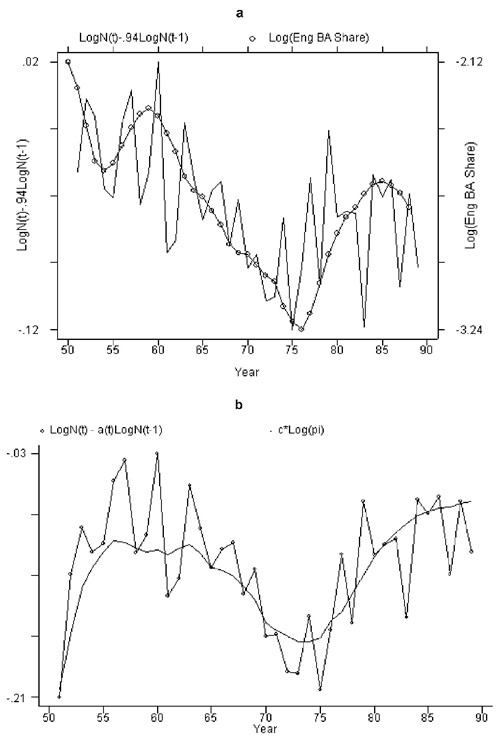
Ryoo and Rosen (2004) found that the labour supply and university enrolment decisions of engineers is “remarkably sensitive” to career earnings prospects. Graduates are the main source of new engineers. Engineers who moved out into other occupations such as management did not often moved back to work again as professional engineers. Ryoo and Rosen (2004) observed when summarising their work that:

 Both the wage elasticity of demand for engineers and the elasticity of supply of engineering students to economic prospects are large. The concordance of entry into engineering schools with relative lifetime earnings in the profession is astonishing.

Ryoo and Rosen (2004) found several periods of surplus in the market for engineers. These periods of shortage or surplus corresponded to unexpected demand shocks in the market for engineers such as the end of the Cold War.

Figure 1: New entry flow of engineers: a, actual vs. imputed from changes in stock of engineers; b, time-varying coefficients.

Source: Ryoo and Rosen (2004)

Ryoo and Rosen (2004) noted that importance of permanent versus transitory changes in earnings. Transitory rises and falls in earnings prospects have much less influence on occupational choices and the educational investments of students.

In light of these findings that the supply of engineers rapidly adapted to changing market conditions, Ryoo and Rosen (2004) questioned whether public policy makers have better information on future labour market conditions than labour market participants do. When politicians get worked up about skill shortages, the markets for scientists and engineers often where they make extravagant claims about the ability of the market to adapt to changing conditions because of the long training pipeline involved in university study, including at the graduate level.

There can be unexpected shifts in the supply or demand for particular skills, training or qualifications. These imbalances even themselves out once people have time to learn, update their expectations and adapt to the new market conditions (Rosen 1992; Ryoo and Rosen 2004; Bettinger 2010; Zafar 2011; Arcidiacono, Hotz and Kang 2012; Webbink and Hartog 2004).

For example, Arcidiacono, Hotz and Kang (2012) found that both expected earnings and students’ abilities in the different majors are important determinants of student’s choice of a college major, and 7.5% of students would switch majors if they made no forecast errors.

The wage premium for a tertiary degree was low and stable in New Zealand in the 1990s (Hylsop and Maré 2009) and 2000s (OECD 2013). This stability in the returns to education suggests that supply has tended to kept up with the demand for skills at least over the longer term at the national level. There were no spikes and crafts that would be the evidence of a lack of foresight among teenagers in choosing what to study.

All in all, the remarkable sensitivity of engineers to a career earnings prospects, the frequent changes of college majors by university students in response to changing economic opportunities, and the stability of the returns on human capital over time suggest that the market for human capital is well functioning.

The argument that the market was not working well was assumed rather than proven. Likewise, the case for additional subsidies for science, technology, engineering and mathematics because of perceived skill shortages has not been made out. There is a large literature showing that the market for professional education works well.

The onus is on those who advocate intervention to come up with hard evidence, rather than innate pessimism about markets that are poorly understood because of a lack of attempts to understand it. Studies dating back to the 1950s by George Stigler and by Armen Alchian found that the market for scientists and engineers works well and the evidence of shortages were more presumed than real.

Robert Lucas and where have all the small entrepreneurs gone?


Robert Lucas predicted the decline in the number of small business people and small firms in 1978. The number of small firms will fall and the number of large firms will rise with increases in real wages (Lucas 1978; Poschke 2013; Gollin 2008; Eeckhout and Jovanovic 2012).

Lucas closed his 1978 discussion of the size distribution of firms, and how firms are getting larger an average over the course of the 20th century, with a discussion of a lovely restaurant he visited on the Canadian border. He predicted that in couple of decades time, these type of restaurants will be fewer.

Nations that are more productive  over time and have higher wages because they have accumulated more capital per worker.

One consequence of more capital per worker is real wages increase at a faster rate than profits (Gollin 2008; Eeckhout and Jovanovic 2012). For example, the rate of return on capital was stable over the 20th century while real wages increased many fold (Jones and Romer 2010). This relationship turns out  to be crucial in terms of occupational choice and the decision to become an entrepreneur – a small business owner

Higher wages reduces the supply of entrepreneurs and increases the average size of firms because entrepreneurship becomes a less attractive occupational choice (Lucas 1978; Gollin 2008; Eeckhout and Jovanovic 2012).

For example, in the mid-20th century, many graduates who were not teachers were self-employed professionals. With an expanding division of labour because of economic growth, many well-paid jobs and new occupations emerged for talented people in white-collar employment.

OECD countries richer than New Zealand should have less self-employment and more firms that are large because paid employment is an increasingly better-rewarded career option for their high skilled workers.

The U.S. had the second lowest share of self-employed workers (7 per cent) in the OECD in 2010 – the latest data – which is less than half the rate of New Zealand self-employment (16.5 per cent) in 2011 (OECD 2013). The Australian self-employment rate was 11.6 per cent in 2010 (OECD 2013).

A companion reason for larger average firm sizes in countries richer than New Zealand is more capital-intensive production can prosper in larger corporate hierarchies than can labour-intensive production (Lucas 1978; Becker and Murphy 1992; Poschke 2011; Eeckhout and Jovanovic 2012).

The more able entrepreneurs can run larger firms with bigger spans of control in richer countries because their employees can profitably use more capital per worker with less supervision. The diseconomies of scale to management and entrepreneurship should rise at a faster rate in less technological advanced countries such as New Zealand because they are more labour intensive economies (Lucas 1978; Becker and Murphy 1992; Poschke 2011; Eeckhout and Jovanovic 2012).

Importantly, the more able entrepreneurs benefit most from introducing frontier technologies because they can deal more easily with their increased complexity and more uncertain prospects (Poschke 2011; Lazear 2005; Shultz 1975; 1980). Growing technological complexity reduces the supply of entrepreneurs because it takes longer to acquire the necessary balance of skills and experience needed to lead a firm (Lazear 2005; Otani 1996).

The more marginal entrepreneurs will switch to be employees as technology advances so the average size of firms will increase. The entrepreneurs that remain in business will be the most able, more skilled and more experienced entrepreneurs and will be more capable of running larger firms that pioneer complex, frontier technologies (Poschke 2011; Lazear 2005, Otani 1996; Lucas 1978).

Countries more technologically advanced than New Zealand will have both larger firms and less self-employment because of growing technological complexity.

The greater is the exposure to foreign competition, the smaller is the fraction of self-employed and small firms in a country (Melitz 2003; Díez and Ozdagli 2012). More foreign competition increases wages because of lower prices, which makes self-employment less lucrative. More exporting favours larger firms both because of the fixed costs of entering export markets and because the stiffer competition will weed-out the lower ability entrepreneurs who run the smaller firms (Melitz 2003; Díez and Ozdagli 2012).

Other factors can countermand the effects that occupational choice, frontier technologies, exporting and capital intensity have to increase the average size of firms as real wages rise.

For example, tax and regulatory policies reduce the average size of firms in many EU member states to levels that are similar to New Zealand. The EU is less likely to have large firms in its labour intensive sectors. Employment protection laws, product market and land use regulation and in particular, high taxes stifled the growth of labour intensive services sectors in the continental EU (Bertrand and Kramatz 2002; Bassanini, Nunziata and Venn 2009; Rogerson 2008).

EU firms are are more capital intensive with fewer employees than otherwise because labour is so expensive to hire in the EU. Small and medium sized firms can struggle to grow in much of the EU because of regulatory burdens that phase in with firm size (Garicano, Lelarge and Van Reenen 2012; Hobijn and Sahin 2013; Rubini, Desmet, Piguillem and Crespo 2012). Average firm sizes are 40% smaller in Spain and Italy than in Germany. Obstacles to firm growth originate in product, labour, technology and financial and the binding constraints differ from one EU member state to another (Rubini, Desmet, Piguillem and Crespo 2012).

Average firm sizes in the USA and UK may be larger because of fewer tax and regulatory policies that limit business growth. Bartelsman, Scarpetta and Schivardi (2005) found that new entrants in the U.S. started on a smaller scale than in Europe but grew at a much higher rate. This willingness to experiment on a smaller scale was worth the risk because the payoff was much larger in terms of growth in the more flexible U.S. markets.

In summary, many factors drive the size distribution of firms countries including taxation and regulation. Underlying this, nonetheless, is Lucas’s point from 1978 that rising real wages makes starting a small business a less inviting occupation choice.

Alchian and Demsetz on the moral stature of property rights

Image

Eugene Fama on the role of the entrepreneur in the theory of the firm

Image

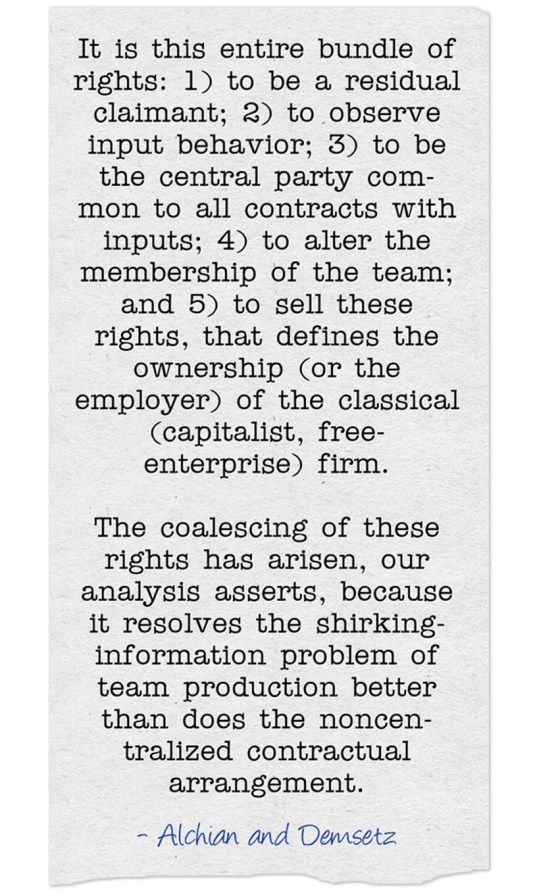
Alchian and Demsetz define the classic capitalist firm

Image

Yoram Barzel on what is a firm

Image

A simple definition of the firm by Doug Allen

Image

Joseph Schumpeter, economic growth, and creative destruction

Alchian and Allen on the role of mathematics in the education of an economic student

Image

Ronald Coase on the emergence of the firm

Image

Previous Older Entries Next Newer Entries

Bassett, Brash & Hide

Celebrating humanity's flourishing through the spread of capitalism and the rule of law

Truth on the Market

Scholarly commentary on law, economics, and more

The Undercover Historian

Beatrice Cherrier's blog

Matua Kahurangi

Celebrating humanity's flourishing through the spread of capitalism and the rule of law

Temple of Sociology

Celebrating humanity's flourishing through the spread of capitalism and the rule of law

Velvet Glove, Iron Fist

Celebrating humanity's flourishing through the spread of capitalism and the rule of law

Why Evolution Is True

Why Evolution is True is a blog written by Jerry Coyne, centered on evolution and biology but also dealing with diverse topics like politics, culture, and cats.

Down to Earth Kiwi

Celebrating humanity's flourishing through the spread of capitalism and the rule of law

NoTricksZone

Celebrating humanity's flourishing through the spread of capitalism and the rule of law

Homepaddock

A rural perspective with a blue tint by Ele Ludemann

Kiwiblog

DPF's Kiwiblog - Fomenting Happy Mischief since 2003

The Dangerous Economist

Celebrating humanity's flourishing through the spread of capitalism and the rule of law

Watts Up With That?

The world's most viewed site on global warming and climate change

The Logical Place

Tim Harding's writings on rationality, informal logic and skepticism

Doc's Books

A window into Doc Freiberger's library

The Risk-Monger

Let's examine hard decisions!

Uneasy Money

Commentary on monetary policy in the spirit of R. G. Hawtrey

Barrie Saunders

Thoughts on public policy and the media

Liberty Scott

Celebrating humanity's flourishing through the spread of capitalism and the rule of law

Point of Order

Politics and the economy

James Bowden's Blog

A blog (primarily) on Canadian and Commonwealth political history and institutions

Science Matters

Reading between the lines, and underneath the hype.

Peter Winsley

Economics, and such stuff as dreams are made on

A Venerable Puzzle

"The British constitution has always been puzzling, and always will be." --Queen Elizabeth II

The Antiplanner

Celebrating humanity's flourishing through the spread of capitalism and the rule of law

Bet On It

Celebrating humanity's flourishing through the spread of capitalism and the rule of law

History of Sorts

WORLD WAR II, MUSIC, HISTORY, HOLOCAUST

Roger Pielke Jr.

Undisciplined scholar, recovering academic

Offsetting Behaviour

Celebrating humanity's flourishing through the spread of capitalism and the rule of law

JONATHAN TURLEY

Res ipsa loquitur - The thing itself speaks

Conversable Economist

Celebrating humanity's flourishing through the spread of capitalism and the rule of law

The Victorian Commons

Researching the House of Commons, 1832-1868

The History of Parliament

Articles and research from the History of Parliament Trust

Books & Boots

Reflections on books and art

Legal History Miscellany

Posts on the History of Law, Crime, and Justice

Sex, Drugs and Economics

Celebrating humanity's flourishing through the spread of capitalism and the rule of law

European Royal History

Exploring the Monarchs of Europe

Tallbloke's Talkshop

Cutting edge science you can dice with

Marginal REVOLUTION

Small Steps Toward A Much Better World

NOT A LOT OF PEOPLE KNOW THAT

“We do not believe any group of men adequate enough or wise enough to operate without scrutiny or without criticism. We know that the only way to avoid error is to detect it, that the only way to detect it is to be free to inquire. We know that in secrecy error undetected will flourish and subvert”. - J Robert Oppenheimer.

STOP THESE THINGS

The truth about the great wind power fraud - we're not here to debate the wind industry, we're here to destroy it.

Lindsay Mitchell

Celebrating humanity's flourishing through the spread of capitalism and the rule of law

Alt-M

Celebrating humanity's flourishing through the spread of capitalism and the rule of law

croaking cassandra

Economics, public policy, monetary policy, financial regulation, with a New Zealand perspective

The Grumpy Economist

Celebrating humanity's flourishing through the spread of capitalism and the rule of law

International Liberty

Restraining Government in America and Around the World