Why America refuses to sign climate treaties that don’t include the BRICs
12 May 2015 Leave a comment
in environmental economics, global warming, international economic law, international economics Tags: climate alarmism, climate treaties, free riding, game theory, global warming
Hypocritical Greens betray NZ sovereignty to US court decision but oppose investor state dispute settlement on sovereignty grounds
10 May 2015 Leave a comment
in defence economics, economics of crime, international economic law, international economics, International law, law and economics, politics - New Zealand, politics - USA Tags: foreign policy, free trade agreements, green hypocrisy, green party, investor state disputes settlement, national security, preferential trading agreements, war against terror
The Greens are happy to betray New Zealand’s sovereignty to a US court where New Zealand’s side of the story was not heard, New Zealand was not a litigant, New Zealand was not named in the proceedings and New Zealand had not agreed to waive its sovereign immunity under US law.
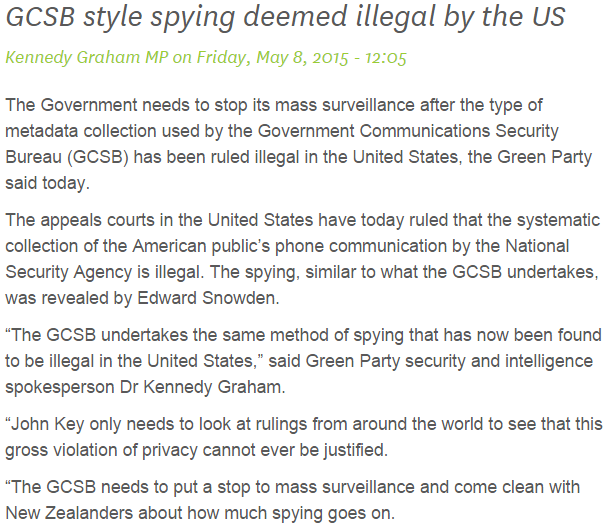
The Greens on the other hand are hysterical about the prospect of New Zealand voluntarily submitting to investor state disputes settlement through an international treaty. International treaties normally are about trading in sovereignty: you give up some form of sovereignty return for something you value more.
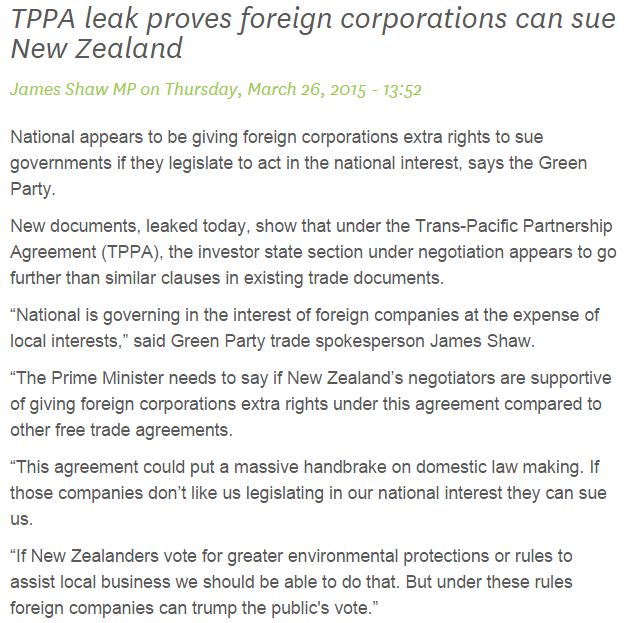
It is thoroughly hypocritical of the Greens to argue the New Zealand should bow down to a foreign court when that court rules in a way that it favours its ideological agenda but refuse to support the principle of international arbitration in circumstances where that may advance New Zealand’s national interests.
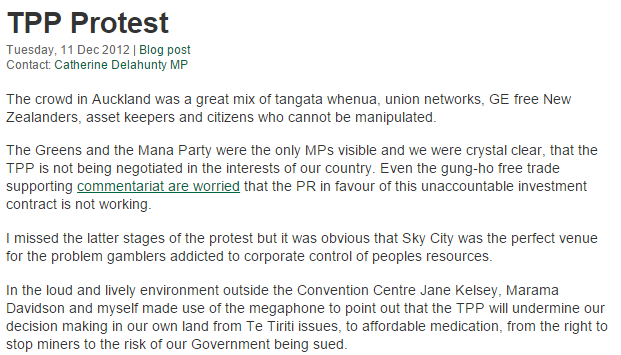
At a minimum, New Zealand itself chose to give up its sovereignty if it agrees to investor state dispute settlement in a trade agreement. The decision was not imposed by a foreign court where it was not heard nor was a party.


Of particular concern to the Greens is international arbitration could "trump the public’s vote vote". New Zealand has repeatedly elected parties that support the alliance with America, and support a robust security and intelligence policy, including electronic surveillance as part of the war on terror.
The last week of the 2014 general election campaign was dominated by the Government Security Communications Bureau and its cooperation with the National Security Agency and the extent to which New Zealand security services engaged in electronic surveillance in New Zealand and abroad.
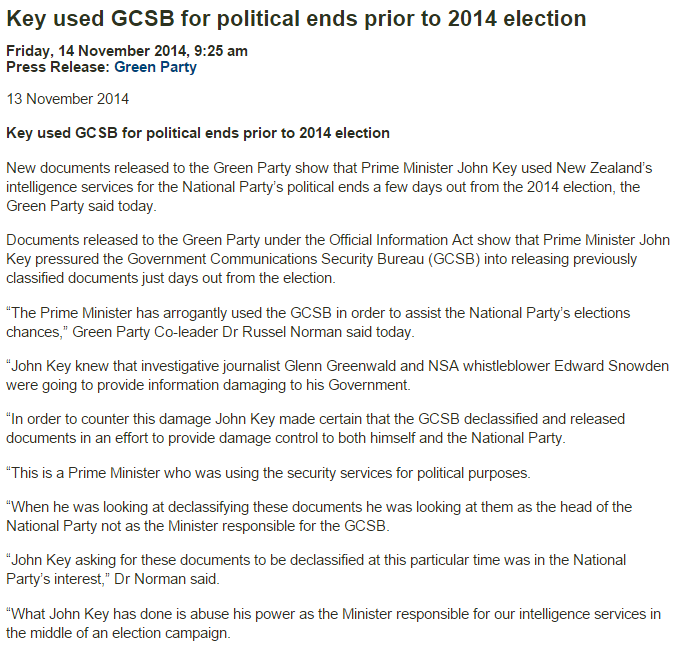
The Greens want to subvert that democratic decision that has been repeated over many New Zealand elections about national security and foreign relations to defer to an American court when New Zealand didn’t even appear as a party.

The US Court of appeal was deciding an issue of statutory interpretation of the Patriot Act. There was no constitutional issues at hand.
The Patriot Act expires in a month unless it is extended. Congress has ample opportunity to amend the renewed law to overturn the appeal court’s decision for the future operation of its security and intelligence laws.
The Greens want a Court of Appeal interpretation of the American Patriot Act to extend to New Zealand without a vote of the New Zealand people or the parliament having any say on whether to give up New Zealand’s sovereignty or waive sovereign immunity in American courts.
.
Senator Warren made a good case against Investor-State Dispute Settlement in the TPP
09 May 2015 Leave a comment
in economic history, economics of regulation, entrepreneurship, industrial organisation, international economic law, international economics, law and economics, politics - Australia, politics - New Zealand, politics - USA, property rights Tags: Australian productivity commission, free trade agreements, investor state disputes settlement, Leftover Left, preferential trade agreements, Senator Elizabeth Warren, Twitter left
In the Washington Post a few months ago, Senator Elizabeth Warren made a balanced case against investor state dispute settlement, not only in the Trans-Pacific Partnership. But in any trade agreement.
Apart from a few rushes of blood in rhetoric to appeal to her base, she made reasoned arguments, good use of history, and put up constructive alternatives to what she was criticising. Furthermore, she put forward arguments that appealed to every point in the political spectrum. The Left over Left critics of investor state disputes settlement clauses in trade agreements in New Zealand never do that.
She echoed arguments I have made the at investor state disputes settlement clauses have no place in trade agreements between liberal democracies.
Liberal democracies have independent courts and honest politics where everyone gets a fair go. That means sometimes you’re on the losing side of politics, but you as free to persuade the majority that they are mistaken. That is democracy in action: sometimes you win, sometimes you lose and there is an election in a few years where you can get another go.
New Zealand has a Closer Economic Relations Agreement with Australia. One provision is a requirement that in most cases New Zealanders are treated the same as Australians under Australian law.
To explain this, some years ago, a New Zealand television production company successfully sued the Australian television regulator to have New Zealand made television shows recognised as Australian content under the 50% Australian content regulations for free-to-air television in Australia.
Note the New Zealand business sued in the Federal Court of Australia and won. They had their day in court.
Senator Warren makes the point that if a business in the USA is unhappy with a regulation, they can challenge by normal democratic and legal means, which investor state disputes settlement undermines:
If a foreign company that makes the toxic chemical opposes the law, it would normally have to challenge it in a U.S. court. But with ISDS, the company could skip the U.S. courts and go before an international panel of arbitrators. If the company won, the ruling couldn’t be challenged in U.S. courts, and the arbitration panel could require American taxpayers to cough up millions — and even billions — of dollars in damages.
Senator Warren also provides a good history of the emergence of investor state disputes settlement and the relevance of that history to contemporary developments:
But after World War II, some investors worried about plunking down their money in developing countries, where the legal systems were not as dependable. They were concerned that a corporation might build a plant one day only to watch a dictator confiscate it the next. To encourage foreign investment in countries with weak legal systems, the United States and other nations began to include ISDS in trade agreements.
Investor state disputes settlement were indeed created to protect businesses that did not have robust democracies and legal systems. Would be international investors in one of these countries were promised international redress if there was a coup, a takeover of their investments or some other unforeseen negative impact because sovereign risk.
She then asked why are these provisions in trade agreements with liberal democracies where they have no relevance:
Those justifications don’t make sense anymore, if they ever did. Countries in the TPP are hardly emerging economies with weak legal systems. Australia and Japan have well-developed, well-respected legal systems, and multinational corporations navigate those systems every day, but ISDS would pre-empt their courts too.
Senator Warren also makes a good point that investor state disputes settlement undermines competition between legal jurisdictions and the rewards for having a sound legal system:
…to the extent there are countries that are riskier politically, market competition can solve the problem. Countries that respect property rights and the rule of law — such as the United States — should be more competitive, and if a company wants to invest in a country with a weak legal system, then it should buy political-risk insurance.
Political risk is is an entrepreneurial opportunity for the insurance market. The World Bank’s Multilateral Investment Guarantee Agency provides insurance to those investing in developing countries against expropriation (including indirect expropriation), as well as acts of war and terrorism. Export Finance schemes of many governments offer political risk Insurance. Anyone who travels in the less safe countries of the world routinely buys travel insurance.
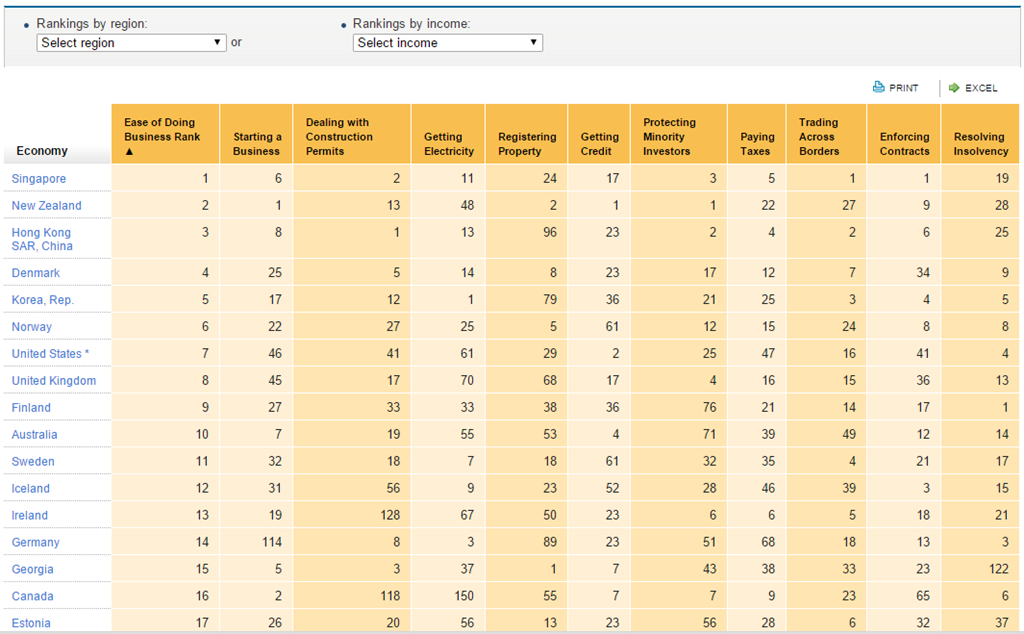
The World Bank puts out an annual index on ease of doing business in every country of the world so foreign investors can’t say they won’t warned of the risks they were taking for the profits they sought.
Investor state disputes that were indeed referred to international arbitration used to be rare. Now they are more common as Senator Warren explains:
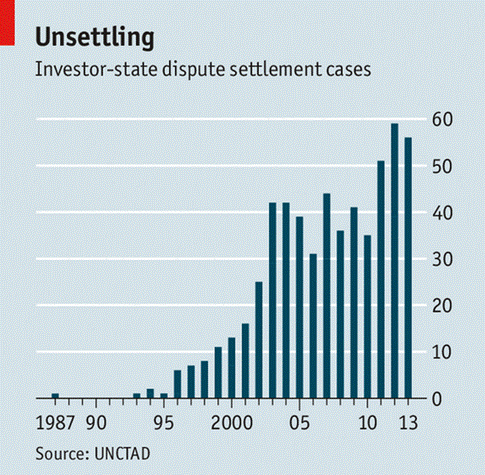
From 1959 to 2002, there were fewer than 100 ISDS claims worldwide. But in 2012 alone, there were 58 cases.
Recent cases include a French company that sued Egypt because Egypt raised its minimum wage, a Swedish company that sued Germany because Germany decided to phase out nuclear power after Japan’s Fukushima disaster, and a Dutch company that sued the Czech Republic because the Czechs didn’t bail out a bank that the company partially owned. U.S. corporations have also gotten in on the action: Philip Morris is trying to use ISDS to stop Uruguay from implementing new tobacco regulations intended to cut smoking rates.
In a response to Senator Warren’s op-ed, Gary Clyde Hufbauer said:
…only 13 ISDS cases have been brought to judgment against the United States. The United States has not lost a single case.
Why? Because the United States does not expropriate private property without compensation, and the United States does not enact arbitrary or discriminatory laws against foreign firms. Contrary to what the Senator implies, American taxpayers have not had to cough up millions and even billions of dollars in damages. They have not had to cough up anything.
The best part of Senator Warren’s op-ed is when she appeals to all points of the political spectrum based on arguments that do indeed appealed to them:
Conservatives who believe in U.S. sovereignty should be outraged that ISDS would shift power from American courts, whose authority is derived from our Constitution, to unaccountable international tribunals. Libertarians should be offended that ISDS effectively would offer a free taxpayer subsidy to countries with weak legal systems. And progressives should oppose ISDS because it would allow big multinationals to weaken labour and environmental rules.
Senator Warren did make a good case against investor state disputes settlement, particularly between liberal democracies. Foreign investors should take their chances in domestic politics and the courts like the rest of us. They’ve invested in a liberal democracy with independent courts, honest politicians and a commitment to a market economy.

Investor state disputes settlement clauses in trade agreements allow foreign investors to sue the host country for laws, policies, or court decisions they find objectionable. This gives foreign investors more rights than local investors; more influence than local citizens. That is contrary to equality before the law, which is the essence of liberalism.

The point that the Twitter Left rarely makes against investor state disputes settlement, and Senator Warren goes a way towards making is the shield offered by investor state disputes settlement clauses against predatory, corrupt governments in underdeveloped countries, many of which were socialist kleptocracies, has become a sword against regulations that arise in any liberal democracy that were sought and obtained through normal democratic means.
The Australian Productivity Commission held a public inquiry into regional and bilateral trade agreements in 2010. The commission specifically addressed investor state disputes settlement in its subsequent report:
1. There does not appear to be an underlying economic problem that necessitates the inclusion of ISDS provisions within agreements. Available evidence does not suggest that ISDS provisions have a significant impact on investment flows.
2. Experience in other countries demonstrates that there are considerable policy and financial risks arising from ISDS provisions.
The Productivity Commission concluded that investor state dispute settlement provisions are just not worth bargaining coin:
Nor, in the Commission’s assessment, is it advisable in trade negotiations for Australia to expend bargaining coin to seek such rights over foreign governments, as a means of managing investment risks inherent in investing in foreign countries. Other options are available to investors.
The Australian Productivity Commission was quite right to question the advantages of setting up a preferential legal system for anyone:
…a bilateral arrangement with Australia to provide a ‘preferential legal system’ for Australian investors is unlikely to generate the same benefits for that country than if its legal system was developed on a domestic non-preferential basis.
To the extent that secure legal systems facilitate investment in a similar way that customs and port procedures facilitate goods trade, there may be a role for developed nations to assist through legal capacity building to develop stable and transparent legal and judicial frameworks.
When the Left over Left usually argues against investor state disputes settlement provisions they get so carried away with the conspiratorial rhetoric that they overlook a much better argument.
Investor state disputes settlement provisions are bad deal from liberal democracies. Liberal democracies with the rule of law, a market economy and private property rights offer ample protections to any foreign investor.

In trade agreements with less democratic countries, the need for reciprocal promises may not be worth the price when there are other options for investment protection, such as political risk insurance.
The question must be asked as to who lobbies for these agreements considering how much is opposition they provoke, and how useful they are as a mobilisation tool for the Twitter Left in their relentless campaign against lower prices and higher living standards.
More evidence of mass kidnapping of environmental activists
08 Apr 2015 Leave a comment
in environmental economics, environmentalism, international economic law, international economics, International law, law and economics, politics - Australia, politics - New Zealand, politics - USA Tags: green hypocrisy, ozone layer
/cdn0.vox-cdn.com/uploads/chorus_asset/file/3577778/ozone_composite.0.png)
Why aren’t they in the streets celebrating the recovery of the ozone layer, pursuant to an international treaty negotiated by the Reagan administration that banned CFCs as soon as they were not required any longer in developed countries:
International efforts to control the gases, particularly among developed countries, began to occur in the mid-1980s as new information appeared that strengthened the link between CFCs and the deterioration of stratospheric ozone. This increased the expected benefits of international action.
At the same time, domestic political opposition began to diminish when Du Pont announced they would no longer make CFCs. A reason for Du Pont’s attitude change was that European firms had increased their share of the CFC market, and in response Du Pont had developed CFC substitutes.
Accordingly, since international controls on CFCs provided them a competitive advantage, Du Pont announced that they would no longer make CFCs and the company lobbied the U.S. Congress for international regulation.
Under the 1987 Montreal Protocol, world leaders agreed to phase out CFCs, and eventually the hole in the ozone layer stopped expanding. In 2014, a UN assessment found that the ozone layer is just now starting to heal — and should be back to its 1980 levels by 2050 or so.
What are the incentives to sign a global climate change treaty? Who must sign up to real commitments?
05 Mar 2015 1 Comment
in environmental economics, global warming, international economic law Tags: change treaty, climate alarmism, global climate, global warming, international public goods
Tourist driver accidents as the price for international reciprocity over international driving permits
02 Mar 2015 Leave a comment
in international economic law, international economics, transport economics
I am feuding with Gareth Morgan on Twitter on charging regimes for tourists. I raised the point about whether foreign countries would recognise international driver permits issued in New Zealand if we started imposing tests on international tourists before they could be issued with driver licences and therefore rent a car. Car rentals are a major form of tourist transport

When I pointed out other countries may retaliate and not recognise international driving permits issued in New Zealand, if we started imposing driving tests or other restrictions on tourist that come here, he thought that point was completely irrelevant. His responses show why he is the successor to Sir Bob Jones as the national contrarian and has an equal number of hits as well as big misses as Sir Bob.
Reciprocity is central to a large number of international concessions which New Zealanders enjoy overseas. These reciprocal arrangements include international driving permits as well as working holiday schemes, health insurance and old age pension reciprocal arrangements, double tax treaties and easy access to tourist and business visas to name but a few.
Who Drives on the Wrong Side of the Road? (blue = left) http://t.co/sblf6hgpXl—
Amazing Maps™ (@amazingmap) July 17, 2015
By the way, in common with the Cook Islands, China does not recognise international driving permits. A local licence must be obtained after a payment.
New Zealand recognises international driver permits issued in China because that such a huge and growing tourist market.
The price of having foreign tourists drive New Zealand roads is more accidents because of their inexperience, including because they are driving on the wrong side of the road and are tired from the international flight.
The benefit is New Zealanders can drive in other countries on international driving permits, including where they drive on the wrong side of the road and have more accidents because they are tired from the international flight. That’s the brutal calculus behind it that people prefer to ignore.
Why did Britain join the EU? A new insight from economic (and political) history
11 Feb 2015 Leave a comment
in Euro crisis, international economic law, macroeconomics Tags: British economy, EU membership, European Union

Nice article by Nauro F. Campos and Fabrizio Coricelli on UK-EU history.
It tracks the history behind the two regions and why UK eventually joined EU in 1973:
View original post 189 more words
Exclusive economic zones around the world – New Zealand’s exclusive economic zone is rather large
08 Jan 2015 Leave a comment
in fisheries economics, international economic law, international economics, International law, resource economics Tags: exclusive economic zones, Law of the Sea, maps, national sovereignty
Nicholas Kristof – Where Sweatshops Are a Dream
20 Nov 2014 Leave a comment
in applied price theory, applied welfare economics, development economics, growth disasters, growth miracles, international economic law Tags: child labour, developing countries, Labour standards, neocolonialism

Before Barack Obama and his team act on their talk about “labor standards,” I’d like to offer them a tour of the vast garbage dump here in Phnom Penh.
This is a Dante-like vision of hell. It’s a mountain of festering refuse, a half-hour hike across, emitting clouds of smoke from subterranean fires. The miasma of toxic stink leaves you gasping, breezes batter you with filth, and even the rats look forlorn.
Then the smoke parts and you come across a child ambling barefoot, searching for old plastic cups that recyclers will buy for five cents a pound. Many families actually live in shacks on this smoking garbage.
Mr. Obama and the Democrats who favor labor standards in trade agreements mean well, for they intend to fight back at oppressive sweatshops abroad.
But while it shocks Americans to hear it, the central challenge in the poorest countries is not that sweatshops exploit too many people, but that they don’t exploit enough.
Talk to these families in the dump, and a job in a sweatshop is a cherished dream, an escalator out of poverty, the kind of gauzy if probably unrealistic ambition that parents everywhere often have for their children.
via Op-Ed Columnist – Where Sweatshops Are a Dream – NYTimes.com.
If Scotland votes yes
07 Sep 2014 4 Comments
in constitutional political economy, international economic law, International law, law and economics Tags: English nationalism, Scottish independence


Free trade weathered well in the global financial crisis
18 Jul 2014 Leave a comment
in global financial crisis (GFC), international economic law Tags: free trade, global financial crisis


Jacob Viner and the ambiguous welfare effects of preferential trade agreements
17 Jun 2014 1 Comment
in applied price theory, applied welfare economics, international economic law, international economics Tags: Jacob Viner, Paul Krugman, preferential trade agreements, trade creation, trade diversion
The world trade system is a growing assortment of discriminatory trade agreements known as the ‘spaghetti bowl’ for reasons that the diagram of regional trade agreements (RTAs) in the Western Hemisphere makes clear.

Preferential trade agreements are the correct name for the political spin masters call free trade agreements or regional trade agreements.
- A preferential trade agreement is a trading bloc that gives preferential access to certain products from the participating countries. This is done by reducing or abolishing tariffs and other trade restrictions for the members of the trade bloc.
- A customs union is a type of trade bloc which is composed of a free trade area with a common external tariff.
Everything you need to know about trade blocs, preferential trading agreements, and customs union is in a book written by Jacob Viner in 1951. His book The Customs Union Issue introduced the distinction between the trade-creating and the trade-diverting effects of customs unions:
Trade diversion occurs if the common tariff around a customs union and the absence of tariffs within the union lead one of the members to purchase products from another member rather than from a “cheaper” producer in the outside world.
The classic example of this is the entry of Britain into the European Common market in 1973. It started sourcing dairy and wool imports from within the common market rather than from New Zealand as was the case for the past hundred years.
Assume the most efficient producer of lamb in the world is New Zealand. Before joining a customs union the UK will place an identical tariff on lamb imported from any country, this is shown on the diagram below. Before the customs union, French lamb is more expensive than New Zealand lamb once the tariff was paid. There are no imports from France. After joining the EU the tariff on French lamb will be removed.

The formation of the customs union between Britain and France reduces the price of lamb imports from PNZ+t to PFrance. Trade diversion now takes place as consumption switches from the low cost New Zealand farmers to the higher cost French lamb. Lower cost imports from outside the customs union have been replaced by high cost imports from within the customs union.
The welfare analysis analysis is tricky because consumer prices fall, but some of the tariff revenue is now converted into higher import prices because the lamb is sourced with the inefficient French farmers. This is shown in the multiple graphs below where some government tariff revenue is lost and is instead converted into payments to the higher-cost French farmers.

On the diagram below it is possible to highlight the gains and losses in welfare:
- There has been an increase in consumer surplus of areas 1 + 2 + 3 + 4.
- There has been a reduction in the producer surplus of UK lamb producers of area 1.
- There will be a loss of government tariff revenue of 3 + 5.

The will be a net loss in UK welfare if 2 + 4 < 5. It is possible that trade diversion will lead to an increase in UK welfare if 2 + 4 > 5. All in all this situation is full of ambiguity rather than the glories of straight out free trade were a country simply abolish the tariffs and buy from the cheapest supplier. As Paul Krugman explains:
If economists ruled the world, there would be no need for a World Trade Organization. The economist’s case for free trade is essentially a unilateral case – that is, it says that a country serves its own interests by pursuing free trade regardless of what other countries may do.
Or as Frederic Bastiat put it, it makes no more sense to be protectionist because other countries have tariffs than it would to block up our harbours because other countries have rocky coasts. So if our theories really held sway, there would be no need for trade treaties: global free trade would emerge spontaneously from the unrestricted pursuit of national interest.
Trade creation occurs if the abolition of tariffs between members of the customs union leads a member country to purchase products from another member country rather than producing it at higher cost itself.

Whether the trade creation of seats that trade to version requires very careful calculations such as those above . Whether there is a net loss or net gain will depend upon how the elasticity of domestic demand and the size of the initial tariff.
It doesn’t take much trade diversion to offset any trade creation. The trade diversion must be to a supplier within the trade bloc that is not much more expensive than the global cheapest price.

Source: http://www.mhhe.com/economics/pugel12e/keygraph/graphkey10h.html
Viner noted that the greater the similarity of the production mixes of the member countries, the greater the scope for trade creation relative to trade diversion; the more different the production mixes, the greater the scope for trade diversion!
Viner recognized that countries forming a customs union would in fact not be likely to permit the extensive relocation and reorganization of industry required to realize the potential benefits from the finer division of labour. This led him to regard customs unions as:
“unlikely to prove a practicable and suitable remedy for today’s economic ills” but rather “a psychological barrier to the realization of the more desirable but less desired objectives of … the balanced multilateral reduction of trade barriers on a non-discriminatory basis”
The expansion of trade after the signing of preferential trading agreements such as the common market and the many that followed including those signed by New Zealand, Australia and NAFTA are consistent with both trade creation and trade diversion.
The quality of arguments mounted against preferential trade agreements are surprisingly poor.There are good economic arguments against them based on the trade diversion cancelling out the trade creation.
By introducing discriminatory treatment into the trading system, the proliferation of preferential trade agreements promote costly trade diversion, interfere with the efficient operation of global business and allow great powers to extract unjustified concessions from weaker countries. These concessions can be in areas such as intellectual property rights, the purchasing pharmaceuticals by government agencies and social clauses on issues such as environmental and labour standards. Krugman again:
Fortunately or unfortunately, however, the world is not ruled by economists. The compelling economic case for unilateral free trade carries hardly any weight among people who really matter.
If we nonetheless have a fairly liberal world trading system, it is only because countries have been persuaded to open their markets in return for comparable market-opening on the part of their trading partners.
Never mind that the “concessions” trade negotiators are so proud of wresting from other nations are almost always actions these nations should have taken in their own interest anyway; in practice countries seem willing to do themselves good only if others promise to do the same.
The last time a world trade agreement was negotiated Clinton was President, cell phones were as heavy as a brick and no one had heard of email.
David Friedman “Global Warming, Population, and the Problem with Externality Arguments”
01 Jun 2014 Leave a comment
The selectivity of the renegade left on international law
31 May 2014 Leave a comment
in international economic law, International law Tags: double standards
International human rights and humanitarian law is a common port of call for the Left in a great many domestic policy debates. This is despite international law being the product of nation-states pursuing their own interests on the international stage.

International law does not pull states towards compliance when this contrary to their national interests. What international law can achieve is therefore rather limited.
International law is a part of international politics. States enter into treaties and other international legal institutions when doing so serves their interests. Any cooperation among states is a by-product of that rational, self-interested act.
The laws of war are governed by reciprocity, which can produce self-enforcing patterns of behaviour. Eric Posner explains:
The laws of war have a simple economic explanation.
When two states go to war, they foresee an endpoint, which will typically involve certain concessions by one state—the transfer of territory, monetary reparations, etc.
Given that both states will end up at some new equilibrium in terms of territory or wealth or power, it is best for both states if they can reach that equilibrium cheaply rather than expensively.
Before the twentieth century, European states and other major powers would presumptively respect the laws of war in wars among themselves but not wars with tribal groups they aimed to subdue.
In World War II, the rules were respected on the western front but not on the eastern front. On the Eastern front, there were long supply lines and the massive number of prisoners who were taken—both of these factors made it extremely costly to hold POWs in humane conditions. The Nazis also regarded Russians as subhuman, when one side launches a total war, the other side has no reason to respect the laws of war.
Human rights laws attempts to produce public goods and is thus subject to collective action problems.
International law that has not been ratified by domestic political processes has a severe democracy deficit because it is not subject to any kind of democratic electoral accountability.
International law-making itself is generally less transparent than domestic political processes, which further undermines democratic control of its content.
The Left is keen on international law despite it being influenced by nondemocratic and even totalitarian nations.
The UN universal declaration of human rights was watered down on requiring multi-party democracy and on the scope of the definition of genocide to accommodate Stalin’s many crimes in the name of socialism.
If you want to scratch a Leftist to find an economic nationalist, start talking about duties under international economic law.
A legal internationalist on the Left quickly become legal xenophobes when it suits them.
International economic law is adopted by mutual agreement bilaterally or multilaterally on a no vote, no veto basis such as at the WTO. Member countries sign the final agreements as they please. Any new rules have no effect until domestic parliaments ratify the agreement and amend local trade and investment laws.
The Left complains about any lack of transparency in international law and their implications for national sovereignty only when trade treaties are under discussion.
When it comes to international human rights law or international environmental law, the most obscure or treaties ratified decades ago under different circumstances and often very limited purposes are holy writ.
These international laws trump national sovereignty without question and the will of the majority within a country and are open to the most free wheeling interpretations and private enforcement by busy bodies, do-gooders and activists with varying degrees of non-violence.
What is most disappointing about the Left and international law is their attempt to bully other countries over the tax rates.
If Sweden has the right to set high taxes, others have the equally sovereign right to set low taxes.
International law is not a cafeteria where you can pick what suits you. Just as there is international humanitarian law, there is international economic law. One in, all in?!
International economic law makes a far greater contribution to peace than any other part of international law. Free trade creates mutual dependencies among nations. Tariff walls do not promote peace.


Recent Comments