Good grief, the architect of "the pivot to Asia" opposes TPP? In her book she praised the deal! http://t.co/9XDiv0btzM—
Ryan Lizza (@RyanLizza) October 07, 2015
@NZGreens @nzlabour @jamespshaw #TPA a brief history of trade policy
08 Oct 2015 Leave a comment
in economic history, international economic law, international economics, Public Choice Tags: Cato Institute, customs unions, Douglas Irwin, preferential trade agreements, regional trade agreements, TPA, TPPA, trade policy
Jane Kelsey oppose handcuffs on the democratic choices of future governments! Does she opposes labour and environmental standards in trade agreements too?
06 Oct 2015 Leave a comment
in development economics, international economic law, international economics, International law, politics - New Zealand, politics - USA Tags: colonialism, GATT, Leftover Left, preferential trading agreements, TPA, TPPA
What's in the #TPP? Robust enforceable environmental protections. Get the facts ustr.gov/tpp #LeadOnTrade http://t.co/hzapJwGaCa—
USTR (@USTradeRep) October 05, 2015What's in the #TPP? Protections for American workers. Get the facts: ustr.gov/tpp #MadeInAmerica http://t.co/VPeV70zaPT—
USTR (@USTradeRep) October 05, 2015https://twitter.com/JimRose69872629/status/651230008875220992
One of my policy essays for my Masters of Public Policy Degree in Japan was on the social clauses of the GATT. I described the labour and environmental clauses is a new form of colonialism.
My classmates were government officials from all around Asia, more than 20 countries. As they spoke English as a second language, they were pleased to learn of a new way of describing social clauses in trade agreements in English.
A Filipino friend had a blunter way of referring to social clauses in trade agreements: “the whites are back, telling us what to do”.
Environmentalists are praising wildlife measures in the Trans-Pacific Partnership trade deal nyti.ms/1hlu7hS http://t.co/ZLYarL9QE7—
The New York Times (@nytimes) October 05, 2015

Jane Kelsey in a television interview said she opposes the reductions in sovereignty in trade agreements that result from investor-state dispute settlement (ISDS) provisions because they limit the democratic choices of future governments.
If so, she must oppose environmental and labour standards in trade agreements and, more importantly, binding the hands of future governments with climate treaties. All international treaties are about restrictions on sovereignty.
Environmental and labour clauses in trade agreements and climate treaties all limit the powers of governments to legislate on environmental and employment law in accordance with the will of the people as expressed in the most recent election and change of government. Power to the people.
https://twitter.com/rorymccourt/status/625540621457960960
Jane Kelsey would do better focusing on those parts of the TPPA deal that lowers the net value of the deal such as those extending the term of patents over the drugs. All international treaties are about trade-offs.
View original post 212 more words
@jamespeshaw nails the #TPPA policy trade-off @NZGreens
06 Oct 2015 1 Comment
in applied price theory, applied welfare economics, comparative institutional analysis, economics of regulation, international economic law, international economics, International law, law and economics, politics - Australia, politics - New Zealand, politics - USA, property rights Tags: conspiracy theories, David Friedman, foreign direct investment, free trade agreements, FTI, international investment law, Leftover Left, New Zealand Greens, preferential trading agreements, TPPA, Twitter left
About 1% more GDP but higher drug prices.
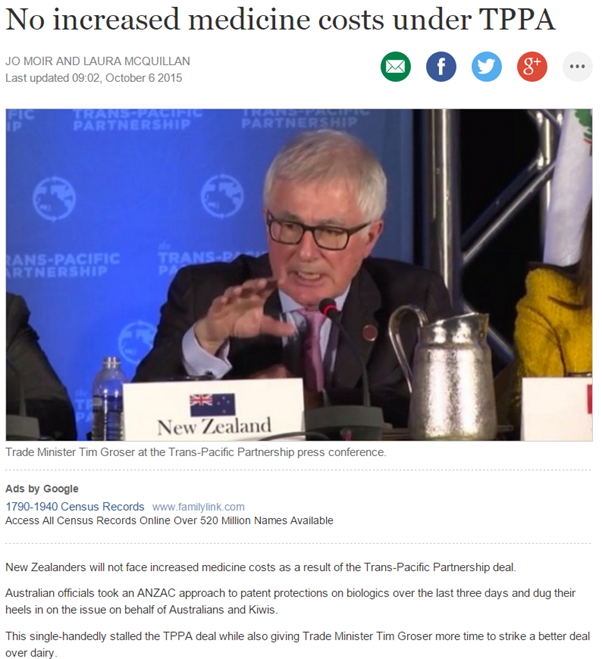
Source: No increased medicine costs under TPPA | Stuff.co.nz
.@MSF: Patients and treatment providers in developing countries the big losers of the #TPP bit.ly/TPPconcludes http://t.co/cbikANleyA—
MSF Access Campaign (@MSF_access) October 05, 2015
The next best arguments James Shaw made were xenophobia about foreign investment in land and some vast conspiracy theory regarding endangered dolphins.
When your next best argument is foreigners are coming to buy up all our land, you are playing from a weak populist hand. About half of million New Zealand born live in other countries.
About 80% of these live in Australia, the great majority as residents rather than as citizens. These New Zealanders living in Australia and elsewhere need protection under international agreements to ensure they are not the victim of populist outbreaks against the sale of land to foreigners.
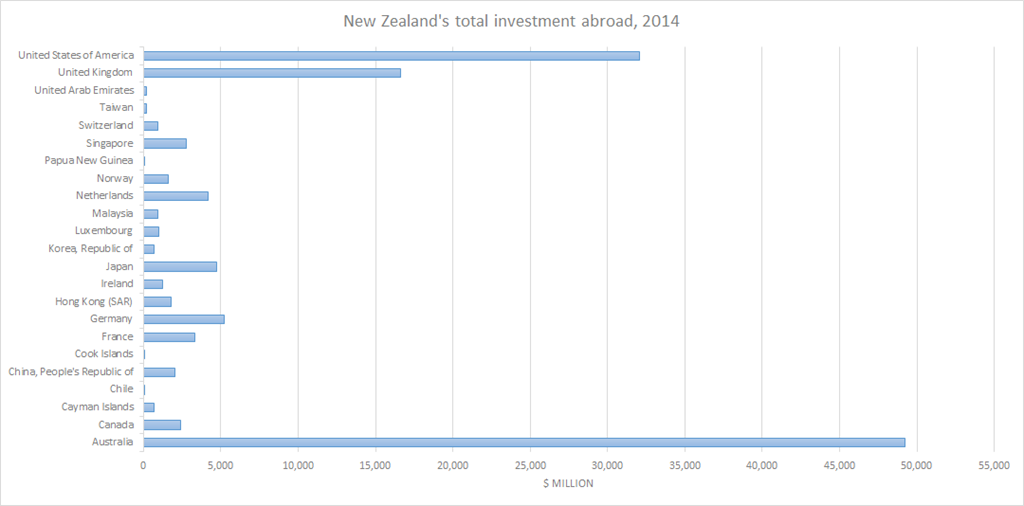
Source: Statistics New Zealand.
In addition, if a foreigner wants to pay over the odds for my house I am glad to separate a fool from his money.
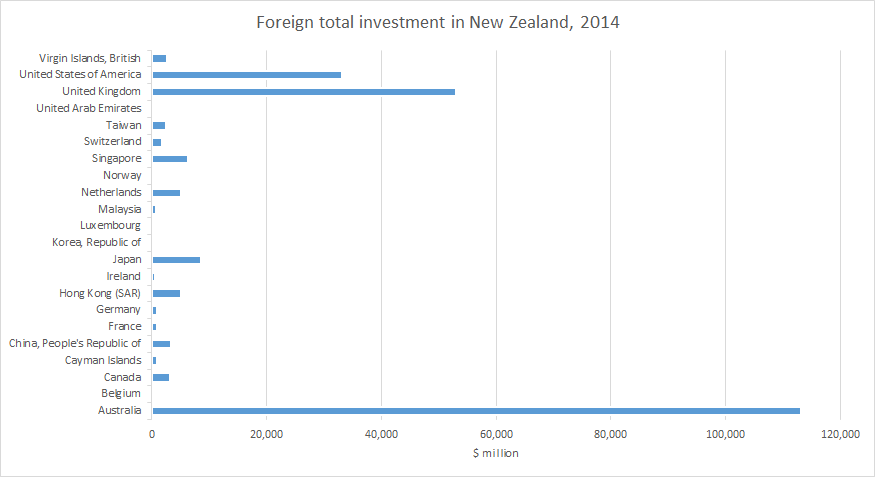
Source: Statistics New Zealand.
New Zealand has a strong interest in protecting the rights of its own expatriates as well as New Zealand foreign investors to buy land in other countries. As David Friedman explains:
Much more commonly, [economic imperialism] is used by Marxists to describe–and attack–foreign investment in “developing” (i.e., poor) nations. The implication of the term is that such investment is only a subtler equivalent of military imperialism–a way by which capitalists in rich and powerful countries control and exploit the inhabitants of poor and weak countries.
There is one interesting feature of such “economic imperialism” that seems to have escaped the notice of most of those who use the term. Developing countries are generally labour rich and capital poor; developed countries are, relatively, capital rich and labour poor. One result is that in developing countries, the return on labour is low and the return on capital is high–wages are low and profits high. That is why they are attractive to foreign investors.
To the extent that foreign investment occurs, it raises the amount of capital in the country, driving wages up and profits down. The effect is exactly analogous to the effect of free migration. If people move from labour-rich countries to labour-poor ones, they drive wages down and rents and profits up in the countries they go to, while having the opposite effect in the countries they come from.
If capital moves from capital-rich countries to capital-poor ones, it drives profits down and wages up in the countries it goes to and has the opposite effect in the countries it comes from. The people who attack “economic imperialism” generally regard themselves as champions of the poor and oppressed.
To the extent that they succeed in preventing foreign investment in poor countries, they are benefiting the capitalists of those countries by holding up profits and injuring the workers by holding down wages. It would be interesting to know how much of the clamour against foreign investment in such countries is due to Marxist ideologues who do not understand this and how much is financed by local capitalists who do.
@JosephEStiglitz talks sense on flaws of the #TPPA @ItsOurFutureNZ @greencatherine @RusselNorman
04 Oct 2015 1 Comment
in economics of regulation, international economic law, politics - New Zealand, politics - USA, rentseeking Tags: drug lags, free trade agreements, Leftover Left, preferential trading agreements, TPPA, Trade Blocs
Joe Stiglitz occasionally gets it right such as this week when he spoke about the downside of the Trans-Pacific Partnership Agreement. As he said:
The reality is that this is an agreement to manage its members’ trade and investment relations – and to do so on behalf of each country’s most powerful business lobbies.
Make no mistake: It is evident from the main outstanding issues, over which negotiators are still haggling, that the TPP is not about “free” trade.
Because of all the haggling over the trade-offs where you do something stupid in return for the other side doing something sensible in terms of liberalisation or something equally stupid in additional regulation, the gains in the agreement can be quite small. Again as Joe Stiglitz explains:
New Zealand has threatened to walk away from the agreement over the way Canada and the US manage trade in dairy products. Australia is not happy with how the US and Mexico manage trade in sugar.
And the US is not happy with how Japan manages trade in rice. These industries are backed by significant voting blocs in their respective countries. And they represent just the tip of the iceberg in terms of how the TPP would advance an agenda that actually runs counter to free trade.
The case for intellectual property rights over drugs is complicated but no one seems to be suggesting that patents should be lengthened.
Far more can be gained in terms of drug availability through regulatory reforms that streamline the drug safety approval process which is currently costing many people their lives.
Barriers to entry – costs ($s) of bringing new drugs to the market have risen manyfold #econ3 http://t.co/MFHTFhTLrj—
Geoff Riley (@tutor2u_econ) November 30, 2014
Sam Peltzman showed in a famous paper in 1973 that the 1962 amendments to US Federal drug approval laws reduced the introduction of effective new drugs in the USA from an average of forty-three annually in the decade before the 1962 amendments to sixteen annually in the ten years afterwards. No increase in drug safety was identified.
The most bizarre part of drug approval processes is they go beyond the checking whether the new drug is safe. What is even more bizarre in New Zealand is the New Zealand drug safety agency duplicates safety processes already performed overseas. This is instead of automatically approving any drug or medical device approved in the USA, UK, Canada or Australia.
Drug safety regulators in the USA also check to see if the drug works – that the drug has its predicted effects. Drug safety is a health policy concern but whether the investors developed a useful drug is something between them and those interested in buying it. Drugs became available years after they were on the market outside the USA because of drug lags at the FDA. To quote David Friedman:
In 1981… the FDA published a press release confessing to mass murder. That was not, of course, the way in which the release was worded; it was simply an announcement that the FDA had approved the use of timolol, a ß-blocker, to prevent recurrences of heart attacks.
At the time timolol was approved, ß-blockers had been widely used outside the U.S. for over ten years. It was estimated that the use of timolol would save from seven thousand to ten thousand lives a year in the U.S.
So the FDA, by forbidding the use of ß-blockers before 1981, was responsible for something close to a hundred thousand unnecessary deaths.
It is a pity that the far left movement ranted against the TPP focused on conspiratorial theories about investor state dispute settlement rather than the risks of this trade deal to the cost of drugs to the health sector. Only late in the game did the far left start talking about drug availability and the costs of drugs to the health budget of the government if patent lives were extended under the TPPA.
@amplifyonly @TaurangaTPPA @actionstation @ActivistsNZ @Keyweekat @endarken #ExposeTPP @gregfullmoon http://t.co/JyG5wQ2MX7—
ItsOurFuture (@ItsOurFutureNZ) July 22, 2015
A campaign against the TPPA on the basis of its impact on drug availability because of longer patent terms running up against the limited budgets of pharmaceutical purchasing agencies would have appealed across the entire political spectrum. As Joe Stiglitz explains:
The TPP would manage trade in pharmaceuticals through a variety of seemingly arcane rule changes on issues such as “patent linkage,” “data exclusivity,” and “biologics.”
The upshot is that pharmaceutical companies would effectively be allowed to extend – sometimes almost indefinitely – their monopolies on patented medicines, keep cheaper generics off the market, and block “biosimilar” competitors from introducing new medicines for years. That is how the TPP will manage trade for the pharmaceutical industry if the US gets its way.
The health sector can only so much to buy drugs. If drug patents last longer, there is less money to go around because the generics become available later than otherwise.
Explanation of the Greece Bailout in 90 Seconds
13 Aug 2015 Leave a comment
in budget deficits, business cycles, currency unions, economic growth, fiscal policy, international economic law, international economics, International law, macroeconomics Tags: credible commitments, Eurosclerosis, game theory, Greece, sovereign bailouts, sovereign defaults

Passports in Europe were abolished between 1861-1914
11 Aug 2015 Leave a comment
in international economic law, international economics, International law Tags: passports
@BrankoMilan Passports in Europe were abolished between 1861-1914 "History of Passports" bit.ly/1N5QSRo http://t.co/P97W2FCKJS—
Old Whig (@aClassicLiberal) August 04, 2015
Income from selling citizenships is now 16% of Malta government’s budget
01 Aug 2015 Leave a comment
in Economics of international refugee law, international economic law, international economics, law and economics Tags: Malta, passports, trading on sovereignty
Income from selling citizenships is now 16% of Malta government's budget bloom.bg/1GFbhJK @dslesperance http://t.co/C5HS8PjOb0—
Old Whig (@aClassicLiberal) March 22, 2015
Jane Kelsey opposes handcuffs on the democratic choices of future governments! Does she oppose labour and environmental standards in trade agreements too?
30 Jul 2015 6 Comments
in applied price theory, applied welfare economics, comparative institutional analysis, constitutional political economy, economics of regulation, environmental economics, health economics, industrial organisation, international economic law, international economics, International law, law and economics, property rights, Public Choice Tags: climate treaties, copyrights, customs unions, environmental standards, free trade agreements, free trade zones, intellectual property law, ISDS, Jane Kelsey, Labour standards, Left-wing hypocrisy, neocolonialism, patents, preferential trading agreeents, regional trade agreements, regulatory harmonisation, TPA, TPPA, WTO
Jane Kelsey in a television interview said she opposes the reductions in sovereignty in trade agreements that result from investor-state dispute settlement (ISDS) provisions because they limit the democratic choices of future governments.
If so, she must oppose environmental and labour standards in trade agreements and, more importantly, binding the hands of future governments with climate treaties. All international treaties are about restrictions on sovereignty.
Environmental and labour clauses in trade agreements and climate treaties all limit the powers of governments to legislate on environmental and employment law in accordance with the will of the people as expressed in the most recent election and change of government. Power to the people.
https://twitter.com/rorymccourt/status/625540621457960960
Jane Kelsey would do better focusing on those parts of the TPPA deal that lowers the net value of the deal such as those extending the term of patents over the drugs. All international treaties are about trade-offs.

The most important reason for focusing on intellectual property law in trade agreements is Kelsey is likely to actually win people over that are not on the far left, including many on the right of politics over to her cause. Kelsey is too busy rounding up the usual suspects.

Ranting about big corporate conspiracies and the investor state dispute settlement clauses puts people off.
As copyright duration's at play in #TPPA, a reminder of the costs when copyright's too long.
offsettingbehaviour.blogspot.co.nz/2014/03/orphan… http://t.co/tOtihpDmSU—
Eric Crampton (@EricCrampton) July 29, 2015
These gusts of paranoia lose support on issues where there is common ground to be suspicious about the growing scope of trade agreements and their reach behind borders.

Regulatory harmonisation is advisable only when there are compelling reasons such as the prevention of hazards or technical compatibility of products – do the plugs fit into each other? As Sykes argues:
as a normative matter, harmonization is inferior to a legal system that tolerates regulatory differences subject to legal constraints, and that relies on mutual recognition where appropriate (the exception to this claim being matters of technical compatibility between products).
Related, as a positive manner, harmonization will often lack any political constituency and thus instances of true harmonization will be rare.
Who has heavily guarded borders?
25 Jul 2015 Leave a comment
in international economic law, international economics, International law, politics - Australia, politics - USA Tags: Australia, British politics, economics of immigration, EU, illegal immigration, Mexico, North Korea, Spain
The walled world
– http://t.co/dXmzCUrjpD—
Amazing Maps (@Amazing_Maps) July 13, 2015
The Puerto Rican sovereign default explained
30 Jun 2015 Leave a comment
in economic growth, fiscal policy, international economic law, politics - USA, population economics Tags: ageing society, economics of immigration, Puerto Rica, sovereign defaults
Puerto Rico's debt is nearly half that of California for a population one-tenth the size on.wsj.com/1Kj5XPZ http://t.co/nM2aM8kWtP—
Nick Timiraos (@NickTimiraos) June 29, 2015
Gambling for Redemption and Self-fulfilling Debt Crises in the Eurozone
29 Jun 2015 Leave a comment
in business cycles, currency unions, economic growth, Euro crisis, fiscal policy, global financial crisis (GFC), international economic law, international economics, macroeconomics Tags: game theory, Greece, Patrick Kehoe, sovereign default
Donald Trump explained
27 Jun 2015 Leave a comment
in international economic law, international economics, politics - USA, Public Choice, rentseeking Tags: 2016 presidential election, antiforeign bias, antimarket bias, crony capitalism, Donald Trump, expressive voting, left-wing populists, populists, right-wing populists
Is investor state dispute settlement a form of overseas development assistance?
24 Jun 2015 Leave a comment
in comparative institutional analysis, constitutional political economy, development economics, growth disasters, growth miracles, international economic law, international economics, law and economics, property rights, Public Choice, rentseeking, Richard Posner Tags: European Court of Justice, free trade agreements, International Court of Justice, international law, investor state dispute settlement, ODA, overseas development assistance, preferential trade agreements, regional trade agreements, WTO
Would objections to the Investor State Dispute Settlement provisions in the proposed Trans-Pacific Partnership wilt away if the adjudicating body was the International Court of Justice? The left-wing opponents of investor state dispute settlement genuflect at the very mention of the International Court of Justice and international law generally (unless it is international economic law).

Disputes over the provisions of European union treaties are adjudicated by the European Court of Justice. The judgements of that court brought by individuals against member states so annoy the British that it is a leading reason for many British wanting to leave the European Union and replace the Human Rights Act 1998 with a British Bill Of Rights policed by British courts rather than by the European Court of Justice and European human rights law.
It is routine for any treaty to have some provision for arbitration of disputes. This includes trade and investment treaties.
The World Trade Organisation treaty includes a dispute settlement provision with arbitrators based in Geneva. Some of the more than 400 cases heard have been motivated by discrimination against imports on the basis of a breached environmental protection policies of the importing country.

A number of countries want to ban imports that are produced in ways that upset them. Others want to include labour and environmental standards in trade agreements to impose developed country standards on developing countries in what is a new form of colonialism.
I have previously said that investor State Dispute Settlement provisions have no place in trade and investment treaties between democracies. I must now admit there are good reasons to have arbitration clauses in treaties between democracies.
The puzzle is why refer these trade and investment disputes to a little-known arbitration body adjunct to the World Bank rather than the far more prestigious International Court of Justice.
Perhaps the reason is both sides want an arbitrator who is not too strong and not too credible. It would look very bad if the International Court of Justice was to rule against you.
William Landes and Richard Posner contended that judicial independence maximises the value of legislative deals with interest groups by enhancing the durability of those deals.
Why no International Court of Commercial Law? When deciding what type in judiciary to enforce international trade bargains, the signatories may prefer a less credible adjudication and enforcement mechanism in case they want to opt out of it or chip around the decision.
The jurisdiction of the International Court of Justice is to settle, in accordance with international law, legal disputes submitted to it by special agreement and matters specifically provided for in treaties and conventions in force.
UN member states are the parties to any litigation but that doesn’t stop them raising cases on behalf of individuals. That said, organizations, private enterprises, and individuals cannot have their cases taken to the International Court, such as to appeal a national supreme court’s ruling. Only the states can bring the cases and become the defendants of the cases.
The International Court of Justice is different from the European Court of Justice because individuals cannot easily bring complaints before it. One of the causes of action before the European Court of Adjusters is under European competition law over member states providing financial aid to industries.
Democratic countries with high levels of economic and social integration, such as the European union, do find it in advantage to set up a European wide Court to adjudicate disputes over rights under European law.
Why then would a democracy sign up to an investment protection treaty with a developing country? One reason is overseas development assistance.
Developing countries with corrupt and incompetent courts, politicians and bureaucracies sign international treaties as a way of assuring foreign investors and trading partners of some degree of security of their property rights and their ability to enforce contracts with suppliers and buyers.
By folding these assurances into trade treaties, the developing country has a stronger incentive to honour its promises. There will be domestic constituencies wanting to retain reciprocal export market access who will lobby for the honouring of the promises of legal protection to investors and businesses in their home country.
New Zealand signing up to the Trans-Pacific Partnership is an example of this form of overseas development assistance. Exporters and investors from the developing country who export and invest in New Zealand have another reason to support more secure property rights and better enforcement of contracts in their home country as a way of securing their treaty rights to export and invest in New Zealand.
The Left of the political spectrum should be keen on this form of overseas development considering their general belief in greatly increasing the amount spent on overseas development assistance. Rather than pay cash to the development country, the payment is in kind as reciprocal legal promises.
Trade treaties that include investor state dispute settlement are forms of governance assistance to developing countries. The reciprocal exchange of promises about investor protection and the enforcement of contracts and property rights improves the quality of governance in the developing country.
The countries most likely to be subject to investor state dispute settlement are those with weaker governance. Even in the European Union, the member states most likely to be sued are former communist countries. The most common course of action was the cancellation of a licence or permit.

Investor state dispute settlement clauses are no different from any other international treaty include environmental and human rights treaties. All these treaties require countries to give up part of their sovereignty.

Democracies give up their sovereignty in investor state dispute settlement in the hope that developing country partners to the treaty will improve the development potential of their country through better governance and more secure property rights.
That is an overseas development aid objective the Left of the political spectrum should support, but it does not. The Left of the political spectrum is happy to use trade agreements to impose developed country labour and environmental standards on poor countries desperate for access to rich country markets, but is not willing to give up anything in return.
Per capita receipt of asylum seekers
19 Jun 2015 Leave a comment
in Economics of international refugee law, international economic law, International law, law and economics, politics - Australia, politics - New Zealand, politics - USA Tags: asylum seekers, economics of immigration
Sweden – the OECD's highest per capita recipient of asylum seekers bit.ly/1vfFEUh http://t.co/y6DmdJjAsE—
Guardian Data (@GuardianData) December 02, 2014


Recent Comments