Pharmaceuticals have high fixed costs of R&D and low marginal costs. The first pill costs a billion dollars; the second costs 50 cents. That cost structure makes price discrimination—charging different customers different prices based on willingness to pay—common. Price discrimination is why poorer countries get lower prices. Not because firms are charitable, but because a…
Trump’s Pharmaceutical Plan
Trump’s Pharmaceutical Plan
07 Feb 2026 Leave a comment
in applied price theory, health economics, politics - USA Tags: price discrimination
Waitangi 2026: the year of in-fighting on the Left
06 Feb 2026 Leave a comment
in politics - New Zealand Tags: constitutional law

Labour and Te Pāti Māori competed in the drama stakes airing their dirty laundry Waitangi Day is an annual time of remembrance, renewal, grievance, self-flagellation, and competing narratives. The summer ritual at the Treaty Grounds is part civic commemoration, part political theatre, and part family reunion. It is also, the ultimate testing ground for the […]
Waitangi 2026: the year of in-fighting on the Left
New Zealand Emancipation Day
06 Feb 2026 Leave a comment
in economic history, economics of crime, law and economics, politics - New Zealand Tags: age of empires, Age of Enlightenment, constitutional law, economics of slavery, regressive left
Today we celebrate the signing of the Treaty of Waitangi – a day which should be called Emancipation Day. For on the 6th of February 1840, slavery became illegal in New Zealand. The granting of British citizenship to Maori freed the slaves in law (the practice took a while longer to end) Slavery was not…
New Zealand Emancipation Day
The Crown versus The People: Reclaiming New Zealand’s democratic story
06 Feb 2026 Leave a comment
in constitutional political economy, law and economics, politics - New Zealand, property rights Tags: constitutional law
In last Waitangi Day’s NZ Herald column, I argued that New Zealand’s sovereignty was not created in a single moment in 1840 but built over generations through practical governance, with Māori and Pākehā participating together. This year’s column takes the next step: asking where that sovereign authority now resides – and what that means for how we […]
The Crown versus The People: Reclaiming New Zealand’s democratic story
Part I(b): Yes, Taxes Change Behavior
06 Feb 2026 Leave a comment
in applied price theory, fiscal policy, macroeconomics, politics - USA, public economics Tags: taxation and entrepreneurship, taxation and investment

The death tax presumably is the most destructive tax on a per-dollar-collected basis, but I suspect the capital gains tax is in second place. Like the death tax, the capital gains tax is pure double taxation, thus exacerbating the tax code’s bias against saving and investment. And the capital gains tax is particularly foolish since […]
Part I(b): Yes, Taxes Change Behavior
The economic impacts of the 2008 NZ-China Free Trade Agreement
06 Feb 2026 1 Comment
in applied price theory, econometerics, industrial organisation, international economics, politics - New Zealand Tags: China, free trade, free trade agreements, tariffs

New Zealand was the first Western developed country to sign a free trade agreement with China, and it came into force in 2008. At the time, the New Zealand government estimated an increase in exports to China of between NZ$225 million and NZ$350 million (between US$180 million and US$280 million), and Ministry of Foreign Affairs…
The economic impacts of the 2008 NZ-China Free Trade Agreement
STEVE MILLOY: 20 Years After ‘An Inconvenient Truth’
05 Feb 2026 1 Comment
in economic history, economics of climate change, economics of natural disasters, economics of regulation, energy economics, environmental economics, environmentalism, global warming, movies, politics - USA Tags: climate activists, climate alarmism
Jan. 24 marked the 20th anniversary of the release of Al Gore’s alarmist global warming movie “An Inconvenient Truth.” Gore has surfed the movie and climate alarmism to a net worth estimated at $300 million and a Nobel Peace Prize.
STEVE MILLOY: 20 Years After ‘An Inconvenient Truth’
Tariffs and Inflation: Where Are We?
05 Feb 2026 Leave a comment
in applied price theory, econometerics, international economics, politics - USA Tags: free trade, tariffs

One of the predictions made by economists when President Trump announce the start of his freewheeling tariff policies in April 2025 was that the costs of the tariffs would ultimately be passed through to consumers, leading to overall higher inflation. Well, President Trump has been tossing out tariff threats, keeping some and withdrawing others. However,…
Tariffs and Inflation: Where Are We?
Iwi ensure respect is shown to a crash site – but how are the beliefs of crash victims and their families respected?
04 Feb 2026 Leave a comment
in economics of religion, liberalism, politics - New Zealand Tags: Freedom of religion
About this time a week ago, the New Zealand Police released a statement to report that two people had died in a helicopter crash north of Wellington earlier in the day. Work was under way to recover the deceased and to examine the crash scene, near the Battle Hill regional park. The statement included: Police […]
Iwi ensure respect is shown to a crash site – but how are the beliefs of crash victims and their families respected?
Debunking Trump’s Error-Filled WSJ Column
04 Feb 2026 Leave a comment
in applied price theory, budget deficits, economic growth, economic history, fisheries economics, history of economic thought, income redistribution, industrial organisation, international economic law, international economics, macroeconomics, politics - USA, Public Choice, rentseeking Tags: free trade, tarrifs
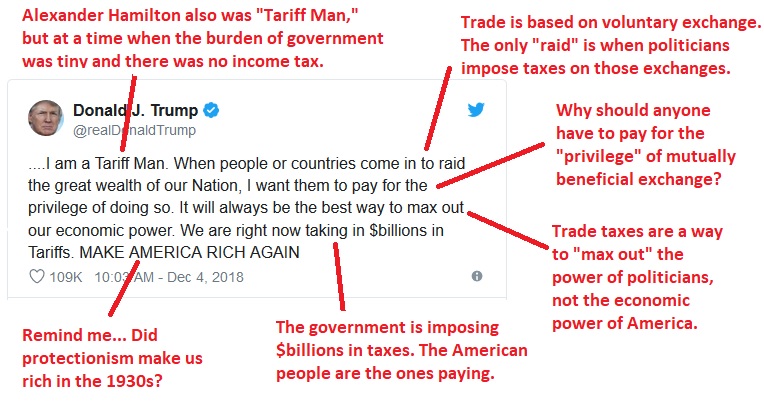
Donald Trump, who describes himself as “Tariff Man,” recently wrote a column in defense of his protectionist trade policy for the Wall Street Journal. After reading the column, my first thought was that Trump was trying to show he is more economically illiterate than Joe Biden (a big challenge, as seen here and here). And […]
Debunking Trump’s Error-Filled WSJ Column
Netflix, WBD, and the Myth of the Streaming Monopoly
03 Feb 2026 Leave a comment
in entrepreneurship, history of economic thought, industrial organisation, law and economics, politics - USA Tags: competition law

The proposed acquisition of Warner Bros. Discovery (WBD) assets by Netflix is already being cast as a landmark antitrust “test case.” If past deals are any guide, the critiques will follow a familiar script: narrow market definitions, selective data points, and headline-friendly market-share claims designed to trigger alarm. Yet in a video ecosystem defined by…
Netflix, WBD, and the Myth of the Streaming Monopoly
Vance on the Greens
03 Feb 2026 Leave a comment
in liberalism, Marxist economics, politics - USA Tags: regressive left
This column by Andrea Vance was actually last March but I only just discovered it, and it is so good it needs repeating. She writes: In the Chlöe Swarbrick era, the Greens have been reduced to a caucus of anarkiddies posting out a flood of social-justice clickbait. They indulge in culturally progressive obsessions, moored in…
Vance on the Greens
Border Security Type I and Type II Errors
03 Feb 2026 Leave a comment
in economics of bureaucracy, economics of crime, labour economics, labour supply, law and economics, politics - USA, Public Choice Tags: economics of immigration

One way of looking at the a policy of increased ICE enforcement of US border security is as a debate over decision error costs. The expressed goal is to remove the worst of the worst criminals. Few would disagree with this goal. However, in this dragnet, immigrants without criminal backgrounds have also been detained. The…
Border Security Type I and Type II Errors
Cutting losses – governments too slow to learn
02 Feb 2026 Leave a comment
Updated 3.20pm Business generally works out when to cut losses because the risks of failure are too high for shareholders and workers. Government on the other hand are very slow, regardless of stripe. Grant Robertson got very grumpy with KiwiRail re the ship and ferry land side infrastructure and should have stopped or changed it, […]
Cutting losses – governments too slow to learn
Newsom talking across the aisle
31 Jan 2026 Leave a comment
in politics - USA Tags: 2028 presidential election
Politico reports: Gavin Newsom is fully embracing his status as his party’s foremost podcast bro. … It got off to a polarizing start last March, with a succession of friendly interviews with conservative influencers like Charlie Kirk and Steve Bannon. And while the headlines that tended to enrage Democrats have fallen off, the California governor’s […]
Newsom talking across the aisle


Recent Comments