
Milton Friedman is said to have mesmerised several countries with a flying visit!?

Milton Friedman visited Australia in 1975. He spoke with government officials and appeared on the  TV show  Monday Conference. Apparently, that was enough for him to take over Australian monetary policy setting for the foreseeable future.

image

When working at the next desk to the monetary policy section in the late 1980s, I heard not a word of Friedman’s Svengali influence:

  • The market determined interest rates, not the reserve bank was the mantra for several years. Joan Robinson would be proud that her 1975 visit was still holding the reins.
  • Monetary policy was targeting the current account. Read Edwards’ bio of Keating and his extracts from very Keynesian treasury briefings to Keating signed by David Morgan that reminded me of macro101.

See Ed Nelson’s (2005) Monetary Policy Neglect and the Great Inflation in Canada, Australia, and New Zealand who used contemporary news reports from 1970 to the early 1990s to uncover what was and was not ruling monetary policy. For example:

“As late as 1990, the governor of the Reserve Bank rejected central-bank inflation targeting as infeasible in Australia, and cited the need for other tools such as wages policy (AFR, October 18, 1990).”

Bernie Fraser was still sufficiently deprogrammed in 1993 to say that “…I am rather wary of inflation targets.” Easy to then announce one in the same speech when inflation was already 2-3%.

image

When as a commentator on a Treasury seminar paper in 1986, Peter Boxhall – fresh from the US and 1970s Chicago educated – suggested using monetary policy to reduce the inflation rate quickly to zero, David Morgan and Chris Higgins almost fell off their chairs. They had never heard of such radical ideas.

In their breathless protestations, neither were sufficiently in-tune with their Keynesian educations to remember the role of sticky wages or even the need for the monetary growth reductions to be gradual and, more importantly, credible as per Milton Freidman and as per Tom Sargent’s End of 4 big and two moderate inflations papers.

I was far too junior to point to this gap in their analytical memories about the role of sticky wages, and I was having far too much fun watching the intellectual cream of the Treasury senior management in full flight. At a much later meeting, another high flying deputy secretary was mystified as to why 18% mortgage rates were not reining in the current account in 1989.

Friedman’s Svengali influence did not extend to brainwashing in the monetarist creed that the lags on monetary policy were long and variable. The 1988 or 1989 budget papers put the lag on monetary policy at 1 year, which is short and rapier, if you ask me.

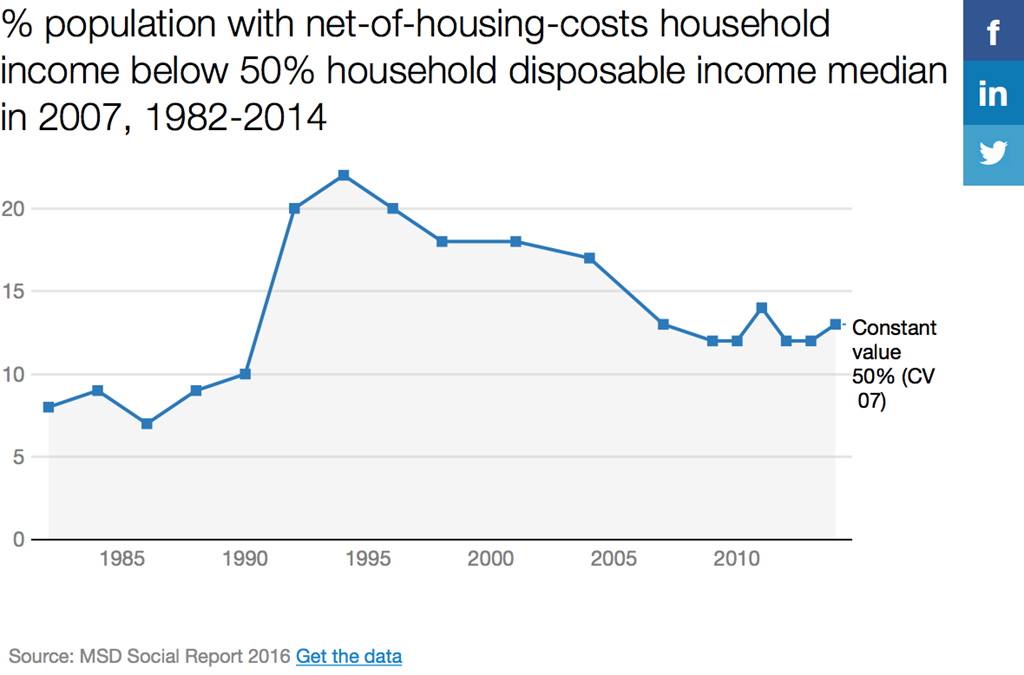
More on the emergence of Generation Rent in New Zealand

image

Source: People: The Social Report 2016 – Te pūrongo oranga tangata.

Discharge without conviction is for offences more serious than argy-bargy after closing time

People get discharges without convictions for offences far more serious than a little bit too much argy-bargy after a few too many with friends after closing time.

Source: Discharge without conviction numbers slump | Radio New Zealand News.

If an offences serious enough to jeopardise your job, an employer would sack you in any case because you are found guilty rather than the entry of a conviction. Allowing criminals to conceal their criminal convictions from future employers allows them to conceal their bad character. It puts law-abiding citizens at a disadvantage to criminals.

Nice members of the middle class are put off committing offences in the first place because of career concerns. In any case, the Spent Convictions Act allows a way out after 7 years.

A few years ago, the Court of Appeal tightened up the criteria to a conviction being all out of proportion of the offence. That means burglars, robbers, sex offenders and thugs got away with it still but less so in the past.

In the past, you just come to court and asked for discharge without conviction. Now you must produce a considerable amount of evidence of the undue career cost.

Equivalents to a discharge without conviction apply in the criminal law of England and Wales, Scotland, Canada and Australia.

.@PPTANews @TraceyMartinMP made best ever argument 4 #charterschools @maori_party

Talk about giving the giving the game away. The only way a state school can do as well as a chartered school in delivering to students is giving it more money than a chartered school can do to deliver the same results.

That is the best ever argument for a charter school, they provide better value for the education dollar. Is my logic faulty?

When did Canberra policy makers accept that inflation was a monetary phenomenon?

Australian policymakers from at least 1971 viewed inflation as not a consequence of their monetary policy decisions. There were repeated references by them to wage-price spirals and both unsuccessful (1977) and successful attempts (1981) at wage freezes.

image

The prices and incomes accord from 1983 onwards was just another 1970s wage tax trade-off. An Incomes policy attributes inflation to non-monetary factors, as did Fraser and Lynch regularly.

• It was not until 1980 that the Fraser government’s monetary policy became genuinely anti-inflationary. With a lag, these changes halved inflation to the mid-single digits by 1983. The implementation lag on the 1975 Monday conference programme must have been long and variable and lasted for a three year window!? Three years out of 20 is hardly a monetarist hegemony!

• Australia had lower CPI inflation in the 1980s than the 1970s, but this was marred by rebounds in 1985–86 and 1988–90 to near 9%.

The monetary policy regime change in the late 1980s was triggered by factors besides rising inflation: a demonic view of currant account.

After several years of high interest rates, the budget papers forecasted a moderate slowing:
• The budget GDP forecast for 1990-91 was 2% with an actual of minus 0.4%; for inflation the actual and forecast were 5.3% versus 6.5%; 1989-90 inflation rate was 8% with GDP growth of 3.3%.

• In 1991-92, the budget GDP forecast was 1.5% with an actual of 2.1%; for inflation the actual and forecast were 1.9% versus 3.8%.

• In 1992-93, the budget papers forecast for inflation 3% for an actual of 1%.

• In 1993-94, the budget forecast for inflation 3.5% for an actual of 1.8%.

The monetarists in the Treasury, entranced as they were by Friedman’s 1975 visit, still had not clicked to the link between a tight monetary policy and low inflation as late as 1993. Australia pursued a stop-go monetary policy from 1971 to the early 1990s.

I worked in the next desk to the monetary policy section in the Prime Minister’s Department in the 1980s. They were determined that market set interest rates, not monetary policy.

I suggest you read the biography of keating by john edwards(?) – his economic advisor in the late 1980s.

Edwards quotes from numerous Treasury briefings to Keating. the Treasury remembered their Keynesian educations well, as did those at DPMC. the prices and incomes accord was very Keynesian: inflation as a non-monetary phenomenon

Mentioning Friedman’s name in the 1980s at job interviews would have been extremely career limiting. Not much better in the early 1990s. Back in the late 1980s, Friedman was graduating from ‘a wild man in the wings’ to just a suspicious character in policy circles.

If you name dropped Hayek in the 1980s and 1990s, any sign of name recognition would have indicated that you were been interviewed by people who were very widely read.

Poverty in NZ has been falling steadily for 20 years despite the dead hand of neoliberalism

image

Source: Population with low incomes: The Social Report 2016 – Te pūrongo oranga tangata.

Spot Generation Rent in New Zealand

image

Source: Housing affordability: The Social Report 2016 – Te pūrongo oranga tangata from Perry (2015), Ministry of Social Development, using data from Statistics New Zealand’s Household Economic Survey.

House crowding continues long run fall despite the dead hand of neoliberalism

Source: Household crowding: The Social Report 2016 – Te pūrongo oranga tangata.

The endless taboos of the politically correct

https://twitter.com/alicemazzy/status/779482689191632896

Image

Clinton’s New Ad on @realdonaldtrump Mocking Women’s Appearance #NeverTrump

Source: Clinton’s Newest Ad Shows Girls Looking in the Mirror While Trump Mocks Women’s Appearances | Mother Jones

How is academic bias going?

Image

50% of @PaulineHansonOz @OneNationAus votes come from @AustralianLabor voters

How can Pauline Hanson be an extreme right-winger if half of her votes come from people who 2nd preference the Australian Labour Party? This strong support for her populism has been well-known since she won the safest Labour Party seed in Queensland in the 1996 Australian Federal Election but is hardly ever mentioned by the media or her critics.

image

Source: Antony Green’s Election Blog: Preference Flows at the 2016 Federal Election.

It should be therefore no surprise that a lot of her views have popular support because she has support across the political spectrum. Not knowing that will means you will be not very good at combating her views which you simply do not understand where they come from.

Few of her supporters see themselves as extremists and will be insulted when you suggest they are. Listen here dummy is no way to win back votes of people who just voted for you recently.

Hanson’s support among Labour voters is increasing. Only 42% of her voters gave their 2nd preference to Labour in previous federal elections for the House of Representatives.

What Wasn’t Said in “Wealth Inequality In America”

Would ceasefires have shortened WWII? The American Civil War? #Syrianconflict

Edward Luttwak in his essay Give War a Chance speculated that if there was a United Nations in the 1860s, there would still be UN peacekeepers stationed between the warring Union and Confederate troops on the Mason Dixon line as of this day.

If you can work out a way in which ceasefires would have shorten World War II in either the European or Pacific theatres, you have got a better crystal ball than me.

There were long interludes on the Western front; several years in which the Nazis fortified the French beaches while the Allies built up their invasion force in England. For all practical purposes, there is a land-forces ceasefire from Dunkirk to D-Day across the English Channel.

Luttwak wrote that cease-fires permit space for both sides to heal while only intensifying and prolonging the struggle once the cease fire ends — and it almost always ends.

This was true in the Arab-Israeli War of 1948-1949. It is true of the dozen of ceases fires in Gaza negotiated by the Security Council. It was true of all the cease-fires that failed in the fall of Yugoslavia with Serbs, Croats, and Bosnians who negotiated month-long cease fires where

all opponents used the pause to rest, train, and equip additional soldiers for combat, both prolonging the war and widening the scope of its killing and destruction.

John Stevenson studied 170 ceasefires. He pretty much vindicated the position that each side uses the lull in the fighting to regroup, rebuild and reinforce when for when the fighting starts again.

image

Source: Cease-fires and peace talks make it worse: International community needs a new approach to humanitarian intervention.

Ceasefires are perplexing in the many sided civil war in Syria. Aside from the Kurds, it is hard to work out who you want to win.

The Kurds just want to be left alone with their own country.

But Turkey is not happy about that prospect nor is Iraq.

You can work out who you want to lose territory but as for who might replace them, maybe the free Syrian army is a bit of an improvement.

There will be a bloodbath in reprisals if any of the other sides win apart from the Kurds. The Kurds are only willing to fight as far into Syria as they need to defend their own territory.

How to show that unions & income inequality are unrelated when attempting to show a link

Fight for $15 tried to show a link between unions and rising income inequality but all it managed to show that unions went into decline several decades before inequality started to rise.

Previous Older Entries Next Newer Entries

Thoughts from the North

Celebrating humanity's flourishing through the spread of capitalism and the rule of law

Fardels Bear

A History of the Alt-Right

Vincent Geloso

Econ Prof at George Mason University, Economic Historian, Québécois

Bassett, Brash & Hide

Celebrating humanity's flourishing through the spread of capitalism and the rule of law

Truth on the Market

Scholarly commentary on law, economics, and more

The Undercover Historian

Beatrice Cherrier's blog

Matua Kahurangi

Celebrating humanity's flourishing through the spread of capitalism and the rule of law

Temple of Sociology

Celebrating humanity's flourishing through the spread of capitalism and the rule of law

Velvet Glove, Iron Fist

Celebrating humanity's flourishing through the spread of capitalism and the rule of law

Why Evolution Is True

Why Evolution is True is a blog written by Jerry Coyne, centered on evolution and biology but also dealing with diverse topics like politics, culture, and cats.

Down to Earth Kiwi

Celebrating humanity's flourishing through the spread of capitalism and the rule of law

NoTricksZone

Celebrating humanity's flourishing through the spread of capitalism and the rule of law

Homepaddock

A rural perspective with a blue tint by Ele Ludemann

Kiwiblog

DPF's Kiwiblog - Fomenting Happy Mischief since 2003

The Dangerous Economist

Celebrating humanity's flourishing through the spread of capitalism and the rule of law

Watts Up With That?

The world's most viewed site on global warming and climate change

The Logical Place

Tim Harding's writings on rationality, informal logic and skepticism

Doc's Books

A window into Doc Freiberger's library

The Risk-Monger

Let's examine hard decisions!

Uneasy Money

Commentary on monetary policy in the spirit of R. G. Hawtrey

Barrie Saunders

Thoughts on public policy and the media

Liberty Scott

Celebrating humanity's flourishing through the spread of capitalism and the rule of law

Point of Order

Politics and the economy

James Bowden's Blog

A blog (primarily) on Canadian and Commonwealth political history and institutions

Science Matters

Reading between the lines, and underneath the hype.

Peter Winsley

Economics, and such stuff as dreams are made on

A Venerable Puzzle

"The British constitution has always been puzzling, and always will be." --Queen Elizabeth II

The Antiplanner

Celebrating humanity's flourishing through the spread of capitalism and the rule of law

Bet On It

Celebrating humanity's flourishing through the spread of capitalism and the rule of law

History of Sorts

WORLD WAR II, MUSIC, HISTORY, HOLOCAUST

Roger Pielke Jr.

Undisciplined scholar, recovering academic

Offsetting Behaviour

Celebrating humanity's flourishing through the spread of capitalism and the rule of law

JONATHAN TURLEY

Res ipsa loquitur - The thing itself speaks

Conversable Economist

In Hume’s spirit, I will attempt to serve as an ambassador from my world of economics, and help in “finding topics of conversation fit for the entertainment of rational creatures.”

The Victorian Commons

Researching the House of Commons, 1832-1868

The History of Parliament

Articles and research from the History of Parliament Trust

Books & Boots

Reflections on books and art

Legal History Miscellany

Posts on the History of Law, Crime, and Justice

Sex, Drugs and Economics

Celebrating humanity's flourishing through the spread of capitalism and the rule of law

European Royal History

Exploring the Monarchs of Europe

Tallbloke's Talkshop

Cutting edge science you can dice with

Marginal REVOLUTION

Small Steps Toward A Much Better World

NOT A LOT OF PEOPLE KNOW THAT

“We do not believe any group of men adequate enough or wise enough to operate without scrutiny or without criticism. We know that the only way to avoid error is to detect it, that the only way to detect it is to be free to inquire. We know that in secrecy error undetected will flourish and subvert”. - J Robert Oppenheimer.

STOP THESE THINGS

The truth about the great wind power fraud - we're not here to debate the wind industry, we're here to destroy it.

Lindsay Mitchell

Celebrating humanity's flourishing through the spread of capitalism and the rule of law