Tax burdens of the top 10% across the OECD
14 Mar 2016 Leave a comment
in politics - New Zealand, politics - USA, public economics Tags: taxation and entrepreneurship, taxation and investment, taxation and labour supply, top 1%
@BernieSanders defence of #Castro did not help spread democracy
14 Mar 2016 Leave a comment
in constitutional political economy, economic history, Marxist economics, politics - USA

Dodging the #Trump Bullet: @zingales (2011) on @realdonaldtrump’s previous run for president
14 Mar 2016 Leave a comment
in economics of media and culture, politics - USA, Public Choice, rentseeking
Read what Zingales wrote five years ago on City Journal that was part of what was cut out of his book “A Capitalism for the People” because Donald Trump running seriously for president was never supposed to happen.
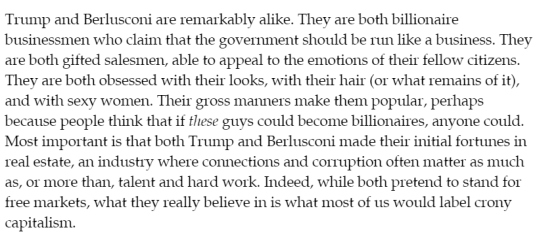
Source: Dodging the Trump Bullet | City Journal.
Zingales is no kinder in his recent op-ed recalling the lost book chapter, which is paywalled.

@TBillTheProf unintentionally destroys the case for a #livingwage @Mark_J_Perry @arindube
13 Mar 2016 Leave a comment
in applied price theory, labour economics, managerial economics, minimum wage, organisational economics, personnel economics, politics - New Zealand, politics - USA Tags: living wage, rational irrationality, The fatal conceit, The pretense to knowledge
Living wage advocate William Lester published a briefing for the Washington Centre for Equitable Growth that destroys the case for a living wage. He did not intend this but he documented in detail the exclusion of inexperienced workers from the restaurant industry in San Francisco after a living wage was imposed. He compared San Francisco’s minimum wage of $12 per hour with North Carolina which only pays the federal minimum of $7.25 per hour.
What Lester found was a systematic increase in hiring standards. The living wage in San Francisco of $12 all but ended the hiring of inexperienced workers as shown in the chart below. This is exactly what basic price theory predicts. I put the two pie charts in his paper into a single bar chart so this powerful effect of the living wage on hiring standards is not lost.
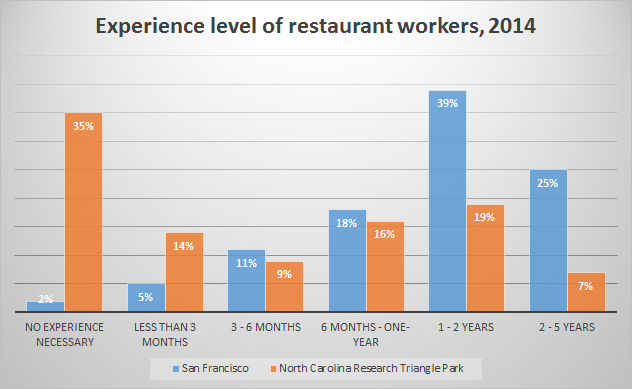
Source: The consequences of higher labor standards in full service restaurants – Equitable Growth.
The most fundamental criticism of living wage and minimum wage increases is they exclude workers who do not meet the new labour productivity level required to make it profitable for employers to hire them. UK research found the same thing – an increase in hiring standards and tougher shortlisting. Lester welcomes this transition of the restaurant industry in San Francisco into a career for professionals. As he says in his briefing paper:
Concurrent with this wage compression was a rise in professional standards as employers sought to hire and keep already well-trained workers at higher wages and with expanded benefits. Both developments reduced turnover and attracted more professional employees who maintain a high level of customer service.
As with all minimum wage and living wage advocates, he is incurious as to what happens to those low skilled, inexperienced workers and new workforce entrants who no longer meet the hiring standards of San Francisco restaurants because of the large minimum wage increase.
Best 2 Minimum Wage Cartoons Ever, from Henry Payne, Updated for Seattle's $15 "Economic Death Wish" @HenryEPayne http://t.co/vatUzkHMss—
Mark J. Perry (@Mark_J_Perry) August 18, 2015
As Lester concedes in his conclusions about what will happen if the San Francisco minimum wage of $12 an hour, the highest in the country, is extended to other cities and states:
Higher professional standards may limit entry-level opportunities within the industry, while lower standards may result in more employer-provided training for new workers.
Employer funded on-the-job training is often a major part of a job package. It is well-known in the labour economics literature since the time of Adam Smith that any job is a package of wages and other attributes including learning opportunities.

Workers sell their services and buy learning opportunities; firms buy labour services and sell jobs with varying learning possibilities (Rosen 1972, 1975, 1976). The rational allocation of time results in most careers starting with large investments in full-time schooling and then mostly investments in on-the-job training (Becker 1975; Ben-Porath 1967, 1970; Weiss 1987).
As the training provided by restaurant employers is useful to other employers, the trainee must fund it through trading off wages for this training. Once trained, the employee can command a higher pay because other employers are willing to pay them more now that they are trained. Again, this is a standard result in the human capital literature.
Where the human capital is more specialised to one firm or job, the employer and the trainee share the cost. A classic example of this is an apprenticeship.

Source: IZA World of Labor – Do firms benefit from apprenticeship investments?
In San Francisco, employers expect recruits to be fully trained and experienced. They provide little in the way of on-the-job training. Their recruits must have been able to afford to fund this in their previous jobs by trading off wages for training as Lester notes in his working paper:
…San Francisco employers were less likely to report lengthy formal training periods for either front-of-house or back-of-house workers. Instead, there is an overall higher level of skill expectation and—as is the case for many professions—workers are expected to acquire and exhibit industry specific knowledge on their own.
In North Carolina, as Lester notes, the restaurant industry hires younger workers with less formal education and offers them intensive on-the-job training:
The restaurant industry in the Research Triangle region tends to hire younger workers with a lower level of formal education. Specifically, 49.5 percent of workers in there are under age 24 or have less than a high school education, compared to 38.9 percent in San Francisco. Conversely, 40.6 percent of workers in San Francisco have some college or a bachelor’s degree or higher, compared to 29.7 percent in the Research Triangle Region.
North Carolina restaurants sought to hire unskilled workers who were friendly and reliable as Lester notes:
One manager of a neighbourhood bistro in Raleigh explained what he looks for in a new front-of-house worker: “Basically, we require [that a server] can work a four-shift minimum per week and go an entire shift, an entire eight-hour shift without smoking a cigarette and [without] any facial piercings or anything. Beyond that, just come in with a smile on your face.”
The restaurant industry in North Carolina is willing to give people low skilled, poorly educated and inexperienced a chance to work if they are willing to work. Lester reports this when quoting an upscale bar-and-grill manager on his hiring standards:
We look for at least one year’s experience, but the biggest thing we look for is we look for the person. We don’t look for the skill. I could teach anybody how [to] wait tables [and] pour drinks. I can teach anybody how to cook steaks. What I can’t teach is how to be a good person.
Lester then discusses with some degree of approval the hiring standards in the San Francisco where restaurants are professional careers:
Rather than viewing servers as essentially interchangeable labourers who can be trained quickly and easily if they possess a modicum of personal hygiene and a friendly personality, employers in San Francisco exhibited a clear description of what a “professional server” was.
One mid-scale restaurant employer said of her front-of-house staff: “We have a lot of people who have made it a career and they’re investing in the knowledge of the product and learning their trade or already know their trade because they’ve done it for years.”
Much to the surprise of believers in the inherent inequality of bargaining power between employers and workers, employers invest heavily in low-skilled employees despite the fact this makes them employable elsewhere. Lester again:
“Training is a huge investment for us and it is constant,” [a manager] said. “Training days depend on the position. Bartending training is ten days and servers require eight days. In the kitchen it’s probably about ten days. Every day they write note cards on all their recipes. But they’ll take a final. When they take their final, their test in the kitchen, they have to know every ingredient, every ounce, and every item, for the entire station. That’s why we require them to write note cards.
Even at higher-end restaurants, employers in the region have built a human resource system that accepts a high rate of turnover. “We try to stay ahead of the game so that we’re always hiring, we’re always interviewing, but hopefully it’s not desperation hires,” says another manager. “And we try to have a mix of needs like people who need fulltime, who can work lunches and brunches and all of that, to servers who really want very part time so that you can kind of over staff on busy shifts and then there’s always someone that wants to go home. There’s always a student that would like a Saturday night off.”
Lester paints a picture of a San Francisco restaurant industry that expects workers to fund their own industry specific human capital. In North Carolina, employers provide those training opportunities to minimum wage workers despite this making these up-skilled employees an attractive proposition for rivals to poach. By depriving low skilled workers of this opportunity of both wages and employer-funded training, a living wage would make them worse off.

I am at a loss here. How can the progressive left regard the exclusion of low paid, low skilled workers as a good thing? How do they put food on the table in San Francisco other than through a welfare check? How do they get their first job?
It's pretty simple: Minimum Wage = Compulsory Unemployment http://t.co/6xiX6YCp9Z—
Mark J. Perry (@Mark_J_Perry) July 25, 2015
General government expenditure and general government revenue as a % of Australian and New Zealand GDP since 1970
13 Mar 2016 Leave a comment
in budget deficits, economic history, fiscal policy, macroeconomics, politics - New Zealand, politics - USA, public economics Tags: Australia, growth of government, size of government
I do not trust the numbers for New Zealand prior to the early 1990s released by the OECD. New Zealand simply did not have a tax structure including a GST in the double digits back then to support estate of that size. Nonetheless, the size of government in New Zealand is systematically larger than in Australia, a richer country which can afford a large government and generous welfare state.

Source: General government – General government revenue – OECD Data and Data extracted on 12 Feb 2016 08:45 UTC (GMT) from OECD.Stat from OECD Economic Outlook November 2015.
Hilarious story of Oberlin cry-baby students fleeing to safe rooms
13 Mar 2016 Leave a comment
in economics of media and culture, liberalism, politics - USA, Public Choice Tags: cry-baby left, political correctness, safe rooms, safe spaces
General government spending and general government revenue as % of US GDP since 1970
12 Mar 2016 Leave a comment
in budget deficits, economic history, fiscal policy, politics - USA, public economics Tags: growth of government, size of government
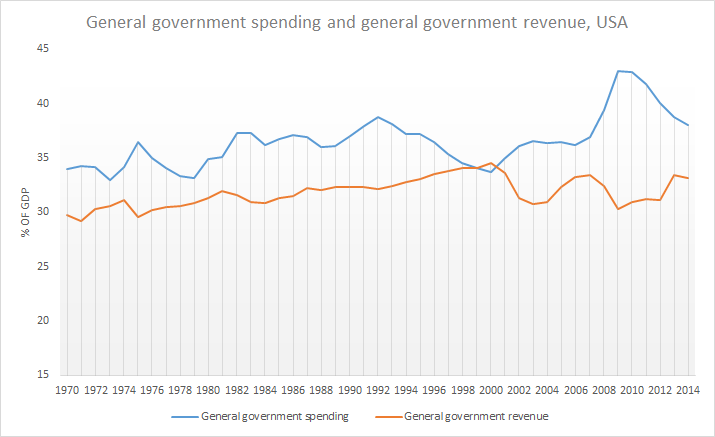
Source: General government – General government spending – OECD Data and Source: General government – General government revenue – OECD Data.

Live from the moon in @BernieSanders good old days
12 Mar 2016 Leave a comment
in economic history, economics of media and culture, politics - USA

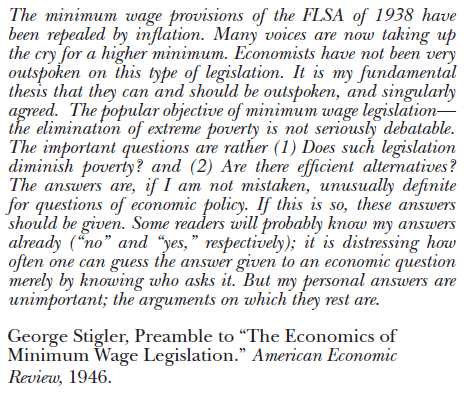
@Income_Equality this mostly criticises @annetterongotai @AndrewLittleMP
11 Mar 2016 Leave a comment
in applied welfare economics, health economics, politics - New Zealand

Solution aversion and the anti-science Left
11 Mar 2016 1 Comment
in applied price theory, applied welfare economics, comparative institutional analysis, constitutional political economy, economics of regulation, energy economics, environmental economics, global warming, health economics, law and economics, politics - Australia, politics - New Zealand, politics - USA, property rights, Public Choice Tags: antiscience left, climate alarmism, geo-engineering, GMOs, growth of knowledge, gun control, motivated reasoning, nuclear power, political persuasion, solar power, solution aversion, wind power
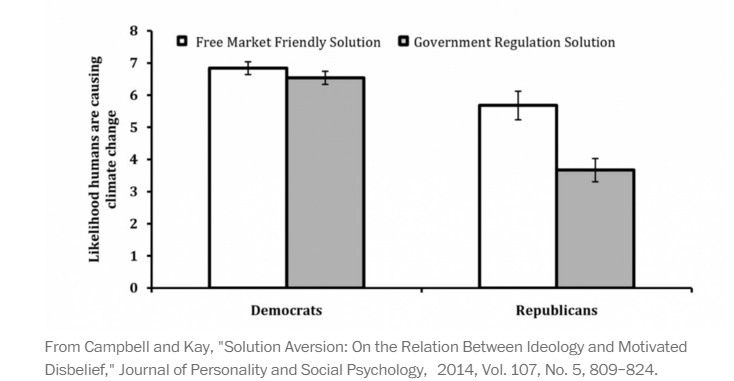
Climate science is the latest manifestation of solution aversion: denying a problem because it has a costly solution. The Right does this on climate science, the Left does it on gun control, GMOs, and plenty more. Cass Sunstein explains:
It is often said that people who don’t want to solve the problem of climate change reject the underlying science, and hence don’t think there’s any problem to solve.
But consider a different possibility: Because they reject the proposed solution, they dismiss the science. If this is right, our whole picture of the politics of climate change is off.
Some psychologists wasted grant money on lab experiments to show that people that think the solution to a problem is costly tend to rubbish every aspect of the argument. Any politician will tell you you do not concede anything. Sunstein again:
Campbell and Kay asked the participants whether they agreed with the IPCC. And in both, about 80 percent of Democrats did agree; the policy solutions made no difference.
Republicans, in contrast, were far more likely to agree with the IPCC when the proposed solution didn’t involve regulatory restrictions…
Here, then, is powerful evidence that many people (of course not all) who purport to be skeptical about climate science are motivated by their hostility to costly regulation.
The Left is equally prone to motivated readings. For example, it was found that those on the left are much more concerned about home invasions when gun control can reduce them rather than increase them.
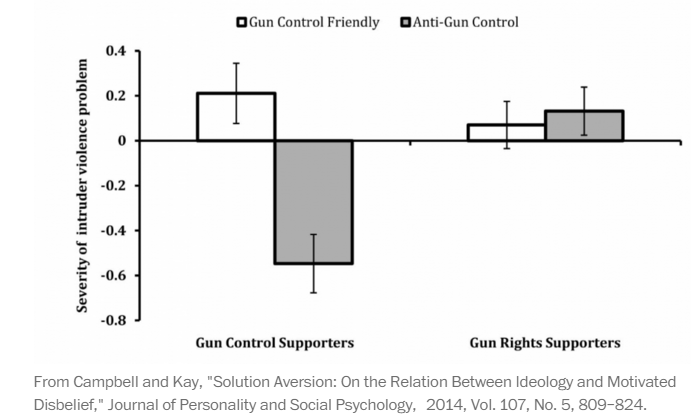
The Left picks and chooses which scientific consensus as it accepts. The overwhelming consensus among researchers is biotech crops are safe for humans and the environment. This is a conclusion that is rejected by the very environmentalist organisations that loudly insist on the policy relevance of the scientific consensus on global warming.
Previously the precautionary principle was used to introduce doubt when there was no doubt. But when climate science turned in their favour, environmentalists wanted public policy to be based on the latest science.
The Right is welcoming of the science of nuclear energy or geo-engineering. The Left rejects it point-blank. Their refusal to consider nuclear energy as a solution to global warming is a classic example of solution aversion. Let he who is without sin cast the first stone.
Monopolies and patents can breed deadweight loss and market inefficiencies
11 Mar 2016 Leave a comment
in applied price theory, applied welfare economics, comparative institutional analysis, law and economics, politics - Australia, politics - New Zealand, politics - USA, property rights Tags: intellectual monopolies, patents and copyright


Recent Comments