The supply-side economics of JFK
23 Sep 2015 Leave a comment
in applied price theory, applied welfare economics, politics - USA, Public Choice Tags: JFK, supply-side economics, taxation and growth, taxation and investment, taxation and the labour supply
Who said the taxpayer was not forward-looking as per the Ricardian equivalence theorem
23 Sep 2015 Leave a comment
in fiscal policy, politics - USA Tags: ageing society, demographic crisis, Ricardian equivalence theorem
51% of nonretirees doubt they will receive Social Security… on.gallup.com/1NcwzEa #GallupDaily http://t.co/ZhKnHYtr1X—
(@GallupNews) August 13, 2015
President Carter said the world would run out of oil by 2010
23 Sep 2015 Leave a comment
in energy economics, environmental economics, politics - USA Tags: doomsday prophecies, Oil prices, peak oil
President Carter said the world would run out of oil by 2010
realclimatescience.com/2015/06/presid… http://t.co/flmIxYOFdd—
Steve Goddard (@SteveSGoddard) June 22, 2015
Deaths in police car chases
22 Sep 2015 Leave a comment
in economics of crime, law and economics, politics - USA Tags: crime and punishment, law and order, police, police car chases

The price tag of Sanders’s proposals
22 Sep 2015 Leave a comment
in politics - USA Tags: 2016 presidential election
Price tag of Sanders’s proposals: $18 trillion on.wsj.com/1NssU4V http://t.co/WDRDcGLeVI—
Wall Street Journal (@WSJ) September 15, 2015
@GreenpeaceNZ should not support the vexatious claims of climate refugees @NZGreens
22 Sep 2015 Leave a comment
in Economics of international refugee law, environmental economics, global warming, international economics, law and economics, politics - New Zealand Tags: climate refugees, global warming, Greenpeace, Kiribati, nuisance suits, political refugees, vexatious litigation, war refugees
Political support is tenuous enough for admitting more political refugees and war refugees to New Zealand without visa overstayers trying it on with claims for asylum on the basis of climate change – that they are a climate refugee.
Currently New Zealand small refugee quota of 750 is under review. Chances of that been increased to 1000 are reasonable. If people are trying to open the floodgates to millions of people as potential refugees of climate change, if Greenpeace’s own alarmist rhetoric about global warming is to be believed, Greenpeace only strengthens the hand of the anti-immigration and xenophobic parties such as New Zealand First and within the National Party caucus.
Not everyone is a worthy cause, particularly those who make vexatious legal claims that were always going to fail in court. The High Court, the Court of Appeal and the Supreme Court all ruled that it is not their place to expand the scope of the international refugee convention to cover those displaced by climate change. As the Court of Appeal ruled
No-one should read this judgment as downplaying the importance of climate change. It is a major and growing concern for the international community. The point this judgment makes is that climate change and its effect on countries like Kiribati is not appropriately addressed under the Refugee Convention.
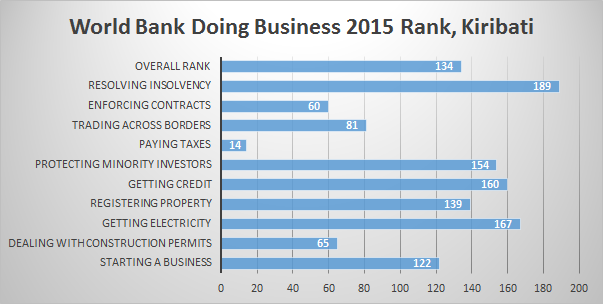
Source: Doing Business in Kiribati – World Bank Group
Kirabati can do a lot more to help itself rather than looking to others to solve its problems. It is ranked 133rd in the World Bank’s Doing Business database. This means it can do a lot to help its own development, which strengthens its resilience against climate change and rising sea levels. In the High Court, Priestley J observed:
The economic environment of Kiribati might certainly not be as attractive to the applicant and his fellow nationals as the economic environment and prospects of Australia and New Zealand. But he would not, if he returns, be subjected to individual persecution…
The appellant raised an argument that the international community itself was tantamount to the “persecutor” for the purposes of the Refugee Convention. This completely reverses the traditional refugee paradigm. Traditionally a refugee is fleeing his own government or a non-state actor from whom the government is unwilling or unable to protect him. Thus the claimant is seeking refuge within the very countries that are allegedly “persecuting” him.
Kiribati’s Human Development Index value for 2012 is 0.629—in the medium human development category—positioning the country at 121 out of 187 countries and territories. The rank is shared with Indonesia and South Africa. Kiribati is not unusually poor if it is similar in human development index ranking is to Indonesia and South Africa. Since 1980, Kiribati life expectancy at birth has increased from 55 years to 68 years. Average years of schooling is nearly 8 years and expected years of schooling for their children is now 12 years.
@TransportBlog How Aucklanders and Wellingtonians commute to work, 2013 Census
22 Sep 2015 1 Comment
in politics - New Zealand, transport economics, urban economics Tags: Auckland, bikes, buses, commuting, cycling, trains, Wellington
Bugger all Aucklanders take the bus (6.5%) or train (1.8%) to work. More Wellingtonians take the train (6.4%) or the public bus (7.9%) than in Auckland but more walk or jog than take either of those two publicly funded and subsidised conveyances. Hardly anybody takes a bike to work these days.
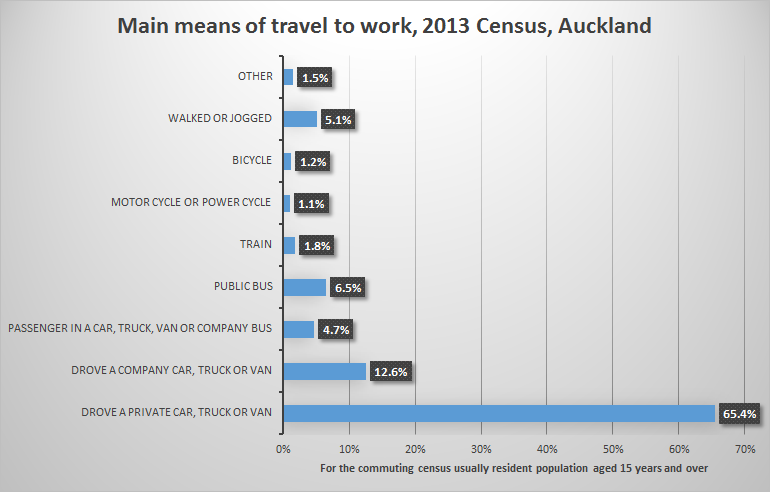
Source: 2013 Census QuickStats about transport and communications.
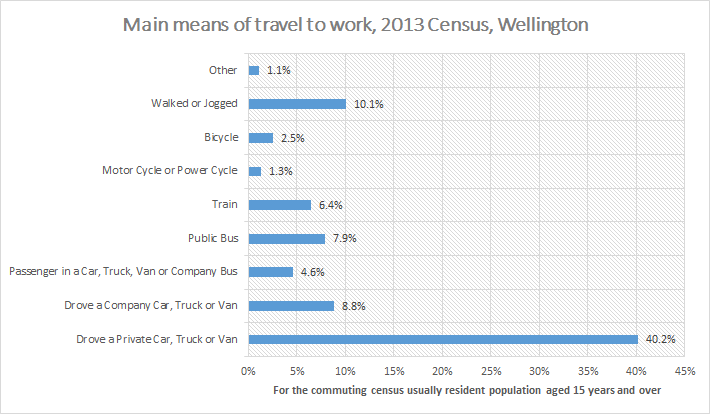
Source: 2013 Census QuickStats about transport and communications
The Moynihan Report revisited
22 Sep 2015 Leave a comment
in economic history, labour economics, politics - USA Tags: economics of families, marriage and divorce, Moynihan report, single mothers, single parents
The decline of the Republican Party in California
22 Sep 2015 Leave a comment
in economic history, politics - USA, Public Choice Tags: 2016 presidential election, California, voted demographics
California: the Republican party's lost state econ.st/1KfIJK0 http://t.co/vkdO87BfPE—
The Economist (@ECONdailycharts) September 17, 2015
728 shot by police by race, 2015 @thecounted @radleybalko @Mark_J_Perry
21 Sep 2015 1 Comment
in economics of crime, law and economics, politics - USA Tags: crime and punishment, law and order, police, police shootings

Source: The Counted: people killed by police in the United States in 2015 – interactive | US news | The Guardian accessed 20 September 2015 New Zealand standard time.

Source: The Counted: people killed by police in the United States in 2015 – interactive | US news | The Guardian accessed 20 September 2015 New Zealand standard time.
NZ Home ownership, 1916–2013
21 Sep 2015 Leave a comment
in economic history, politics - New Zealand, urban economics Tags: homeownership, housing affordability

@ChristchurchCC Deputy Mayor is clueless about the criminal justice system
21 Sep 2015 Leave a comment
in economics of crime, law and economics, politics - New Zealand, television, transport economics, urban economics Tags: crime and punishment, evidence-based policy, law and order, local government, rational ignorance, rational rationality, road safety, Yes Minister
 In responding to demands for police to crack down on windscreen washers, some of whom intimidate motorists to pay, the deputy mayor of Christchurch showed a cultured ignorance of youth courts. She has never read newspaper reports that show that youth court defendants are never named and their convictions are not held against them as adults. Furthermore, she is unaware of the spent convictions law in New Zealand that expunges most convictions after seven years, especially petty convictions.
The dangerous left-wing bias of economists strikes again
21 Sep 2015 2 Comments
in applied price theory, budget deficits, business cycles, economics of regulation, history of economic thought, occupational choice, politics - USA
The left-wing bias of economists must be taken into account in public policy-making. Any suggestions to regulate the economy, spend our way out of a recession, increase the top tax rate and so on must be discounted for that well-known but little publicised political bias.
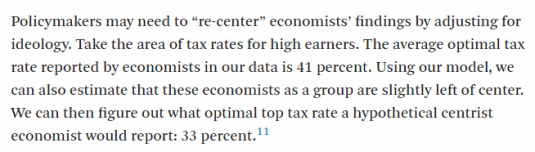
Source: Economists Aren’t As Nonpartisan As We Think | FiveThirtyEight
As is not well-known enough, Cardiff and Klein (2005) used voter registration data to rank disciplines at Californian Ivy League universities by Democrat to Republican ratios. Economics is the most conservative social science, with a Democrat to Republican ratio of a mere 2.8 to 1. This can be contrasted with sociology (44 to 1), political science (6.5 to 1) and anthropology (10.5 to 1). 40% of Americans are Democrats, 32% are independents with the balance Republicans.

Zubin Jelveh, Bruce Kogut, and Suresh Naidu confirmed that bias: that the typical economist is a moderate Democrat. They found a 60–40 liberal conservative bias

Jelveh, Kogut, and Naidu also reminded, as many have before them that economics is the most politically diverse of academic professions. Sociology is a notorious left-wing echo chamber as an example. Their most likely view of Jeremy Corbyn is he is a bit of a Tory. Oddly enough, sociologists are the first to point the finger at economists for political bias.

Jelveh, Kogut, and Naidu correlated political donations of more than $200 in the Federal Elections Commission database with the language used in 18,000 journal articles back to the 1970s.

More interestingly, they correlated political bias with the estimates of quantitative effects such as the top tax rate and its impact on labour supply and investment:
We found a (significant) correlation when we compared the ideologies of authors with the numerical results in their papers. That means that a left-leaning economist is more likely to report numerical results aligned with liberal ideology (and the same is true for right-leaning economists and conservative ideology)… liberals think the fiscal multiplier is high, meaning the government can improve economic growth by increasing spending, while conservatives believe the multiplier is close to zero or negative.
They are not suggesting a rigging of the results. Economists tend to sort into the fields that suit their ideologies:
It’s more likely that these correlations are driven by research areas and the methodologies employed by economists of differing political stripe. Economics involves both methodological and normative judgments, and it is difficult to imagine that any social science could completely erase correlations between these two… macroeconomists and financial economists are more right-leaning on average while labour economists tend to be left-leaning. Economists at business schools, no matter their specialty, lean conservative. Apparently, there is “political sorting” in the academic labour market.
Before you start writing out the indictment that economic policy and the global financial crisis is the product of a vast left-wing conspiracy within the economics profession you should remember the wise words of George Stigler.
Stigler argued that ideas about economic reform needed to wait for a market. He contended that economists exert a minor and scarcely detectable independent influence on the societies in which they live. As is well known, Stigler in the 1970s toasted Milton Friedman at a dinner in his honour by saying:
Milton, if you hadn’t been born, it wouldn’t have made any difference.
Stigler said that if Richard Cobden had spoken only Yiddish, and with a stammer, and Robert Peel had been a narrow, stupid man, England would have still have repealed the Corn Laws in the 1840s. England would still have moved towards free trade in grain as its agricultural classes declined and its manufacturing and commercial classes grew in the 1840s onwards because of the industrial revolution.
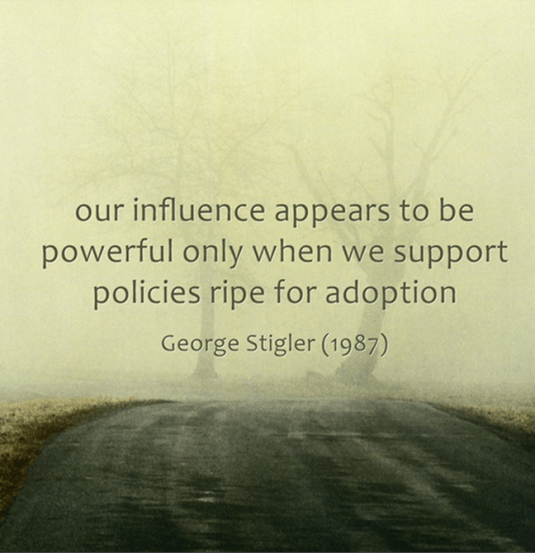
As Stigler noted, when their day comes, economists seem to be the leaders of public opinion. But when the views of economists are not so congenial to the current requirements of special interest groups, these economists are left to be the writers of letters to the editor in provincial newspapers. These days, they would run an angry blog.
The 43 Taser deaths by race in 2015 @thecounted @radleybalko @Mark_J_Perry
21 Sep 2015 Leave a comment
in economics of crime, law and economics, politics - USA Tags: crime and punishment, law and order, police, tasers

Source: The Counted: people killed by police in the United States in 2015 – interactive | US news | The Guardian accessed 1:30 p.m. 20 September 2015 New Zealand standard Time.

Source: The Counted: people killed by police in the United States in 2015 – interactive | US news | The Guardian accessed 1:30 p.m. 20 September 2015 New Zealand standard Time.
A history of US growth per capita
21 Sep 2015 Leave a comment
in economic growth, economic history, macroeconomics, politics - USA Tags: prosperity and depression
Time to replace eagle with unicorn? The US as a high growth startup. @JimPethokoukis goo.gl/D4MK9x http://t.co/6WRB7nvUTp—
AEIdeas Blog (@AEIdeas) September 03, 2015


Recent Comments