28 Sep 2015
by Jim Rose
in energy economics, industrial organisation, politics - New Zealand
Tags: expressive voting, privatisation, state owned enterprises
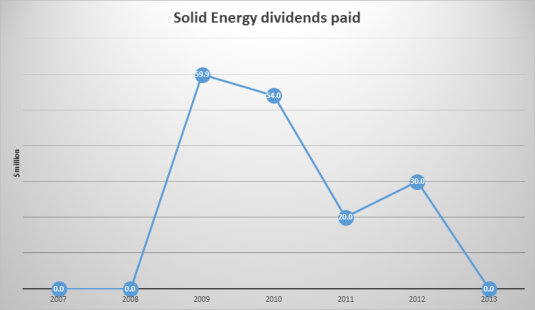
Leaving aside the fortunes and vicissitudes of the mining industry, Solid Energy’s numbers have been up and down by so much that if this was in a private company, you would start to wonder.

Source: The New Zealand Treasury – data released under the Official Information Act.
Taxpayers barely saw a cent of those multibillion-dollar valuations of just a few years ago for a company now under receivership. I doubt the ride was worth the price of passage for the taxpayer.
Source: The New Zealand Treasury – data released under the Official Information Act.

Source: The New Zealand Treasury – data released under the Official Information Act.
28 Sep 2015
by Jim Rose
in economic history, industrial organisation, politics - New Zealand
Tags: expressive voting, NZ Post, privatisation, state owned enterprises, sunset industries
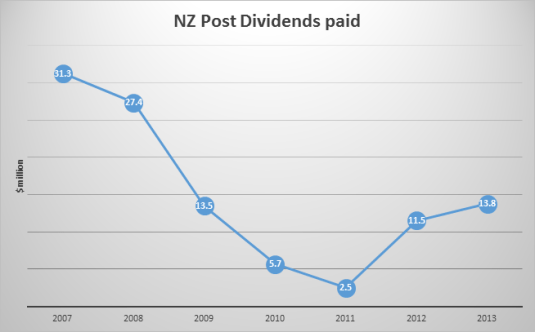
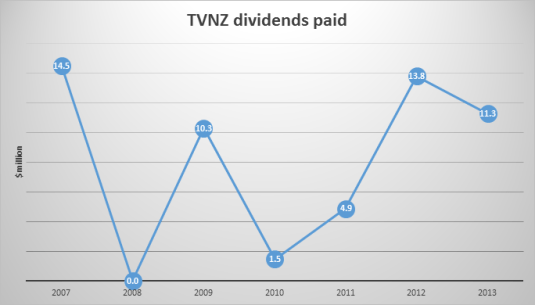
New Zealand Post is slowly going out the door with declining dividends to taxpayers, a sustained decline in its commercial valuation and a negative or poor Total Shareholder Return. Letter volumes declined by a one-half in 10 years but the parcels business is growing because of the rise of e-commerce and Internet shopping.

Source: The New Zealand Treasury – data released under the Official Information Act.
Source: The New Zealand Treasury – data released under the Official Information Act.

Source: The New Zealand Treasury – data released under the Official Information Act.
26 Sep 2015
by Jim Rose
in economic history, gender, human capital, labour economics, labour supply, politics - New Zealand
Tags: female labour force participation, graduate premium, male labour force participation, postgraduate premium, reversing gender gap
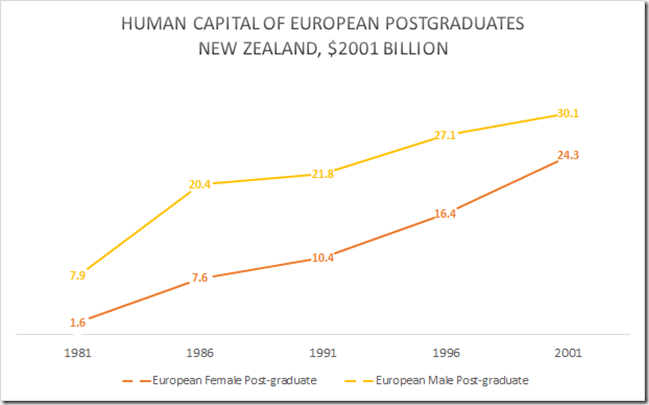
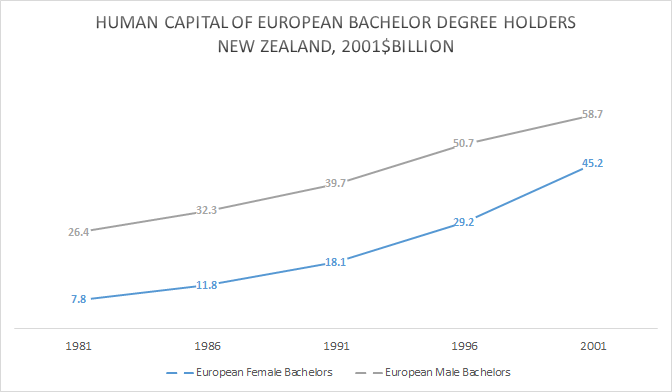
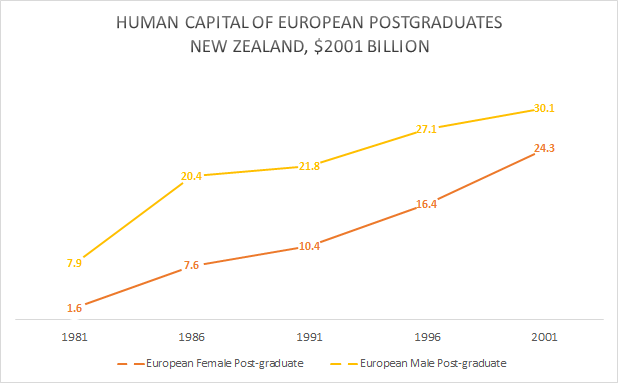
There was rapid growth in the human capital of graduates and postgraduates in New Zealand between 1981 and 2001 according to the census data. The growth in female human capital was particularly rapid and especially so at the postgraduate level.

Source: Lˆe Thi. Vˆan Tr`ınh, Estimating the monetary value of the stock of human capital for New Zealand, thesis submitted in partial fulfilment of the requirements for the Degree of Doctor of Philosophy at the University of Canterbury (September 2006).
Source: Lˆe Thi. Vˆan Tr`ınh, Estimating the monetary value of the stock of human capital for New Zealand, thesis submitted in partial fulfilment of the requirements for the Degree of Doctor of Philosophy at the University of Canterbury (September 2006).
25 Sep 2015
by Jim Rose
in economic history, income redistribution, politics - Australia, Public Choice, public economics
Tags: Australia, incidence of taxation, social insurance, taxation and entrepreneurship, taxation and investment, taxation and labour supply, top 1%, top tax rates, welfare state
25 Sep 2015
by Jim Rose
in environmental economics, global warming, politics - Australia, politics - New Zealand, politics - USA, Public Choice
Tags: China, climate alarmism, climate treaties, global warming, green tariffs, Greenpeace, international environmental law, Paris Summit 2015, Twitter left
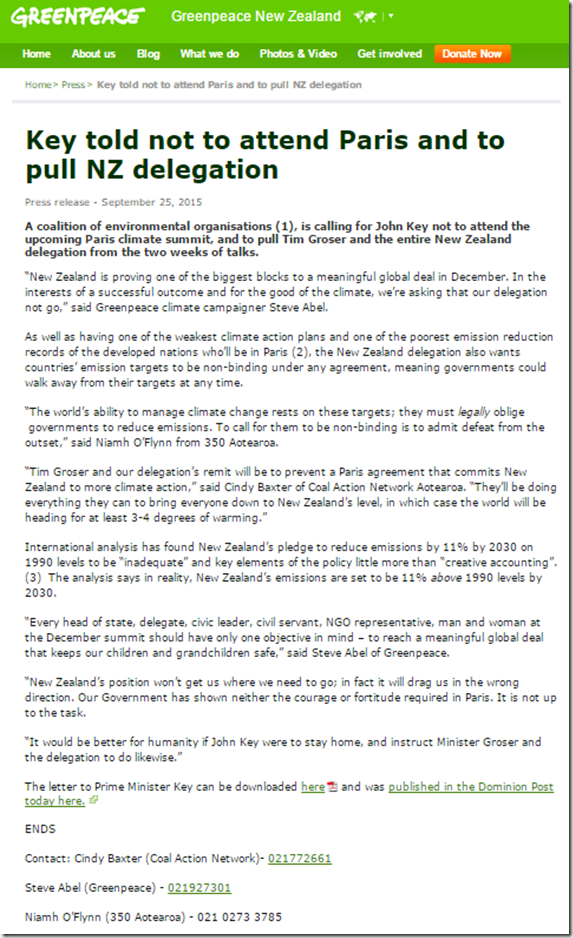
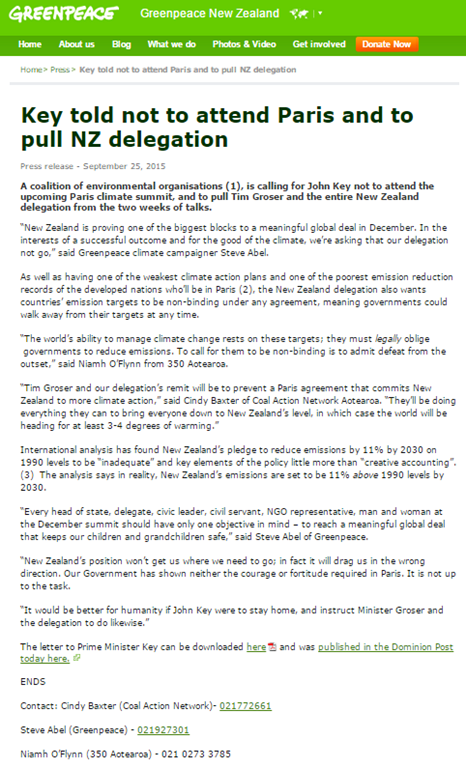
Greenpeace is right in saying in their open letter with others that New Zealand should not send a minister to the climate talks in Paris later this year. I agree for different reasons.
In common with many previous climate summits, the Paris talks will be a futile gesture that will have no significant effect on the pace of global warming and holding the summit is a waste of taxpayers money.
Nothing will come of them because the developing countries have no interest in postponing their development because of a minor inconvenience from global warming.
The easy way to tell if there is anything going to happen at a climate summit is the seniority of the delegation.

The Chinese made it clear at the Copenhagen summit in 2009 that they were not interested in an agreement by sending a Vice Minister of Foreign Affairs to a key side meeting of the American and French presidents, the British Prime Minister and the German Chancellor. All subsequent policy manoeuvrings by the Chinese on global warming are an attempt to head off green tariffs on their exports.
25 Sep 2015
by Jim Rose
in financial economics, industrial organisation, politics - New Zealand, public economics, rentseeking, survivor principle, transport economics
Tags: government ownership, KiwiRail, privatisation, rational ignorance, rational rationality, state owned enterprises, suppressive voting
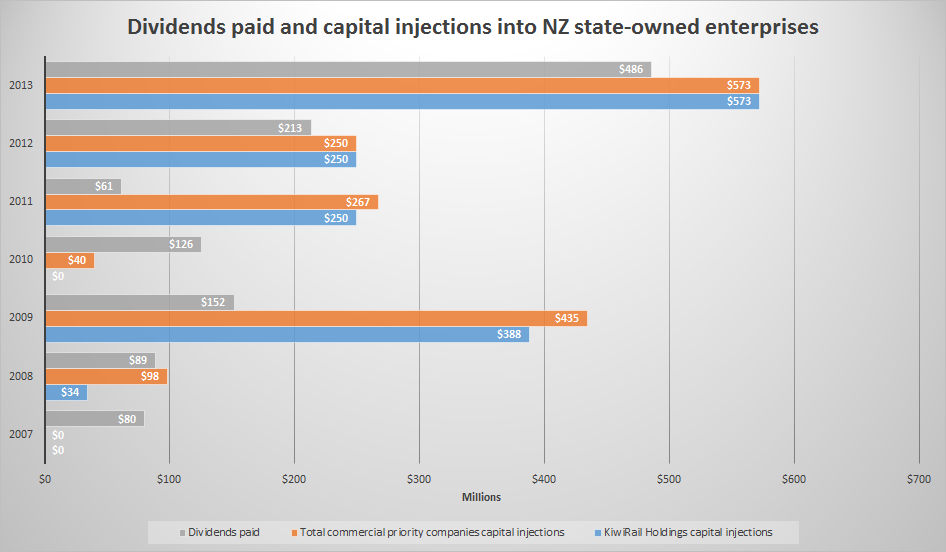
The New Zealand Labour Party and New Zealand Greens both make much of the fact that when you privatise a state-owned enterprise the taxpayer is no longer entitled to dividends from the privatised business. The fact that the sale price is the net present value of those future dividends is a rating fallacy that is not the subject of this post.
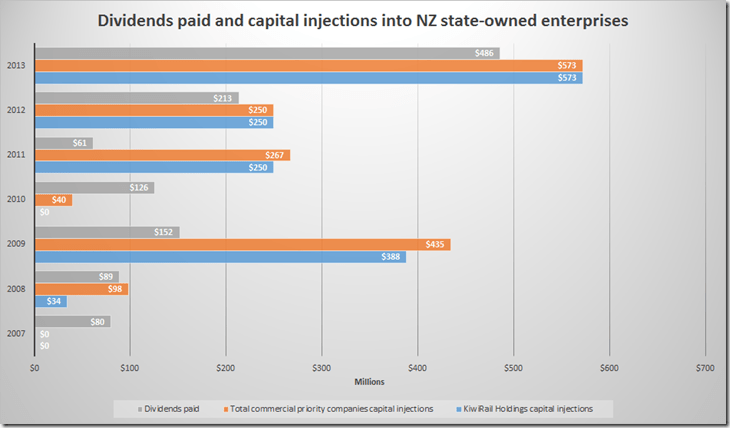
Source: New Zealand Treasury – data released under the Official Information Act.
What is the subject of this post is whether there are indeed any dividends paid to taxpayers after capital injections. 2007 was the last year in which dividends to the taxpayer exceeded capital injections. The reason was that dog called KiwiRail.
25 Sep 2015
by Jim Rose
in applied price theory, labour economics, labour supply, occupational choice, personnel economics, politics - New Zealand
Tags: employment law, employment protection law, employment regulation, fixed costs of employment, Leftover Left, The fatal conceit, unintended consequences, zero hours contracts
This Labour Party link made it very easy for me to submit to the Select Committee of Parliament to oppose the Bill on regulating zero hours contracts. I oppose the Bill for the exact opposite reasons that the Labour Party opposes the Bill.
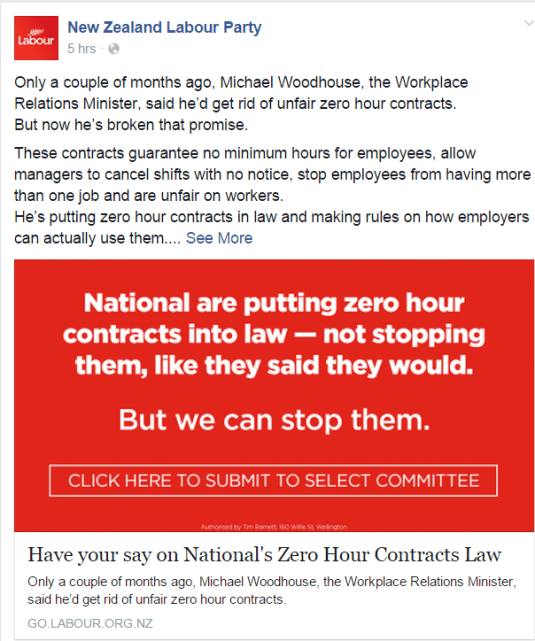
I encourage others to make a submission to Parliament as well opposing this draft amendment that will lower the wages of workers. My submission is as follows:
I do not support the proposed changes to the legislation governing zero hour contracts in the Employment Standards Legislation Bill. There should be no regulation of zero hours contracts.
Zero hours contracts is creative destruction at work in the labour market, sweeping away obsolete working time arrangements, mostly in the retail services sector. Plenty of new ways of working have emerged in recent years that include the proliferation of part-time work, temporary workers, leased workers, working from home, teleworking and sub-contracting. Employment laws were built on the now decaying assumption that workers had career-long, stable relationships with single employers.
Advance notice of work schedules is always known only to a minority of temporary and permanent employees in New Zealand, and there’s not much difference between that advance notice between temporary and permanent employees.
Critics overplay their hand if they suggest that somehow workers are very much disadvantaged and employers are holding all the cards. Job turnover and recruitment problems are a serious cost to a business. Workers will not sign zero hours contracts if they are not to their advantage.
Unless labour markets are highly uncompetitive with employers having massive power over employees, employers should have to pay a wage premium if zero-hour contracts are a hassle for workers.
The fixed costs of employment are such that you shouldn’t expect zero-hour contracts: you’ll typically do better with one 40-hour worker over two 20-hour workers because of these costs. Zero hour contracts would be most likely in jobs with low recruitment costs and where specialised training needs are low. Workers with low fixed costs of working will move into the zero-hour sector while those with higher fixed costs would prefer lower hourly rates but more guaranteed hours. Again, read lower here as meaning relative to what they could elsewhere earn.
Unless we have a good idea about why firms are moving to zero hours contracts, which we don’t, and why employees sign these contracts rather than work for other employers who offer more regular hours, meddling in these novel working time arrangements is risky.
Employers must pay a wage premium to induce in workers to sign zero hours contracts. This Bill seeks to deny workers the right to seek higher wages.
Feel free to use the above text as the basis for your own submission to Parliament.
24 Sep 2015
by Jim Rose
in financial economics, politics - New Zealand, Public Choice, public economics
Tags: expressive voting, government ownership, privatisation, state owned enterprises
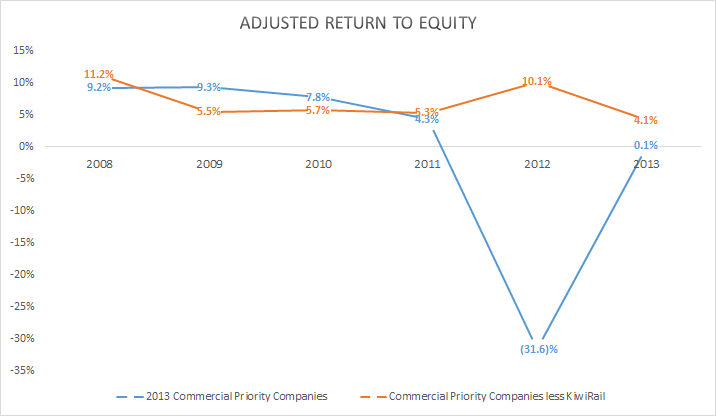
I asked for information from the Treasury for as far back as 2000 but could only get information back to 2008 on the return on equity of the portfolio of state-owned enterprises to the taxpayer.
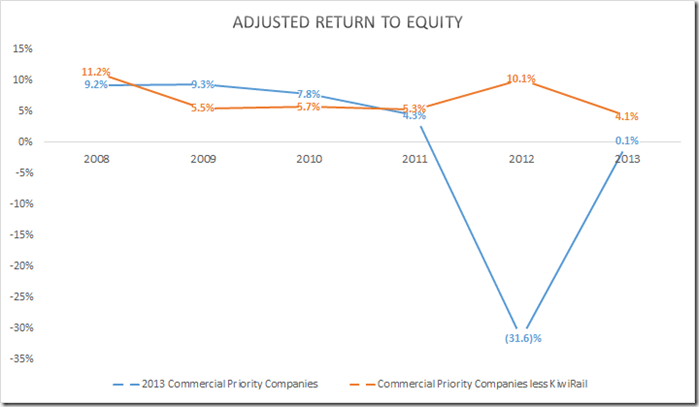
Source: New Zealand Treasury – released under Official Information Act.
Apparently, long-term information on the performance of the state-owned enterprise portfolio is not available. Anyone wanting to know the performance of an individual or group of listed companies simply looks at the share price was far back as they want. The prices of individual shares reflect market expectations of future dividends and future price movements, and they go up and down as new information is revealed. The history of a share price indicates the ups and downs of a company in one number far better than any other available indicator.
I also included the adjusted rate of return on equity taking out the two dogs in the portfolio: Solid Energy and KiwiRail.
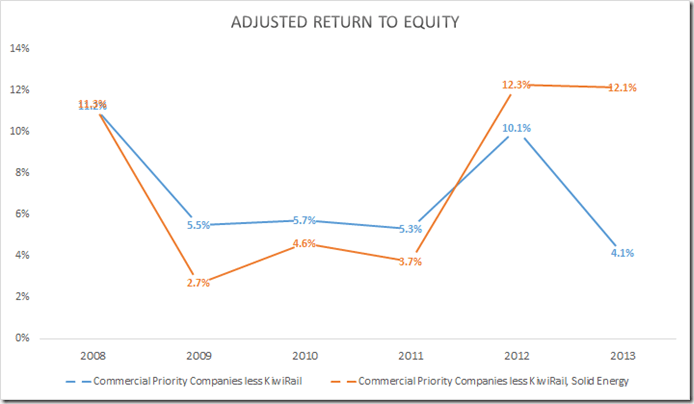
Source: New Zealand Treasury – released under Official Information Act.
24 Sep 2015
by Jim Rose
in applied price theory, applied welfare economics, comparative institutional analysis, economics of regulation, entrepreneurship, health economics, industrial organisation, law and economics, politics - USA, property rights, survivor principle
Tags: creative destruction, endogenous growth theory, innovation, intellectual property rights, patents and copyrights, pharmaceutical innovation, price controls
Our research shows that when prices fall, innovation falls even more. Patients would see their lives cut short by delayed or absent drugs.
Source: Drug Price Controls End Up Costing Patients Their Health – NYTimes.com
…cutting prices by 40 to 50 percent in the United States will lead to between 30 and 60 percent fewer R and D projects being undertaken in the early stage of developing a new drug. Relatively modest price changes, such as 5 or 10 percent, are estimated to have relatively little impact on the incentives for product development – perhaps a negative 5 percent.
Source: The Effect of Price Controls on Pharmaceutical Research


Source: U.S. Pharmaceutical Policy In A Global Marketplace
Previous Older Entries Next Newer Entries






Recent Comments