In 1985, Obama’s science advisor John Holdren predicted that by now we’d be approaching a billion CO2-related deaths from famine
28 Aug 2015 Leave a comment
in environmental economics, global warming, politics - USA Tags: climate alarmists, cranks, doomsday profits, doomsday prophecies, global warming, Quacks
Did Mass Incarceration Destroy the Black Family?
28 Aug 2015 Leave a comment
in discrimination, economics of crime, economics of love and marriage, labour economics, law and economics, politics - New Zealand, population economics, poverty and inequality, unemployment, urban economics, welfare reform Tags: crime and punishment, criminal deterrence, economics of the family, racial discrimination, single mothers, single parents, teen pregnancies
Did Mass Incarceration Destroy the Black Family? Not exactly. bit.ly/1f8jgXm http://t.co/1q2nKJnU9W—
City Journal (@CityJournal) August 13, 2015
Should backyard swimming pools be banned?
26 Aug 2015 Leave a comment
in applied price theory, economics of crime, economics of regulation, health and safety, law and economics, politics - USA, property rights Tags: gun control, meddlesome preferences, nanny state, risk risk trade-offs
The Bootleggers and Baptists alliance between big tobacco and anti-smoking lobbyists on e-cigarettes
25 Aug 2015 Leave a comment
in applied price theory, applied welfare economics, economics of regulation, health economics, politics - Australia, politics - New Zealand, politics - USA, Public Choice, rentseeking Tags: bootleggers and baptists, economics of smoking, meddlesome preferences, nanny state, pressure groups, special interests
Do the @NZGreens care about the fuel poverty consequences of carbon taxes?
24 Aug 2015 Leave a comment
in energy economics, environmental economics, global warming, politics - Australia, politics - New Zealand, politics - USA, poverty and inequality Tags: carbon tax, climate alarmism, expressive voting, fuel poverty, global warming
Who is harmed the most from higher energy costs? The poor, who spend almost 25% of their disposable income on energy? http://t.co/YOn28COXy8—
Mark J. Perry (@Mark_J_Perry) June 22, 2015
The Molotov-Ribbentrop Pact was signed #OnThisDay 1939
23 Aug 2015 Leave a comment
in economic history, Marxist economics, politics - Australia, politics - New Zealand, politics - USA Tags: communist party, left-wing traitors, World War II
The Molotov-Ribbentrop Pact was signed #OnThisDay in 1939. Stalin was no less evil than Hitler econ.trib.al/iCowG41 http://t.co/yxr5FCW1xg—
The Economist (@EconEurope) August 23, 2015
The next Australian election will be much more competitive than I thought
23 Aug 2015 Leave a comment
in politics - Australia, Public Choice Tags: 2016 Australian federal election
Any new strategy after Feb's "Good govt starts today" yet to pay dividends for LNP #auspoI #ipsos http://t.co/cnbksuQAvL—
Danny Rose (@_DannyRose) August 16, 2015
How big is Uber
23 Aug 2015 Leave a comment
CHART: How Big is Uber vs. Legacy Taxis? VERY, VERY BIG nationalpost.com/m/wp/blog.html… http://t.co/gz0vXPZDip—
Mark J. Perry (@Mark_J_Perry) August 22, 2015
via Summer of Uber: Everything you need to know about the upstart ride-sharing service.
Marginal tax rates of 2-income couples with 2 children in USA, UK, Australia and New Zealand since 2000
23 Aug 2015 Leave a comment
in economic history, economics of love and marriage, labour economics, labour supply, politics - Australia, politics - New Zealand, politics - USA, public economics Tags: Australia taxation and labour supply, British economy, marriage and divorce
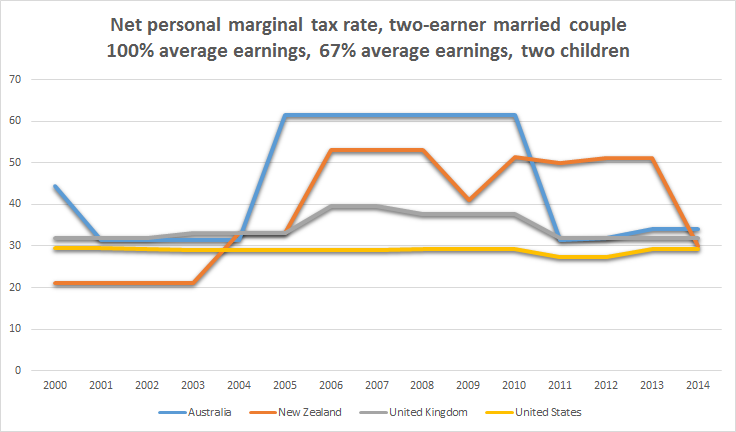
Source: OECD StatExtract.
Why some billionaires are bad for growth, and others aren’t
22 Aug 2015 Leave a comment
in applied price theory, applied welfare economics, economics of bureaucracy, economics of regulation, financial economics, income redistribution, industrial organisation, politics - Australia, politics - New Zealand, politics - USA, Public Choice, rentseeking, survivor principle Tags: Australia, billionaires, Russia, top 0.1%, top 1%

…Bagchi and Svejnar carefully went through the lists of all the Forbes billionaires, and divided them into those who had acquired their wealth due to political connections, and those who had not. This is kind of a slippery slope — almost all billionaires have probably benefited from government connections at one time or another.
But the researchers used a very conservative standard for classifying people as politically connected, only assigning billionaires to this group when it was clear that their wealth was a product of government connections. Just benefiting from a government that was pro-business, like those in Singapore and Hong Kong, wasn’t enough.
Rather, the researchers were looking for a situation like Indonesia under Suharto, where political connections were usually needed to secure import licenses, or Russia in the mid-1990s, when some state employees made fortunes overnight as the state privatized assets.
…The negative effects of wealth inequality are largely being driven by politically connected wealth inequality. That seems to be the primary channel that drives this relationship…
a 3.72 percent increase in the level of wealth inequality would cost a country about half a percent of real GDP per capita growth. That’s a big impact, given that average GDP growth is in the neighbourhood of two percent per year
@guardianeco slimes New Zealand’s record on #climatechange @NZGreens @GreenpeaceNZ
22 Aug 2015 Leave a comment
in economics of information, energy economics, environmental economics, global warming, politics - Australia, politics - New Zealand, Public Choice Tags: Australia, climate alarmism, global warming, Left-wing hypocrisy, The Guardian
https://twitter.com/guardianeco/status/634681114527797248
Excellent wrap up of carbon pricing globally, found here: worldbank.org/en/news/featur… #renewables http://t.co/Hocf9Z5cEC—
Danny Rose (@_DannyRose) August 19, 2015
Carbon pricing expanded in the last 21 months. New report shows where & how:
wrld.bg/R0EuZ http://t.co/VB69szI1je—
World Bank (@WorldBank) August 19, 2015
A carbon price gives investors a clearer view of the future risks of high-carbon assets: wrld.bg/R0GLE http://t.co/GuNnzlMMlZ—
World Bank (@WorldBank) August 21, 2015
Marginal tax rates of a nuclear family in USA, UK, Australia and New Zealand since 2000
22 Aug 2015 Leave a comment
in economic history, economics of love and marriage, labour economics, labour supply, politics - Australia, politics - New Zealand, politics - USA Tags: Australia, British economy, marriage and divorce, taxation and labour supply
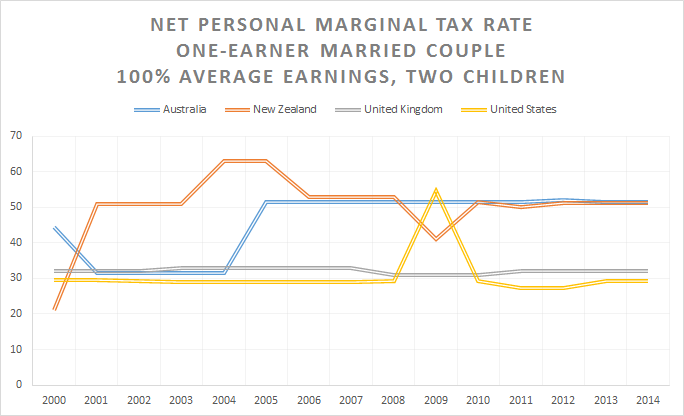
Source: OECD StatExtract.
What Can We Learn From National Primary Polling?
22 Aug 2015 Leave a comment
in politics - USA, Public Choice Tags: 2016 presidential election, expressive voting, opinion polling, rational ignorance, rational rationality, voter demographics
The 2012 race was even crazier. GOP voters flirted seriously with nearly every other candidate before finally settling on Romney.

via What Can We Learn From National Primary Polling? Virtually Nothing. – Reason.com.


Recent Comments