Brilliant piece by @PCollinsTimes: "denial already has its two candidates in the field." thetimes.co.uk/tto/opinion/co… http://t.co/PLs36JBk3i—
Harry Cole (@MrHarryCole) May 15, 2015
British Labour’s defeat was actually worse than initially reported
16 May 2015 Leave a comment
Is the Mother Country catching up with Down Under? Real GDP per working age New Zealander, British and Australian, detrended, 1956 –2013
15 May 2015 Leave a comment
in economic growth, economic history, macroeconomics, politics - Australia, politics - New Zealand Tags: Australia, British economy, lost decades
Figure 1: Real GDP per New Zealander, British and Australian aged 15-64, converted to 2013 price level with updated 2005 EKS purchasing power parities, 1956-2013

Source: Computed from OECD Stat Extract and The Conference Board, Total Database, January 2014, http://www.conference-board.org/economics
Figure 2: Real GDP per New Zealander, British and Australian aged 15-64, converted to 2013 price level with updated 2005 EKS purchasing power parities, 1.9 per cent detrended, 1956-2013
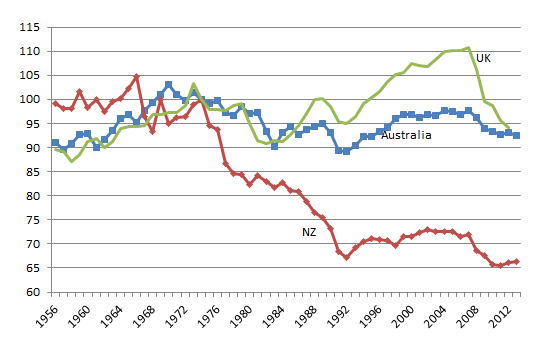
Source: Computed from OECD Stat Extract and The Conference Board, Total Database, January 2014, http://www.conference-board.org/economics
When is a sample size too small to make inferences about global warming?
15 May 2015 Leave a comment
in environmental economics, global warming, politics - New Zealand Tags: climate alarmism, conjecture and refutation

The main drivers of child poverty
15 May 2015 Leave a comment
in applied welfare economics, economics of love and marriage, gender, labour economics, labour supply, occupational choice, politics - Australia, politics - New Zealand, politics - USA, population economics, welfare reform Tags: child poverty, economics of the family, family poverty, marriage and divorce, single mothers, single parents
CHART: Black Illegitimacy Rate Went from < 20% in 1950 to 75.2% in 2010. Has Obama ever mentioned that? http://t.co/1UBUQ5aLRi—
Mark J. Perry (@Mark_J_Perry) May 12, 2015
Quotation of the Day from Charles Murray http://t.co/Y8W6xGjRPO—
Mark J. Perry (@Mark_J_Perry) May 12, 2015
Urban planners are confident souls
15 May 2015 Leave a comment
in development economics, economics of regulation, environmental economics, growth miracles, politics - Australia, politics - New Zealand, politics - USA, urban economics Tags: green rent seeking, housing affordability The fatal conceit, land use regulation, offsetting behaviour, RMA, The pretence to knowledge, unintended consequences, urban planning, zoning

Health spending has been slow for a few years now
15 May 2015 Leave a comment
in health economics, politics - Australia, politics - New Zealand, politics - USA Tags: public health expenditure, welfare state


Further evidence that street politics is counter-productive
14 May 2015 Leave a comment
in constitutional political economy, politics - Australia, politics - New Zealand, politics - USA, Public Choice Tags: activists, civil disobedience, Leftover Left, protesters, street politics
Public disorder and rioting by a large leads to a law and order response among the public and a hardening of social attitudes against whatever the desired social reform might be when it is tainted by civil disorder.

The Left, the Green Left and the watermelons in particular want to believe that street protests change things. They have to validate their youthful offences against public order.
Sadly, no; sadly for them but not for the law-abiding rest of us who resolve our differences by trying to persuade each other and elections.
The law-abiding rest of us believe in democratic equality. Your vote counts as much as mine in a democracy with free speech. The only way you can change my vote is by free speech, not by public disorder, threats and intimidation and taking the law into your own hands.
Public confidence in the police in America
14 May 2015 Leave a comment
in economics of bureaucracy, economics of crime, politics - USA Tags: crime and punishment, law and order, police, voter demographics
How motherhood in America has changed
14 May 2015 Leave a comment
in discrimination, economic history, gender, job search and matching, labour economics, labour supply, politics - USA Tags: female labour force participation
How motherhood in America has changed pewrsr.ch/1kRRCey http://t.co/9lTNrzDlSJ—
PewResearch FactTank (@FactTank) May 10, 2015
Does tax reform lead to lower taxes?
14 May 2015 Leave a comment
in politics - Australia, politics - New Zealand, politics - USA, public economics, taxation Tags: efficient taxes, tax reform
Why is the gender gap so large and the glass ceiling so thick in Sweden?
14 May 2015 1 Comment
in discrimination, economics of love and marriage, gender, human capital, labour economics, occupational choice, politics - USA Tags: asymmetric marriage premium, do gooders, economics of families, gender wage gap, maternity leave, Sweden, The fatal conceit, unintended consequences
The gender wage gap is no better than the OECD average, despite generous maternity and paternity leave. What gives?
America: one day a year celebrating mothers, fathers.
Sweden: 480 days paid leave per child. vox.com/2014/5/12/5708… http://t.co/weFDrTj7Jb—
Ezra Klein (@ezraklein) May 11, 2015
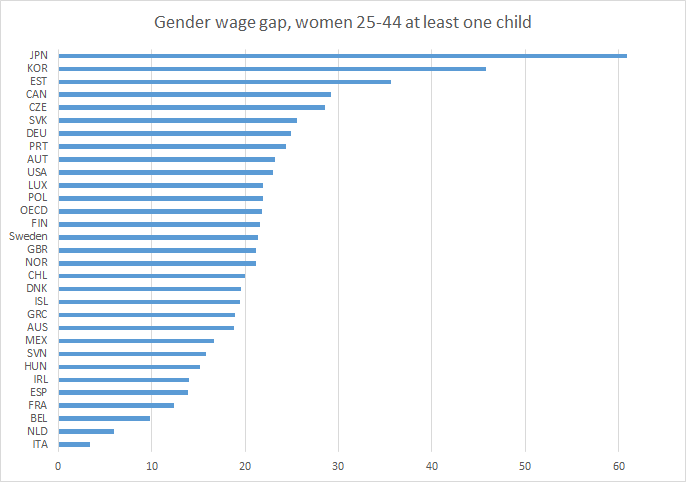
Source: Closing the gender gap: Act now – http://dx.doi.org/10.1787/9789264179370-en
How big is the wage gap in your country? bit.ly/18o8icV #IWD2015 http://t.co/XTdntCRfDQ—
(@OECD) March 08, 2015
One important question is whether government policies are effective in reducing the gap. One such policy is family leave legislation designed to subsidize parents to stay home with new-born or newly adopted children.
One of the RLE articles shows that for high earners in Sweden there is a large difference between the wages earned by men and women (the so-called “glass ceiling”), which is present even before the first child is born. It increases after having children, even more so if parental leave taking is spread out.
These findings suggest that the availability of very long parental leave in Sweden may be responsible for the glass ceiling because of lower levels of human capital investment among women and employers’ responses by placing relatively few women in fast-track career positions. Thus, while this policy makes holding a job easier and more family-friendly, it may not be as effective as some might think in eradicating the gender gap.
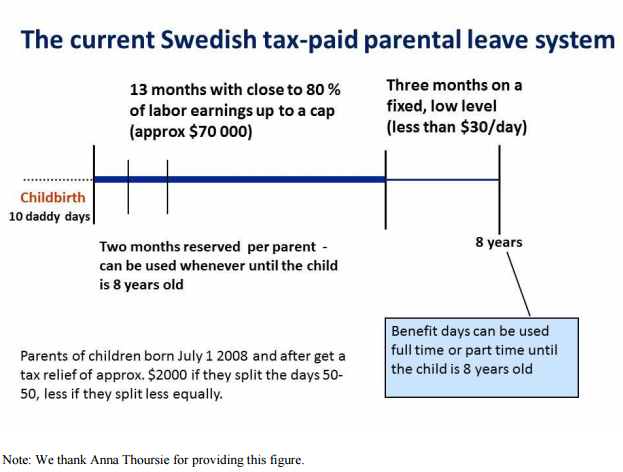
via New volume on gender convergence in the labour market | IZA Newsroom.
Labour lost the working-class vote a long time ago
13 May 2015 Leave a comment
in economic history, politics - Australia, politics - New Zealand, politics - USA, Public Choice Tags: British Labour Party, Labour Party, Leftover Left, Twitter left, UK politics, withering away the of proletariat


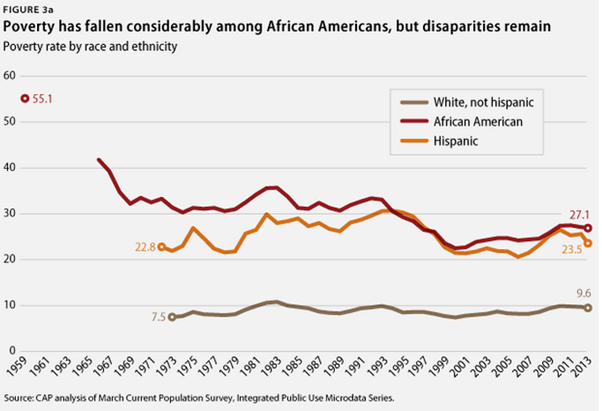
Black and Hispanic poverty dropped by a third after the 1996 US welfare reforms
13 May 2015 Leave a comment
in labour economics, labour supply, politics - USA, poverty and inequality, welfare reform Tags: 1996 welfare reforms, child poverty, family poverty, welfare state
Just passed 40th anniversary of top climate scientists wanting to melt Arctic ice cap
13 May 2015 Leave a comment
in environmental economics, global warming, politics - Australia, politics - New Zealand, politics - USA Tags: climate alarmism, global cooling, global warming
We have just passed the 40th anniversary of our top climate scientists wanting to melt the Arctic ice cap. http://t.co/2ccvJgBREy—
Steve Goddard (@SteveSGoddard) May 12, 2015
How the Socialists lost the British general election
12 May 2015 Leave a comment
Official: Lazy Socialists Lost the Election order-order.com/2015/05/12/off… http://t.co/zv9CfEjFbu—
Guido Fawkes (@GuidoFawkes) May 12, 2015


Recent Comments