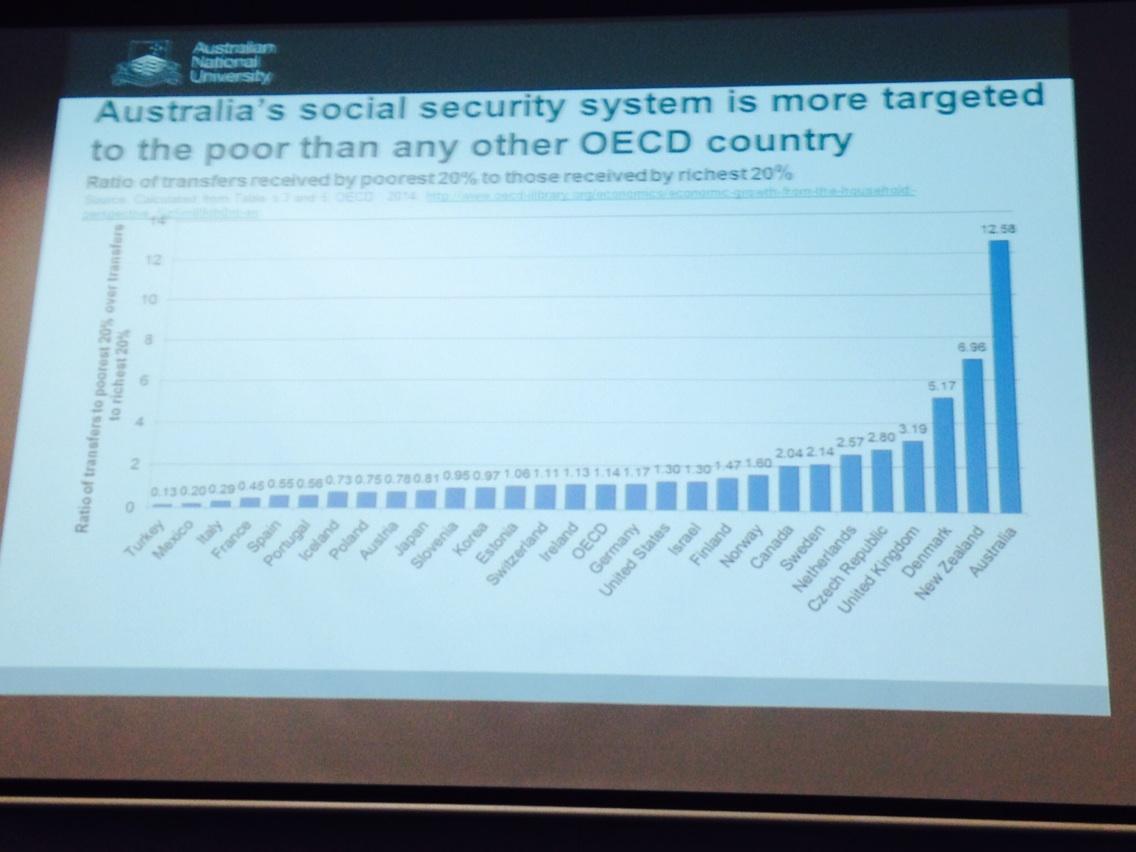
The New Zealand social welfare system is the second most targeted towards the poor in the OECD
11 Oct 2014 Leave a comment
in applied welfare economics, labour economics, politics - New Zealand, welfare reform Tags: welfare reform
My New Report on Corporate Welfare in New Zealand
10 Oct 2014 Leave a comment
in politics - New Zealand, rentseeking Tags: corporate welfare, New Zealand, rent seeking, Taxpayers Union
The Taxpayers’ Union today launched my report, Monopoly Money, which examines the cost and case for New Zealand’s extensive corporate welfare programmes.
Figure 1: Corporate welfare, Budgets 2008/09 to 2014/15
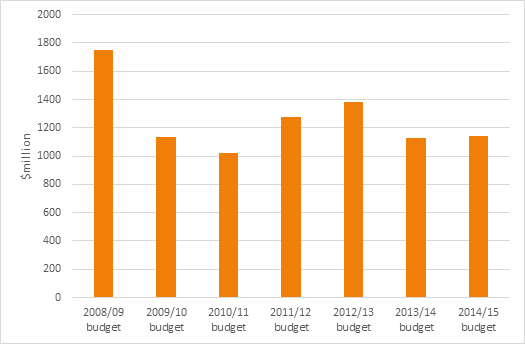
My report, which examines the cost of corporate welfare examines government spending since the 2007/2008 budget, shows:
- Since National took office, corporate welfare has cost taxpayers $1-1.4 billion ($600 – $800 per household) per year
- If corporate welfare was abolished, enough money would be saved to reduce the corporate tax rate from 28% to 22.5%
- If applied to personal income tax rates, the saving would allow the 30% and 33% income tax rates to be lowered to 29%
Figure 2: Corporate welfare, Budgets 2008/09 to 2014/15 by Vote
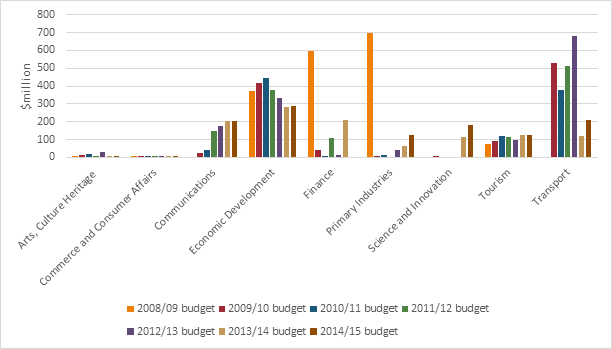
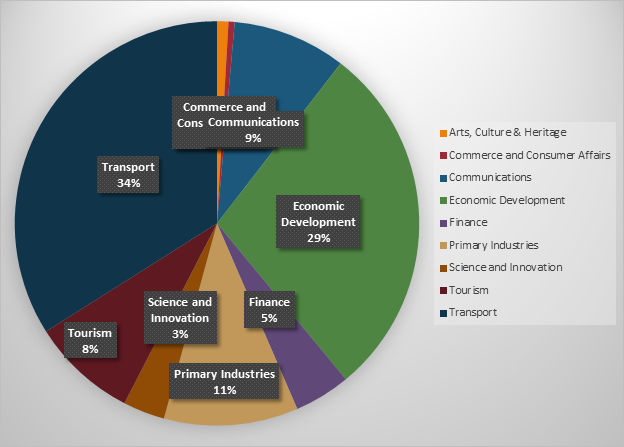
Figure 3: Distribution of total corporate welfare across votes, 2008/09 to 2014/15


A Report on ‘Can Hearts and Minds be Bought?’ The Economics of Counterinsurgency in Iraq by Eli Berman, Jacob N. Shapiro and Joseph H. Felter
08 Oct 2014 Leave a comment
in applied price theory, defence economics, occupational choice, politics - Australia, politics - New Zealand, politics - USA Tags: war on terror


Can hearts and minds be bought? A metaphorical question posed to ask whether government spending can aid counterinsurgency. In their paper, Berman et al. seek to answer this basic question using current literature, recent data and a model of counterinsurgency.
They chose Iraq for their research because it is presently significant, there is a large amount of data and most importantly, because it is characterised by insurgency and not by ‘conventional warfare’. It is this characteristic, argued by Berman et al. that will be seen more often in future conflicts that is so crucial to understand. Another important facet to note is that current ‘US Army counterinsurgency doctrine’ is not based on any social scientific theory; thereby making the need to understand insurgency more vital to aid spending.
By using current data, Berman et al. find on the whole that the correlation between reconstruction spending and violence across Iraqi districts…
View original post 2,864 more words
Can millionaires buy their way into Parliament? Lessons from the recent New Zealand election
07 Oct 2014 Leave a comment
in applied price theory, election campaigns, politics - New Zealand, politics - USA, Public Choice Tags: 2014 New Zealand general election, campaign finance reform, Leftover Left, median voter theorm, public choice

Two millionaires, one on the left and one on the right, set up parties to get into Parliament in the recent New Zealand election. The millionaire of the left failed abysmally. The millionaire on the right made progress towards getting into Parliament in the 2017 election.
Each spent vast sums of money by New Zealand standards on their party:
- Kim.com gave $4.5 million to his Internet – Mana party; and
- Colin Craig gave about $1.5 million to his Conservative party with another millionaire giving $750,000 to the Conservative party.
By way of context, the maximum that a political party can spend on campaign expenses in the three months prior to the election is $1.1 million, plus $25,000 per electorate seat It is contesting. None of this is spent on radio and television advertising because this is allocated for free by the electoral commission based on previous election performance.
One of the major rationales for election finance regulation is to stop the rich buying elections by flooding the airways and billboards with their call to arms and buying politicians short of campaign donations:
Conventional wisdom holds that money plays a central and nefarious role in American politics.
Underlying this belief are two fundamental assumptions:
(1) elective offices are effectively sold to the highest bidder, and
(2) campaign contributions are the functional equivalent of bribes.
Campaign finance regulations are thus an attempt to hinder the operation of this political marketplace.
John Milyo
New Zealand is a good example of how difficult it is to buy votes if you’re underlying message does not work. This is a key point to remember.
The millionaire of the left, Kim.com, gave money to a far left party in New Zealand, recycled a couple of middle-aged lefties, ran a hard left campaign, and won all of 2000 extra party votes over last time out of electorate of about 2 million.
He came unstuck because his sitting electorate MP lost 3000 votes and lost his seat. If he had kept his seat, his party would have been also entitled to a List MP seat because his party won 1.3% of the party vote. Under the New Zealand system of mixed member proportional representation, if you win a seat in Parliament, you’re entitled to list seats to ensure that your representation in Parliament is equal to your party vote.
The millionaire of the right, Colin Craig, ran a socially conservative, economic nationalist campaign and won 4% of the vote. A party needs 5% of the party vote to get into Parliament if your party does not win an electorate seat.
Both of these parties that did not get into Parliament outspent the winning national party which won 60 of the 121 seats in Parliament.
The failure of Kim.com and Colin Craig to buy their way Parliament should be no surprise. Most systematic studies find no effect of marginal campaign spending on the electoral success of candidates.
For example, see Steven Levitt, “Using Repeat Challengers to Estimate the Effects of Campaign Spending on Electoral Outcomes in the U.S. House,” Journal of Political Economy 102 (1994): 777–798.
Levitt noted that previous studies of congressional spending have found a large positive effect of challenger spending, but little evidence for effects of incumbent spending. Those studies did not adequately control for inherent differences in vote-getting ability across candidates.
- His paper examined elections in which the same two candidates face one another on more than one occasion; differencing eliminates the influence of any fixed candidate or district attributes.
- His estimates of the effects of challenger spending are an order of magnitude below those of previous studies. Campaign spending has an extremely small impact on election outcomes, regardless of who does the spending.
Jeff Milyo also found that a more systematic analysis of the electoral fortunes of wealthy candidates found no significant association between electoral or fund-raising success and personal wealth. For example, see Jeffrey Milyo and Timothy Groseclose, “The Electoral Effects of Incumbent Wealth,” Journal of Law and Economics 42 (1999): 699–722.
A range of rich candidates have attempted to buy Senate seats and gubernatorial posts with little success if they were themselves unappealing candidates.

The best explanation to date for the minor effect of campaign spending on electoral success is competent candidates are adept at both convincing contributors to give money and convincing voters to give their vote.
The finding that campaign spending and electoral success are highly correlated exaggerates the importance of money to a candidate’s chances of winning.
Campaign donors give more money to the expected winners because they want to be on the winning side. What lobbyist doesn’t want to be that the best new friend of the incoming minister?
Legislators tend to act in accordance with the interests of donors, but this is not because of a quid pro quo. Instead, donors tend to give to like-minded candidates. See Steven Levitt, “Who are PACs Trying to Influence with Contributions: Politicians or Voters?” Economics and Politics 10, no. 1 (1998): 19–36.
It is a much surer thing to give donations to a party that already agrees with you, rather than persuade someone to change their minds with campaign donations. That is a much less certain bet.
Studies of legislative behaviour indicate that the most important determinants of an incumbent’s voting record are constituent interests, party, and personal ideology. These three factors explain nearly all of the variation in incumbents’ voting records. See Steven Levitt, “How Do Senators Vote? Disentangling the Role of Party Affiliation, Voter Preferences and Senator Ideology,” American Economic Review 86 (1996): 425–441.

As an aside, the hard left campaign was instructive in another regard. The hard left honestly believes that there is a large number of people out willing to vote hard left if only their message was properly funded and got a hearing. These would be hard left voters are currently parking their vote elsewhere, such as with the right wing parties, apparently.
A massively funded hard left campaign in New Zealand won 1.2% of the party vote. In the 2011 election, the same hard left party, when woefully underfunded, won 1.1% of the party vote. Getting the message out appears to have absolutely no effect on the party vote of the hard left. The median voter theory rules.
The Conservative party was much more successful because the Christian parties in New Zealand usually get about 4% of the vote, except when they’re fighting with each other over who was following the Word of God better, which is rather common.
Furthermore, about 10-15% of the New Zealand election is both socially conservative and economically nationalist. They used to be called working-class Tories. Much of this vote currently votes for the New Zealand First Party– a one-man party – and its leader will be 72 at the next election.
HT: Jeff Milyo
IOC diva-like demands on Norway for its now scuttled Winter Olympics bid
05 Oct 2014 Leave a comment
in economics of media and culture, politics, Public Choice, rentseeking Tags: Olympic Games, rent seeking
- They demand to meet the king prior to the opening ceremony. Afterwards, there shall be a cocktail reception. Drinks shall be paid for by the Royal Palace or the local organizing committee
- Separate lanes should be created on all roads where IOC members will travel, which are not to be used by regular people or public transportation.
- A welcome greeting from the local Olympic boss and the hotel manager should be presented in IOC members’ rooms, along with fruit and cakes of the season. (Seasonal fruit in Oslo in February is a challenge…)
- The hotel bar at their hotel should extend its hours “extra late” and the minibars must stock Coke products.
- The IOC president shall be welcomed ceremoniously on the runway when he arrives.
- The IOC members should have separate entrances and exits to and from the airport.
- During the opening and closing ceremonies a fully stocked bar shall be available. During competition days, wine and beer will do at the stadium lounge.
- IOC members shall be greeted with a smile when arriving at their hotel.
- Meeting rooms shall be kept at exactly 20 degrees Celsius at all times.
- The hot food offered in the lounges at venues should be replaced at regular intervals, as IOC members might “risk” having to eat several meals at the same lounge during the Olympics.
George Stigler (1982) on why the working class did not vote for the Green Party in the 2014 NZ election–part 4
04 Oct 2014 Leave a comment


George Stigler (1982) on why the working class did not vote for the Green Party in the 2014 NZ election–part 3
03 Oct 2014 Leave a comment

The housing affordability crisis is the key driver of child poverty rates in New Zealand since the late 1980s
02 Oct 2014 Leave a comment

George Stigler (1982) on why the working class did not vote for the Green Party in the 2014 NZ election–part 2
02 Oct 2014 Leave a comment

George Stigler (1982) on why the working class did not vote for the Green Party in the 2014 NZ election–part 1
01 Oct 2014 Leave a comment

The Reserve Bank of New Zealand is hinting at exchange rate intervention!!
27 Sep 2014 Leave a comment
in inflation targeting, macroeconomics, monetary economics, politics - New Zealand Tags: exchange rate interventions, rules versus discretion, sterilised interventions


Uncomplicated Loyalties: Why Cunliffe and the Labour Left Cannot Win – Chris Trotter
26 Sep 2014 Leave a comment

The Key to victory: Run against Piketty-nomics, Scott Sumner | EconLog | Library of Economics and Liberty
23 Sep 2014 Leave a comment
in income redistribution, politics - New Zealand, Public Choice, rentseeking Tags: 2014 New Zealand election, Piketty
This is good news:
New Zealand’s NZX 50 Index increased 1.1 percent, driven higher by power-company stocks, after John Key won a third term as prime minister. Key, a former head of foreign exchange at Merrill Lynch & Co., led his National party to a 48 percent victory in New Zealand’s weekend election, securing the first single-party majority in the South Pacific nation’s parliament since at least 1996. The main opposition Labour Party, which wanted to introduce a tax on capital gains and raise the minimum wage, suffered its worst defeat since 1922.
Perhaps Labour got their ideas from Paul Krugman.
When right-of-center parties are elected, they generally disappoint. Although right-of-center economists favor free markets, most conservative politicians do not. Abe (Japan) and Modi (India) are two recent examples of conservatives who promised reforms and failed to come through (thus far). Fortunately New Zealand is different.
Via http://econlog.econlib.org/archives/2014/09/the_key_to_vict.html


Recent Comments