
How on earth did this guy get to become French Minister of Finance? Shades of Roger Douglas?
28 Oct 2014 Leave a comment
Trends in union membership in New Zealand, Australia, the UK and the USA
27 Oct 2014 Leave a comment
in labour economics, politics - Australia, politics - New Zealand, politics - USA, unions Tags: Employment Contracts Act, union membership
The Encyclopaedia of New Zealand says that the rate of union membership dropped sharply to under 20% when the Employment Contracts Act was passed in 1991 using the chart below.
Figure 1: Percentage of union members

The OECD union density data, which allows international comparisons back to 1970, tells a different story. OECD data on union membership in New Zealand started in 1970.
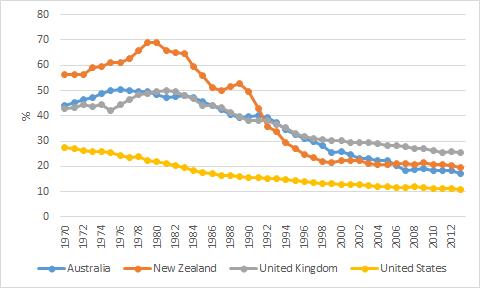
Figure 2: Union density,New Zealand, Australia, the UK and USA 1970-2013
Source: OECD Stats Extract
Note: Trade union density corresponds to the ratio of wage and salary earners that are trade union members, divided by the total number of wage and salary earners (OECD Labour Force Statistics).
Figure 2 above shows that union membership has been in a long slow decline in New Zealand since the mid-1970s. This is been pretty much the pattern all round the world.
The much hated Employment Contracts Act 1991, much hated by the Left over Left, doesn’t really show up in the union density figures in figure 2. There is no sudden break in trend obvious in figure 2.
The longer time series in union membership in figure 1 compiled by the Encyclopaedia of New Zealand has long gaps between the data observations. Because of this, the sharp decline in union membership from the late 1970s, which it actually show up in its start-up , is not sufficiently distinguished from subsequent events because of the long gaps between observations reported in the figure 1.
If anything, union membership stopped declining in New Zealand in the late 1990s. Stabilising at about 20% of wage and salary earners.
Union membership continued to decline slowly in Australia, the UK and the USA subsequent to 1998. Union membership stabilised in New Zealand by contrast. Perhaps the Employment Contracts act should be able to claim credit for that?
The Top 1% of income earners in NZ are lazy – the Occupy Movement have nothing to protest about – updated
25 Oct 2014 Leave a comment
in applied welfare economics, income redistribution, Marxist economics, politics - New Zealand, rentseeking Tags: lost decades, occupy movement, poverty and inequality, prosperity and depression, top 1%
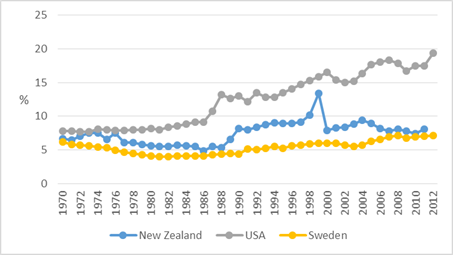
The NZ top 1% share has been steady at 8-9% since the mid-1990s. The top 1%’s share rose strongly in the USA in recent decades, from 13% in the mid-1980s to 19% in 2012.
Figure 1: Top 1% income shares, USA, New Zealand and Sweden, 1970-2012
Source: The World Top Income Database at http://topincomes.g-mond.parisschoolofeconomics.eu/#Database
The top 1% in New Zealand is so lazy that Sweden is overtaking it – See figure 1.
The Occupy crowd blame everything from the global financial crisis to a bad environment on growing inequality and the top 1%. Such an argument has no foundation in fact in New Zealand.
Income inequality as measured by the Gini coefficient has not risen much in New Zealand for 20 years – See figure 2. How can the poor be getting getting poorer, ground under by the yoke of capitalism, if the rich are not getting richer. The occupy movement should apply for unemployment benefits and seek career guidance.
Figure 2: Gini coefficient New Zealand 1980-2015
![clip_image002[7]](https://utopiayouarestandinginit.com/wp-content/uploads/2014/10/clip_image00271.png "clip_image002[7]")
Source: Bryan Perry, Household incomes in New Zealand: Trends in indicators of inequality and hardship 1982 to 2013. Ministry of Social Development (July 2014).
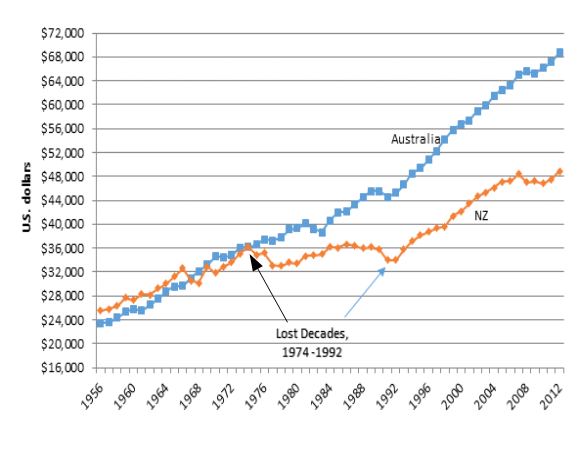
The last major increase in income inequality in New Zealand was in the late 1980s and early 1990s and that was followed by a long economic boom – See figure 3 .
Figure 3: Real GDP per New Zealander and Australian aged 15-64, converted to 2013 price level with updated 2005 EKS purchasing power parities, 1956-2012
Source: Computed from OECD Stat Extract and The Conference Board, Total Database, January 2014, http://www.conference-board.org/economics .
This long boom was after two decades of next to no economic growth in the 1970s and 1980s in New Zealand – see figure 3 . This depression between 1974 and 1992 was New Zealand’s lost decades.
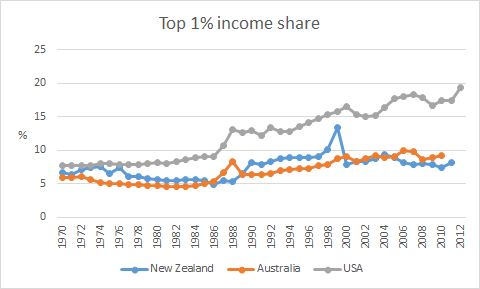
Figure 4 shows that both the lost decades of economic growth in New Zealand and the emergence of the trans-Tasman income gap the seemed to somewhat coincide with the top 1% of earners in Australia increasing their share of income from 6% to 10% of total incomes while the New Zealand top 1% sat on their hands. They are such lazy devils.
Figure 4: Top 1% income shares, USA, New Zealand and Australia, 1970-2012
Source: The World Top Income Database at http://topincomes.g-mond.parisschoolofeconomics.eu/#Database
British terrorists bought ‘Islam for Dummies’ book before travelling to Syria to join rebel fighters in jihad
23 Oct 2014 Leave a comment
in economics of crime, politics, war and peace Tags: economics of oppositional identities, The war on terror
 Two British terrorists who fled the UK to fight in Syria ordered Islam For Dummies, The Koran For Dummies and Arabic For Dummies from Amazon ahead of their trip.
After eight months fighting in Syria they were arrested on their return to Heathrow Airport in January after their relatives tipped off counter-terrorism detectives.

They told officers they had been doing humanitarian work but a camera including images of them posing with guns on the front line, was found in their luggage. Traces of ‘military-grade explosives’, including TNT and nitro-glycerine were on the men’s clothes and trainers.

Each admitted one count of engaging in conduct in preparation of terrorism acts contrary to Section 5 of the Terrorism Act. They pleaded guilty after the judge indicated a reduced sentence if they were to plead guilty early in proceedings.
The families of both men put pressure on them to return to the UK once they discovered where they were.
HT: dailymail

Vocabulary of New Left, Post-New Left, and the Left over Left
21 Oct 2014 Leave a comment
in politics Tags: Leftover Left
| NEW LEFT VOCABULARY
(1960s-1970s) |
POST-NEW LEFT VOCABULARY
(1990s-today) |
|
“Oppression”: a pattern of persistent and systematic disadvantage imposed on large groups of people, in many domains of social life, including employment, social status, treatment by the legal system, vulnerability to violence, and more; e.g, racial oppression, gender oppression, etc. |
“Privilege”: a set of unearned benefits that some individuals enjoy (and others are denied) in their everyday lives, by virtue of their place in a racial or gender or other ‘identity’-hierarchy, e.g., male privilege, white privilege, cisgender privilege, etc. |
|
“Exploitation”: a feature of economic systems, including capitalism, in which unpaid labour is extracted from working people for the benefit of a relatively small number of exploiters, who comprise, in economic terms, a ruling class. |
“Classism”: an attitude of scorn, condescension, or disrespect toward persons of low income, similar to what once was called “snobbery” or class-based “elitism.” |
|
“Alliances”: the confluence in struggle of large-scale social forces (like social classes, or social movements), as part of a strategic orientation toward the coordinated pursuit of common aims. |
“Being an Ally”: a sincere commitment on the part of a privileged individual to offer on-going support to individuals, groups or organizations that oppose that kind of privilege, and to take direction from them about the form that support should take. |
|
“Consciousness-raising”: a process of popular political education, in which learners are viewed as already having an implicit grasp of critical insights about injustice and social change, but invites them to participate in a collective learning process in order to become fully aware of these insights and their implications through dialogue with peers. |
“Calling Out”: an approach to challenging “folks” who show a lack of insight or concern about issues of privilege, in which they are confronted by peers and urged to “check” their privilege. A regional variant in parts of the US is the phrase, “calling people on their shit.” |
|
“Solidarity”: a stance, within and between social movements, of treating “injuries to one” as if they were “injuries to all,” and resisting them in common, as matters of shared priority, rather than as the concern only of those under attack. Example: The “I am Trayvon Martin” slogan used in anti-racist protests in 2013, which echoed the old labour-movement principle of solidarity (“An injury to one is an injury to all.) |
“Positionality”: a practice of acknowledging the specificity of one’s social position, especially one’s access to privilege, which may make one incapable of understanding or speaking authoritatively about the ways others are impacted adversely by the operation of privilege. Example: the “I am not Trayvon Martin” meme” from 2013, which urged white people to refrain from identifying with African-American resistance, for reasons of positionality. |
|
“The People”: a label for the totality or potential collectivity of those who are not members of the small, ruling elite; it is usually seen as including workers, the unemployed, small farmers, students, and almost all women, people of colour, and so on. |
“Folks”: a term that refers to groups of people, in the plural, without suggesting that they comprise a singular totality that could be united in one common struggle, which may be precluded by the difference of their experiences and degrees of privilege. |
|
“Liberation”: a term used to refer to ultimate victory in struggles against systems of oppression and/or exploitation, e.g., national liberation, women’s liberation, black liberation. Cf. “emancipation,” e.g., the emancipation of women, the emancipation of the working class. |
“Safe[r] Space”: the attempt to create occasions or locations wherein the adverse effects of privilege on marginalized people are minimized in everyday interpersonal interactions, notably by encouraging “folks” in those spaces to “check their privilege” and by “calling out” any failures to “be an ally.” |

Paul Krugman (1998) on the fiscal politics of the minimum wage/living wage movement
19 Oct 2014 Leave a comment


The labour demographics of a NZ living wage
17 Oct 2014 Leave a comment
in labour economics, minimum wage, politics - New Zealand Tags: living wage, minimum wage
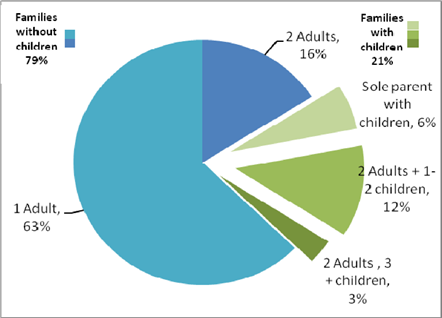
Distribution of families earning below the Living Wage
Source: Taxwell
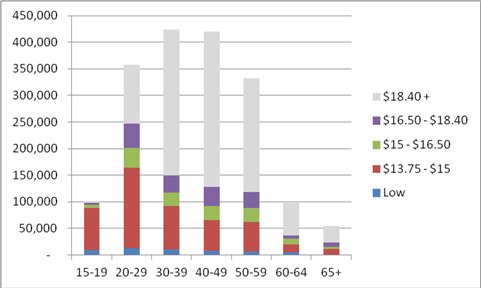
The wage rates of people of different ages
Source: Taxwell
The distribution of wages by industry
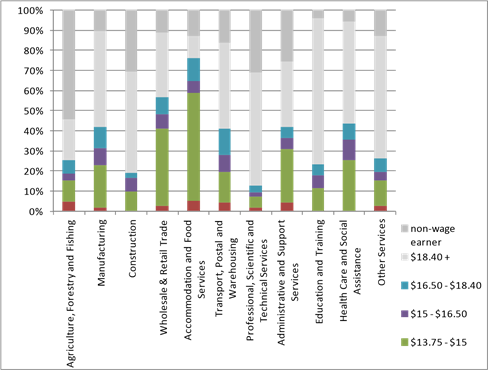
Non-wage earners is mainly self employed. Source: Taxwell
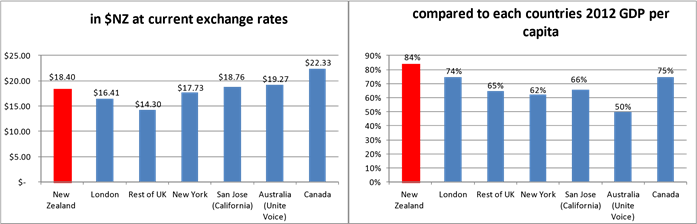
NZ’s proposed Living Wage compared to other Living Wage proposals
Source: Living Wage campaign websites, and exchange rates as at 20 September 2013
- The Living Wage proposal is an ineffective way to help families with low incomes, because:
- Many low income earners are people below the age of 30 who are single or part of a childless couple;
- The extra earnings by parents would result in reduced tax credits or benefit payments (as they abate with higher income).
- If adopted as a minimum wage, New Zealand would be out of line with other countries, and it is likely to reduce employment, particularly of younger people trying to enter the labour market.
- The overall impact on poverty levels is likely to be small, but it would represent a change of focus from supporting families with children towards supporting young, single people.
General source: The Treasury Living Wage Information Release

Ebola protocols in action – The clipboard man
16 Oct 2014 Leave a comment
in health economics, politics - USA Tags: Ebola


Recent Comments