
HT: sinclair davidson
Celebrating humanity's flourishing through the spread of capitalism and the rule of law
05 Nov 2014 Leave a comment
in politics - Australia Tags: Gough Whitlam
HT: sinclair davidson
05 Nov 2014 Leave a comment
in economics of media and culture, liberalism, politics Tags: Jihadist, Nick Cohen, political correctness
The British recruits who have joined Isis are not exceptions. They flourish in a culture in which it is so commonplace to offer support to authoritarian regimes and movements that few bother to condemn it.
Free speech ought to mean the freedom to challenge and criticise in all except the most tightly defined circumstances. Instead in Britain tolerance has become indifference; a lazy desire to live in our comfortable bubbles.
The dominant culture views vigorous criticism as rude or insensitive – or, to use that popular and completely meaningless school-prefect putdown, “inappropriate.” More often that not, criticism is taken down and used as evidence of the critic’s failings, his or her obsessions and phobias.
We cannot be bothered to challenge fanatics. We say we don’t want to ‘force our views on others’ – as if argument were physical coercion. And if those others leave England to enslave Kurdish women, or applaud kleptomaniac dictators, we are not responsible. We never concerned ourselves with their affairs, nor argued with them for a moment.
Many poisonous plants have bloomed in this dank climate.
via Britain is a world leader in exporting creeps » Spectator Blogs.
05 Nov 2014 Leave a comment
in Marxist economics, politics, Public Choice Tags: collapse of communism, Fall the Berlin war
05 Nov 2014 Leave a comment
in economics of regulation, politics - New Zealand, politics - USA, urban economics Tags: Auckland urban limit, land use regulation, metropolitan urban limits, Resource Management Act, zoning
05 Nov 2014 Leave a comment
in applied price theory, economics of education, politics - New Zealand, poverty and inequality, welfare reform Tags: Heartless Left, Leftover Left, school breakfast programmes
The Feed the Kids Bill that has been reintroduced into the new New Zealand Parliament still contains no provision to feed the parents who are too poor to make their children breakfast.

Why are these hungry parents not invited for breakfast as well? No parent would have breakfast if their children was to go hungry. Both the parent and child must have gone hungry that morning, perhaps morning after morning. There is no other charitable explanation.
The Bill aims to set up government funded breakfast and lunch programmes in all decile 1-2 schools. The cost is $100 million a year – including food, staffing, administration, monitoring and evaluation.
Lindsay Mitchell was on the money when she wrote:
Even parents reliant on a benefit are paid enough to provide some fruit and modest sandwiches daily.
An inability to do so is a symptom of a greater problem requiring scrutiny – for the sake of their child.
“The ‘income management’ regime provides a response to genuinely hungry children.
It may interest you that even Labour advocated for extended income management in its election manifesto.
Their 2014 ‘Social Development’ policy paper proposed, “…allow[ing] income management to be used as a tool by social agencies where there are known child protection issues and it is considered in the best interests of the child, especially where there are gambling, drug and alcohol issues involved.”
Hungry children is a child protection issue. Parents who fail to feed their children should come to the attention of the child protection authorities. Those on the benefit should be subject to income management because they clearly are spending their money elsewhere.
On the Left, there is a refusal to discuss the role of addiction and incompetent parenting in child poverty. The 2014 election manifesto of the Labour Party is a welcome departure from that tradition of denial.
05 Nov 2014 Leave a comment
in applied welfare economics, income redistribution, politics - USA

02 Nov 2014 Leave a comment
in economics of religion, labour economics, politics - New Zealand, urban economics, welfare reform Tags: child poverty, Duncan Garner, expressive voting, green rent seeking, land use zoning, regulation of land supply, Resource Management Act
Duncan Garner wrote a passionate column yesterday in the local paper calling for gutsy action on child poverty.
His analysis of the causes of child poverty in New Zealand was good. Garner’s solutions had nothing to do with what he had identified as the causes of child poverty. As Garner himself wrote:
… in order to tackle poverty it’s important to attempt to define what it means today.
Poverty is children living in crowded, damp homes who don’t get three square meals a day.
They may not have their own bed, they won’t see a doctor when they’re sick and many of them will be admitted to hospital with serious poverty-related illnesses such as respiratory problems and skin infections.
They may live in households where paying the rent accounts for 60 per cent of the family’s income every week.
Garner then discussed the plight of one particular family in Auckland:
The parents are nice people, with seven children.
They shared a tiny home with three other adults and another child.
Dad works full-time at a meat factory and they had been waiting 10 months for a state house. They had beds in the dining room and lounge.
They couldn’t afford the cost of a private rental home. One son, aged 11, had a serious lung problem. I saw poverty in action that day and it was deeply disturbing. I highlighted their plight on my radio show and within weeks a shamed Housing NZ had found them a home.
The family Garner discussed is in a tiny house because they lacked the income to rent a better one. They must rely on social housing provided by government with income related rents.
Recurring through his problem definition is the impact that rising housing costs is having on the poor.
Nonetheless, Garner then advocates cash payments to low income families, a tax credit system seen as more generous and inclusive, and a back to school bonus without addressing the supply of housing.
The evidence is overwhelming in New Zealand that the main driver of the increases in the child poverty since the 1980s is rising housing costs.
In the longer run after housing costs child poverty rates in 2013 were close to double what they were in the late 1980s mainly because housing costs in 2013 were much higher relative to income than they were in the late 1980s.
– Bryan Perry, 2014 Household Incomes Report – Key Findings. Ministry of Social Development (July 2014).
Any policy to reduce child poverty must increase the supply of houses by reducing regulatory restrictions on the supply of land.
The Metropolitan Limit confines the expansion of Auckland beyond the existing built-up area. This regulatory constraint explains the exceptionally high housing price-income ratio of Auckland.

The limit imposed on the horizontal expansion of the city in green fields encourages increases in residential prices. As demand for new housing increases, no new land supply can enter the market and stem price rises in response to this increased demand.

If you serious about child poverty, you have to criticise government regulation: the dead hand of the Resource Management Act (RMA) on the poor and the vulnerable.
02 Nov 2014 Leave a comment
in applied welfare economics, discrimination, gender, human capital, occupational choice, politics - USA Tags: gender wage gap, myths and fallacies
01 Nov 2014 Leave a comment
in environmentalism, politics - Australia, politics - New Zealand, politics - USA Tags: expressive voting, green rent seeking, green voters

The Greens are no more than a reincarnation of the 19th century British Tory Radicals with their aristocratic sensibilities that combined strong support for centralised power with a paternalistic concern for the plight of the poor:
Environmentalists have an aristocratic vision of a stratified, terraced society in which the knowing ones would order society for the rest of us.
Environmentalism offered the extraordinary opportunity to combine the qualities of virtue and selfishness
Many left-wingers thought they were expressing an entirely new and progressive philosophy as they mouthed the same prejudices as Trollope’s 19th century Tory squires: attacking any further expansion of industry and commerce as impossibly vulgar, because it was:
View original post 346 more words
01 Nov 2014 Leave a comment
in health economics, politics - New Zealand Tags: anti-vaccination movement, Quacks

Not so long ago, any Green MP who suggested sipping camomile tea or some other herbal concoction to ward off the horrific Ebola virus would surely have been deemed by his or her colleagues to be guilty – but only of being eccentric.
There used to be a lot of it about. Who can forget the senior party official who marked the opening session of one Green Party conference by lighting a large candle in recognition of any spirits that might have been present or invoke any that delegates wished to be present. (Sadly, the candle had to be extinguished soon after this mind-boggling seance. It fell foul of more earthly and more mundane forces – namely health and safety regulations.)
31 Oct 2014 Leave a comment
in health economics, politics - New Zealand Tags: Ebola, Quacks
On their website, Van der Zee now urges supporters of homeopathy to sign the Change.org petition started in Australia, calling on WHO “to test and distribute homeopathy as quickly as possible to contain the outbreaks”.
Among the signatories is Steffan Browning, a Green Party MP in New Zealand.
He was publicly dismissed by the prime minister John Key as “barking mad”.
“Let’s be honest, this is a serious global issue, and if he really thinks that’s the answer I’d love to see the medical research,” said Key.
Browning admitted “it was probably a bit unwise” to sign the petition, which he also shared on his Facebook page encouraging other people to sign it. He said he had signed it “pretty late at night”, although he hoped WHO would keep an open mind on potential treatment options, since there was currently no cure.
New Zealand’s health minister, Jonathan Coleman, however, said treating Ebola patients with homeopathic remedies was “a wacko idea”, adding: “I don’t know what he’s thinking, it’s very, very dangerous. I think he really needs to engage his brain, it’s a really and stupid dangerous idea.”
via Homeopaths offer services ‘to help fight’ Ebola epidemic in west Africa | World news | The Guardian.
31 Oct 2014 Leave a comment
in liberalism, politics, Rawls and Nozick Tags: Leftover Left, new inquistion, Pat Condell, political corrections, progressive left, superiority of western civilisation, The Age of Enlightenment
30 Oct 2014 Leave a comment
in health economics, politics - New Zealand, politics - USA Tags: Anti-Science left, do gooders, GMOs, Quacks, vaccines
NZ Green MP Steffan Browning says giving his support to a call for the World Health Organisation to deploy homeopathic remedies to combat the Ebola epidemic in West Africa.

Mr Browning this week signed a petition started by Australian Fran Sheffield which calls on the World Health Organisation (WHO) to
End the suffering of the Ebola crisis. Test and distribute homeopathy as quickly as possible to contain the outbreaks.
Asked whether he thought homeopathy could cure Ebola, Mr Browning said:
It’s not for me to go down that track at all.
The World Health Organisation, world health authorities are doing that.
They will be considering I hope absolutely every possible options to this very concerning disease.
Green Party co-leader Russel Norman said the petition did not reflect the position of the party, and agreed it was unwise of Browning to have signed it.
Green party health spokesman Kevin Hague said he was "disappointed" Browning had signed the petition.
Browning is also on the record has been anti-GMOs, and is the green party spokesmen on genetic modification as well as the range of science-based portfolios such as agriculture and biosecurity.
To listen to most pundits, evolution, stem cells, and climate change are the only scientific issues worth mentioning—and the only people who are anti-science are on the right of politics.
Those on the left have numerous fallacies of their own. Aversion to clean energy programs, basic biological research, and even life-saving vaccines come naturally to many progressives. These are positions supported by little more than junk-science and paranoid thinking.
Concerns about vaccine safety and genetically modified organisms (GMOs) are often held up as evidence of anti-scientific beliefs among liberals. The anti-GMO movement is a product of the political left and has reached levels of delusion, paranoia and anti-intellectualism worthy of Michele Bachmann and young-earth creationists.
Though 70 percent of scientists support nuclear power, left-leaning organizations such as Greenpeace and the Sierra Club strongly oppose it.
29 Oct 2014 Leave a comment
in applied price theory, applied welfare economics, economics of regulation, gender, income redistribution, minimum wage, politics - New Zealand, rentseeking Tags: gender wage gap, living wage, minimum wage, pay equity
I wonder who will pay for this? Caregiver wages are funded out of a fixed budget allocated by the government.
A higher wage will change the type of worker that the caregiving sector will seek to recruit, as happened after increases in the teenage went minimum wage.
When the teenage minimum wage went up in New Zealand, employment of 17 and 18-year-olds fell, while the employment of 18 to 19-year-olds increased because the latter were more mature and reliable than the younger contemporaries.

Media release: Pay Equity Challenge Coalition
28 October 2014
Coalition Celebrating Equal Pay Case Outcome
“The Court of Appeal’s decision declining the employers’ appeal in the Kristine Bartlett case is a huge victory for women workers” said Pay Equity Coalition Challenge spokesperson Angela McLeod.
“The Courts’ decision that equal pay may be determined across industries in female-dominated occupations revitalises the Equal Pay Act 1972 and will be a major factor in closing New Zealand’s stubborn 14 percent gender pay gap”.
The judgement by the Court of Appeal upholding the Employment Court decision again validates the work of caregivers and that they are underpaid, she said.
“We commend the Service and Food Workers Union Nga Ringa Tota in taking this case and exposing the underpayment and undervaluation of aged care workers. And the decision is a victory for all the women’s organisations who have never given up fighting for equal pay,”…
View original post 92 more words
29 Oct 2014 Leave a comment
in economic growth, economics of regulation, income redistribution, politics - New Zealand, rentseeking Tags: Auckland urban limit, economic growth, Gini coefficient, green rent seeking, poverty and inequality, Resource Management Act
Figure 1: Before Housing Costs Gini coefficient, New Zealand, 1982 – 2013

closertogether.org.nz/nzs-income-inequality-problem claims that NZ income inequality increased very rapidly in the late 1980s and 1990s — faster than in any other wealthy country.
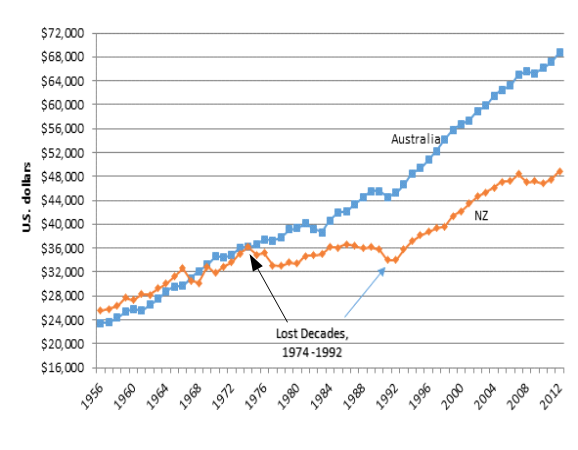
Figure 2 shows that this rapid rise in inequality coincided with the resumption of economic growth after two lost decades: next to no increase in real GDP per working age New Zealander from 1974 to 1992.
Figure 2: Real GDP per New Zealander and Australian aged 15-64, converted to 2013 price level with updated 2005 EKS purchasing power parities, 1956-2012
Source: Source: Computed from OECD Stat Extract and The Conference Board, Total Database, January 2014, http://www.conference-board.org/economics
Perry (2014) found that:
Perry (2014) concluded that:
Overall, there is no evidence of any sustained rise or fall in inequality in the last two decades. The level of household disposable income inequality in New Zealand is a little above the OECD median. The share of total income received by the top 1% of individuals is at the low end of the OECD rankings.
This remark by Parry that there is no evidence of any sustained rise or fall in inequality in New Zealand in the last 20 years is very much at odds with the claim of Closer Together New Zealand that income inequality inequality increased rapidly in the late 1980s and 1990s.
The increase in inequality in New Zealand was in the late 1980s and early 1990s. In the early 1990s, a long economic boom started that lasted until the global financial crisis.
Figure 3 : Income Inequality in New Zealand as Assessed by the Gini Coefficient

Source: Perry 2014 derived from Statistics NZ Household Economic Survey (HES) 1982–2012.
Figure 4: Income Inequality in New Zealand as Assessed by the P80/P20 Ratio

Source: Perry 2014 derived from Statistics NZ Household Economic Survey (HES) 1982–2012.
Figures 3 and 4 both show that after housing costs inequality in New Zealand is higher, but has been pretty stable for 20 years as measured by the Gini coefficient and by the P80/P20 ratio. (When individuals are ranked by equivalised household income and then divided into 100 equal groups, each group is called a percentile. If the ranking starts with the lowest income, then the income at the top of the 20th percentile is denoted P20; the income at the top of the 80th percentile is called P80. The ratio of the value at the top of the 80th percentile to the value at the top of the 20th percentile is called the P80/20 ratio and is often used as a measure of income inequality).
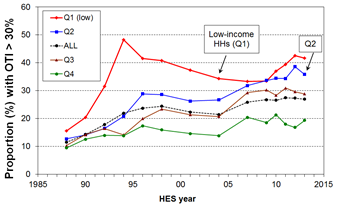
Figure 5: Proportion of HHs with housing cost outgoings to income of greater than 30%, by income quintile
Source: Perry (2014); OTI = outgoings to income
Figure 5 shows that
Rising housing costs in New Zealand have one explanation, which is restrictions on the supply of land under the Resource Management Act.
HT: nzchildren.co.nz/income_inequality for figures 3 and 4.
Celebrating humanity's flourishing through the spread of capitalism and the rule of law
Celebrating humanity's flourishing through the spread of capitalism and the rule of law
Celebrating humanity's flourishing through the spread of capitalism and the rule of law
Celebrating humanity's flourishing through the spread of capitalism and the rule of law
Celebrating humanity's flourishing through the spread of capitalism and the rule of law
Celebrating humanity's flourishing through the spread of capitalism and the rule of law
Celebrating humanity's flourishing through the spread of capitalism and the rule of law
A History of the Alt-Right
Econ Prof at George Mason University, Economic Historian, Québécois
Celebrating humanity's flourishing through the spread of capitalism and the rule of law
Scholarly commentary on law, economics, and more
Beatrice Cherrier's blog
Celebrating humanity's flourishing through the spread of capitalism and the rule of law
Celebrating humanity's flourishing through the spread of capitalism and the rule of law
Celebrating humanity's flourishing through the spread of capitalism and the rule of law
Why Evolution is True is a blog written by Jerry Coyne, centered on evolution and biology but also dealing with diverse topics like politics, culture, and cats.
Celebrating humanity's flourishing through the spread of capitalism and the rule of law
A rural perspective with a blue tint by Ele Ludemann
DPF's Kiwiblog - Fomenting Happy Mischief since 2003
Celebrating humanity's flourishing through the spread of capitalism and the rule of law
The world's most viewed site on global warming and climate change
Tim Harding's writings on rationality, informal logic and skepticism
A window into Doc Freiberger's library
Let's examine hard decisions!
Commentary on monetary policy in the spirit of R. G. Hawtrey
Thoughts on public policy and the media
Celebrating humanity's flourishing through the spread of capitalism and the rule of law
Politics and the economy
A blog (primarily) on Canadian and Commonwealth political history and institutions
Reading between the lines, and underneath the hype.
Economics, and such stuff as dreams are made on
"The British constitution has always been puzzling, and always will be." --Queen Elizabeth II
Celebrating humanity's flourishing through the spread of capitalism and the rule of law
Celebrating humanity's flourishing through the spread of capitalism and the rule of law
WORLD WAR II, MUSIC, HISTORY, HOLOCAUST
Undisciplined scholar, recovering academic
Celebrating humanity's flourishing through the spread of capitalism and the rule of law
Res ipsa loquitur - The thing itself speaks
In Hume’s spirit, I will attempt to serve as an ambassador from my world of economics, and help in “finding topics of conversation fit for the entertainment of rational creatures.”
Researching the House of Commons, 1832-1868
Articles and research from the History of Parliament Trust
Reflections on books and art
Posts on the History of Law, Crime, and Justice
Celebrating humanity's flourishing through the spread of capitalism and the rule of law
Exploring the Monarchs of Europe
Cutting edge science you can dice with


Recent Comments