Have @NZGreens accidentally published a chart showing substantial and pretty continuous real wages growth in recent decades?
12 Nov 2014 Leave a comment
in labour economics, politics - New Zealand, poverty and inequality, welfare reform Tags: poverty and inequality, The Great Enrichment
Obama is doing a Clinton on climate change agreements
12 Nov 2014 Leave a comment
in environmental economics, environmentalism, global warming, politics - USA Tags: climate alarmism, expressive politics, global warming, international law, Kyoto Protocol
Last week, I planned to write a blog about how Obama might do a Clinton: safe in the knowledge that Congress will never approve any of his climate change agreements, he will run round the world signing up to all sorts of ambitious carbon emission reduction goals.
The agreement Obama just signed today with the Chinese after the secret talks over the congressional election period is an example. This secret agreement goes to show that the Obama administration can actually keep a secret.
The agreement with China and any other futures similar agreements will win Obama brownie points with the Left of his party, but not bother anyone else in particular because they know they’ll never get through Congress.
The moment Bush took office in 2001, the Democrats started asking why wouldn’t Bush submit the Kyoto protocol to the Senate for ratification.
Bill Clinton had 801 days left in his administration after he signed the Kyoto protocol in December 1997 to submit it for Senate ratification. He did not lift a finger.
Clinton was safe in the knowledge that prior to the signing of the Kyoto protocol, the Senate voted 95 to nil in July 1997 to not ratify any treaty on climate change that did not impose mandatory obligations on Russia, China and other major developing countries.

President Clinton approved and signed into law appropriations bills for fiscal years 1999, 2000, and 2001 that included language prohibiting the Environmental Protection Agency from using its funds to “issue rules, regulations, decrees, or orders for the purpose of implementation, or in preparation for implementation, of the Kyoto Protocol” until the Protocol is ratified by the Senate and entered into force under the terms of the treaty.

The major feature of the Kyoto Protocol is that it sets binding targets for 37 industrialized countries and the European community for reducing greenhouse gas (GHG) emissions. These amount to an average of five per cent reduction against 1990 levels over the five-year period 2008-2012.

Developing countries, including China and India, weren’t mandated to reduce emissions, given that they’d contributed a relatively small share of the current century-plus build-up of CO2.
The Europeans were happy to sign the Kyoto Protocol after the Americans pulled out because the emissions trading price in any such protocol would be very low because no American companies would have to buy emission credits.
U.S. and China Reach Climate Deal After Secret Negotiations – where are the protesters? Where is the hypocrisy?!
12 Nov 2014 1 Comment
in environmental economics, global warming, politics - New Zealand, politics - USA Tags: climate alarmism, expressive voting, global warming, international environmental law, international law, international trade law, Leftover Left, preferential trading agreements
The United States and China have unveiled a secretly negotiated deal to reduce their greenhouse gas output, with China agreeing to cap emissions for the first time and the US committing to deep reductions by 2025. Jointly announced in Beijing by President Obama and President Xi Jinping, includes new targets for carbon emissions reductions by the United States and a first-ever commitment by China to stop its emissions from growing by 2030.
https://twitter.com/CearaProut/status/531251207033982977
Will protestors take to streets about the secrecy that proceeded the negotiation of this international agreement?
- 10,000 protesters took to the streets of New Zealand at the weekend against the secrecy surrounding the Trans-Pacific partnership trade and investment talks. The air was thick with conspiracy theories and the demand for transparency in international diplomacy.
- Why were these treaty negotiations with China over carbon emissions kept from the watchful eye of the American public before the recent congressional elections?
The Left over Left picks and chooses the international law that it champion:
- International law on both human rights and the environment are both an addendum to the 10 Commandments and must be followed, come hell or high water. Even better if the UN is somehow involved – moral status is then beyond question.
- International trade and investment laws are the spawn of Satan. The fact that these trade and investment treaties are freely negotiated between sovereign states adds nothing to their moral standing and much to their conspiratorial origins.
- International criminal courts, the European Court of Justice and the World Court are all superior to national courts. International trade and investment dispute tribunals are the lackeys of multinationals.
State owned enterprises continue to be a bad investment for the NZ taxpayer
12 Nov 2014 2 Comments
in industrial organisation, Marxist economics, politics - New Zealand, public economics Tags: privatisation, state owned enterprises
In a Briefing to the Incoming Minister just released, the Treasury said that in 2013, total shareholder return from state owned enterprises to the taxpayer was just 3 per cent. This is a little bit better than leaving the money in the bank.

Note: KiwiRail is excluded because of significant changes in its valuation methodologies over the past few years, including the significant write down in its asset values in 2012. . Total shareholder return for 2012 has been restated to include Solid Energy.
KiwiRail lost $248 million in 2013, after a $174.4 million loss a year earlier. Solid Energy lost $182 million last year last year. This $182m loss follows a $335.4m loss in the June 2013 year and a $40m loss the year before that.

The Great Enrichment – wages growth in the post-war period version
10 Nov 2014 Leave a comment
in politics - USA Tags: The Great Enrichment
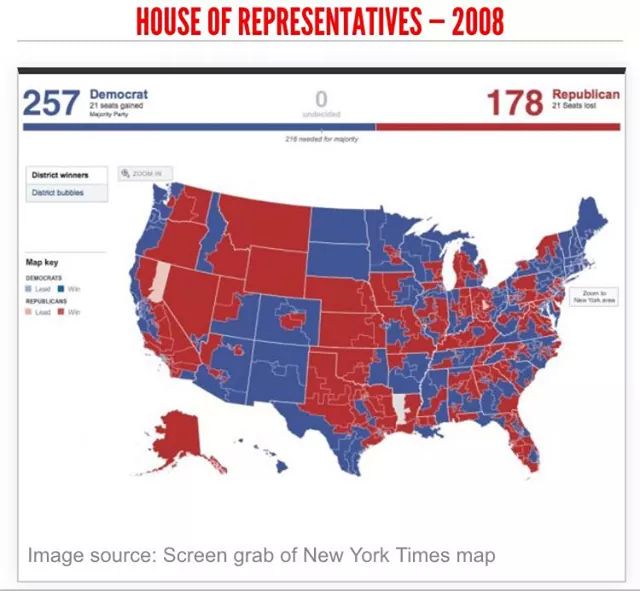
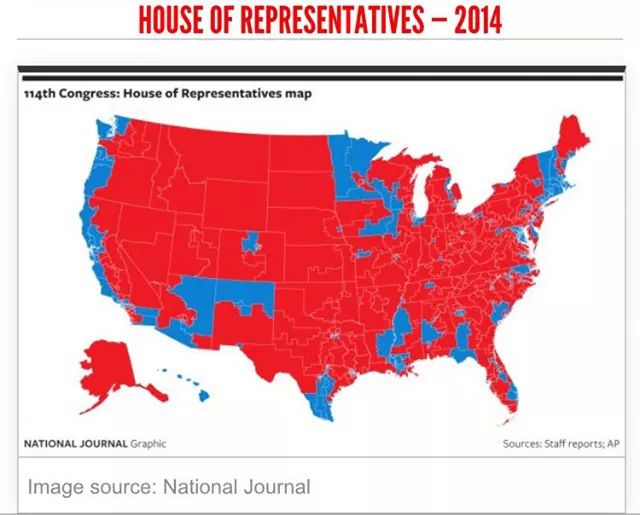
Modern topology software does make for rather frightening gerrymanders
10 Nov 2014 Leave a comment
in politics - USA, Public Choice Tags: gerrymanders
U.S. House of Representatives, 2008 and 2014
10 Nov 2014 Leave a comment
in politics - USA Tags: 2014 U, S. election
On the withering away of the Labour Party
08 Nov 2014 1 Comment
in politics - Australia, politics - New Zealand Tags: Leftover Left, The withering away of the Labour Party, the withering away of the proletariat

John Quiggin made an interesting point the other day that explains why the Australian Labor Party caucus is no longer the cream of the working class:
In 1945, the largest single occupational group in Australia (and an archetypal group of Labor supporters) were railwaymen (there were almost no women in the industry).
By the 1970s, the largest occupational group, also becoming the archetypal group of Labor supporters. were schoolteachers.
Quiggin was not making the point I am making, but his data was instructive.

The traditional labour voter of days gone by was socially conservative, fiscally conservative, strict on educational standards and believed in hard work, self-improvement and being frugal. They agreed with Dalton Trumbo who said:
I never considered the working class anything other than something to get out of.
Working for Families and work incentives
08 Nov 2014 Leave a comment
in labour economics, labour supply, politics - New Zealand, public economics, taxation, welfare reform Tags: effective marginal tax rates, tax – welfare system interactions

There are 3.38 million individual taxpayers. Of these, about 120,000 (3.4 percent) face EMTRs over 60%, 120,000 (3.4 percent) face EMTRs between 50% and 60%, and 160,000 (4.5 percent) face EMTRs between 40% and 50%. Slightly more than 88 percent of taxpayers face EMTRs below 40%.
HT: New-Zealand-tax-system-and-how-it-compares-internationally
One World Trade Center is finally open for business. All 12 years of construction in one gif!
07 Nov 2014 Leave a comment
in economics of media and culture, politics - USA, urban economics Tags: World Trade Center
Wellington City Council builds inner city children’s sandpit next to red-stickered buildings marked for collapse in next earthquake
07 Nov 2014 Leave a comment
in economics of bureaucracy, health and safety, politics - New Zealand, Public Choice Tags: economics of natural disasters, expressive voting, health and safety, Taxpayers Union, Wellington City Council
Average Marginal Income Tax Rates for New Zealand, 1907-2009 (WP 12/04) — The Treasury – New Zealand
07 Nov 2014 Leave a comment
in applied price theory, fiscal policy, politics - New Zealand Tags: Marginal tax rates, public economics, public finance

Note: Average marginal tax rate calculations exclude the impact of ACC levies, the Benefit system and the Family Tax Credit (FTC) system which, at various times since the 1970s, involved lump sum transfers to lower income families with children that were withdrawn at higher income levels at rates of up to 30c/$, thereby adding to effective MTRs.
Comment: The average marginal tax rate has been pretty stable in New Zealand since about 1990 excepting for a drop in the late 1990s and then an increase in 1999.
via http://www.treasury.govt.nz/publications/research-policy/wp/2012/12-04


Recent Comments