If staged in the studio, a 143 minute continuous broadcast of the footage of the Moon approach and the astronauts on the Moon with the recording technology of the time would have required tapes the size of cars if it were pre-recorded in some manner on 5,300 feet of film that is free of scratches and specs of dust. 1969 did not have the technology to fake the landing on video. Slow motion video was truly primitive in 1969: 30 seconds replayed at 90 seconds maximum.
Limiting ourselves to democratically elected governments, and there are many of these even in the under-developed countries, progressive ideas seem to fail, and fail again at the ballot box right around the globe as you concede the strong right-wing bias of many governments across the globe.
There was one left-wing federal government in Australia in the last 60 years. That was for three years between 1972 and 1975, and it lost in a landslide. the Whitlam government got in buy a few seats in 1972by beating tired and smelly government that had held office for 23 years
This inability of progressive politics get anywhere is important because every set of ideas needs effective critics to keep it on its toes and stop it from slouching into error and special interest capture.
The Right needs a vibrant Left to keep the Right fit, trim and down to its fighting weight so as to be able to thrash the Left once again at the next election. That is the function of left-wing governments: mind the shop while the right-wing parties are fed and rested and rejuvenated.
Prior to the 1990s, all it took to see progressive ideas off the political and economic stage in a country was a visit or two by Milton Friedman, if some are to be believed. I do not believe that political transformations are as easy as this.
However, some still want to maintain the rage over, for example, Friedman’s April 1975 trip to Australia for 18 days leading to a paradigm shift to neo-liberalism and Hayden’s supposedly monetarist budget shortly after if Alex Millmow is to be believed. Apparently, the spirited, witty Joan Robinson’s visit the same month and her own Monday conference program did not do the trick as an anti-biotic and vaccine.
Progressives will have no role in future political transformations because if you scratch a progressive you will find a left wing populist.
A left-wing populist is too busy telling you who to fear and who to blame to put up policies that are actually robust enough to work and to have worked in the past in a society where people are not perfect in their motivations, they do not have perfect knowledge in a changing world, and there is no offsetting behaviour and unintended consequences when these policies are put in practice.
73 percent of millennials favor allowing private accounts for Social Security; 51 percent favor private accounts even it means cutting Social Security benefits for current and future retirees because 53 percent of millennials say Social Security is unlikely to exist when they retire
64 percent of millennials say cutting government spending by 5 percent would help the economy
59 percent say cutting taxes would help the economy
57 percent prefer a smaller government providing fewer services with low taxes, while 41 percent prefer a larger government providing more services with high taxes
57 percent want a society where wealth is distributed according to achievement
55 percent say reducing regulations would help the economy
53 percent say reducing the size of government would help the economy
74 percent of millennials say government has a responsibility to guarantee every citizen has a place to sleep and enough to eat
An old graduate school mate of ours from our Japan days, Pavin Chachavalpongpun, a prominent Thai political scholar and outspoken opponent of the country’s coup, has had his passport revoked as part of the Thai junta’s on-going campaign against dissent.
He is based at Japan’s Kyoto University, and is expected to seek asylum in Japan.
There are at least 98 regulated occupations in New Zealand covering about 20% of the workforce. In 2011, this amounts to 440,371 workers. The skills that are regulated range across all skill sets and many occupations:
49% of regulation is in the form of a licence;
18% of regulated work is in the form of licensing of tasks;
31% of regulated workers require a certificate; and
4% of regulated workers require registration.
There are 32 different governing Acts that regulated occupations in New Zealand with 55% of the workers subject to occupational regulation are employed in just five occupations:
98,000 teachers;
48,500 nurses;
42,730 bar managers;
32,733 chartered accountants; and
22,749 electricians.
The Health Practitioners Competency Assurance Act 2003 regulates 22 occupations and a total of 89,807 workers. The next best is the 10 occupations regulated by the Health and Safety in Employment Act 2002 which regulates an unknown number of occupations. The Civil Aviation Act 1990 regulates eight occupations and 19,095 workers, the Building Act 2004 regulates seven occupations and 21,101 workers and the Maritime Transport Act 1994 regulates six occupations and 20,500 workers. 12 of the regulated occupations are regulated under laws passed since 2007.
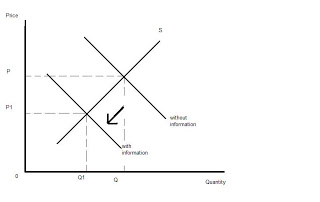
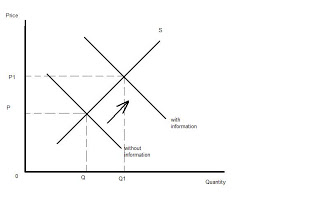
The purpose of occupational regulation is to protect buyers from quacks and lemons – to overcome asymmetric information about the quality of the provider of the service.
Adverse selection occurs when the seller knows more than the buyer about the true quality of the product or service on offer. This can make it difficult for the two people to do business together. Buyers cannot tell the good from the bad products on offer so many they do not buy to all and withdraw from the market.
Goods and services divide into inspection, experience and credence goods.
Inspection goods are goods or services was quality can be determined before purchase price inspecting them;
Experience goods are goods whose quality is determined after purchase in the course of consuming them; and
Credence goods are goods whose quality may never be known for sure as to whether the good or service actually worked – was that car repair or medical procedure really necessary?
The problem of adverse selection over experience and credence goods present many potentially profitable but as yet unconsummated wealth-creating transactions because of the uncertainty about quality and reliability.
Buyers are reluctant to buy if they are unsure of quality, but if such assurances can be given in a credible manner, a significant increase in demand is possible.
Any entrepreneur who finds ways of providing credible assurances of the quality of this service or work stands to profit handsomely. Brand names and warranties are examples of market generated institutions that overcome these information gaps through screening and signalling.
Screening is the less informed party’s effort, usually the buyer, to learn the information that the more informed party has. Successful screens have the characteristic that it is unprofitable for bad types of sellers to mimic the behaviour of good types.
Signalling is an informed party’s effort, usually the seller, to communicate information to the less informed party.
The main issue with quacks in the labour market is whether there are a large cost of less than average quality service, and is there a sub-market who will buy less than average quality products in the presence of competing sellers competing on the basis of quality assurance. This demand for assurance creates opportunities for entrepreneurs to profit by providing assurance.
David Friedman wrote a paper about contract enforcement in cyberspace where the buyer and seller is in different countries so conventional mechanisms such as the courts are futile in cases where the quality of the good is not as promised or there is a failure to deliver at all:
Public enforcement of contracts between parties in different countries is more costly and uncertain than public enforcement within a single jurisdiction.
Furthermore, in a world where geographical lines are invisible, parties to publicly enforced contracts will frequently not know what law those contracts are likely to fall under. Hence public enforcement, while still possible for future online contracts, will be less workable than for the realspace contracts of the past.
A second and perhaps more serious problem may arise in the future as a result of technological developments that already exist and are now going into common use. These technologies, of which the most fundamental is public key encryption, make possible an online world where many people do business anonymously, with reputations attached to their cyberspace, not their realspace, identities
Online auction and sales sites address adverse selection with authentication and escrow services, insurance, and on-line reputations through the rating of sellers by buyers.
E-commerce is flourishing despite been supposedly plagued by adverse selection and weak contract enforcement against overseas venders.
In the labour market, screening and signalling take the form of probationary periods, promotion ladders, promotion tournaments, incentive pay and the back loading of pay in the form of pension investing and other prizes and bonds for good performance over a long period.
In the case of the labour force, there are good arguments that a major reason for investments in education is as a to signal quality, reliability, diligence as well as investment in a credential that is of no value the case of misconduct or incompetence. Lower quality workers will find it very difficult if not impossible to fake quality and reliability in this way – through investing in higher education.
In the case of teacher registration, for example, does a teacher registration system screen out any more low quality candidates for recruitment than do proper reference checks and a police check for a criminal record.
Mostly disciplinary investigations and deregistrations under the auspices of occupational regulation is for gross misconduct and criminal convictions rather than just shading of quality.
Much of personnel and organisational economics is about the screening and sorting of applicants, recruits and workers by quality and the assurance of performance.
Alert entrepreneurs have every incentive to find more profitable ways to manage the quality of their workforce and sort their recruitment pools.
Baron and Kreps (1999) developed the recruitment taxonomy made up of stars, guardians and foot-soldiers.
Stars hold jobs with limited downside risk but high performance is very good for the firm – the costs of hiring errors for stars such as an R&D worker are small: mostly their salary. Foot-soldiers are employees with narrow ranges of good and bad possible outcomes.
Guardians have jobs where bad performance can be a calamity but good job performance is only slightly better than an average performance.
Airline pilots and safety, compliance, finance and controller jobs are all examples of guardian jobs where risk is all downside. Bad performance of these jobs can bring the company down. Dual control is common in guardian jobs.
The employer’s focus when recruiting and supervising guardians is low job performance and not associating rewards and promotions with risky behaviours. Employers will closely screen applicants for guardian jobs, impose long apprenticeships and may limit recruiting to port-of-entry jobs.
The private sector has ample experience in handling risk in recruitment for guardian jobs. Firms and entrepreneurs are subject to a hard budget constraints that apply immediately if they hire quacks and duds.
Blackboard economics says that governments may be able to improve on market performance but as Coase warned that actually implement regulatory changes in real life is another matter:
The policy under consideration is one which is implemented on the blackboard.
All the information needed is assumed to be available and the teacher plays all the parts. He fixes prices, imposes taxes, and distributes subsidies (on the blackboard) to promote the general welfare.
But there is no counterpart to the teacher within the real economic system
Occupational regulation comes with the real risk of the regulation turning into an anti-competitive barrier to entry as Milton Friedman (1962) warned:
The most obvious social cost is that any one of these measures, whether it be registration, certification, or licensure, almost inevitably becomes a tool in the hands of a special producer group to obtain a monopoly position at the expense of the rest of the public.
There is no way to avoid this result. One can devise one or another set of procedural controls designed to avert this outcome, but none is likely to overcome the problem that arises out of the greater concentration of producer than of consumer interest.
The people who are most concerned with any such arrangement, who will press most for its enforcement and be most concerned with its administration, will be the people in the particular occupation or trade involved.
They will inevitably press for the extension of registration to certification and of certification to licensure. Once licensure is attained, the people who might develop an interest in undermining the regulations are kept from exerting their influence. They don’t get a license, must therefore go into other occupations, and will lose interest.
The result is invariably control over entry by members of the occupation itself and hence the establishment of a monopoly position.
Friedman’s PhD was published in 1945 as Income from Independent Professional Practice. With co-author Simon Kuznets, he argued that licensing procedures limited entry into the medical profession allowing doctors to charge higher fees than if competition were more open.
Data Source: Martin Jenkins 2012, Review of Occupational Regulation, released by the Ministry of Business, Innovation and Employment under the Official Information Act.
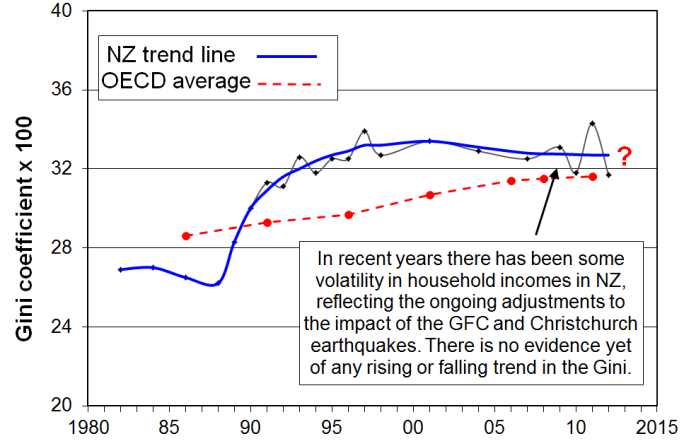
An urban legend in New Zealand is that income inequality is going from bad to worse.
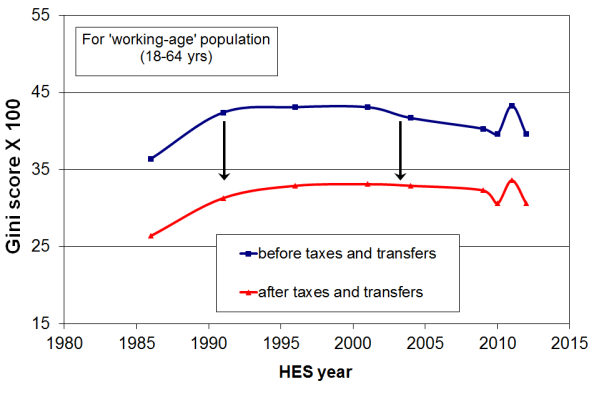
Since the mid 1990s to around 2011 there was a small net fall in New Zealand’s income inequality trend line in the graph for the Gini coefficient for the income distribution for New Zealand shows. inequality in New Zealand is similar to that in Australia, Ireland, Canada and Japan.
Source: Ministry of Social Development (2014)
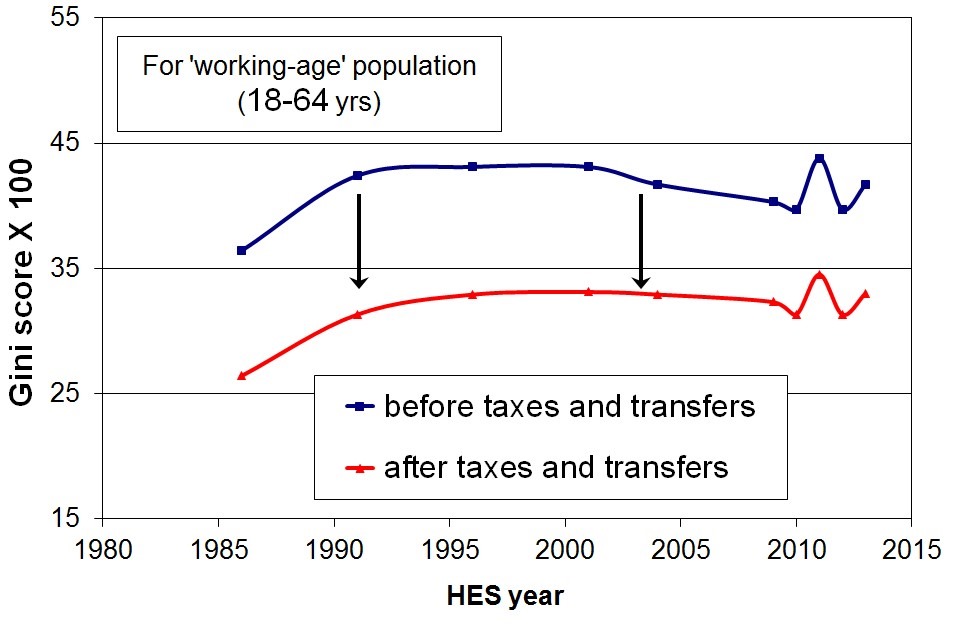
Taxes and transfers have reduced inequality in New Zealand when measured by Gini coefficients, but the trend is been relatively stable for many years.
Source: Ministry of Social Development (2014)
Rawls pointed out that behind the veil of ignorance, people will agree to inequality as long as it is to everyone’s advantage. Rawls was attuned to the importance of incentives in a just and prosperous society. If unequal incomes are allowed, this might turn out to be to the advantage of everyone. Robert Nozick said that:
Political philosophers must now either work within Rawls’s theory or explain why not.
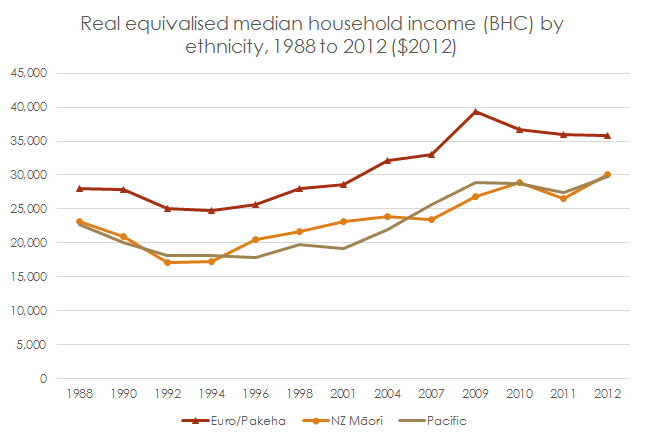
The groups that have been doing best in New Zealand have been Maori and Pasifika. In real terms, overall median household income rose 47% from 1994 to 2010; for Maori, this rise was 68%; for Pacific, 77%!
Source: Ministry of Social Development (2014)
The large improvements in Māori incomes since 1992 were based on rising Māori employment rates, fewer Māori on benefits or zero incomes, more Māori moving into higher paying jobs, and greater Māori educational attainment (Dixon and Maré 2007).
Maori unemployment reached a 20-year low of 8 per cent from 2005 to 2008. Labour force participation by Maori increased from 45% in the late 1980s to about 62% in the last few years.
Most of the remaining income disparities between Māori and non-Māori flow from differences in educational attainment and demographic and socio-economic characteristics including household composition (Chapple 2000; Maani 2004; Dixon and Maré 2007).
How much of the massive increases in incomes over the last 20 years spread throughout the entire community are you willing to give up for a little more equality? How much of your income will you donate to charity to lead the way?
Attempts to keep the dollar from going “too high” would have ruinous domestic consequences as the Governor of the Reserve Bank explained last year:
If New Zealand decided to cap the NZ dollar, depending on where the cap is enforced, similar levels of intervention might be required as global foreign exchange turnover in NZ dollars relative to GDP is similar to that in Swiss francs.
The OCR would need to drop to zero first in order to eliminate the interest arbitrage motivation for NZ dollar inflows. Any attempt to retain non-zero interest rates by “sterilising” such massive intervention would be very difficult.
In effect therefore a Swiss type operation to cap the value of the NZ dollar through large scale FX intervention would also amount to quantitative easing. As I mentioned, this would be highly inflationary in the NZ context.
Graeme Wheeler, Governor of the Reserve Bank of New Zealand
Sterilised interventions in the foreign exchange market are a fool’s errand
If exchange rate manipulation had any chance of working, the U.S. Fed, the Bank of England, the European Central Bank and the Bank of Japan would be all over it already. Their mutual efforts to depreciate their own currencies would cancel out.
Most central banks gave up on exchange rate interventions in the mid-1990s because attempts to manipulate exchange rates without loosening monetary policy rarely worked. Brute experience taught them that they were on fool’s errand.
These exchange rate interventions, known as sterilised interventions, become an independent source of exchange rate instability and invite counter-speculation by currency traders and hedge funds. Every hint that a central bank might intervene in the exchange rate invites currency speculation. As Milton Friedman said:
The central problem is not designing a highly sensitive [monetary] instrument that offsets instability introduced by other factors [in the economy], but preventing monetary arrangements becoming a primary source of instability…
By trying to move the value of the dollar, the Reserve Bank of New Zealand will add its own element of currency instability and invite counter speculation by currency traders and hedge funds. This is a dangerous game for a small Reserve Bank to play.
As stated by Paul Krugman in 1999 on the concept of the impossible trinity: free capital movement, a fixed exchange rate, and an effective monetary policy –
The point is that you can’t have it all: A country must pick two out of three.
It can fix its exchange rate without emasculating its central bank, but only by maintaining controls on capital flows (like China today); it can leave capital movement free but retain monetary autonomy, but only by letting the exchange rate fluctuate (like Britain – or Canada); or it can choose to leave capital free and stabilize the currency, but only by abandoning any ability to adjust interest rates to fight inflation or recession (like Argentina today or for that matter most of Europe).
Exchange rate manipulation by the Reserve Bank cannot alter the competiveness of exporters. The looser monetary policy will inevitably lead to higher CPI inflation that will erode any temporary advantage to exporters from the initial depreciation of the NZ dollar.
What did the Swiss do to keep their exchange rate down in the GFC?
Labour’s Monetary Policy Upgrade referred to the efforts of the Swiss National Bank to cap a massive appreciation of the Swiss Franc after 2009 and the Euroland sovereign debt crisis:
The Swiss have actively protected their currency from appreciating to the detriment of their tradeable sector (p.16)
The Swiss National Bank stemmed the rise of Swiss franc by loosening their monetary policy as they say so themselves:
The Swiss National Bank has successfully maintained its exchange-rate floor against the euro, often through heavy nonsterilized purchases of foreign exchange (Swiss National Bank Annual Report, 2012, p. 34).
These non-sterilised exchange rate interventions were a loosening of Swiss monetary policy. The Swiss National Bank happens to be one of a number of central banks that conduct their monetary policies by buying and selling in the foreign exchange markets.
Labour’s aim of a positive external balance through a tightening of monetary policy is a repeat of the fool-hardy policies of the Hawke-Keating government in the late 1980s.
1988 witnessed a major monetary policy tightening in Australia. The tightening was motivated by a current account deficit rather than double-digit inflation:
The inflation rate fell to below 3% in 1991.
The current account did not change much as a result of the deep recession and 10%+ unemployment rate designed to bring it under control.
The current account deficit as a major policy problem was then quietly forgotten in Australia.
Three conflicting monetary policy objectives
The New Zealand Labour Party wants the Reserve Bank to do three impossible things before breakfast:
Loosen monetary policy to bring the dollar down such as in Switzerland after 2009;
Tighten monetary policy to reduce the current account deficit such as in Australia after 1988; and
Loosen and tighten monetary policy as required to stay within the inflation target.
The best contribution of monetary policy to the competitive positions of exporters is low inflation.
Inflation targeting removes monetary policy as in independent source of exchange rate instability. Attempts to manipulate the exchange rate undermines the inflation target that has been such a great success since 1989, and reduces the commitment of public policy to a stable, predictable business climate. Bordo and Humpage add:
…sterilised foreign-exchange intervention can sometimes affect exchange-rate movements, but sterilised intervention does not provide central banks with a mechanism for systematically altering exchange rates independent of their monetary policies.
Attempts to stabilise or undervalue exchange rates necessarily weaken a country’s control of its monetary policy and ultimately leave the real exchange rate unaffected.
What really matters?
Labour’s monetary policy upgrade is a distraction from the only game in town for the future prosperity of New Zealanders:
Productivity isn’t everything, but in the long run it is almost everything. A country’s ability to improve its standard of living over time depends almost entirely on its ability to raise its output per worker.
Lower houses tend to be elected in single member constituencies; upper houses tend to be elected in larger multi-member, state-wide or national constituencies by proportional representation.
This diversity in legislative arrangements ensures that more people are participating in decision-making and it is harder to pass new laws without majority support.
The two elected chambers will clash as each exerts its mandate to represent the will of the people who elected it. The laws that pass these two chambers elected by different methods must have substantial popular support.
When upper and lower houses are elected by similar methods, it is much easier to assemble a majority through vote trading and lobbying.
An individual’s religious beliefs does not excuse him from compliance with an otherwise valid law of general application prohibiting conduct that governments are free to regulate.
Allowing exceptions to every law or regulation that directly or indirectly affects religion would open the prospect of constitutionally required exemptions from legal obligations of almost every conceivable kind. Examples are compulsory military service, payment of taxes, polygamy, vaccination requirements, and child-neglect laws. some parliaments do provide exemptions and accommodations but that does not say they must.
Justice Frankfurter wrote in 1940:
conscientious scruples have not in the course of the long struggle for religious toleration relieved the individual from obedience to a general law not aimed at the promotion or restriction of religious beliefs.
The mere possession of religious convictions which contradict the relevant concerns of political society does not relieve the citizen from the discharge of political responsibilities
Religious freedom bars laws that prohibit:
the holding of a religious belief,
the right to communicate those beliefs to others, and
the right of parents to direct the education of their children.
This approach also has the advantage of not placing courts into the position of having to determine the importance of a particular belief in a religion or the plausibility of a religious claim when weighing it against other government interests and the objectives of the disputed law.
It might be said that there should be a compelling government interest before a religious objection can be overridden. Deciding what is a compelling government interest raises questions of public policy.
Men and women decide what is more or less important in the course of making legislation goes to the very heart of democratic decision-making. This clash of opinions and visions of the good society and what laws should be passed or not are all resolved peacefully through the ballot box and free speech even in the most desperate times.
This is not to say that a parliament may if it wishes exempt people from certain obligations on the basis of religious objections or making other accommodations. What it does require is that religions take their chances in democratic politics like the rest of us when seeking exemptions from a law.
Minorities with strong feelings about an issue regularly prevail in legislative battles because they are willing to vote as a block on one issue and trade their block support with other groups in the society to assemble the necessary majority for what they want.
Indeed, a major discontent with contemporary democratic politics is minorities and special interests have too much say, not too little.
It is up to the political process to decide whether to disadvantage those religious practices that are not widely engaged in, but that unavoidable consequence of democratic government must be preferred to a system in which each conscience is a law unto itself. To quote Frankfurter again:
Its essence is freedom from conformity to religious dogma, not freedom from conformity to law because of religious dogma.
Religious loyalties may be exercised without hindrance from the state, not the state may not exercise that which except by leave of religious loyalties is within the domain of temporal power. Otherwise each individual could set up his own censor against obedience to laws conscientiously deemed for the public good by those whose business it is to make laws…
The validity of secular laws cannot be measured by their conformity to religious doctrines. It is only in a theocratic state that ecclesiastical doctrines measure legal right or wrong
At the UK General Election of 1964, a 2% of voters with no ‘working class characteristics’ voted Labour.
People’s socio-economic characteristics are now much less significant than they used to be as indicators of how they are likely to vote, for not only do many working class people vote for parties of the right, but large swathes of the middle class now vote Labour.
Support for Labor among manual working class voters as a whole was no higher than support for the right-wing parties in the 2004 Australian election.
If lower grade white collar occupations are included as working class, the right-wing parties in Australia actually achieved a small lead over the Australian Labor Party among working class voters.
POSSUM COMITATUS asks why are the Greens strongest in the inner cities? What is the cause of Greens voters living in the inner cities?
He found that people working in the arts, education, media and technology industries are more likely to vote Green, and as a result of the distribution of workplaces for these industries having a higher density in the inner suburbs, the people living within close proximity to their workplaces naturally leads to the inner cities having higher levels of Greens voters. He concludes:
it’s just a modern evolution of class based electoral analysis – whereas the Labor vote used to correlate strongly with manufacturing and low skill, labour intensive industries – today, the Green vote correlates with new skilled services industries like arts, education, media and technology.
Why Evolution is True is a blog written by Jerry Coyne, centered on evolution and biology but also dealing with diverse topics like politics, culture, and cats.
In Hume’s spirit, I will attempt to serve as an ambassador from my world of economics, and help in “finding topics of conversation fit for the entertainment of rational creatures.”





 The Swiss National Bank stemmed the rise of Swiss franc by loosening their monetary policy as they say so themselves: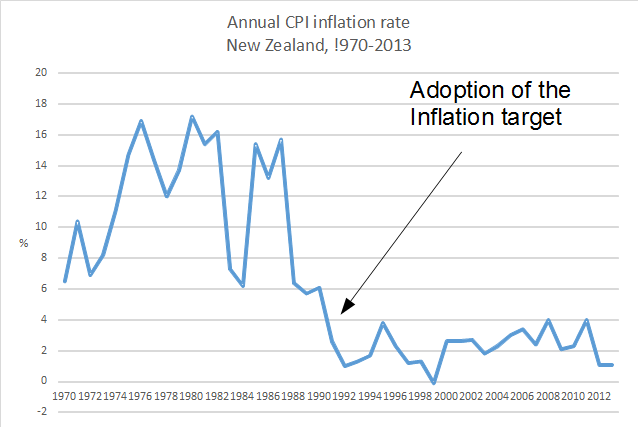


Recent Comments