
Milton Friedman is said to have mesmerised several countries with a flying visit!?
30 Sep 2016 Leave a comment
in business cycles, economic growth, macroeconomics, Milton Friedman, monetarism, monetary economics, politics - Australia Tags: central banks, conspiracy theories, lags on monetary policy, monetary policy, rules versus discretion, The fatal conceit, The pretense to knowledge
Milton Friedman visited Australia in 1975. He spoke with government officials and appeared on the TV show Monday Conference. Apparently, that was enough for him to take over Australian monetary policy setting for the foreseeable future.
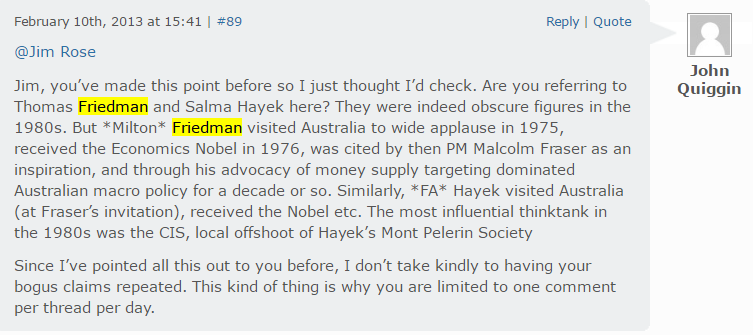
When working at the next desk to the monetary policy section in the late 1980s, I heard not a word of Friedman’s Svengali influence:
- The market determined interest rates, not the reserve bank was the mantra for several years. Joan Robinson would be proud that her 1975 visit was still holding the reins.
- Monetary policy was targeting the current account. Read Edwards’ bio of Keating and his extracts from very Keynesian treasury briefings to Keating signed by David Morgan that reminded me of macro101.
See Ed Nelson’s (2005) Monetary Policy Neglect and the Great Inflation in Canada, Australia, and New Zealand who used contemporary news reports from 1970 to the early 1990s to uncover what was and was not ruling monetary policy. For example:
“As late as 1990, the governor of the Reserve Bank rejected central-bank inflation targeting as infeasible in Australia, and cited the need for other tools such as wages policy (AFR, October 18, 1990).”
Bernie Fraser was still sufficiently deprogrammed in 1993 to say that “…I am rather wary of inflation targets.” Easy to then announce one in the same speech when inflation was already 2-3%.
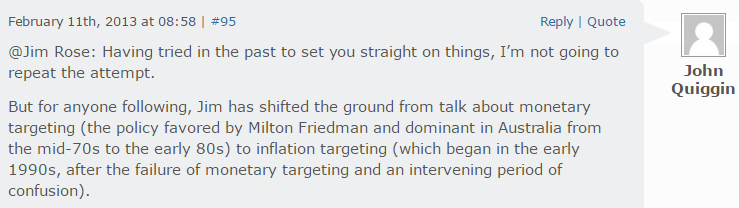
When as a commentator on a Treasury seminar paper in 1986, Peter Boxhall – fresh from the US and 1970s Chicago educated – suggested using monetary policy to reduce the inflation rate quickly to zero, David Morgan and Chris Higgins almost fell off their chairs. They had never heard of such radical ideas.
In their breathless protestations, neither were sufficiently in-tune with their Keynesian educations to remember the role of sticky wages or even the need for the monetary growth reductions to be gradual and, more importantly, credible as per Milton Freidman and as per Tom Sargent’s End of 4 big and two moderate inflations papers.
I was far too junior to point to this gap in their analytical memories about the role of sticky wages, and I was having far too much fun watching the intellectual cream of the Treasury senior management in full flight. At a much later meeting, another high flying deputy secretary was mystified as to why 18% mortgage rates were not reining in the current account in 1989.
Friedman’s Svengali influence did not extend to brainwashing in the monetarist creed that the lags on monetary policy were long and variable. The 1988 or 1989 budget papers put the lag on monetary policy at 1 year, which is short and rapier, if you ask me.
When did Canberra policy makers accept that inflation was a monetary phenomenon?
27 Sep 2016 3 Comments
in business cycles, economic history, macroeconomics, monetarism, monetary economics, politics - Australia Tags: central banks, monetary policy, The Great Inflation
Australian policymakers from at least 1971 viewed inflation as not a consequence of their monetary policy decisions. There were repeated references by them to wage-price spirals and both unsuccessful (1977) and successful attempts (1981) at wage freezes.
The prices and incomes accord from 1983 onwards was just another 1970s wage tax trade-off. An Incomes policy attributes inflation to non-monetary factors, as did Fraser and Lynch regularly.
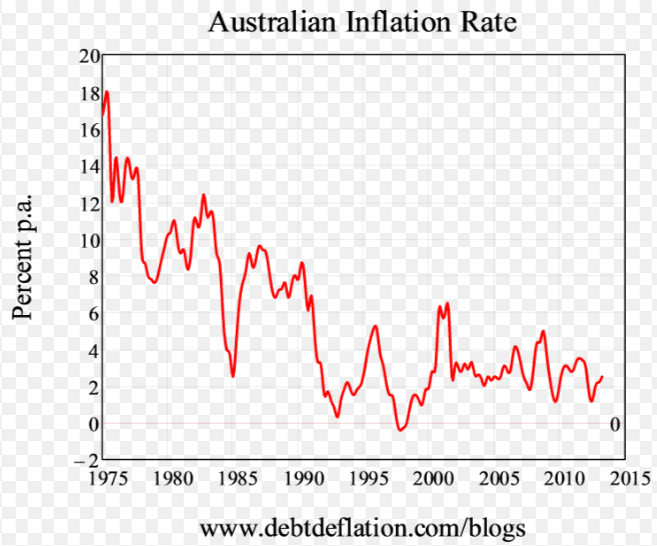
• It was not until 1980 that the Fraser government’s monetary policy became genuinely anti-inflationary. With a lag, these changes halved inflation to the mid-single digits by 1983. The implementation lag on the 1975 Monday conference programme must have been long and variable and lasted for a three year window!? Three years out of 20 is hardly a monetarist hegemony!
• Australia had lower CPI inflation in the 1980s than the 1970s, but this was marred by rebounds in 1985–86 and 1988–90 to near 9%.
The monetary policy regime change in the late 1980s was triggered by factors besides rising inflation: a demonic view of currant account.
After several years of high interest rates, the budget papers forecasted a moderate slowing:
• The budget GDP forecast for 1990-91 was 2% with an actual of minus 0.4%; for inflation the actual and forecast were 5.3% versus 6.5%; 1989-90 inflation rate was 8% with GDP growth of 3.3%.
• In 1991-92, the budget GDP forecast was 1.5% with an actual of 2.1%; for inflation the actual and forecast were 1.9% versus 3.8%.
• In 1992-93, the budget papers forecast for inflation 3% for an actual of 1%.
• In 1993-94, the budget forecast for inflation 3.5% for an actual of 1.8%.
The monetarists in the Treasury, entranced as they were by Friedman’s 1975 visit, still had not clicked to the link between a tight monetary policy and low inflation as late as 1993. Australia pursued a stop-go monetary policy from 1971 to the early 1990s.
I worked in the next desk to the monetary policy section in the Prime Minister’s Department in the 1980s. They were determined that market set interest rates, not monetary policy.
I suggest you read the biography of keating by john edwards(?) – his economic advisor in the late 1980s.
Edwards quotes from numerous Treasury briefings to Keating. the Treasury remembered their Keynesian educations well, as did those at DPMC. the prices and incomes accord was very Keynesian: inflation as a non-monetary phenomenon
Mentioning Friedman’s name in the 1980s at job interviews would have been extremely career limiting. Not much better in the early 1990s. Back in the late 1980s, Friedman was graduating from ‘a wild man in the wings’ to just a suspicious character in policy circles.
If you name dropped Hayek in the 1980s and 1990s, any sign of name recognition would have indicated that you were been interviewed by people who were very widely read.
50% of @PaulineHansonOz @OneNationAus votes come from @AustralianLabor voters
22 Sep 2016 1 Comment
in constitutional political economy, politics - Australia, Public Choice Tags: 2016 Australian federal election, antiforeign bias, antimarket bias, expressive voting, free trade, globalisation, left-wing popularism, makework bias, rational irrationality, right-wing popularism
How can Pauline Hanson be an extreme right-winger if half of her votes come from people who 2nd preference the Australian Labour Party? This strong support for her populism has been well-known since she won the safest Labour Party seed in Queensland in the 1996 Australian Federal Election but is hardly ever mentioned by the media or her critics.
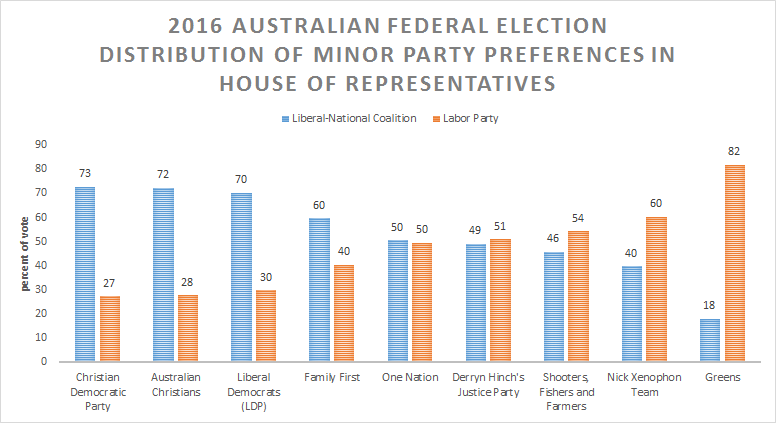
Source: Antony Green’s Election Blog: Preference Flows at the 2016 Federal Election.
It should be therefore no surprise that a lot of her views have popular support because she has support across the political spectrum. Not knowing that will means you will be not very good at combating her views which you simply do not understand where they come from.
Few of her supporters see themselves as extremists and will be insulted when you suggest they are. Listen here dummy is no way to win back votes of people who just voted for you recently.
Hanson’s support among Labour voters is increasing. Only 42% of her voters gave their 2nd preference to Labour in previous federal elections for the House of Representatives.
@Greens @PaulineHansonOz are peas in a pod
15 Sep 2016 1 Comment
in international economics, politics - Australia
This chart from coming on 20 years ago by Lyndon Rowe illustrates that the Australian Greens, Pauline Hanson’s One Nation and a now-defunct Australian political party of self-proclaimed do-gooders have plenty in common and still do.
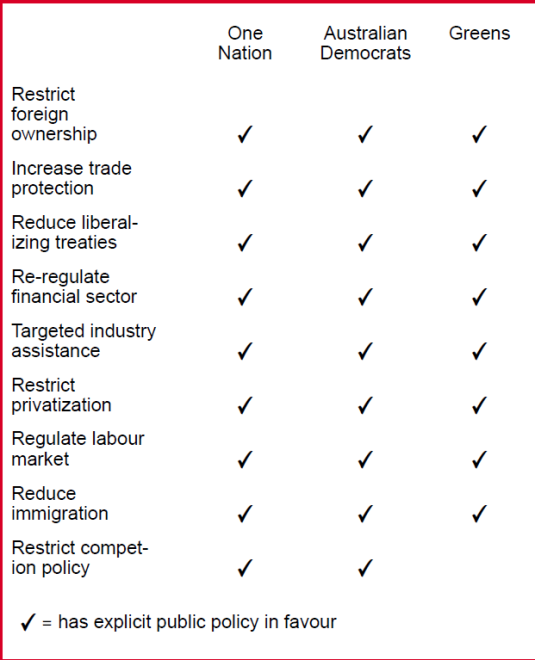
Pauline Hanson and the Australian Greens will vote the same way many times despite the Greens self-righteously boycotting the maiden speech of a fellow economic nationalist.

Climate alarmists launch the media career of @SenatorMRoberts – updated again
17 Aug 2016 8 Comments
in economics of media and culture, energy economics, environmental economics, global warming, politics - Australia Tags: climate alarmism, Scepticism
https://twitter.com/SteveSGoddard/status/765409693275566080
The television appearance the other night of Senator elect Roberts shows that any publicity is good publicity especially if no one has ever heard of you before.
Through breathless journalism, the media career of climate sceptic Malcolm Roberts has been launched. He is self-confident, vaguely articulate so it was reasonable television viewing.

The appeals to authority such as by Brian Cox when debating Roberts is not science.
Unlike Pauline Hanson, who is a ill-educated buffoon, Roberts is educated and presumably has the ability to learn and acquire media skills. After the television appearance the other night, he is guaranteed many other media outings that givens him publicity he could never have imagined. This is all courtesy of people who do not want to hear from him who made him famous.
Why so few successful left-wing populists
16 Aug 2016 Leave a comment
in politics - Australia, politics - New Zealand, politics - USA, Public Choice Tags: economics and immigration, growth of government, left-wing populists, right-wing populists, size of government, social insurance, welfare state
The Twitter Left is doing its best to attribute the surge against globalisation and immigration to inequality. This is despite the main beneficiary at the ballot box is right-wing populists.
The beneficiaries in the last few years were UKIP, the French National Front, Alternative for Germany, various pro-welfare state but anti-immigration parties in the rest of Europe, Pauline Hanson and Donald Trump. Barely a left wing party in sight outside of Greece.
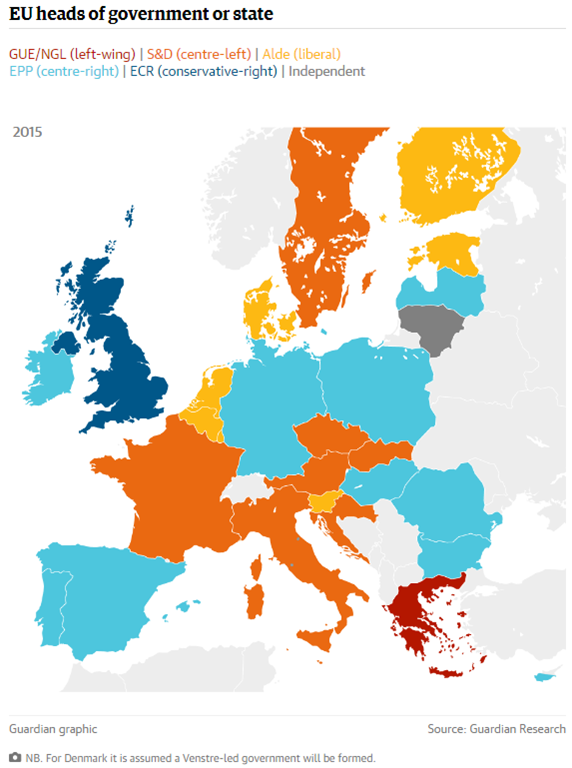
Source: Only a third of the EU is governed by the centre-left | World news | The Guardian.
Bernie Sanders is a fake left-wing populist because much of his support comes from college students and the university educated, not the aroused working class. These college students are unwilling to pay more than $1000 in taxes for the socialist revolution especially if they have a job.
At the last New Zealand election, two-thirds of the electorate voted for other than centre-left and left-wing parties. The hard left party, Mana-Internet, won 1% of the party vote despite having millions of dollars in campaign donations from a criminal fugitive hoping to avoid extradition.
These right-wing populists combine a heady brew of nationalism and social conservatism, scepticism about market competition, strong support for social security and old-age pensions but not welfare dependency, and opposition to immigration, imports and cultural change. The rise of the parties are not the first signs of an aroused working class seeking to overthrow capitalism. Face up to it.
Just how anti-science are the Australian @Greens?
08 Aug 2016 Leave a comment
in applied price theory, applied welfare economics, comparative institutional analysis, constitutional political economy, development economics, economic history, economics of media and culture, economics of regulation, energy economics, environmental economics, global warming, growth disasters, growth miracles, health economics, politics - Australia, politics - New Zealand, Public Choice, rentseeking, technological progress Tags: Anti-Science left, anti-vaccination movement, atomic energy, Australian Greens, climate alarmism, coal, fluoridation, global warming, GMOs, New Zealand Greens, nuclear power, The Great Enrichment, The Great Escape, The Great Fact, vaccinations, vaccines
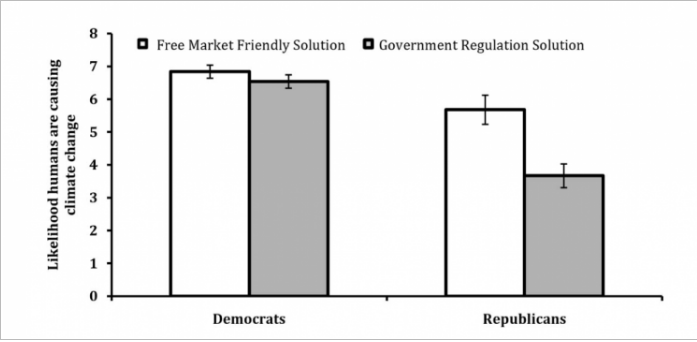
Source: Denying Problems When We Don’t Like the Solutions | Duke Today
I am not sure that the Australian Greens earn brownie points for referring to the scientific consensus on global warming as follows
Current global climate change is primarily caused by human activities contributing to increased concentrations of greenhouse gases in the atmosphere, and is already contributing to disruption of human societies through sea level rise, extreme weather events, desertification, harm to health, wellbeing and other effects. This is the overwhelming consensus of the international scientific community.
The Greens then give their opponents a free kick regarding their views on coal:and their commitment to science-based risk policy:
No new coal-fired power stations or coal mines, and no expansions to any existing power stations or mines, plus the development of programs to assist coal-dependent communities to make the transition to other more sustainable sources of economic prosperity.
There is no attempt to refer to science to justify this blanket prohibition against a specific energy source.
The views of the Australian Greens is no more science based on atomic energy:
- The world should be free of nuclear weapons and the nuclear fuel chain.
- There is a strong link between the mining and export of uranium and nuclear weapons proliferation.
- The use of nuclear weapons, nuclear accidents or attacks on reactors pose unacceptable risk of catastrophic consequences.
- Future generations must not be burdened with dangerous levels of radioactive waste.
- Nuclear power is not a safe, clean, timely, economic or practical solution to reducing global greenhouse gas emissions.
If there is any basis in science with this blanket opposition, I am sure the Australian Greens might have mentioned it.
Do the Australian Greens refer to the scientific consensus on GMOs in their policy platform as a helpful reminder or is there just have an ever rising demand for more evidence
- Genetically modified organisms (GMOs), their products, and the chemicals used to manage them may pose significant risks to natural and agricultural ecosystems.
- GMOs have not been proven safe to human health.
- Scientific evidence produced independently from the developers and proponents of the GMO must be undertaken and form the basis for assessing and licensing of GMOs. GMO assessments must be broad, independent and scientifically robust.
- The precautionary principle must be applied to the production and use of GMOs.
Unlike the New Zealand Greens, at least they do not simply reject the possibility of GMOs, the Australian Greens prefer the tactic of never being satisfied by the evidence.
The only thing I can find on the position of the Greens on fluoridation and vaccines is from a Victorian upper house MP who is half sensible on these issues. On fluoridation she says on behalf of the Greens
The Greens policy is quite clear on this. We do not have a policy for or against fluoride. Our policy supports the right of communities to determine the introduction of fluoride into local water supplies.
Not expressing the opinion on the wisdom of not putting fluoride in local water supply hardly shows a strong commitment to science-based public health policy.
On vaccines, this Victorian upper house green MP is not too bad at all:
I want to begin by stating that the Greens join health and scientific experts in absolutely supporting vaccination as a safe, proven and critical preventative health measure. The elimination of horrific diseases such as polio in Australia is testament to the incredible effectiveness and importance of vaccines…
There is also a group of people who might be called ‘hesitators’. They are not strongly opposed to vaccination, but they have heard that there might be some risks and they are thus unsure about them. These people do not perceive a strong risk of their child contracting any of the horrible diseases that immunisation prevents, so they think that on balance it might be reasonable not to vaccinate or to delay vaccination until their child is older or they simply have not yet made a decision either way. Hesitating parents may not realise that in some areas the local vaccination rate is getting well below safe levels and thus the risk of an outbreak is increasing.
This is far better than her New Zealand counterparts who do not seem to have an opinion on this vital public health issue. Indeed, the New South Wales Greens moved in the state parliament to tighten up a bill on exemptions from vaccinations.
Changes to the NSW Public Health Act in 2013 prohibited unvaccinated children from attending childcare unless their parents held “a personal, philosophical, religious or medical belief involving a conviction that vaccination under the National Immunisation Program should not take place” and they had discussed the matter with their GP”. The NSW Greens moved an amendment to remove personal, philosophical and religious beliefs as a grounds for exemption. This is one of the few times I can say something nice about a green MP.
Many on the right have their doubts about climate change science, much of which is actually delivered driven by solution aversion.They do not like the costs of the solution so they attack the rationale for it for tactical reasons. Cass Sunstein explains:
It is often said that people who don’t want to solve the problem of climate change reject the underlying science, and hence don’t think there’s any problem to solve. But consider a different possibility: Because they reject the proposed solution, they dismiss the science. If this is right, our whole picture of the politics of climate change is off.
The Left picks and chooses which scientific consensus as it accepts. The overwhelming consensus among researchers is biotech crops are safe for humans and the environment. This is a conclusion that is rejected by the very environmentalist organisations that loudly insist on the policy relevance of the scientific consensus on global warming.
What is worse is this rejection of science is not based on solution aversion; that the costs are high. It is a plain rejection of science on principle by the green left rather than for tactical reasons such as by the right on global warming.
What is more worrying is all the science that is rejected by the left will make us more prosperous. Only when the solutions make is poorer does the green left support them such as with global warming and carbon taxes.
In many ways what divides the left and right onn science is a question of values: the value placed on progress, on the Great Enrichment, on the Great Fact and on the Great Escape.
The Greens are no more than a reincarnation of the 19th century British Tory Radicals with their aristocratic sensibilities that combined strong support for centralised power with a paternalistic concern for the plight of the poor:
- 19th century Tory radicals opposed the middle classes and the aesthetic ugliness they associated with an industrial economy; and
- Like the 19th century Tory Radicals, today’s green gentry see the untamed middle classes as the true enemy.
Many Greens think they are expressing an entirely new and progressive philosophy as they mouthed the same prejudices as Trollope’s 19th century Tory squires; attacking any further expansion of industry and commerce as impossibly vulgar, because it was
ecologically unfair to their pheasants and wild ducks.
Neither the failure of the environmental apocalypse to arrive nor the steady improvement in environmental conditions because of capitalism has dampened the ardour of those well-off enough to be eager to make hair-shirts for others to wear.
True to its 1960s origins, environmentalism is a mix of bureaucrats and hippies: a global, little-brother government that keeps the lower classes in line and a back-to-the-earth localism imposed on others but presenting no real threat to the inner city green elites’ comfortable middle class lives.
What Happened to the Anti-War Movement?
05 Aug 2016 2 Comments
in defence economics, economics, politics - Australia, war and peace Tags: anti-war movement
More proof of the unreliability of renewable energy
01 Aug 2016 Leave a comment
in energy economics, environmental economics, politics - Australia Tags: hydroelectric power, reading myths, renewable energy, Tasmania
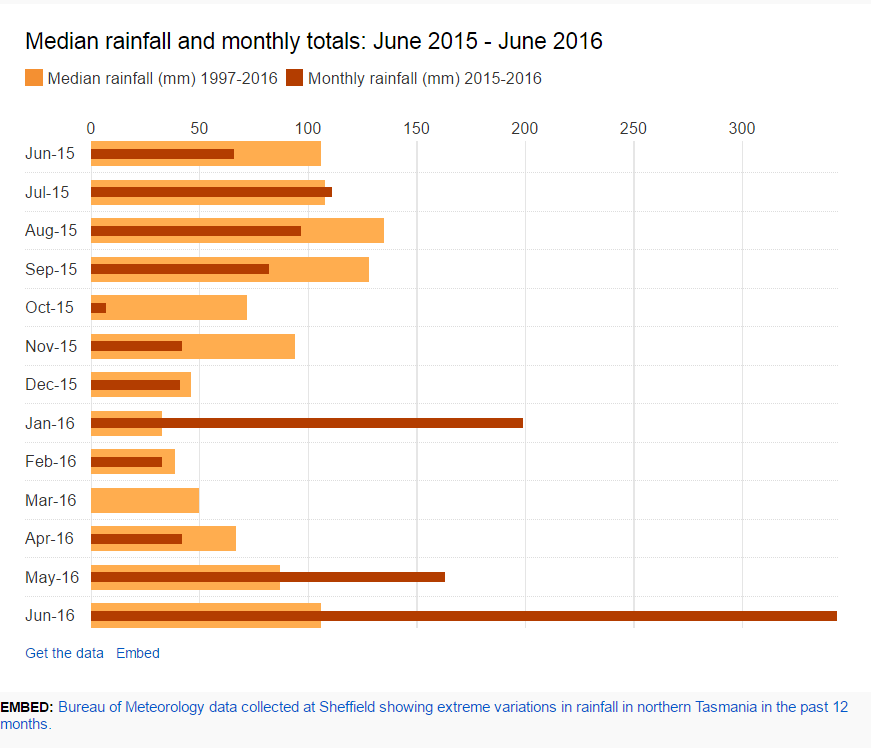
The Lake Pedder dam is full for the first time since 1988. A few months ago, Tasmanian hydroelectric lake levels were 13% with 6% the level at which the entire system shuts down.
Australians May Elect a Second Libertarian Senator
21 Jul 2016 Leave a comment
in libertarianism, politics - Australia Tags: 2016 Australian federal election
Meet Gabriel Buckley, free market anarchist and rock guitarist.
Source: Australians May Elect a Second Libertarian Senator – Hit & Run : Reason.com
% Australian top incomes from wages, salaries and pensions since 1954
19 Jul 2016 Leave a comment
in economic history, human capital, industrial organisation, labour economics, occupational choice, politics - Australia, poverty and inequality Tags: Australia, CEO pay, superstar wages, superstars, top 1%, top incomes
Australia has had a working rich for a long time now. Australian top income earners are top wage earners. They are athletes, celebrities, business executives and in the professions.
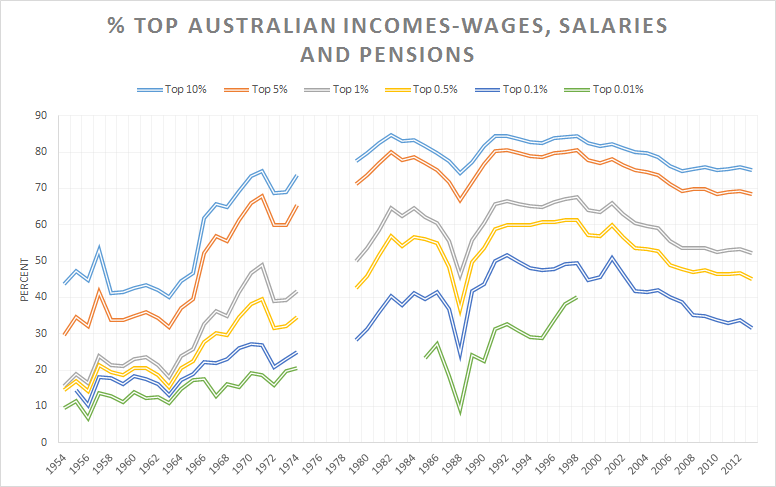
Source: The World Wealth and Income Database.


Recent Comments