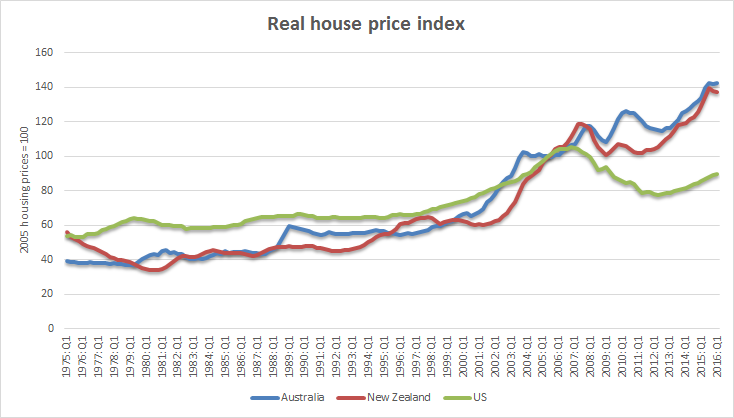
US, Australian and NZ real house prices, March 1975 to March 2016
17 Jul 2016 Leave a comment
in economics of regulation, politics - Australia, politics - New Zealand, politics - USA, urban economics Tags: Australia, housing affordability
Who 2nd preferences @PaulineHansonOz?
15 Jul 2016 Leave a comment
in politics - Australia Tags: Australian politics, left-wing popularism, right-wing popularism
Hanson draws support from across the spectrum and always has. She is not an extreme right-winger who only extreme right wing is vote for. Countering her repeal start with recognising whom she appeals to? On election night, the Liberal party commentator on the TV panel said that about 58% of One Nation preferences go to the Liberals.
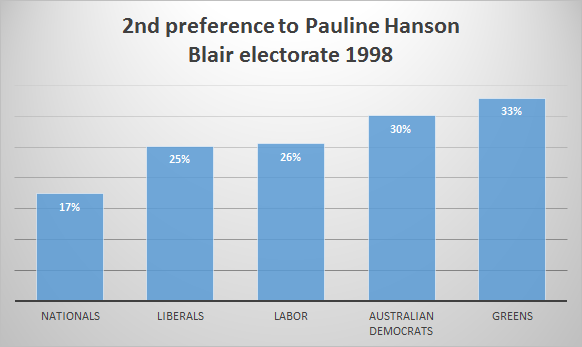
Source: Antony Green’s Election Blog: Pauline Hanson and preferences.
Difference between @nzlabour @NZGreens; between @AustralianLabor @Greens
10 Jul 2016 Leave a comment
in constitutional political economy, politics - Australia, politics - New Zealand, Public Choice
To be a party of government requires compromise, a willingness to appeal to the average voter, and to adopt policies because they are wedge issues rather than because they are principled stands.

Labour (at least their social democratic wings) want to win and govern by adopting policies that work; Greens want to send a message.
.@TheAusInstitute will EU finance ministers welcome 15% British company tax?
04 Jul 2016 Leave a comment
in applied price theory, politics - Australia, public economics

If the Australian Institute’s analysis of company tax cuts is to be believed, European Union member states must be rubbing their hands in glee at the extra tax revenue that will flow to them because of Britain’s plans to cut its company tax rate to 15%.
Their analysis is a company tax cut in Australia, or in this case Britain, will simply mean more taxes will be paid in the home country of the foreign investing owned company when it repatriates dividends.
Ireland was relentlessly bullied over its 12.5% company tax rates by the rest of the European Union. Facts speaks louder than words and the Australia Institute economic analysis.
You do wonder why losing finance ministers complain about lowering of company taxes as a race to the bottom. They are complaining because they are losing foreign investment to lower company tax jurisdictions.
But @OneNationAus @realdonaldtrump @UKIP are not extreme right wingers
03 Jul 2016 Leave a comment
in constitutional political economy, politics - Australia, politics - USA, Public Choice
The fatal error of the Left is to smear populists such as Hansen, Trump and UKIP as extreme right.
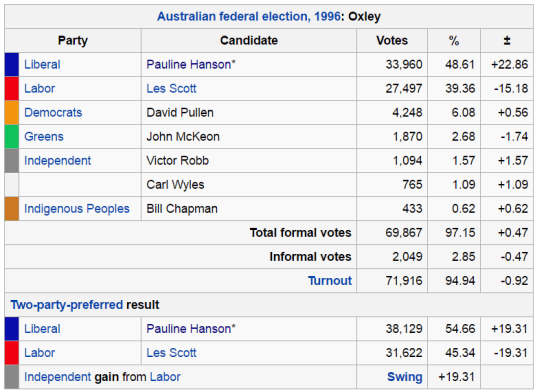
Hanson won the safest Labour seat in Queensland when first elected in 1996. Her 23% swing was mainly made up of Labour voters. Few in the media or commentariat like to remind of that.
Donald Trump defeated opposition on his right from Ted Cruz to win the Republican nomination. If moderate candidate Kasich had dropped out earlier, many of his voters would have gone to Trump, not to Cruz. Trump has appeal to working class Democrat party voters. The only group he seems to win is white men
UKIP is no longer a party out of the Tory shires, when it won 3% of the vote in 2010 in the UK. UKIP is slightly to the left of the LDP and came 2nd in 40 Labour seats in the last UK election. UKIP is a real threat to win seats from Labour or divide the working class work to allow the Tories to come through the centre.
All of these populists combine nationalism, an anti-immigration sentiment, a dislike of globalism and free trade because it involves dealing with foreigners, a preference for lower taxes but no particular opposition to extensive economic and social regulation. In many ways they are Alf Garnett Labour voters.

The work-horses of rational irrationality – antimarket bias, pessimism bias is, anti-foreign bias and make-work bias – are strong among these populist politicians and their voting base.
So few Labour Party MPs, present and upcoming, are working class in origin now that they have simply no experience of the anti-immigration and nationalist settlements of the working class. Until labour parties they work out how to deal with that and meet those concerns, they will keep losing votes to populists.
There is a wonderful quote about how a voter explained he did not vote Labour anymore because he was a white working class Englishman not on the benefit – Labour was no longer interested in him. Identity politics is not just the preserve of the left.

‘Unrepresentative swill’
27 Jun 2016 Leave a comment
in economics, politics - Australia Tags: Paul Keating
‘Give him a valium’
26 Jun 2016 Leave a comment
in economics, politics - Australia Tags: Paul Keating
‘I wanna do you slowly’
25 Jun 2016 Leave a comment
in economics, politics - Australia Tags: Paul Keating
@TheAusInstitute @BenOquist wrong to say every economist agrees on effects of company tax cut
24 Jun 2016 Leave a comment
in applied price theory, politics - Australia, politics - USA, public economics
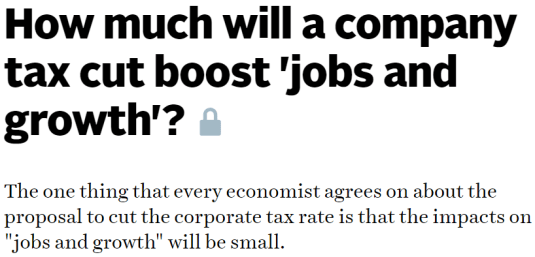
Source: Company tax cut won’t help Australian economy, jobs – Crikey.
It is unfortunate that the Australia Institute today misspoke when it claimed that every economist agrees that the effect of a company tax rate cut is small.
The top economists in the field of public economics disagree. Their views are freely available on the Internet. They are easiest to find by googling the words abolish the corporate tax. Optimal rate of tax on capital is zero are other good words to Google.
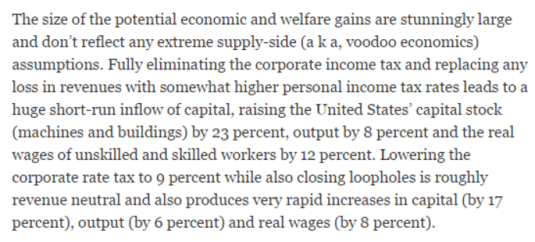
Source: Abolish the Corporate Income Tax – The New York Times.
It has been well known for decades of the optimal rate of tax on income from capital and from capital gains are zero. The Australia Institute has joined with Paul Krugman in not reporting this as Greg Mankiw explains
Paul Krugman responds to my post about a recent column of his. He is correct that not all economists agree that low capital taxation is desirable; he appropriately cites Diamond and Saez, who are on the high-capital-tax side of this debate. FYI, here is another recent paper, written in part as a response to Diamond and Saez, which finds that optimal rates of capital taxation, while positive, are quite low.
But that is not really the issue. If Paul had said “reasonable economists disagree, here are the arguments, and here is why I tend to favor one side rather than the other” I would not have objected.
Instead, in his original column, he wrote as if there were no reasonable arguments for the policy pursued by the Bush administration, and he attributed the most vile motives to those who advanced the policy.
This episode illustrates a fundamental difference between Paul and me. I try not to assume the worst in other people, just because they disagree with me.
Taxes on incomes from capital should be much lower because capital migrates from high-tax to low-tax locations, reducing capital-to-labour ratios in the higher company tax countries.
The low-tax on income from capital countries experience higher capital-to-labour ratios, a higher marginal product of labour, and higher wages. Robert Lucas described abolishing taxes on income from capital is one of the few genuinely free lunches out there in applied welfare economics.
Mankiw and Weinzierl “Dynamic Scoring: A Back-of-the-Envelope Guide,” Journal of Public Economics (September 2006): 1415-1433 argue that, in the long run, about 17% of a cut in individual income taxes is recouped through higher economic growth. For a cut in company taxes, their figure is 50%.
The Australia Institute manages to put itself in the contradictory position of saying a company tax rate just means more revenue for the IRS in the USA but Google, Facebook and other multinationals managed to avoid tax on a massive stale through tax havens. If the former is correct, their less company tax in Australia means more company tax paid in the USA means multinationals must be rather unsuccessful at avoiding tax through tax havens.
Multinationals are both avoiding company tax in Australia and offshore and paying it in full in the USA if Australia’s company taxes cut if the Australian Institute is to be believed today.
More than 50% of US corporate profits earned abroad are made in nations considered tax havens on.wsj.com/1h2Uitv http://t.co/6L8Hqislxd—
Nick Timiraos (@NickTimiraos) September 29, 2015
The Australia Institute obviously has not picked up on the relentless bullying that Ireland was subject to by the rest of the European Union over its 12.5% company tax.
The Irish company tax rate of 12.5% was initially on export profits. To finesse European Union member state complaints about that 12.5% company tax rate on discrimination grounds, the Irish government extended that low rate to all companies in 1995.
I am yet to see a minister of finance welcoming a company tax cut in a competing jurisdiction, rubbing his hands in anticipation of greater tax revenues on the foreign profits of multinationals that are headquartered in his country.
If there is an ounce of sense in what the Australia Institute said about foreign taxmen benefiting from low company taxes in Australia, high corporate tax rate countries such as Germany, France and the USA should welcome low company tax rates in destination countries for foreign investment originating in those countries but they do not.
Rather than seek tax harmonisation, high tax country should welcome low company taxes in competing investment destinations but they do not. Why is this so if the Australia Institute is making sense?
The Nordic countries follow optimal tax theory and have high but flat taxes on labour income, low taxes on business income and a high, broad-based consumption tax. That is the only way they can fund their welfare states.
The Nordics are alert to not killing the goose that laid the golden egg. Company taxes are relatively low in Scandinavian countries as compared to the USA so that businesses do not flee to other jurisdictions.

A large welfare state such as those in the Nordic countries require a significant amount of revenue, so the tax base in these countries must be broad. This also means higher taxes on consumption through the VAT or GST and higher taxes on middle-income taxpayers.
Business taxes are a less reliable source of revenue because of capital flight and disincentives to invest. Thus, the Nordics do not place above-average tax burdens on capital income and focus taxation on labour and consumption. All those nuances are lost if you are to believe the Australia Institute today.
How to vote for the Liberal Democrats
21 Jun 2016 Leave a comment
in politics - Australia Tags: 2016 Australian federal election
@billmaher at his best on Social Justice Warriors In Defense of Recklessness #PCPolice
19 Jun 2016 Leave a comment
in applied price theory, economics of media and culture, liberalism, libertarianism, politics - Australia, politics - New Zealand, politics - USA, sports economics, television Tags: political correctness, safe spaces
why no protests against #UBI bureaucratic job losses but #TPPANoWay protests aplenty about jobs?
08 Jun 2016 Leave a comment
in fiscal policy, labour economics, politics - Australia, politics - New Zealand, politics - USA, poverty and inequality, public economics Tags: expressive voting, growth of government, rational rationality, size of government, social insurance, universal basic income

The universal basic income is a rare bird for the left. It is the only time the usual suspects on the left are happy to cut government bureaucracy.

Furthermore, the left makes no inquiries as to how these redundant bureaucrats who administered the welfare state will find jobs. The market is left to work its magic for once. How convenient.

When a tariff cut is proposed, a trade deal signed, or job reduction in a bureaucracy suggested perhaps as the result of a privatisation, left-wing activists chain themselves to factory gates or government offices in solidarity. The social upheaval from the job losses among existing workers and their dim prospects of reemployment are paramount in their minds.

Why in the case of a universal basic income is the left so relaxed about job losses. Indeed, it celebrates as an advantage of a universal basic income that “Most of the bureaucracy of the welfare system [is] swept away” .

The universal basic income is the only time the left welcomes a reduction in bureaucracy and the role in the state. This switch from welfare payments to a universal basic income does not make those on the benefit any better off. Normally they are worse off under a universal basic income.
None of the the less well groups which of the concern of the left gain from a universal basic income. Despite this, they sell the jobs of their comrades in the public sector down the river.

I cannot believe the explanation is job losses are OK as long as they are the result of left-wing policies. Unless the labour market is liberalised, its ability to find new jobs for workers, for example, made redundant in the public sector after the introduction of a universal basic income is not any under greater than under a right-wing policy that costs jobs.


Recent Comments