Economic policy election posters used to be better. pic.twitter.com/uLZkhnZSz1
— Duncan Weldon (@DuncanWeldon) June 4, 2016
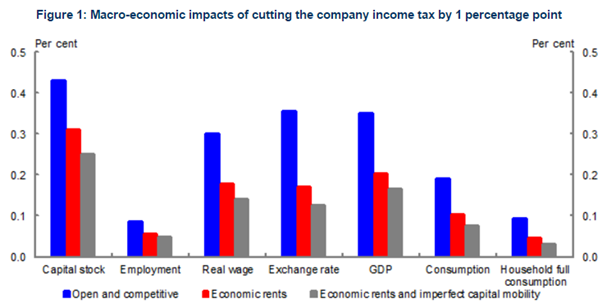
The effects of cutting the Australian company tax by one percentage point
02 Jun 2016 Leave a comment
in applied price theory, politics - Australia, politics - New Zealand, public economics Tags: Australia, company tax, international tax competition, tax incidents, taxation and entrepreneurship, taxation and investment
No @sarahinthesen8 this is not acceptable. Stopping the boats saved hundreds of lives
30 May 2016 Leave a comment
in Economics of international refugee law, international economic law, International law, labour economics, politics - Australia Tags: Australian Greens, avoiding difficult choices, economics of immigration, Leftover Left, rational irrationality
People who enter illegally by boat do not increase the number of refugees of Australia admits in any one year. They change who was granted asylum within the same fixed quota. Increasing the quota will not change incentives for illegal entry if illegal entry allows for settlement in Australia.
Gap in GDP per Australian, Canadian, French, German, Japanese, New Zealander and British hour worked with the USA
28 May 2016 Leave a comment
in economic growth, economic history, labour economics, labour supply, macroeconomics, politics - Australia, politics - New Zealand, politics - USA, public economics Tags: Australia, British economy, Canada, Eurosclerosis, France, Germany, Japan, labour productivity, measurement error, taxation and labour supply
This data tells more of a story than I expected. Firstly, New Zealand has not been catching up with the USA. Japan stopped catching up with the USA in 1990. Canada has been drifting away from the USA for a good 30 years now in labour productivity.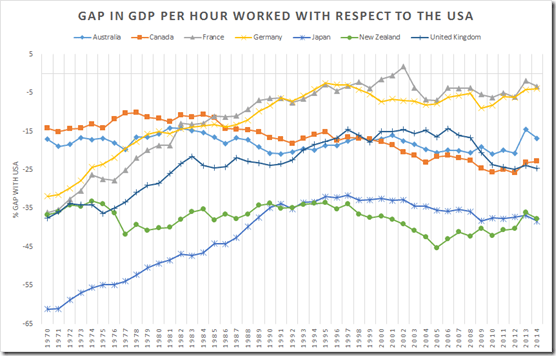
Data extracted on 28 May 2016 05:15 UTC (GMT) from OECD.Stat from OECD Compendium of Productivity Indicators 2016 – en – OECD.
Australia has not been catching up with the USA much at all since 1970. It has maintained a pretty consistent gap with New Zealand despite all the talk of a resource boom in the Australia; you cannot spot it in this date are here.
Germany and France caught up pretty much with the USA by 1990. Oddly, Eurosclerosis applied from then on terms of growth in income per capita.
European labour productivity data is hard to assess because their high taxes lead to a smaller services sector where the services can be do-it-yourself. This pumps up European labour productivity because of smaller sectors with low productivity growth.
Tax bracket creep in Australia
24 May 2016 Leave a comment
in politics - Australia, politics - New Zealand, public economics Tags: bracket creep, growth of government, size of government, taxation and inflation
Don’t let Mal and Bill get their grubby paws on your Super boy Bill well they got that smallest of the bill coming up your super
20 May 2016 Leave a comment
in politics - Australia, public economics Tags: 2016 Australian federal election
@TheAusInstitute has not heard of Ireland’s 12.5% company tax and European tax harmonisation
19 May 2016 Leave a comment
in politics - Australia, politics - New Zealand, politics - USA, public economics Tags: company tax rate, Ireland, race to the bottom, tax competition, tax harmonisation, taxation and investment
The Australia Institute has been running the line that cutting the Australian company tax rate just means more tax revenue for offshore tax departments. They will tax the larger after-tax Australian dividends in the home country of the foreign investor if Australia were to cut its company tax rate.
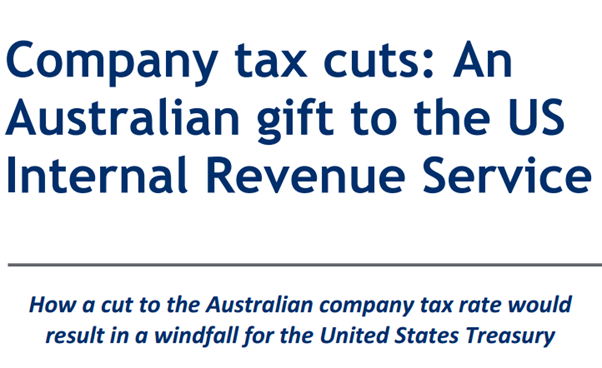
Source: David Richardson, Company tax cuts: An Australian gift to the US Internal Revenue Service How a cut to the Australian company tax rate would result in a windfall for the United States Treasury. Australia Institute (May 2015).
The Australia Institute obviously has not picked up on the relentless bullying that Ireland was subject to by the rest of the European Union over its 12.5% company tax.
The Irish company tax rate of 12.5% was initially on export profits. To finesse European Union member state complaints about that 12.5% company tax rate on discrimination grounds, the Irish government extended that low rate to all companies in 1995.
I am yet to see a minister of finance welcoming a company tax cut in a competing jurisdiction, rubbing his hands in anticipation of greater tax revenues on the foreign profits of companies headquartered in his country.
If there is no race to the bottom in company tax rates, you must wonder why there is substantial efforts within the European Union on tax harmonisation regarding company tax?
France and Germany are pushing plans to introduce a minimum corporation tax rate across the continent, it was reported today, in a move that could result in higher taxes on British companies.
European officials will debate plans to set a EU-wide floor on corporation tax in order to crack down on tax havens such as Ireland and Luxembourg, it emerged.
If there is an ounce of sense in what the Australia Institute said about foreign taxmen benefiting from low company taxes in Australia, high corporate tax rate countries such as Germany, France and the USA should welcome low company tax rates in destination countries for foreign investment originating in those countries but they do not. Rather than seek tax harmonisation, high tax country should welcome low company taxes in competing investment destinations but they do not.
About $2 trillion in profits is held offshore by American businesses because they do not pay company tax in the USA until they actually repatriate the profits to the USA. This is common. You wonder what the purpose of tax havens is if a company tax rate cut in Australia is so easily captured by the IRS?
Studies of the company tax in the USA suggest that a cut in that company tax would lead to large inflows of foreign investment into the USA boosting wages significantly.
Fed up with Coalition and Labor Budget lies? So is the LDP
14 May 2016 Leave a comment
in liberalism, politics - Australia, Public Choice Tags: 2016 Australian federal election
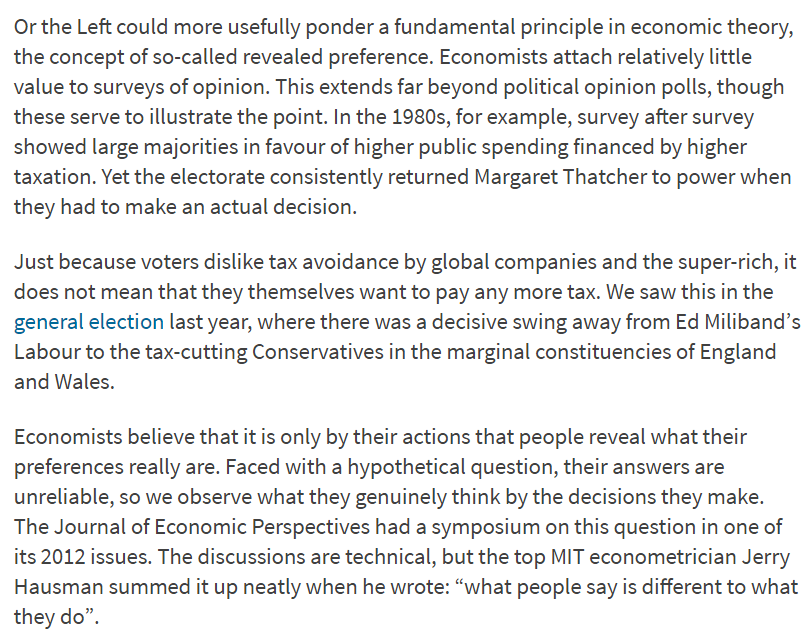
Forget avoidance outrage: public’s real attitude to tax is revealed by their actions @JordNZ
21 Apr 2016 Leave a comment
in applied price theory, constitutional political economy, economic history, economics of media and culture, politics - Australia, politics - New Zealand, politics - USA, Public Choice, public economics Tags: British economy, British politics, expressive voting, growth of government, rational irrationality, revealed preference, size of government, voter demographics
@FairnessNZ NZ leads world in closing the gender pay gap #equalpayday @greencatherine
13 Apr 2016 Leave a comment
in discrimination, economic history, gender, human capital, labour economics, labour supply, politics - Australia, politics - New Zealand, politics - USA, poverty and inequality Tags: Australia, British economy, gender wage gap

1992 Camille Paglia trashes Gloria Steinem wing of feminism
10 Apr 2016 Leave a comment
in discrimination, economics of love and marriage, economics of media and culture, gender, labour economics, law and economics, politics - Australia, politics - New Zealand, politics - USA, television Tags: feminism
Australian taxes on income are not particularly high if you include social security
02 Apr 2016 Leave a comment
in politics - Australia, public economics Tags: Australia, old age pensions, retirement savings, taxation and labour supply
@AntonyGreenABC priceless tweets on Australian upper house quotas
21 Mar 2016 Leave a comment
in constitutional political economy, economics, politics - Australia Tags: bicameralism, proportional representation, Upper Houses
Left-wing governments are rare in Australia
21 Mar 2016 Leave a comment
in constitutional political economy, economic history, politics - Australia, Public Choice Tags: Australian Labour Party, Bob Hawke, Gough Whitlam, left-wing governments, Paul Keating, Social Democrats
There have been one left-wing government in Australia since 1949. That was the Whitlam government elected between 1972 to 1975.
The Australian Labour Party defeated a tired and smelly Liberal National party government that had held office for 23 years. There was no landslide when it was time to throw out a 23 year government.
Gough Whitlam managed to beat dopey old Billy McMahon on a small swing and win a majority of 9 seats in 1972. That was later reduced to 7 in the 1974 election.

Hawke, Keating, Rudd and Gillard Labour governments were all social democratic governments. They were not left-wing governments.
Solution aversion and the anti-science Left
11 Mar 2016 1 Comment
in applied price theory, applied welfare economics, comparative institutional analysis, constitutional political economy, economics of regulation, energy economics, environmental economics, global warming, health economics, law and economics, politics - Australia, politics - New Zealand, politics - USA, property rights, Public Choice Tags: antiscience left, climate alarmism, geo-engineering, GMOs, growth of knowledge, gun control, motivated reasoning, nuclear power, political persuasion, solar power, solution aversion, wind power
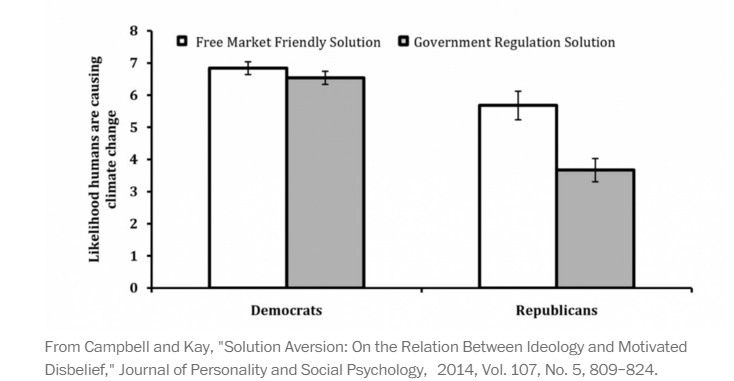
Climate science is the latest manifestation of solution aversion: denying a problem because it has a costly solution. The Right does this on climate science, the Left does it on gun control, GMOs, and plenty more. Cass Sunstein explains:
It is often said that people who don’t want to solve the problem of climate change reject the underlying science, and hence don’t think there’s any problem to solve.
But consider a different possibility: Because they reject the proposed solution, they dismiss the science. If this is right, our whole picture of the politics of climate change is off.
Some psychologists wasted grant money on lab experiments to show that people that think the solution to a problem is costly tend to rubbish every aspect of the argument. Any politician will tell you you do not concede anything. Sunstein again:
Campbell and Kay asked the participants whether they agreed with the IPCC. And in both, about 80 percent of Democrats did agree; the policy solutions made no difference.
Republicans, in contrast, were far more likely to agree with the IPCC when the proposed solution didn’t involve regulatory restrictions…
Here, then, is powerful evidence that many people (of course not all) who purport to be skeptical about climate science are motivated by their hostility to costly regulation.
The Left is equally prone to motivated readings. For example, it was found that those on the left are much more concerned about home invasions when gun control can reduce them rather than increase them.
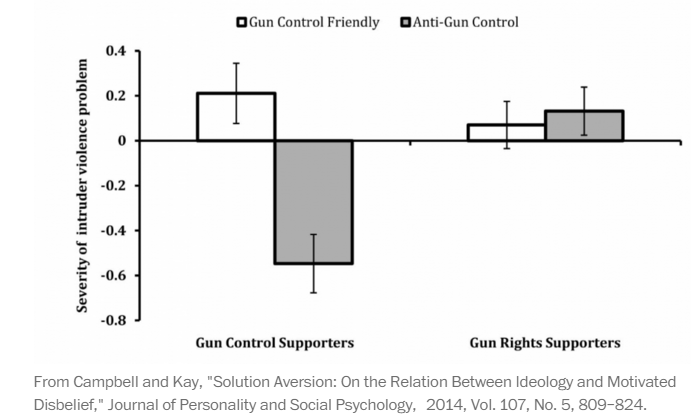
The Left picks and chooses which scientific consensus as it accepts. The overwhelming consensus among researchers is biotech crops are safe for humans and the environment. This is a conclusion that is rejected by the very environmentalist organisations that loudly insist on the policy relevance of the scientific consensus on global warming.
Previously the precautionary principle was used to introduce doubt when there was no doubt. But when climate science turned in their favour, environmentalists wanted public policy to be based on the latest science.
The Right is welcoming of the science of nuclear energy or geo-engineering. The Left rejects it point-blank. Their refusal to consider nuclear energy as a solution to global warming is a classic example of solution aversion. Let he who is without sin cast the first stone.


Recent Comments