In Mexico, most cash-based public social benefits go to households in the highest income quintile, per OECD. http://t.co/xykkPkDVZs—
Catherine Rampell (@crampell) November 24, 2014
Australia has the most targeted welfare state
10 Apr 2015 2 Comments
in politics - Australia, politics - New Zealand, politics - USA, poverty and inequality, welfare reform Tags: welfare state
More evidence of mass kidnapping of environmental activists
08 Apr 2015 Leave a comment
in environmental economics, environmentalism, international economic law, international economics, International law, law and economics, politics - Australia, politics - New Zealand, politics - USA Tags: green hypocrisy, ozone layer
/cdn0.vox-cdn.com/uploads/chorus_asset/file/3577778/ozone_composite.0.png)
Why aren’t they in the streets celebrating the recovery of the ozone layer, pursuant to an international treaty negotiated by the Reagan administration that banned CFCs as soon as they were not required any longer in developed countries:
International efforts to control the gases, particularly among developed countries, began to occur in the mid-1980s as new information appeared that strengthened the link between CFCs and the deterioration of stratospheric ozone. This increased the expected benefits of international action.
At the same time, domestic political opposition began to diminish when Du Pont announced they would no longer make CFCs. A reason for Du Pont’s attitude change was that European firms had increased their share of the CFC market, and in response Du Pont had developed CFC substitutes.
Accordingly, since international controls on CFCs provided them a competitive advantage, Du Pont announced that they would no longer make CFCs and the company lobbied the U.S. Congress for international regulation.
Under the 1987 Montreal Protocol, world leaders agreed to phase out CFCs, and eventually the hole in the ozone layer stopped expanding. In 2014, a UN assessment found that the ozone layer is just now starting to heal — and should be back to its 1980 levels by 2050 or so.
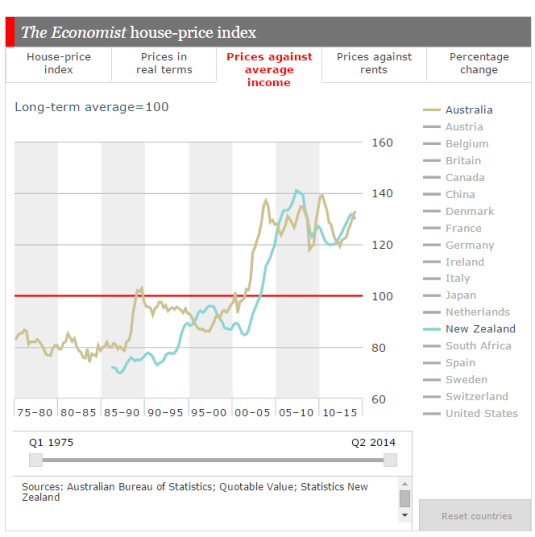
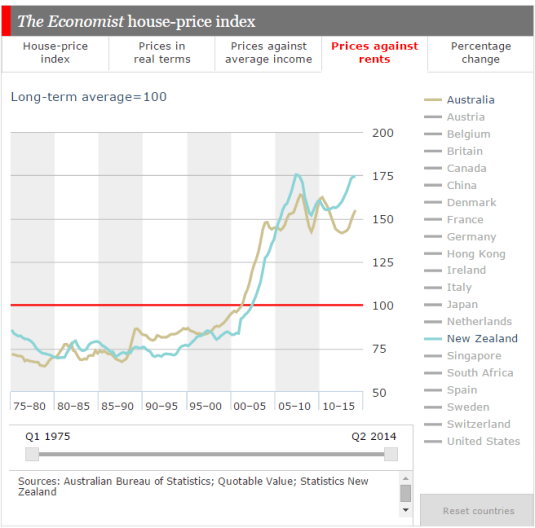
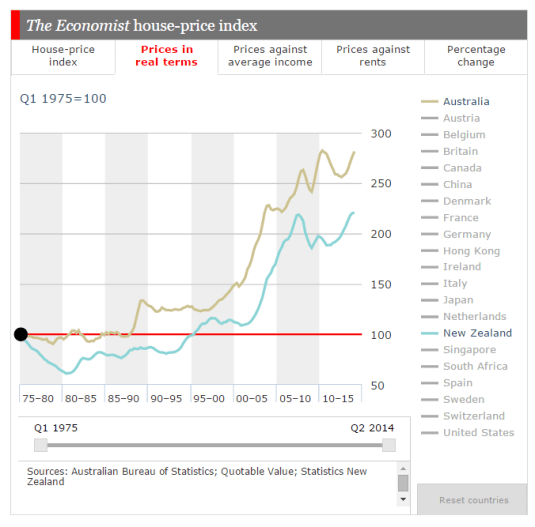
New Zealand and Australia in The Economist House-Price Index
07 Apr 2015 Leave a comment
in economics of regulation, politics - Australia, politics - New Zealand, urban economics
Everything seemed to go wrong regarding housing prices in New Zealand in about the year 2000, which was the year after the election of a Labour government. Labour parties are supposed to stand for a better deal for the ordinary worker. Clearly, they did not when housing prices run away because of restrictions on land supply.
Trans-Tasman trends in real equivalised mean household income since 1982
04 Apr 2015 Leave a comment
in business cycles, economic growth, global financial crisis (GFC), macroeconomics, politics - Australia, politics - New Zealand Tags: GFC, Rogernomics, Trans-Tasman income gap
@JimRose69872629 @JohnQuiggin @pagdavidson Largest fall in real mean incomes in NZ was in the early 1990s http://t.co/DDVgeMIGsj—
Peter Whiteford (@WhitefordPeter) April 04, 2015
Real household mean incomes rose during Rogernomics; fell during the deep recession at the beginning of the early 1990s; then rose strongly until 2009 and the onset of the Global Financial Crisis.
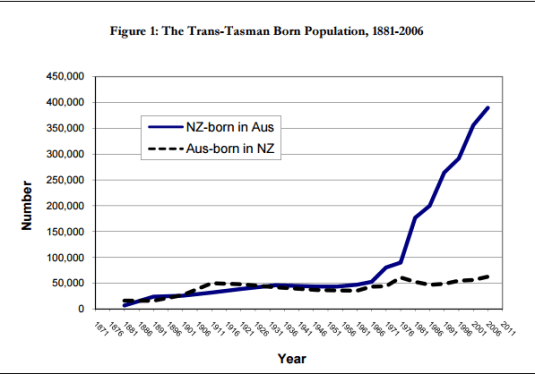
Trans-Tasman populations since 1881
03 Apr 2015 Leave a comment
in economic history, politics - Australia, politics - New Zealand, population economics
Who has the smallest Anglo-Saxon welfare state of them all?
02 Apr 2015 1 Comment
in income redistribution, labour economics, politics - Australia, politics - New Zealand, politics - USA, welfare reform Tags: social insurance, social safety nets, welfare reform, welfare state
I have reanalysed data published by the Peterson Institute on the true levels of social expenditure across the industrialised countries for the Anglo-Saxon countries.
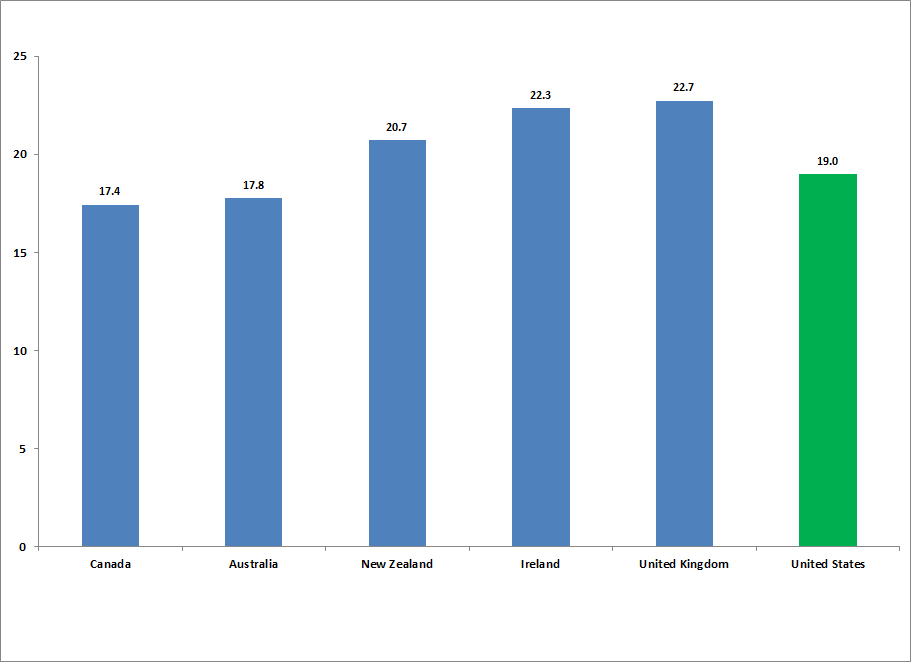
Figure 1: gross public social expenditures in OECD countries, 2011
Source: POLICY BRIEF 15-4: The True Levels of Government and Social Expenditures in Advanced Economies.
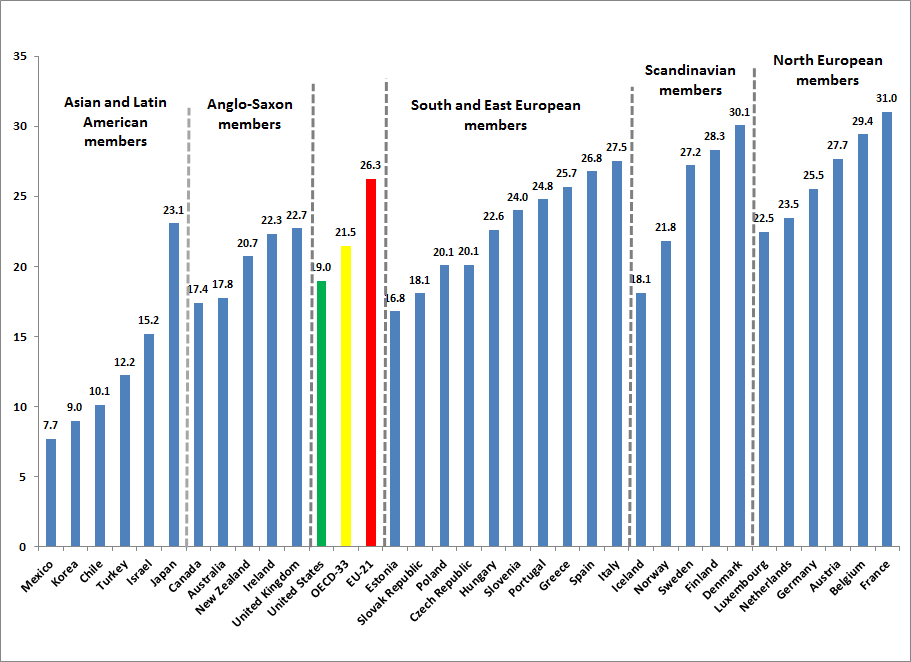
When you just look at gross public social expenditure, New Zealand is in the middle of the pack with the United Kingdom having the largest spending. There are not particularly large differences across social spending in the Anglo-Saxon welfare states.
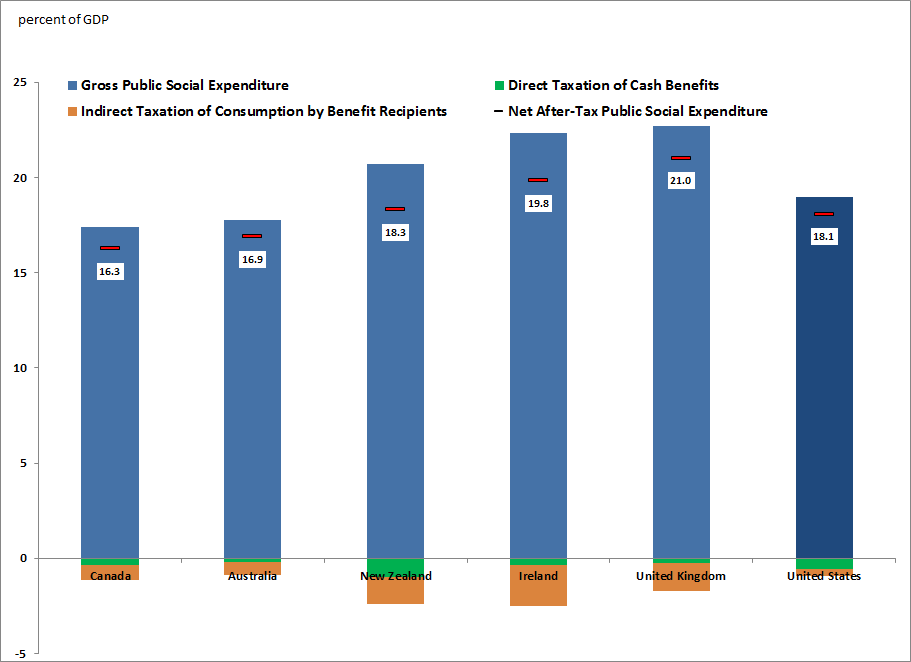
Figure 2: Gross public social expenditure and the effects of taxation in OECD countries, 2011
Source: POLICY BRIEF 15-4: The True Levels of Government and Social Expenditures in Advanced Economies.
There is not much change when you include the effects of taxation on consumption by benefit recipients.
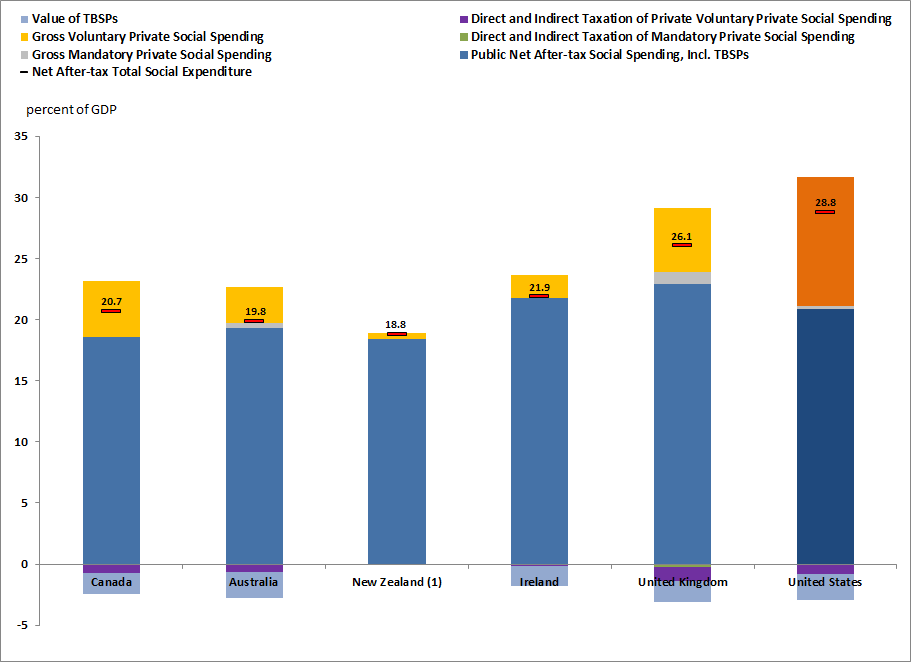
Figure 3: Net after-tax public and private social expenditure in OECD countries, 2011
Source: POLICY BRIEF 15-4: The True Levels of Government and Social Expenditures in Advanced Economies.
When private mandatory social spending is included, such as employer sponsored health cover, there is considerable change with United States leaping to the front and New Zealand dropping to the bottom. The USA has the largest and most expensive is health sector in the world so they are leaping of the front, either because healthcare is expensive in United States or people in the United States are not constrained by government rationing to spend less than they would prefer on their own healthcare. Let’s leave that war of ideas for another day.
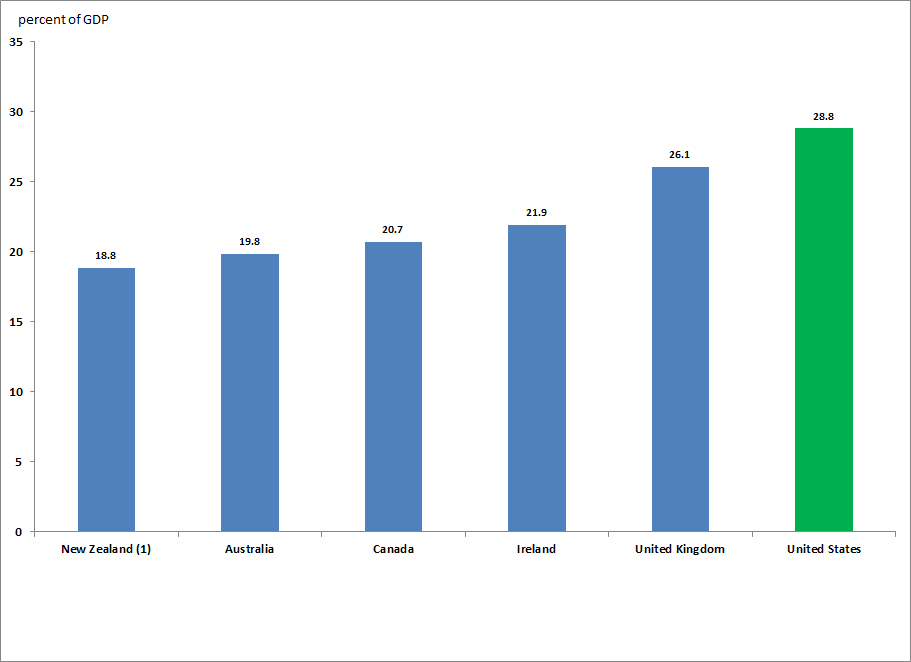
Figure 4: Net after-tax total social expenditures in OECD countries, 2011
Source: POLICY BRIEF 15-4: The True Levels of Government and Social Expenditures in Advanced Economies.
On the face of it, New Zealand has the smallest Anglo-Saxon welfare state while the United States has the largest. A more accurate measure of the relative sizes of these Anglo-Saxon welfare states would require the wisdom of Solomon in measuring waste and underfunding in the respective systems and more trust than you should have in services sector in purchasing power parity adjustments.
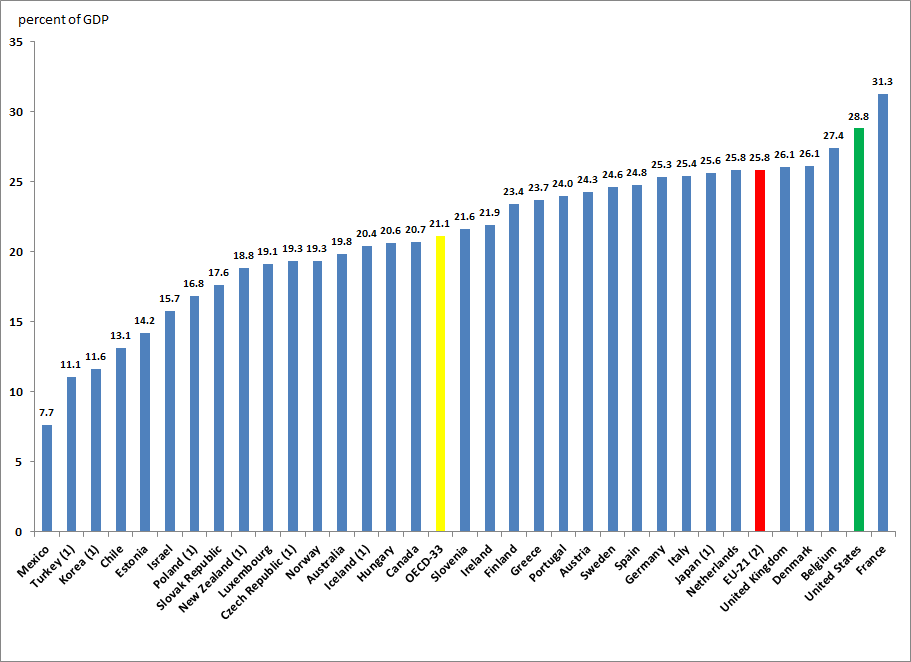
For those that are interested, the OECD-wide gross social spending and net after-tax total social spending are reproduced below in figures 5 and 6.
Figure 5: Net after-tax total social expenditures in OECD countries, 2011
Source: POLICY BRIEF 15-4: The True Levels of Government and Social Expenditures in Advanced Economies.
The Figure 5 data on the OECD wide welfare state sizes shows that when you add private spending, including social spending mandated by law, the US has the second largest OECD social safety net as Kirkegaard said in his Peterson Institute paper:
Taking the full effects of tax systems and social spending from both private and public sources into account, the United States is seen to be devoting more resources toward social purposes than is generally acknowledged. In fact, only the French spend more than Americans, while the alleged welfare-addicted Scandinavians and Europeans spend less on average.
Figure 6: Gross public social expenditures in OECD countries, 2011
Source: POLICY BRIEF 15-4: The True Levels of Government and Social Expenditures in Advanced Economies.
Via The US welfare state and safety net are bigger than you think. But who are they helping? – AEI | Pethokoukis Blog » AEIdeas and POLICY BRIEF 15-4: The True Levels of Government and Social Expenditures in Advanced Economies
The relative political importance of climate change
01 Apr 2015 Leave a comment
in environmental economics, global warming, politics - Australia, politics - New Zealand, politics - USA Tags: 2014 congressional elections, climate alarmism, global warming, opinion polls, voter demographics
Tax reform leads to higher taxes – the evidence on the GST
31 Mar 2015 Leave a comment
in constitutional political economy, politics - Australia, politics - New Zealand, Public Choice, public economics, taxation Tags: Geoffrey Brennan, James Buchanan, tax reform
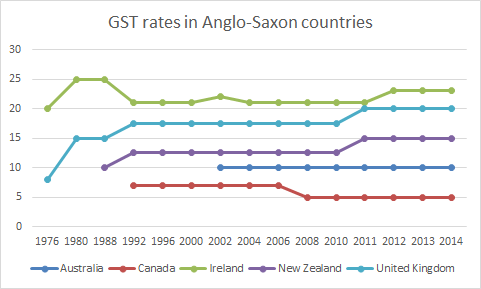
The GST increased from 10 to 15% in New Zealand; more than doubled in the UK; but GST rates were stable or went up and down in the remaining Anglo-Saxon countries.
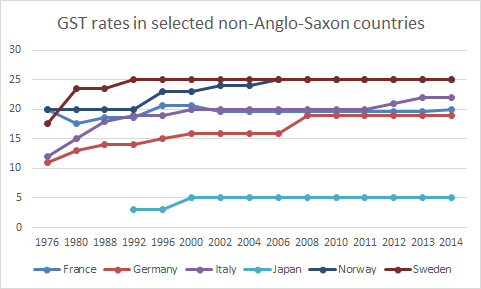
As for a selection of other non-Anglo-Saxon countries , Brennan and Buchanan were right. Tax reforms such as a broad-based consumption tax leads to higher taxes through time.
ICYMI: How does Australia's GST compare with other nations? ab.co/1eBsdrS #factcheck http://t.co/QFP05xonEB—
ABC Fact Check (@ABCFactCheck) July 31, 2015
The GST (goods and services tax) in Europe is known as the value added tax (VAT).
Source: OECD Tax Database – OECD.
New Zealand and Australian private health insurance rates compared
31 Mar 2015 Leave a comment
in health economics, politics - Australia, politics - New Zealand
Seems like imposing a tax on those did not have a private cover induced high income people to take out private cover stop

Via http://www.healthfunds.org.nz/pdf/dec2013%20Quarterly%20statistical%20summary.pdf

Via INFOGRAPHIC: A snapshot of private health insurance in Australia.
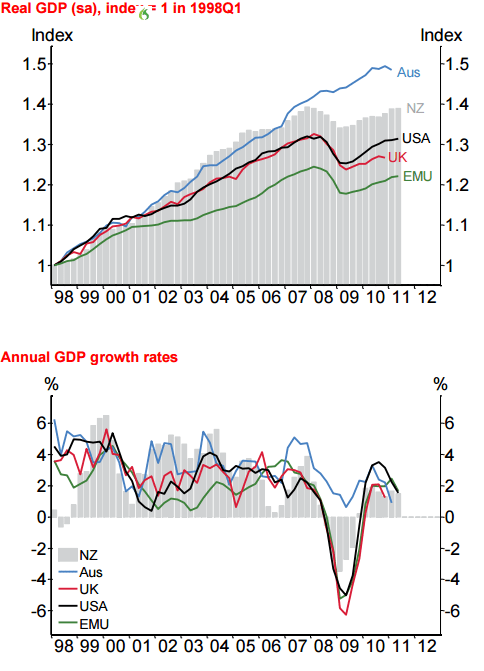
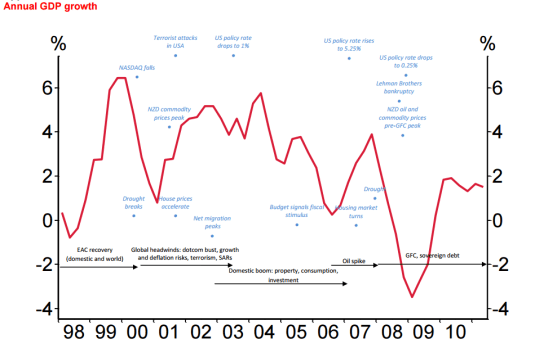
Recent New Zealand economic growth compared
31 Mar 2015 Leave a comment
in economic growth, macroeconomics, politics - Australia, politics - New Zealand, politics - USA
Whitlam’s curse – How higher education drives inequality among the bottom 99%
30 Mar 2015 Leave a comment
in economics of education, human capital, labour economics, labour supply, occupational choice, politics - Australia, politics - USA Tags: David Autor, education premium, Gough Whitlam, top 1%
Gough Whitlam abolished tuition fees at Australian universities in 1972. The idea was to reduce inequality. He entrenched it instead, and gave a flying start to those of already above-average talents.
David Autor in a recent paper has illustrated how the gap between the highly educated and the less educated is growing at a far faster rate than the gap between the top 1% in the bottom 99% in the USA. David Autor argues that
a single minded focus on the top 1% can be counterproductive given that the changes to the other 99% have been more economically significant.

- since the early 1980s, the earnings gap between workers with a high school degree and those with a college education has become four times greater than the shift in income during the same period to the very top from the 99%.
- Between 1979 and 2012, the gap in median annual earnings between households of high-school educated workers and households with college-educated ones expanded from $30,298 to $58,249, or by roughly $28,000.
- If the incomes of the bottom 99% are grown at the same pace as the top 1% their incomes would have increased by $7000 per household.
Autor argues that the growth of skill differentials among the other 99% is more consequential than the rise of the 1% for the welfare of most citizens.

via How Education Drives Inequality Among the 99% – Real Time Economics – WSJ.
Australia takes eight times as many refugees as New Zealand, per capita
27 Mar 2015 Leave a comment
in Economics of international refugee law, politics - Australia, politics - New Zealand Tags: economics of immigration, refugees
Sweden – the OECD's highest per capita recipient of asylum seekers bit.ly/1vfFEUh http://t.co/y6DmdJjAsE—
Guardian Data (@GuardianData) December 02, 2014
In Defence of Negativity in Politics – John G. Geer
24 Mar 2015 Leave a comment
in economics of information, economics of media and culture, politics - Australia, politics - New Zealand, politics - USA, Public Choice Tags: Attack Ads, expressive voting, John G. Geer, political psychology, rational ignorance, rational irrationality
John G. Geer, author of In Defense of Negativity: Attack Ads in Presidential Campaigns, argues that negative ads are positive. They focus on important political issues and give voters critical information about differences between candidates. Attack ads do not degrade, but rather enrich the democratic process. When political candidates attack each other, they raise doubts about each other’s views and qualifications. Voters—and the democratic process—benefit from this clash of opinions.
The Guardian on the strength of the scientific consensus on global warming and on GMOs
22 Mar 2015 Leave a comment
in environmental economics, health economics, politics - Australia, politics - New Zealand, politics - USA
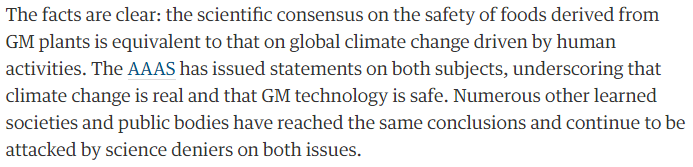
I marvel at the ability of The Guardian to launch a diatribe against science deniers on GMOs, and not mention that most of them come from the left-wing of politics and the Greens and the environmental movement.


Recent Comments