
Source: Inequality and the City – The New York Times via Krugman: Deregulate Housing, David Henderson | EconLog | Library of Economics and Liberty.
Celebrating humanity's flourishing through the spread of capitalism and the rule of law
01 Dec 2015 Leave a comment
in economics of regulation, politics - New Zealand, urban economics
Source: Inequality and the City – The New York Times via Krugman: Deregulate Housing, David Henderson | EconLog | Library of Economics and Liberty.
01 Dec 2015 Leave a comment
in economic growth, economic history, macroeconomics, politics - Australia, politics - New Zealand
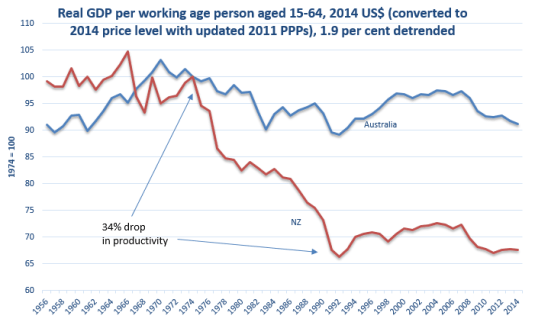
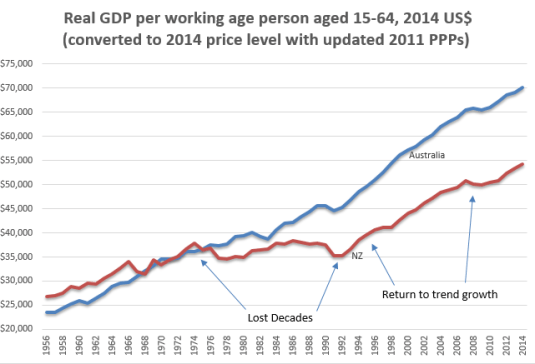
I have updated my estimates of Australian and New Zealand detrended real GDP growth for the 2014 working age population statistics from the OECD. The charts show:
Source: Computed from OECD Stat Extract and The Conference Board. 2015. The Conference Board Total Economy Database™, May 2015, http://www.conference-board.org/data/economydatabase/
The real GDP data in the above chart is detrended by 1.9% per annum. 1.9% growth per year is the trend real GDP growth rate of the USA in the 20th century. The growth rate of the USA is taken as the growth rate of the global technological frontier. A flat line in the above chart is real GDP growth at 1.9% per year. A falling line is real GDP growth in that year of less than 1.9%; a rising line is growth that is greater than 1.9% in that year.
Source: Computed from OECD Stat Extract and The Conference Board. 2015. The Conference Board Total Economy Database™, May 2015, http://www.conference-board.org/data/economydatabase/
01 Dec 2015 1 Comment
in applied price theory, economics of bureaucracy, industrial organisation, politics - New Zealand
For some months now I’ve been trying to ascertain the latest performance of the state owned enterprises (SOE) portfolio. The last Crown Portfolio Report was issued in December 2013. That was two long years ago. I therefore asked for access to the quarterly report on the Crown commercial portfolio to the Minister of Finance by the Treasury.

My Official Information Act request to the Treasury was declined on commercial in confidence grounds. Not only was my request to the Minister of Finance similarly refused, he told me to do the analysis myself by working my way through the 49 annual reports of the state owned enterprises in New Zealand.

Source: Bill English, Minister of Finance, Response to Official Information Act request, 30 November 2015.
Look it up yourself is not a good approach to public accountability to busy taxpayers who have lives to lead. There is a very well-paid Treasury that can do that analysis and has been doing that analysis every year until two years ago.
There is been no explanation for the non-publication of the Crown Portfolio report for two years. That is unacceptable in terms of tax payer accountability.
What is weird about this blow to taxpayer accountability is I have been refused access to Treasury analysis of public information. I’m not actually asking for the analysis. I am asking for a tabulation of 49 annual reports of state owned enterprises. Somehow a tabulation of public information is commercial in confidence despite the fact I can do it myself. This makes no sense.
It appears that for two years now the Minister of Finance has not been advised on the annual rates of return of the state owned enterprise portfolio as a whole. If he had, the Treasury and the Minister of Finance would have supplied that data to me in the course of my Official Information Act requests because it was obvious that I was after that information and they have a duty to be helpful when processing Official Information Act requests.
The Minister of Finance should be more curious about tens of billions of dollars in taxpayer’s assets that currently struggle to offer a positive return.

Source: The New Zealand Treasury, Crown Portfolio Report 2013, p. 41.
No publicly listed company could fail to publish its annual report. The fact that this has not been picked up as an example of why public ownership is inferior. No one profits from highlighting these governance shortcomings.
If the state owned enterprises were listed on the stock exchange, investors would sell off a company that missed its reporting date. Missing a reporting date is a sure sign of both poor governance and poor performance. Entrepreneurs would see a poorly governed company as a takeover opportunity. There are no similar disciplines for state owned enterprises whose governance and transparency falls short.
By the way, the original objective of my research was to compare state-owned enterprise performance under the current and previous governments. The Treasury was unable to supply data further back than 2007. Everything before then is on paper. The individual company reports have to be looked up by hand.
Nothing is at the fingertips of the Treasury if the Minister of Finance was interested in knowing whether his stewardship of state owned enterprises was superior to that of his predecessors.
30 Nov 2015 1 Comment
in discrimination, gender, minimum wage, politics - New Zealand
The minimum wage was pretty stable as a percentage of the median wage in New Zealand until recently. Nonetheless, the gender wage gap narrowed at the bottom of the labour market rapidly in the 1980s and 1990s.

Source: OECD Employment Database and Data extracted on 30 Nov 2015 04:03 UTC (GMT) from OECD.Stat.
In common with the USA, that narrowing of the gender wage gap stopped in the early 2000s after the minimum wage started increasing as a percentage of the median wage.
Again, that is contrary to the idea that the minimum wage is a failsafe that narrows the gender wage gap at the bottom. This failsafe is said to be the leading reason why the gender wage gap is much smaller at the bottom of the labour market than higher-up such as the median and in particular at the top.
28 Nov 2015 9 Comments
in discrimination, entrepreneurship, gender, labour economics, occupational choice, politics - New Zealand, survivor principle Tags: compensating differentials, employer discrimination, entrepreneurial alertness, gender wage gap, market selection, The meaning of competition
Geoff Simmons’ Friday Whiteboard podcast last night on the 12% gender wage gap was a good summary of the proximate drivers such as occupational segregation and part-time work. I have a few quibbles with his stress on unconscious bias as the driver of the gender wage gap.
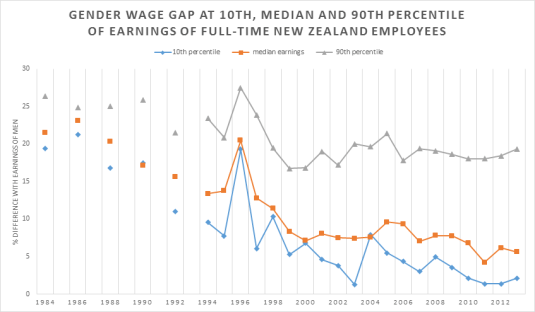
The first of these quibbles is the gender wage gap is tiny at the bottom and even the middle of the labour market but is so high and so stable for so long at the top-end. Why does unconscious bias increase with the wages on offer? Better paid professional women have far more options to look around for the best paid job and turned down inferior officers.
Source: OECD Employment Database.
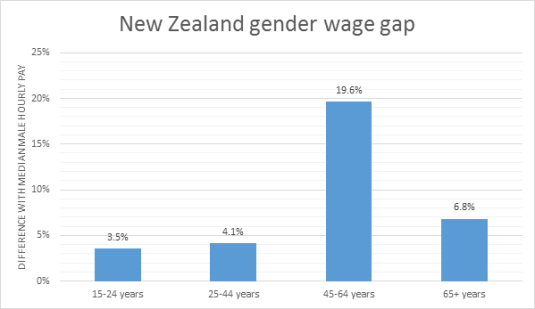
My second quibble is the New Zealand gender wage gap is trivial for women under the age of 45 but suddenly there is a burst of unconscious bias until they retire. This is odd because mature age workers have had plenty of time to accumulate human capital, search around for the best job offer and will have a job and therefore can turn down inferior offers. These women are not new starters on the unemployment benefit desperate for employment.
Source: New Zealand Income Survey 2014 via Human Rights Commission: Tracking Equality at Work.
My final quibble is the gender wage gap for part-time workers is reversed. No one takes this higher pay per hour as evidence that there is no unconscious bias against women who work part-time. If the gender pay gap was in the opposite direction, of course, that pay gap would be conclusive evidence of unconscious bias against women in part-time jobs. But as the gap is as it is in favour of women not against them, the usual adjustments for skills, age and experience become convenient truths.
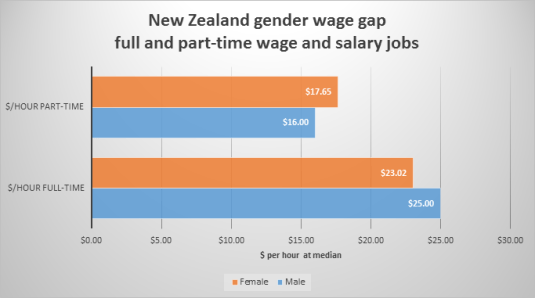
Source: Statistics New Zealand, New Zealand Income Survey, June quarter 2015.
Is what’s left of the unconscious bias hypothesis that we chauvinistic men, bastards all, have an unconscious bias against women who work full-time, who are over the age of 45 or earn a lot of money making us jealous?
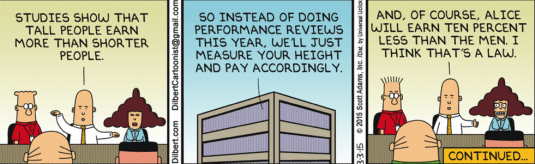
The unconscious bias hypothesis for the residual in the gender wage gap has come to the fore because earlier hypotheses of deliberate discrimination against women fell by the wayside as explanations for the gender wage gap.
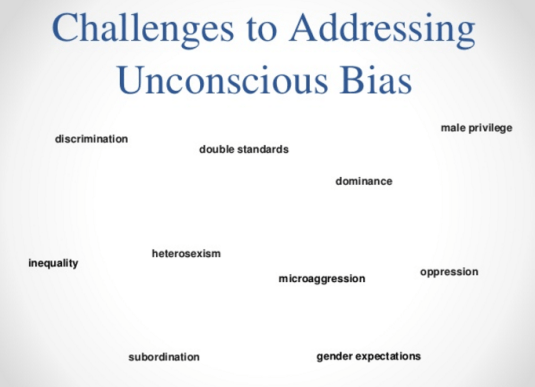
Complicating things is the unconscious bias hypothesis must explain why the unconscious bias is so much stronger at the top end of the labour market against women who have plenty of options to fight back including found in their own companies to hire women underpaid elsewhere.
As is well known, sex and race discrimination by employers as a profit opportunity for other less prejudiced employers including unconsciously prejudiced employers to hire the undervalued workers.
The process whereby the market bids up the wages of women undervalued by unconsciously biased employers can be itself be thoroughly unconscious as Armen Alchian explained in 1950. Alchian pointed out the evolutionary struggle for survival in the face of market competition ensured that only the profit maximising firms survived:
These surviving firms may not know why they are successful, but they have survived and will keep surviving until overtaken by a better rival. All business needs to know is a practice is successful. The reason for its success is less important.
In the case of unconscious bias against women, those employers who are less unconsciously biased than the rest will grow at the expense of less enlightened albeit unconsciously less enlightened rivals. Undervaluing workers for any reason is a business opportunity. The market processes will reduce this undervaluation. All that is required is that some employers be less unconsciously biased than others.

One method of organising production will supplant another when it can supply at a lower price (Marshall 1920, Stigler 1958). Gary Becker (1962) argued that firms cannot survive for long in the market with inferior product and production methods regardless of what their motives are. They will not cover their costs.
The more efficient sized firms are the firm sizes that are currently expanding their market shares in the face of competition; the less efficient sized firms are those that are currently losing market share (Stigler 1958; Alchian 1950; Demsetz 1973, 1976). Business vitality and capacity for growth and innovation are only weakly related to cost conditions and often depends on many factors that are subtle and difficult to observe (Stigler 1958, 1987). In the case of unconsciously biased employers, they are less likely to survive.

What is even more peculiar is this unconscious bias exists at the end of the market where there is the greatest incentive to invest in ascertaining the quality of recruits if Edward Lazear’s pioneering work on the personnel economics of hiring standards is to believed:
Screening is more profitable when the stakes are higher: The purpose of screening is to avoid the unprofitable candidates. Therefore, the greater the downside risk from hiring the wrong person, the more value there is to screening. Similarly, the longer that a new candidate can be expected to stay with the employer, the more valuable will be the screen. Firms that intend to hire employees for the long term thus tend to invest more in careful screening before committing to a new hire.
The higher the wage of recruit, the more important they are to the success of the firm. That gives the entrepreneur more reasons to sort and screen from better quality recruits. The higher paid is the recruit, the greater the returns to the applicant from signalling their quality:
Signalling is helpful when employers do not have enough information about job applicants to assess their potential accurately enough. It is useful when differences in talent among potential employees matter a lot to productivity. When differences in talent do not make much difference to productivity, signalling will not be very useful.
These ideas suggest when we should expect to see employment practices consistent with signalling. First, signalling should be more important in jobs where skills are most important. Such jobs tend to be those that are at high levels of the hierarchy, in research and development, and in knowledge work. They also correspond well to professional service firms, such as consulting, accounting, law firms, and investment banks. In such professions, even small differences in talent can lead to large differences in effectiveness on the job, so sorting for talent is very important. For this reason, such firms tend to screen very carefully at recruiting, and usually have promotion systems that correspond well to our probation story above, at least in the first few years on the job.
The presence of more unconscious bias at the top of the labour market than at the middle and the bottom doesn’t have as many legs as suggested by Geoff Simmons in his Friday podcast. The higher is the wage, the greater is investment by both sides to the recruitment equation in an unbiased consideration of the job application. This runs against the notion that the gender gap at the top end of the labour market is due to unconscious bias.

A far better explanation is compensating differentials. Women at the top are trading off wages from work-life balance and more time with their children. They can do so because they are well-paid.
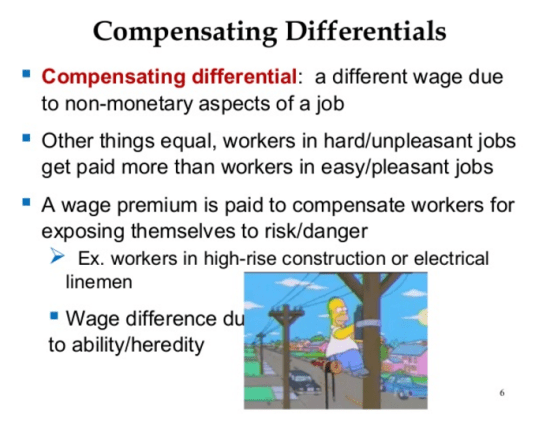
Whatever the hypothesis about compensating differentials is, that hypothesis has nothing to do with unconscious bias by employers. Alison Booth and Jan van Ours were almost annoyed to find that British women are actually quite satisfied with part-time work:
Women present a puzzle. Hours satisfaction and job satisfaction indicate that women prefer part-time jobs irrespective of whether these are small or large but their life satisfaction is virtually unaffected by hours of work.
I will close with a quote from Amy Wax on the impractical nature of doing anything about unconscious bias:
Demonstrating racial bias is no easy matter because there is often no straightforward way to detect discrimination of any kind, let alone discrimination that is hidden from those doing the deciding. As anyone who has ever tried a job-discrimination case knows, showing that an organization is systematically skewed against members of one group requires a benchmark for how each worker would be treated if race or sex never entered the equation. This in turn depends on defining the standards actually used to judge performance, a task that often requires meticulous data collection and abstruse statistical analysis.
Assuming everyone is biased makes the job easy: The problem of demonstrating actual discrimination goes away and claims of discrimination become irrefutable. Anything short of straight group representation — equal outcomes rather than equal opportunity — is “proof” that the process is unfair.
Advocates want to have it both ways. On the one hand, any steps taken against discrimination are by definition insufficient, because good intentions and traditional checks on workplace prejudice can never eliminate unconscious bias. On the other, researchers and “diversity experts” purport to know what’s needed and do not hesitate to recommend more expensive and strenuous measures to purge pervasive racism. There is no more evidence that such efforts dispel supposed unconscious racism than that such racism affects decisions in the first place.
25 Nov 2015 Leave a comment
in applied welfare economics, politics - New Zealand, rentseeking, transport economics
24 Nov 2015 2 Comments
in applied price theory, labour economics, minimum wage, politics - New Zealand, politics - USA

Noah Smith overnight argued that increasing the minimum wage to $15 an hour in the USA will induce innovation that will, in time, mitigate much of the costs of the minimum wage increase to employers:
So minimum-wage laws, by forcing us to abandon low-skilled labour, might actually increase technological innovation. Some people even speculate that this effect might have started the Industrial Revolution itself! Economic historian Robert Allen has argued that the Industrial Revolution began in Europe, rather than in China, because European employers were forced to pay more for labour. Since labour was more expensive, companies invested in technology, which then raised productivity so much that it boosted wages even higher, forcing companies to invest more in technology, even as their increased incomes allowed them to make those investments. A 1987 theory by growth economics pioneer Paul Romer operated on a similar principle — expensive labour causes an upward spiral of technological improvement.
Smith is confusing induced innovation with standard substitution effects and offsetting behaviour. When you make something more expensive, buyers look for cheaper alternatives including technologies that were previously unprofitable to employ.
Up until the minimum wage increase, these labour saving technologies were not profitable investments because the best available choice was still lawful to employ, which was low skilled labour. A minimum wage increase makes it unlawful to employ the best available alternative. As Modeled Behaviour explains better than me:
If throwing the costly challenges of artificially expensive Labor at businesses drives economic growth, then perhaps we should have an Office of Government Hurdles that is designed to generate arbitrary restrictions for businesses. After all, if this innovation is a driver of economic growth it should have value by itself and not simply as a by-product of some other regulatory goal, e.g. keeping out immigrants or raising wages. Consider a law that banned bending over in the workplace. Is there any doubt that this would spur innovative products that aided in grabbing without bending? Or consider a law that mandated everyone work from home. This would spur massive investment in broadband and telecommunications. But there is no doubt we would be poorer from both of these regulations.
One of the reasons demand curves slope downwards is as the price of the good increases, buyers have other options so they stop buying and pursue these other options which include innovation.
It's pretty simple: Minimum Wage = Compulsory Unemployment http://t.co/6xiX6YCp9Z—
Mark J. Perry (@Mark_J_Perry) July 25, 2015
Smith also falls for the standard labour market policy response in a crisis, which is to send them on a course:
And as workers raise their own skill levels, that new technology would raise their wages as well. The entire economy, including any workers who temporarily lost their low-wage jobs, would benefit in the long run. Of course, this theory is fairly speculative — theories that play out over years or decades are hard to test with real-world data. But it’s a potential benefit of the minimum wage that is worth thinking about.
Whenever there is a crisis in the labour market, the standard policy response is send them on a course. That makes you look like you care and by the time they graduate, the problem might have fixed itself. I encountered this policy response to labour market crises to repeat itself over and over again while working in the bureaucracy.

Clever geeks such as yourself sitting at your desk as a policy analysis, public intellectual, politician, activist or minister did well at university. University graduates succumb to the fatal conceit when they assume others will as well, including those who have neither the ability or aptitude to succeed in education.
Educational romanticism will not solve the disemployment problems of a minimum wage increase. People don’t go on from high school to higher education for a range of reasons that include a lack of motivation to study or a simple lack of ability no matter how hard they try.

Charles Murray believes many students make poor investments by going to college, in part, because many don’t complete their degrees:
…even though college has been dumbed down, it is still too intellectually demanding for a large majority of students, in an age when about 50 per cent of all high school graduates are heading to four-year colleges the next fall. The result is lots of failure. Of those who entered a four-year college in 1995, only 58 per cent had gotten their BA five academic years later
Murray does not want to abandon these teenagers:
…Too few counsellors tell work-bound high-school students how much money crane operators or master stonemasons make (a lot). Too few tell them about the well-paying technical specialties that are being produced by a changing job market. Too few assess the non-academic abilities of work-bound students and direct them toward occupations in which they can reasonably expect to succeed. Worst of all: As these students approach the age at which they can legally drop out of school, they are urged to take more courses in mathematics, literature, history and science so that they can pursue the college fantasy. Is it any wonder that so many of them drop out?
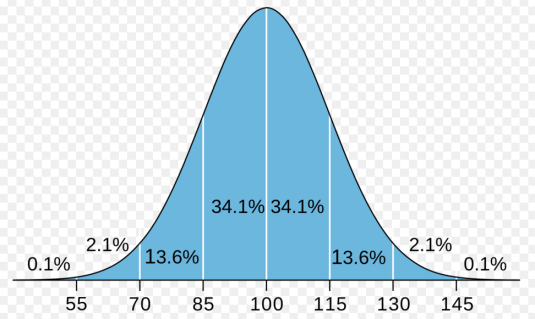
Charles Murray is frank about educational romanticism. Half the population is of below average IQ. That is before considering the necessary personality traits to be a successful student. Asking people without the necessary IQ and personality traits to waste their time with up skilling insults them.
Carrying that send them on a course educational romanticism over to the minimum wage and living wage debates is to use the low skilled as lab rats in the social experiments that are bound to fail as they failed in the past.
One of the purposes of applied price theory, the study of economic history and even labour econometrics is to spare us policy experiments we already know will not turn out well.
We do know what will happen if the minimum wage is raised to $15 per hour. Some people will lose their jobs. More importantly, there is a reduced incentive for the low paid to invest in skills to improve their earning power because the minimum wage is already delivered that assuming they still have a job. Human capital effects of minimum wage increases is under discussed.
As for investing in up skilling, active labour market programs that invest heavily in upskilling the unemployed have a dreadful record. This dreadful record is when there are subsidies direct to the unemployed going on prearranged courses focused on work skills. We’re not talking about indirect incentives such as raising the minimum wage and hoping for the best regarding their upskilling both on the job or while on the unemployment benefit.
Back to Noah Smith. He admits that increases in the minimum wage reduce employment. He tries to ride out on the conclusion that that increase in unemployment after a small minimum wage increase isn’t much.
Great quote on the cruelty of the minimum wage from Nobel economist Vernon Smith, illustrated by Henry Payne https://t.co/Lwch51acEY—
Mark J. Perry (@Mark_J_Perry) October 24, 2015
Obviously the teenagers and adults thrown onto the scrapheap of society by the increased minimum wage don’t count in the brutal utilitarian calculus employed by Noah Smith and other champions of the low paid.
Smith is now trying to fortify his argument by arguing that minimum wage activists have spotted an untapped innovation right under the noses of entrepreneurs who profit from exploiting gaps in the market faster than the rest. Bureaucrats and politicians notice these gaps in the market before those who gain from superior entrepreneur alertness to hitherto untapped opportunities for profit do so and instead leave that money on the table.
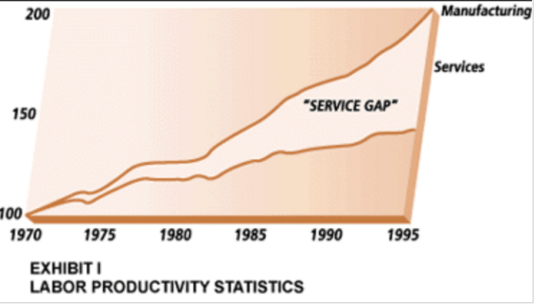
What is even richer in this induced innovation hypothesis of Noah Smith and others is many of these minimum wage workers are in the services sector. Services suffer from Baumol’s disease: the limited ability to innovate in labour-intensive areas.
The optimal timing of innovation spawned a vast literature. So has offsetting behaviour to regulation. The former innovation is welfare enhancing. The latter is mitigation of the dead weight social losses of regulation.
What and where to innovate is a process of market discovery. The life cycle of many industries starts with a burst of new entrants with similar products and production processes. These new or upgraded products and the different ways of making them often use ideas that cross-fertilise.
In time, there is an industry shakeout where a few leapfrog the rest with cost savings and design breakthroughs to yield the mature product (Boldrin and Levine 2008, 2013). Fast-seconds and practical minded latecomers often imitate and successfully commercialise ideas seeded by the market pioneers using prior ideas as their base.
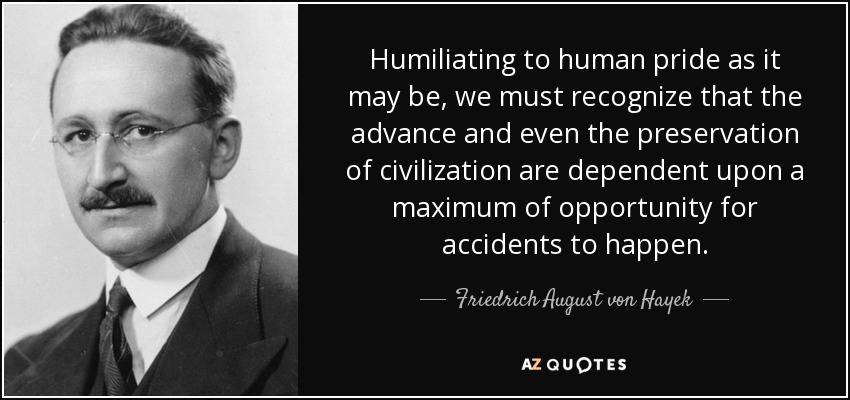
This entire dynamic market process of competitive selection, competition as a discovery procedure, trial and error and leapfrogging is distorted if one or more of the contending entrepreneurs as their hand forced by regulation on labour imports rather than because of competitive merits. The government cannot enable this process because neither the outcome nor even the direction of the competitive struggle for survival is known in advance. To quote Thomas Babington (1830):
The maxim, that governments ought to train the people in the way in which they should go, sounds well. But is there any reason for believing that a government is more likely to lead the people in the right way than the people to fall into the right way of themselves?
The firms that survive and grow in competition with rival ways of doing business are the more efficient simply because they survived. What will survive in market competition will not be known in advance to politicians and activists when they decide to make one specific input more expensive. The results of the competitive market process that weeds out the less efficient firm are known at the end of this long race, not at the start.
Knowing that innovation is induced by changing relative prices and wages doesn’t help wise bureaucrats and farsighted politician know which one of those relative prices or wages will be decisive in determining the direction of innovation. As Alfred Marshall explains in The Social Possibilities of Economic Chivalry (1907):
A Government could print a good edition of Shakespeare’s works, but it could not get them written… I am only urging that every new extension of Governmental work in branches of production which need ceaseless creation and initiative is to be regarded as prima facie anti-social, because it retards the growth of that knowledge and those ideas which are incomparably the most important form of collective wealth.
What is not explored adequately in this debate by either Noah Smith or the New Zealand Living Wage Movement is why limit the efficiency wage and induced innovation hypotheses to low skilled workers.
Why not increase the wages of all workers by 20-30%? There will not be a large disemployment effect and the induced innovation will mitigate the costs, if Noah Smith and his efficiency wage and induced innovation hypotheses are to be believed.
30% would be a good number for increasing all New Zealand wages was that is about the wage gap with Australia. Let’s go for broke. What’s the risk other than massive unemployment and economic chaos?
Does a higher minimum wage really reduce employment? econ.st/1gp4Jbs http://t.co/WGMZGLKHmI—
The Economist (@EconBizFin) July 30, 2015
The living wage sought in New Zealand and the fight for $15 campaign in the USA presuppose massive offsetting labour productivity gains. A doubling in labour productivity overnight in low-paid service and other jobs or at least within a few years because of higher work morale.
The labour productivity increase required to offset even some of the costs of the double-digit living wage increases proposed at home and abroad are large, very large:
Looking first at the 2016 position, the proposed wage floor increase would require productivity growth of around 11% between 2015 and 2016. By 2020, the cumulative productivity gains from 2015 would need to rise above 37%, implying an average annual increase of 6.6%… the pace of productivity growth implied by our thought exercise is unprecedented: the annual average increase during the economic growth years of 1991-2008 was 2.2%. That points to two conclusions. First, firms are likely to need support in meeting the productivity challenge. And second, any productivity plan should look beyond the obvious forms of high-tech wizardry in high value-added sectors to encompass new forms of organisational approaches and business models in our most labour-absorbing industries.
What is missing in most discussions of the efficiency wage hypothesis and the latest discussion of induced innovation and wage increases is, as the Washington Centre for Equitable Growth notes is the upper limit on the wage increase that carries only minimal disemployment risks:
Many activists and policymakers across the country are vigorously pushing for an increase in the minimum wage at the federal, state, and local levels. Of course, while many people agree that the minimum wage needs to be higher, that still leaves the question of how high it should be… The trouble, however, is taking that research and applying it to potential minimum wage increases that would be outside the range of previous hikes. For example, raising the current federal minimum wage from $7.25 to $15—more than doubling it—would be significantly larger than prior increases.
That upper bound discussion is a small hole in their arguments compared to their failure to advocate massive efficiency wage increases and massive induced innovation wage increases across the entire economy. Why is the efficiency wage and induced innovation hypotheses only extended to the low paid? Why not hire wages for everyone?

One of the reasons for the high labour productivity in Western Europe is their minimum wages, employment protection laws and high taxes made it unprofitable to employee low skilled service workers.
European consumers innovated in the face of these high costs of taxes and regulation by doing for themselves what Americans buy on the market be it anything from takeaways to home help. That is well known as Richard Rogerson explains:
The empirical work establishes two results. First, hours worked in Europe decline by almost 45 percent compared to the United States over this period [from 1956 to 2003]. Second, this decline is almost entirely accounted for by the fact that Europe develops a much smaller market service sector than the United States… relative increases in taxes and technological catch-up can account for most of the differences between the European and American time allocations over this period.
The phenomena that developed in Europe as the result of the additional costs of taxes and labour market regulation is known as Eurosclerosis, not a productivity breakout through efficiency wages and induced innovation.
24 Nov 2015 Leave a comment
in constitutional political economy, energy economics, environmental economics, environmentalism, politics - New Zealand
Greenpeace thugs today climbed aboard a Government science ship that will search for oil. Three Greenpeace activists have locked themselves to the mast with others secured to various areas on deck. They unfurled a banner reading: “Climb it Change” and intend to stay as long as possible.
https://twitter.com/gen_tweets1/status/668891794726256640
Greenpeace are keen to pass laws to save the environment but they’re more than happy to break laws they disagree with. I wonder if they extend that same courtesy to others they regard as less enlightened than them?
Greenpeace expects others to obey the laws for which Greenpeace lobbied. Why does Greenpeace think they can break laws that others secured through lawful, peaceful democratic action? Is some peaceful democratic action more equal than others? Why does Greenpeace think their vote counts more than mine?
The Greenpeace vandals who trespassed at Parliament a few months ago by climbing up to put signs down showed a flagrant disregard of the ample possible options for peaceful protest right outside. In their favour, they showed some sort of fidelity to law by later pleading guilty in court. That showed an acknowledgement that what they did was a criminal offence.
John Rawls makes the point that the purpose of civil disobedience is not to impose your will upon others but through your protest to implore them to reconsider their position and change the law or policy you are disputing.
Rawls argues that civil disobedience is never covert or secretive; it is only ever committed in public, openly, and with fair notice to legal authorities. Openness and publicity, even at the cost of having one’s protest frustrated, offers ways for the protesters to show their willingness to deal fairly with authorities. Rawls argues:
Rawls argues, and too many forget, that civil disobedience and dissent more generally contribute to the democratic exchange of ideas by forcing the dominant opinion to defend their views.
https://twitter.com/nzheraldvideo/status/668968510060564480
Legitimate non-violent direct action are publicity stunts to gain attention and provoke debate within the democratic framework, where we resolve our differences by trying to persuade each other and elections.
The civil disobedient is attempting to appeal to the “sense of justice” of the majority and a willingness to accept arrest is proof of the integrity of the act says Rawls:
…any interference with the civil liberties of others tends to obscure the civilly disobedient quality of one’s act.
Rawls argues that the use or threat of violence is incompatible with a reasoned appeal to fellow citizens to move them to change a law. The actions are not a means of coercing or frightening others into conforming to one’s wishes. That is a breach of the principles of a just society.
Too many acts of non-violent direct action aim to impose their will on others rather than peaceful protests designed to bring about democratic change in the laws or policies. That ‘might does not make right’ is fundamental to democracy and the rule of law. As United States Supreme Court Justice Antonin Scalia said
The virtue of a democratic system [with a constitutionally guaranteed right to free speech] is that it readily enables the people, over time, to be persuaded that what they took for granted is not so and to change their laws accordingly.
John Rawls’ view that fidelity to law and democratic change through trying to persuade each other is at the heart of civil disobedience reflects the difference between the liberal and the left-wing on democracy and social change as Jonathan Chait observed:
Liberals treat political rights as sacrosanct. The left treats social and economic justice as sacrosanct. The liberal vision of political rights requires being neutral about substance. To the left, this neutrality is a mere guise for maintaining existing privilege; debates about “rights” can only be resolved by defining which side represents the privileged class and which side represents the oppressed… Liberals believe that social justice can be advanced without giving up democratic rights and norms. The ends of social justice do not justify any and all means.
If you want to reform the world, do what we ordinary people have to do: change your vote, write to an MP, protest, donate to or even join a political party, or run for parliament.
https://twitter.com/siana_tweets/status/668927311928954880
The great strength of democracy is a small group of concerned and thoughtful citizens can band together and change things by mounting single issue campaigns or joining a political party and running for office and winning elections or influencing who wins.
Yesterday’s majority of the vote sooner or later and often sooner than they expect will break off into different minorities on the next big issue of the day. These newly formed minorities will use that same ability to band together as a minority to block vote to protect what they think is important and advance agendas they think are to be wider benefit despite the opinion of the current majority to the contrary. All reforms start as a minority viewpoint.
Indeed, it is a strength of democracy – small groups of concerned citizens banding together – is what is holding up legislating in many areas. It is not that minorities are powerless and individuals are voiceless. It is exactly the opposite.
Nothing stirs up the impassioned (and most other people as well) more than depriving them of their right to support or oppose what is important to them through political campaigns and at an election. The losing side, we all end up on the losing side at one time or another, are much more likely to accept an outcome if they had their say and simply lost the vote at the election or in Parliament.
Greenpeace should show fidelity to democracy by obeying the laws supported by others when they were in the majority. Yes, Greenpeace is in despair over oil exploration. Others rejoice in it but that clash of strong opinions is the nature of any important controversy.
Greenpeace wants to do is rob the winners of their honest democratic victory over the balance between oil exploration and other energy options. Greenpeace are also robbing themselves of a fair defeat.
A fair defeat flows from laws and policies secured through normal democratic means knowing that one day you may be in a majority. Only by respecting the will of the majority when you are in the minority do you have any right to expect future minorities to respect your honest democratic victories as the majority of some future day. Democratic majorities of patched together through give-and-take and the reality that even the most important policies may be reversed in the future.
Right now, the thuggery of Greenpeace is poisoning the democratic process. Greenpeace should respect the political process because democracy alone can produce compromises satisfying a sufficient mass of the electorate on deeply felt issues so as to not distort the remainder of the democratic process. Greenpeace owes New Zealand democracy better than what it is doing today
23 Nov 2015 Leave a comment
in applied price theory, economics of regulation, politics - New Zealand, urban economics
The Māori Party face the least political risks from deregulating land supply because so few Māori own their own homes. Less than half the rate of European New Zealanders. Māori home ownership rates peaked in 1991.
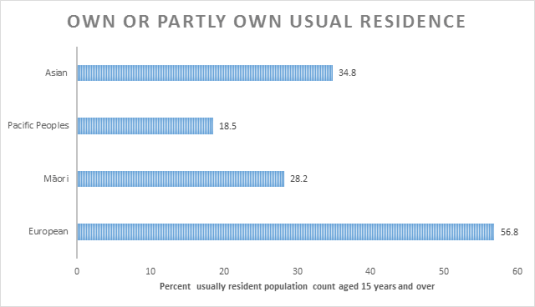
Source: 2013 Census QuickStats about housing.
Nonetheless, the Māori Party supplied the last two votes to vote down attempts to relax regulatory restrictions on the supply of land in New Zealand.
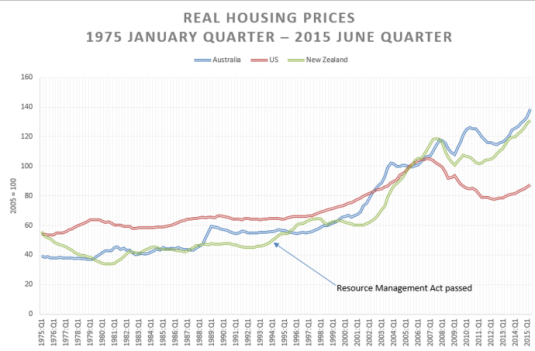
Source and notes: International House Price Database – Dallas Fed June 2015; nominal housing prices for each country is deflated by the personal consumption deflator for that country.
Their rationale for making land more expensive is a commitment to environmental principles. As the Māori Party coleader explained at the time:
We know there is considerable pressure and need for this Government to address the housing shortage, particularly in Auckland. However, one intent of the RMA, is to protect our environment for generations to come and this must remain paramount.
The 2014 policy manifesto of the party did not discuss housing supply or the need for reform of the RMA. It was mainly about social housing and the quality of rental house.
The chances of Māori increasing their homeownership rates rather than becoming leading members of Generation Rent requires a relaxation in restrictions in the RMA on the supply of land.
Auckland is up with London and New York in terms of housing unaffordability relative to median incomes. US cities with responsive land regulation don’t experience housing bubbles.
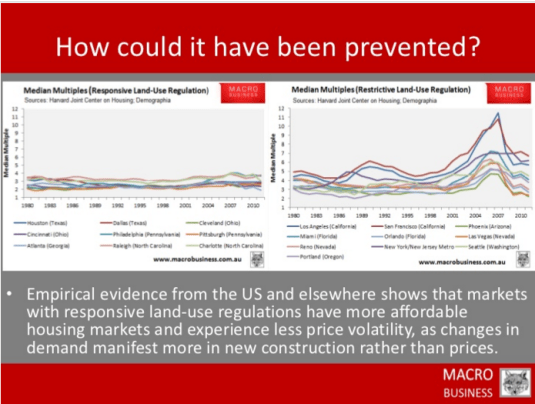
Glaeser and Gyourko summarised the findings of a number of studies on land supply and housing prices:
Recent research also indicates that house prices are more volatile, not just higher, in tightly regulated markets …. price bubbles are more likely to form in tightly regulated places, because the inelastic supply conditions that are created in part from strict local land-use regulation are an important factor in supporting ever larger price increases whenever demand is increasing. …. It is more difficult for house prices to become too disconnected from their fundamental production costs in lightly regulated markets because significant new supply quickly dampens prices, thereby busting any illusions market participants might have about the potential for ever larger price increases.
There has been a steady decline in housing affordability in New Zealand. The position is critical of the bottom 20% of the income ladder. Four in 10 now spend more than 30% of their disposable income on housing costs. Māori will be over-represented in this group but the party set-up to speak for them fails to do everything it can to make their housing cheaper.
23 Nov 2015 Leave a comment
in environmental economics, global warming, politics - New Zealand, Thomas Schelling
It is a stretch to say that New Zealand Greens have accepted that adaptation is the only proper response to the threat of global warming.
Nonetheless, their call for a plan for adaptation is an acceptance that more must be done than hoping for the best that a massively expensive international public good will be provided through a climate change treaty.

It is time for the environmental movement to face up to the fact that there never will be an international treaty to restrain carbon emissions.
The practical way to respond to global warming is healthier is wealthier, richer is safer. Faster economic growth creates more resources for resilience and adaptation to a changing environment.
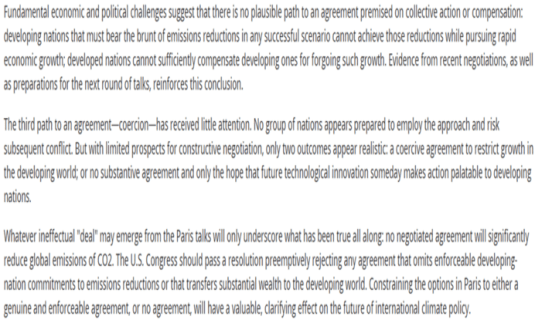
Tom Schelling has been involved with the global warming debate since chairing a commission on the subject for President Carter in 1980.
Schelling is an economist who specialises in strategy so he focuses on climate change as a bargaining problem. Schelling drew in his experiences with the negotiation of the Marshall Plan and NATO.

International agreements rarely work if they talk in terms of results. They work better if signatories promise to supply specific inputs – to perform specific actions now. Individual NATO members did not promise to slow the Soviet invasion by 90 minutes if it happened after 1962. NATO members promised to raise and train troops, procure equipment and supplies, and deploy these assets geographically. All of these actions can be observed, estimated and compared quickly.
The Kyoto Protocol commitments were made not about actions but to results that were to be measured after more than a decade and several elections.
Climate treaties should promise to do certain actions now such as invest in R&D and develop carbon taxes that return the revenue as tax cuts. If the carbon tax revenue is fully refunded as tax cuts, less reliable countries, in particular, have an additional incentive to collect the carbon tax properly to keep their budget deficits under control.
As for the chances of a global treaty, Schelling has said:
The Chinese, Indonesians, or Bangladeshis are not going to divert resources from their own development to reduce the greenhouse effect, which is caused by the presence of carbon-based gases in the earth’s atmosphere. This is a prediction, but it is also sound advice. Their best defence against climate change and vulnerability to weather in general is their own development, reducing their reliance on agriculture and other such outdoor livelihoods. Furthermore, they have immediate environmental problems — air and water pollution, poor sanitation, disease — that demand earlier attention.
The costs of global warming to New Zealand are small. For developing countries, their best protection against global warming is rapid economic development through capitalism and freedom.
The latest report from the Intergovernmental Panel on Climate Change’s (IPCC) Working Group II has concluded that global warming of 2.5˚C would cost the equivalent to losing between 0.2-2.0% of annual income.

23 Nov 2015 2 Comments
in politics - New Zealand, transport economics, urban economics
Bugger all people commute by bus or train outside of Wellington. Even in Wellington taking the bus or the train has trouble staying well ahead of walking to work.
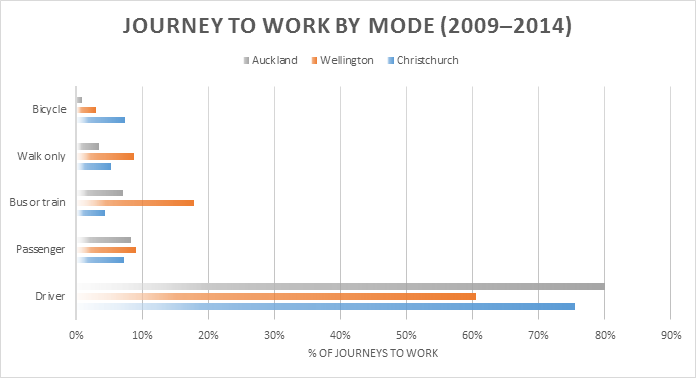
Source: Ministry of Transport. (2015). 25 years of New Zealand travel: New Zealand household travel 1989–2014. Wellington: Ministry of Transport.
23 Nov 2015 Leave a comment
in energy economics, environmental economics, politics - New Zealand
21 Nov 2015 1 Comment
in applied price theory, applied welfare economics, entrepreneurship, industrial organisation, labour economics, minimum wage, politics - New Zealand, poverty and inequality, survivor principle Tags: British economy, living wage
A brilliant point by @FlipChartRick in the reblog. What sort of single year labour productivity increase is required to cover a UK living wage increase. Basic arithmetic kills.
A 6.6% annual productivity growth would be required to fund a living wage. This will be far above trend and would be required in sectors such as services that are not at all known for rapid productivity growth because of Baumol’s disease.
A subsequent Twitter exchange updated a key chart to include Australia and New Zealand.
The CIPD and the Resolution Foundation are collaborating on a piece of research into the impact of the National Living Wage (NLW). According to their first study over half of the country’s employers expect to be affected by it. Around a third said they would meet the increased cost by improving productivity and 22 percent said they would take lower profits. Only 15 percent said they would lay off workers or slow down recruitment.
That all sounds promising but, as Matt Whittaker points out, the productivity increase needed to cover the cost of the NLW could be pretty steep. As you might expect, there is a strong relationship between rising minimum wages and rising productivity. Most countries in the OECD have not strayed very far from this line of best fit.
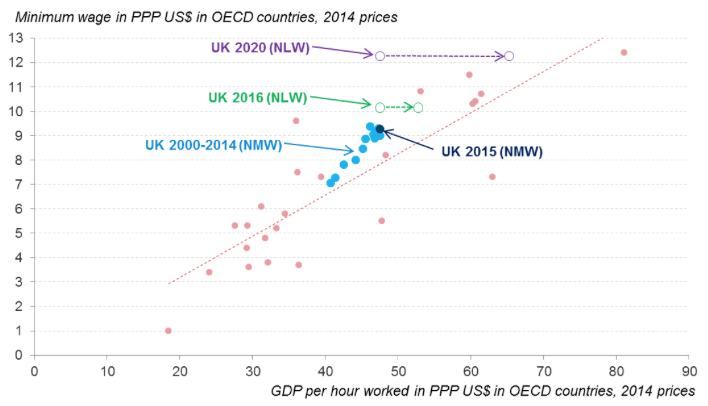 In the absence of any productivity growth, the proposed NLW would move some way from the line (the green circle) by 2016 and…
View original post 565 more words
20 Nov 2015 1 Comment
in politics - Australia, politics - New Zealand, politics - USA, Public Choice, public economics Tags: Denmark, Finland, growth of government, Norway, Scandinavia, size of government, Sweden, taxation and entrepreneurship, taxation and investment, taxation and labour supply, welfare state
Celebrating humanity's flourishing through the spread of capitalism and the rule of law
Celebrating humanity's flourishing through the spread of capitalism and the rule of law
Celebrating humanity's flourishing through the spread of capitalism and the rule of law
Celebrating humanity's flourishing through the spread of capitalism and the rule of law
Celebrating humanity's flourishing through the spread of capitalism and the rule of law
A History of the Alt-Right
Econ Prof at George Mason University, Economic Historian, Québécois
Celebrating humanity's flourishing through the spread of capitalism and the rule of law
Scholarly commentary on law, economics, and more
Beatrice Cherrier's blog
Celebrating humanity's flourishing through the spread of capitalism and the rule of law
Celebrating humanity's flourishing through the spread of capitalism and the rule of law
Celebrating humanity's flourishing through the spread of capitalism and the rule of law
Why Evolution is True is a blog written by Jerry Coyne, centered on evolution and biology but also dealing with diverse topics like politics, culture, and cats.
Celebrating humanity's flourishing through the spread of capitalism and the rule of law
A rural perspective with a blue tint by Ele Ludemann
DPF's Kiwiblog - Fomenting Happy Mischief since 2003
Celebrating humanity's flourishing through the spread of capitalism and the rule of law
The world's most viewed site on global warming and climate change
Tim Harding's writings on rationality, informal logic and skepticism
A window into Doc Freiberger's library
Let's examine hard decisions!
Commentary on monetary policy in the spirit of R. G. Hawtrey
Thoughts on public policy and the media
Celebrating humanity's flourishing through the spread of capitalism and the rule of law
Politics and the economy
A blog (primarily) on Canadian and Commonwealth political history and institutions
Reading between the lines, and underneath the hype.
Economics, and such stuff as dreams are made on
"The British constitution has always been puzzling, and always will be." --Queen Elizabeth II
Celebrating humanity's flourishing through the spread of capitalism and the rule of law
Celebrating humanity's flourishing through the spread of capitalism and the rule of law
WORLD WAR II, MUSIC, HISTORY, HOLOCAUST
Undisciplined scholar, recovering academic
Celebrating humanity's flourishing through the spread of capitalism and the rule of law
Res ipsa loquitur - The thing itself speaks
In Hume’s spirit, I will attempt to serve as an ambassador from my world of economics, and help in “finding topics of conversation fit for the entertainment of rational creatures.”
Researching the House of Commons, 1832-1868
Articles and research from the History of Parliament Trust
Reflections on books and art
Posts on the History of Law, Crime, and Justice
Celebrating humanity's flourishing through the spread of capitalism and the rule of law
Exploring the Monarchs of Europe
Cutting edge science you can dice with
Small Steps Toward A Much Better World
“We do not believe any group of men adequate enough or wise enough to operate without scrutiny or without criticism. We know that the only way to avoid error is to detect it, that the only way to detect it is to be free to inquire. We know that in secrecy error undetected will flourish and subvert”. - J Robert Oppenheimer.


Recent Comments