

HT: Television Arrives in New Zealand – Whale Oil Beef Hooked | Whaleoil Media.
Celebrating humanity's flourishing through the spread of capitalism and the rule of law
01 Jun 2015 1 Comment
in economics of media and culture, entrepreneurship, politics - New Zealand, technological progress Tags: creative destruction, good old days
01 Jun 2015 Leave a comment
Six ways in which Qatar doesn't make a lot of sense as a World Cup host 53eig.ht/1BpVlrH #FIFA http://t.co/0N87zTO07x—
(@FiveThirtyEight) May 30, 2015
31 May 2015 1 Comment
in economic growth, economic history, macroeconomics, politics - Australia, politics - New Zealand Tags: Australia, Canada, economic geography, endogenous growth theory, lost decades
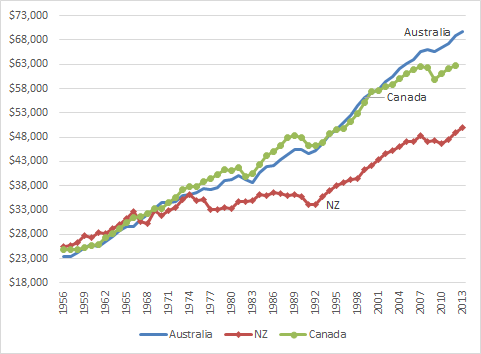
Figure 1 shows that Canada has been diverging from Australia in real GDP per working age person since the mid-1990s particularly since the global financial crisis.
Figure 1: Real GDP per New Zealander, Canadian and Australian aged 15-64, converted to 2013 price level with updated 2005 EKS purchasing power parities, 1956-2013
Source: Computed from OECD StatExtract and The Conference Board, Total Database, January 2014, http://www.conference-board.org/economics
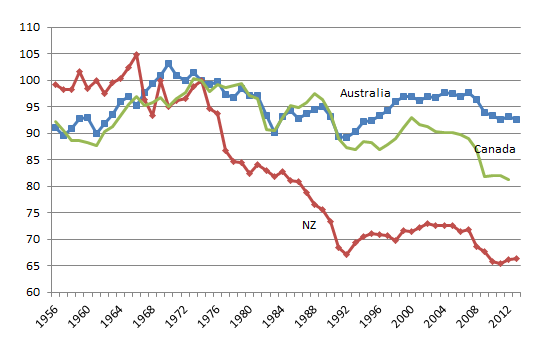
In common with New Zealand, Figure 2 shows that Canadian productivity has been in a pretty much along declines is about 1974, rarely catching up with any lost ground. Figure 1 shows that Canada used to be richer than Australia but is now poorer than Australia. Figure 2 is real GDP growth data detrended by the growth rate of the USA in the 20th century. A flat line in figure 2 is annual real GDP growth at 1.9%; a rising line is growth above 1.9%; a falling line is annual growth below 1.9% a year.
Figure 2: Real GDP per New Zealander, Canadian and Australian aged 15-64, converted to 2013 price level with updated 2005 EKS purchasing power parities, 1.9 per cent detrended, 1956-2013
Source: Computed from OECD StatExtract and The Conference Board, Total Database, January 2014, http://www.conference-board.org/economics
Figure 2 shows that Canadian productivity has been below trend for perhaps 30 years. There has been the occasional recovery but followed by a further decline. If Canadian labour productivity had grown at the same rate as the USA since 1974, labour productivity in Canada is something like 18% better.
Australia, as shown in figure 2, has neither caught up nor falling behind the USA in labour productivity for the entire post-war period since 1956. Canada has been falling behind its neighbour most markedly since the mid-1970s.
The proximate causes of the Canadian productivity gap with the USA have a familiar echo to New Zealand ears. Relative to the USA, Rao et al. (2006) and Sharp (2003) attributed the gap to less capital per worker, an innovation gap as shown by lower R&D expenditure, a smaller and less dynamic high technology sector, less developed human capital at the top end of the labour market, and more limited scale and scope economies.
These factors have been put forward, at one time or another, as the proximate causes of the New Zealand productivity gap with the USA. Identifying the barriers to higher Canadian productivity may offer fresh insights into removing similar productivity barriers in New Zealand.
Canada, New Zealand and Australia should be catching-up with the USA in productivity per capita because copying the global leader is cheaper than innovation. Canada, New Zealand and Australia all have the basics to do this: a market economy, the rule of law and openness to foreign technology and international trade.
Instead of asking why New Zealand is not catching-up with Australian productivity, further study of the lack of productivity catch-up of Australia and Canada with the USA may uncover subtle barriers to productivity growth with similarities in New Zealand.
The productivity decline in Canada is of interest in New Zealand because Canada certainly cannot blame remoteness because it borders the USA. Canada cannot blame lack of size because it is noticeably larger than Australia and certainly New Zealand.
30 May 2015 Leave a comment
People in Britain who bothered to vote: on the whole, as @NickCohen4 points out, fairly Right-wing http://t.co/BFYRBVnray—
Michael Deacon (@MichaelPDeacon) May 30, 2015
30 May 2015 Leave a comment
in politics - New Zealand, Public Choice Tags: expressive voting, James Shaw, New Zealand Greens, New Zealand Labour Party, rational ignorance, rational irrationality, swinging voter, tactical voting, vote parking
The New Zealand Greens have elected a new male co-leader. James Shaw is a first term MP who is supposed to consolidate and build the green vote from 10%. At the last election, the Greens were targeting a 15% party vote. Their vote fell from 11.1% to 10.7%.
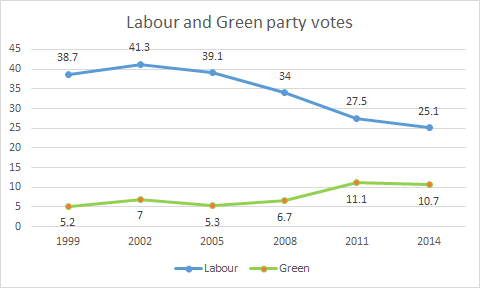
I doubt that he can do it because much of the improvement of the Green vote since the 2005 election has been an expense of the Labour Party.
The Green vote was pretty sickly at 5-7% when the Labour Party was popular in government between 1999 and 2005. In the 2005 election, the Greens failed to reach the 5% party vote threshold necessary to win seats in Parliament on election night. It was only saved by absentee and postal votes that pushed its party vote up to 5.3%.
Maybe 30% of the Green vote, perhaps more, is made up of disgruntled Labour Party voters awaiting the call home. These disgruntled Labour voters will vote for the Labour Party again when it is fit for government.
Once there is a Labour–Green government in New Zealand, the Green vote faces the recurring theme that green parties lose a substantial part of their vote whenever they get into government such as happened federally in Australia and in Tasmania.
If the Greens go into government with about 7% of the party vote in the 2017 or 2020 New Zealand general elections, the Greens face the real prospect of of being voted out of Parliament completely in the 2023 New Zealand general election if their vote drops below 5%.
James Shaw happened to run for the Wellington Central electorate in the 2014 general election. He did not ask for the electorate vote in that election. Only the party vote.
Wellington Central has one of the highest green party votes in New Zealand. The Green party vote is 2000 more than Labour’s party vote in Wellington Central although the National Party won the party vote with 14,000 party votes.

Given the fact that the Greens may dropped below 5% by 2020, James Shaw would be wise to try to win Wellington Central in 2017 as a safety margin. If a party wins electorate seat under MMP, their party vote counts towards winning list MPs even if they win less than 5% of the party vote.
To add a twist to the tail, the deputy leader of the Labour Party, Grant Robertson, is the sitting member for Wellington Central with a margin of 8000 votes. If the current leader of the opposition fails at his job, Grant Robertson is his natural replacement.
There’s not much room at the top of the Labour Party list for defeated electoral seat candidates because of the last election Labour’s party vote was so low that it was only eligible for five list MPs. The last of these was the current leader of the opposition prove wasn’t even elected on election night but got back into Parliament on postal and absentee votes.
To complicate Grant Robinson’s golden parachute even further, the Labour Party has a policy that 50% of its caucus should be female by 2017 and the party list should be drawn up with that gender quota in mind. Grant Robertson may be a victim of this policy if he does not win Wellington Central.
More than a few careers hinge on the election of James Shaw as male co-leader of the Greens including the very survival of his party. It would be a tight race, but James Shaw could win Wellington Central.
.
30 May 2015 2 Comments
in economic history, politics - Australia, politics - New Zealand, politics - USA, public economics Tags: Australia, Canada, growth of government
The tax take is noticeably higher in Canada and New Zealand and has been for a long time.
Figure 1: US, Canadian, Australian and New Zealand tax revenues as a percentage of GDP, 1965–2013

Source: OECD StatExtract.
30 May 2015 Leave a comment
in applied price theory, applied welfare economics, comparative institutional analysis, development economics, economic history, entrepreneurship, growth disasters, growth miracles, income redistribution, politics - Australia, politics - New Zealand, politics - USA, Public Choice, public economics, rentseeking Tags: entrepreneurial alertness, Leftover Left, taxes and the labour supply, The inequality and growth, Thomas Piketty, top 1%, Twitter left
Tim Taylor, the editor of the Journal of Economic Perspectives, has written a superb blog post on why we should be sceptical about a strong relationship between inequality and economic growth. Taylor was writing in response to the OECD’s recent report "In It Together: Why Less Inequality Benefits All,".
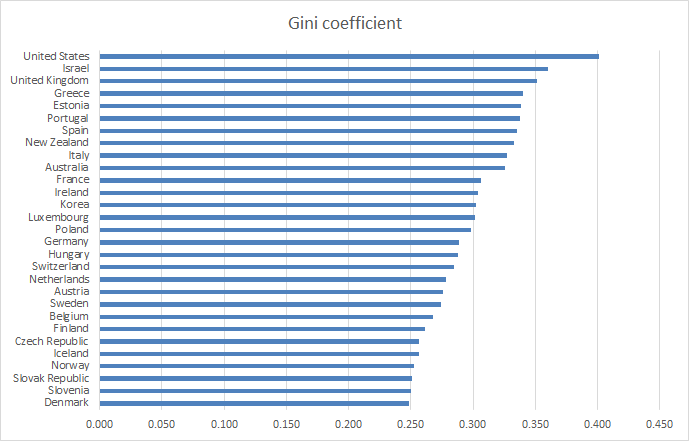
Taylor’s basic point is economists have enough trouble working out what causes economic growth so trawling within that subset of causes to quantify the effects of rising or falling inequality inequality seems to be torturing the data to confess. The empirical literature is simply inconclusive as Taylor says:
A variety of studies have undertaken to prove a connection from inequality to slower growth, but a full reading of the available evidence is that the evidence on this connection is inconclusive.
Most discussions of the link between inequality and growth are notoriously poor of theories connecting two. There are three credible theories in all listed in the OECD’s report:
The report first points out (pp. 60-61 that as a matter of theory, one can think up arguments why greater inequality might be associated with less growth, or might be associated with more growth. For example, inequality could result less growth if:
1) People become upset about rising inequality and react by demanding regulations and redistributions that slow down the ability of an economy to produce growth;
2) A high degree of persistent inequality will limit the ability and incentives of those in the lower part of the income distribution to obtain more education and job experience; or
3) It may be that development and widespread adoption of new technologies requires demand from a broad middle class, and greater inequality could limit the extent of the middle class.
About the best theoretical link between inequality and economic growth is what Taylor calls the "frustrated people killing the goose that lays the golden eggs." Excessive inequality within a society results in predatory government reactions at the behest of left-wing or right-wing populists.

Taylor refers to killing the goose that laid the golden egg as dysfunctional societal and government responses to inequality. He is right but that is not how responses to inequality based on higher taxes and more regulation are sold. Thomas Piketty is quite open about he wants a top tax rate of 83% and a global wealth tax to put an end to high incomes:
When a government taxes a certain level of income or inheritance at a rate of 70 or 80 percent, the primary goal is obviously not to raise additional revenue (because these very high brackets never yield much).
It is rather to put an end to such incomes and large estates, which lawmakers have for one reason or another come to regard as socially unacceptable and economically unproductive…
The left-wing parties don’t say let’s put up taxes and redistribute so that is not something worse and more destructive down the road. Their argument is redistribution will increase growth or at least not harm it. That assumes the Left is addressing this issue of not killing the goose that lays the golden egg at all.

Once you discuss the relationship between inequality and growth in any sensible way you must remember your John Rawls. Incentives encourage people to work, save and invest and channels them into the occupations where they make the most of their talents. Taylor explains:
In the other side, inequality could in theory be associated with faster economic growth if: 1) Higher inequality provides greater incentives for people to get educated, work harder, and take risks, which could lead to innovations that boost growth; 2) Those with high incomes tend to save more, and so an unequal distribution of income will tend to have more high savers, which in turn spurs capital accumulation in the economy.
Taylor also points out that the OECD’s report is seriously incomplete by any standards because it fails to mention that inequality initially increases in any poor country undergoing economic development:
The report doesn’t mention a third hypothesis that seems relevant in a number of developing economies, which is that fast growth may first emerge in certain regions or industries, leading to greater inequality for a time, before the gains from that growth diffuse more widely across the economy.
At a point in its report, the OECD owns up to the inconclusive connection between economic growth and rising inequality as Taylor notes:
The large empirical literature attempting to summarize the direction in which inequality affects growth is summarised in the literature review in Cingano (2014, Annex II).
That survey highlights that there is no consensus on the sign and strength of the relationship; furthermore, few works seek to identify which of the possible theoretical effects is at work. This is partly tradeable to the multiple empirical challenges facing this literature.
The OECD’s report responds to this inclusiveness by setting out an inventory of tools with which you can torture the data to confess to what you want as Taylor notes:
There’s an old saying that "absence of evidence is not evidence of absence," in other words, the fact that the existing evidence doesn’t firmly show a connection from greater inequality to slower growth is not proof that such a connection doesn’t exist.
But anyone who has looked at economic studies on the determinants of economic growth knows that the problem of finding out what influences growth is very difficult, and the solutions aren’t always obvious.
The chosen theory of the OECD about the connection between inequality and economic growth is inequality leads to less investment in human capital at the bottom part of the income distribution.
[Inequality] tends to drag down GDP growth, due to the rising distance of the lower 40% from the rest of society. Lower income people have been prevented from realising their human capital potential, which is bad for the economy as a whole
I found this choice of explanation curious. So did Taylor as the problem already seems to have been solved:
There are a few common patterns in economic growth. All high-income countries have near-universal K-12 public education to build up human capital, along with encouragement of higher education. All high-income countries have economies where most jobs are interrelated with private and public capital investment, thus leading to higher productivity and wages.
All high-income economies are relatively open to foreign trade. In addition, high-growth economies are societies that are willing to allow and even encourage a reasonable amount of disruption to existing patterns of jobs, consumption, and ownership. After all, economic growth means change.
In New Zealand, interest free student loans are available to invest in higher education as well as living allowances for those with parents on a low income. There are countries in Europe with low levels of investment in higher education but that’s because of high income taxes not because of inequality.
The OECD’s report is fundamentally flawed which is disappointing because most research from the OECD is to a good standard.
via CONVERSABLE ECONOMIST: Does Inequality Reduce Economic Growth: A Skeptical View.
29 May 2015 Leave a comment
in comparative institutional analysis, constitutional political economy, politics - New Zealand, Public Choice Tags: citizen initiated referendums, Colin Craig, Conservative Party, Edmund Burke, expressive voting, Joseph Schumpeter, parliamentary sovereignty, rational ignorance, rational irrationality
The Conservative Party of New Zealand in the 2014 general election was very much formed around the notion of introducing citizen initiated binding referendums in a country with the Parliament is sovereign. The first referendum is likely to be on one of the following:
· decriminalising marijuana,
· banning smoking,
· voluntary euthanasia,
· a living wage,
· life means life in prison,
· same-sex marriages,
· marriage is between a man and a woman,
· entrenching the Treaty of Waitangi,
· abolishing the Maori seats,
· entrenching the Maori seats,
· stop school closures, and
· capital punishment; and
· future referendums not be binding
Binding referenda are unworkable. Parliament can’t amend them later as we learn from the implementation of the law and unintended consequences arise. Every new law is riddled with unintended consequences and blow-backs.
Do you really want to have to have another referendum to undo a binding referendum that turned out to be a bit of a mistake? One of the few redeeming features of the Parliament that is sovereign – a parliament for can make or unmake any law whatsoever – is it can repeal its mistakes quickly.
The first citizens initiated referendum was held on 2 December 1995. The question was
Should the number of professional fire-fighters employed full-time in the New Zealand Fire Service be reduced below the number employed in 1 January 1995?
Turnout was low as the referendum was not held in conjunction with a general election, and the measure was voted down easily, with just over 12% voting “Yes” and almost 88% voting “No”.
The key to constitutional design is not empowering you and yours – it is how to restrain those crazies to the Left or the Right of you, as the case may be, when they get their hands on the levers of power, as they surely will in three, six or nine years’ time.
The one inevitability of democracy is power rotates – unbridled power and binding referenda lose their shine when you must share that power with the opposing side of politics who put up their own referendum question.
Constitutions are brakes, not accelerators. Much of constitutional design is about checks and balances and the division of power to slow the impassioned majority down.
Constitutional constraints are basically messages from the past to the present that you must think really hard, and go through extra hurdles before you do certain things.
The 18th and 19th century classical liberals were highly sceptical about the capability and willingness of politics and politicians to further the interests of the ordinary citizen, and were of the view that the political direction of resource allocation retards rather than facilitates economic progress.
Governments were considered to be institutions to be protected from but made necessary by the elementary fact that all persons are not angels. Constitutions were to constrain collective authority.
The problem of constitutional design was ensuring that government powers would be effectively limited. The constitutions were designed and put in place by the classical liberals to check or constrain the power of the state over individuals.
The motivating force of the classical liberals was never one of making government work better or even of insuring that all interests were more fully represented. Built in conflict and institutional tensions were to act as constraints on the power and the size of government.
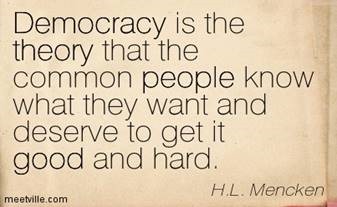
Representative democracy is a division of labour in the face of information overload. John Stuart Mill had sympathy for parliaments as best suited to be places of public debate on the various opinions held by the population and as a watchdog of the professionals who create and administer laws and policy:
Their part is to indicate wants, to be an organ for popular demands, and a place of adverse discussion for all opinions relating to public matters, both great and small; and, along with this, to check by criticism, and eventually by withdrawing their support, those high public officers who really conduct the public business, or who appoint those by whom it is conducted.
Representative democracy has the advantage of allowing the community to rely in its decision-making on the contributions of individuals with special qualifications of intelligence or character. Representative democracy makes a more effective use of resources within the citizenry to advance the common good.
Members of parliament are trustees who follow their own understanding of the best action to pursue in another view. As Edmund Burke wrote:
Parliament is not a congress of ambassadors from different and hostile interests; which interests each must maintain, as an agent and advocate, against other agents and advocates; but parliament is a deliberative assembly of one nation, with one interest, that of the whole; where, not local purposes, not local prejudices ought to guide, but the general good, resulting from the general reason of the whole.
You choose a member indeed; but when you have chosen him, he is not a member of Bristol, but he is a member of parliament. … Our representative owes you, not his industry only, but his judgment; and he betrays instead of serving you if he sacrifices it to your opinion.
Modern democracy is government subject to electoral checks. Citizens do have sufficient knowledge and sophistication to vote out leaders who are performing poorly or contrary to their wishes. Modern democracy is the power to replace governments at periodic elections.
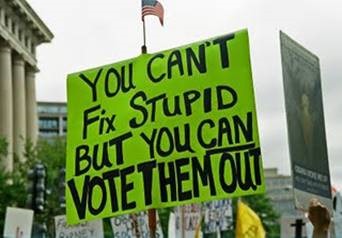
The power of the electorate to turn elected officials out of office at the next election gives elected officials an incentive to adopt policies that do not outrage public opinion and administer the policies with some minimum honesty and competence.
Richard Posner argued that a representative democracy enables the adult population, at very little cost in time, money or distraction from private pursuits commercial or otherwise:
to assure an orderly succession of at least minimally competent officials,
to generate feedback to the officials concerning the consequences of their policies,
to prevent officials from (or punish them for) entirely ignoring the interests of the governed, and
to prevent serious misalignments between government action and public opinion.
Enough of politics and elections, I have a life to lead. Don’t you? Too many want to remake democracy with the faculty workshop as their model.

Such deliberation has demanding requirements for popular participation in the democratic process, including a high level of knowledge and analytical sophistication and an absence, or at least severe curtailment, of self-interested motive. The same goes for citizen initiated binding referendums.
27 May 2015 Leave a comment
in economics of crime, law and economics, politics, politics - Australia, politics - New Zealand, politics - USA, war and peace Tags: Amnesty International, BDS, Gaza Strip, Hamas, Left-wing hypocrisy

Can there be any other explanation for why the BDS activists are not protesting in the streets against these summary executions by Hamas other than mass kidnappings.
What else is stopping them from protest against these flagrant human rights violations and calling for boycotts, disinvestment and sanctions against the Gaza Strip? Kudos to Amnesty International for finally putting out this report.
27 May 2015 Leave a comment
Habeaus Corpus Act (strengthening person's right to challenge unlawful arrest) passes in England #OnThisday in 1679. http://t.co/MAYp7ttLg1—
✍ Bibliophilia (@Libroantiguo) May 27, 2015
26 May 2015 Leave a comment
in economic history, politics - Australia, politics - New Zealand, politics - USA Tags: Director's Law, growth of government
Long live the Slopegraph. Long live Edward Tufte. tinyurl.com/naeh7rc http://t.co/C8Lgnupxz9—
Amity Shlaes (@AmityShlaes) May 16, 2015
25 May 2015 Leave a comment
in politics - Australia, politics - New Zealand, Public Choice Tags: Australian Greens, Australian Labor Party, expressive voting, Inner-city Left, New Zealand Greens, voter demographics
25 May 2015 Leave a comment
in economic history, labour economics, politics - Australia, politics - New Zealand, politics - USA, unions Tags: Australia, British economy, Canada, trade union density, union power, union wage premium

Source: OECD StatExtract
24 May 2015 Leave a comment
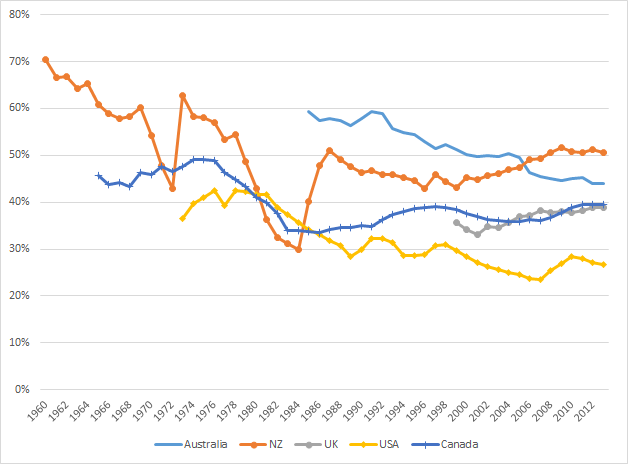
in economic history, labour economics, minimum wage, politics - Australia, politics - New Zealand, politics - USA Tags: Australia, British economy, Canada
Figure 1: minimum wage relative to median wage in full-time worker, UK, USA, Canada, New Zealand and Australia, 1960 – 2012

Source: OECD StatExtract
Figure 2: minimum wage relative to mean wage in full-time worker, UK, USA, Canada, New Zealand and Australia, 1960 – 2012
Source: OECD StatExtract
Celebrating humanity's flourishing through the spread of capitalism and the rule of law
Celebrating humanity's flourishing through the spread of capitalism and the rule of law
Celebrating humanity's flourishing through the spread of capitalism and the rule of law
Celebrating humanity's flourishing through the spread of capitalism and the rule of law
Celebrating humanity's flourishing through the spread of capitalism and the rule of law
A History of the Alt-Right
Econ Prof at George Mason University, Economic Historian, Québécois
Celebrating humanity's flourishing through the spread of capitalism and the rule of law
Scholarly commentary on law, economics, and more
Beatrice Cherrier's blog
Celebrating humanity's flourishing through the spread of capitalism and the rule of law
Celebrating humanity's flourishing through the spread of capitalism and the rule of law
Celebrating humanity's flourishing through the spread of capitalism and the rule of law
Why Evolution is True is a blog written by Jerry Coyne, centered on evolution and biology but also dealing with diverse topics like politics, culture, and cats.
Celebrating humanity's flourishing through the spread of capitalism and the rule of law
A rural perspective with a blue tint by Ele Ludemann
DPF's Kiwiblog - Fomenting Happy Mischief since 2003
Celebrating humanity's flourishing through the spread of capitalism and the rule of law
The world's most viewed site on global warming and climate change
Tim Harding's writings on rationality, informal logic and skepticism
A window into Doc Freiberger's library
Let's examine hard decisions!
Commentary on monetary policy in the spirit of R. G. Hawtrey
Thoughts on public policy and the media
Celebrating humanity's flourishing through the spread of capitalism and the rule of law
Politics and the economy
A blog (primarily) on Canadian and Commonwealth political history and institutions
Reading between the lines, and underneath the hype.
Economics, and such stuff as dreams are made on
"The British constitution has always been puzzling, and always will be." --Queen Elizabeth II
Celebrating humanity's flourishing through the spread of capitalism and the rule of law
Celebrating humanity's flourishing through the spread of capitalism and the rule of law
WORLD WAR II, MUSIC, HISTORY, HOLOCAUST
Undisciplined scholar, recovering academic
Celebrating humanity's flourishing through the spread of capitalism and the rule of law
Res ipsa loquitur - The thing itself speaks
In Hume’s spirit, I will attempt to serve as an ambassador from my world of economics, and help in “finding topics of conversation fit for the entertainment of rational creatures.”
Researching the House of Commons, 1832-1868
Articles and research from the History of Parliament Trust
Reflections on books and art
Posts on the History of Law, Crime, and Justice
Celebrating humanity's flourishing through the spread of capitalism and the rule of law
Exploring the Monarchs of Europe
Cutting edge science you can dice with
Small Steps Toward A Much Better World
“We do not believe any group of men adequate enough or wise enough to operate without scrutiny or without criticism. We know that the only way to avoid error is to detect it, that the only way to detect it is to be free to inquire. We know that in secrecy error undetected will flourish and subvert”. - J Robert Oppenheimer.



Recent Comments