
via NSW election 2015: Policies come second for voters | The Australian.
Celebrating humanity's flourishing through the spread of capitalism and the rule of law
24 May 2015 Leave a comment
in politics - Australia, politics - New Zealand, Public Choice, rentseeking Tags: animal rights, Australian Greens, do gooders, expressive voting, New South Wales election, New Zealand Greens, voter demographics, workers rights
24 May 2015 Leave a comment
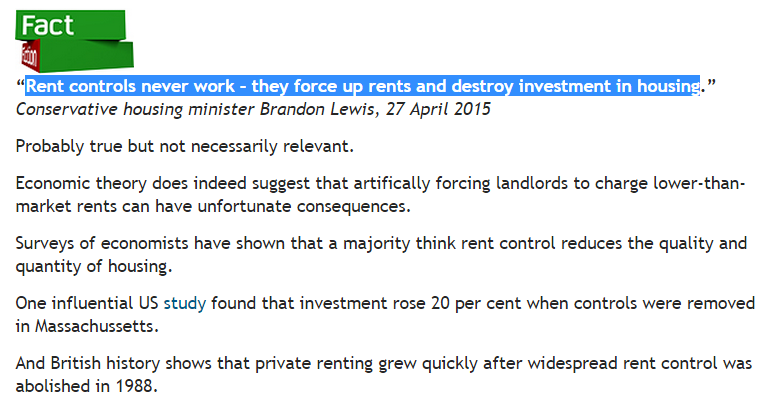
in economics of regulation, politics - Australia, politics - New Zealand, politics - USA, urban economics Tags: British general election, expressive voting, offsetting behaviour, rational irrationality, rent controls, The fatal conceit, UK politics, unintended consequences
23 May 2015 Leave a comment
in international economics, politics - Australia, politics - New Zealand, war and peace Tags: Left-wing hypocrisy, New Zealand Greens
23 May 2015 Leave a comment
in economic history, politics - Australia, politics - New Zealand, politics - USA Tags: European offshoots
The United Kingdom's Western offshoots have done well economically: buff.ly/1KlVm4A #ukelection2015 #progress http://t.co/AOaojfToiO—
HumanProgress.org (@humanprogress) May 08, 2015
20 May 2015 Leave a comment
in comparative institutional analysis, politics - New Zealand, Public Choice Tags: capital gains tax, evidence-based policy, land supply, RMA, zoning
This week, the New Zealand government announced a special capital gains tax for investments in housing. Specifically, if a buyer sells the house within two years of buying it, and this house is not their home, the investor will be liable to income tax on any profit.

This solution also has been put forward by the left-wing political parties in New Zealand as their solution to the problem of restricted land supply in Auckland and other cities in New Zealand.
The introduction of a capital gains tax is a breakthrough for housing affordability. This solution of using a capital gains tax to dampen demand has been given its chance and it will fail.

Once a capital gains tax fails to make housing more affordable, political parties on the left and on the right can no longer put off confronting real solutions such as major reforms to the Resource Management Act (RMA) to loosen restrictions on the supply of land in the big cities in New Zealand and in particular in Auckland.
20 May 2015 1 Comment
in environmental economics, global warming, politics - Australia, politics - New Zealand, politics - USA Tags: climate alarmists, global warming
@ctvqp Harper. waaaay ahead of public opinion. Global Warming scam is over, Enviros/Journos flogging dead horse. http://t.co/STZxrsogFI—
Tea Leaf LaCampagne (@TillyLaCampagne) May 17, 2015
18 May 2015 Leave a comment
in politics - New Zealand, politics - USA, public economics Tags: company tax, endogenous growth theory, foreign direct investment, lost decades

New Zealand is one of only two developed countries, the other being Finland, that switched from a territorial tax system to a worldwide system.Both eventually returned to a territorial tax system for competitiveness reasons. New Zealand went one step further in their experiment with worldwide taxation by ending deferral.
This resulted in a twenty year stagnation in foreign investment at a time when foreign investment was growing dramatically in the rest of the developed world.
This coincided with an economic decline in New Zealand relative to Australia and the rest of the developed world. Because foreign investment is key to accessing the world’s consumers, it is not surprising that less foreign investment translated to less economic prosperity at home.
The New Zealand experience shows that ending or limiting deferral in the United States, as President Obama and others have proposed, would likely have severe economic downsides. Instead, as New Zealand eventually did in 2009, the U.S. should implement a territorial system that exempts foreign earnings.

via New Zealand’s Experience with Territorial Taxation | Tax Foundation.
18 May 2015 Leave a comment
in labour economics, labour supply, politics - New Zealand, politics - USA Tags: ageing society, Australia, Japan, labour demographics, New Zealand
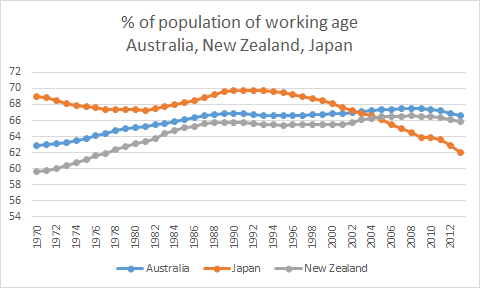
HT: OECD
15 May 2015 Leave a comment
in economic growth, economic history, macroeconomics, politics - Australia, politics - New Zealand Tags: Australia, British economy, lost decades
Figure 1: Real GDP per New Zealander, British and Australian aged 15-64, converted to 2013 price level with updated 2005 EKS purchasing power parities, 1956-2013

Source: Computed from OECD Stat Extract and The Conference Board, Total Database, January 2014, http://www.conference-board.org/economics
Figure 2: Real GDP per New Zealander, British and Australian aged 15-64, converted to 2013 price level with updated 2005 EKS purchasing power parities, 1.9 per cent detrended, 1956-2013
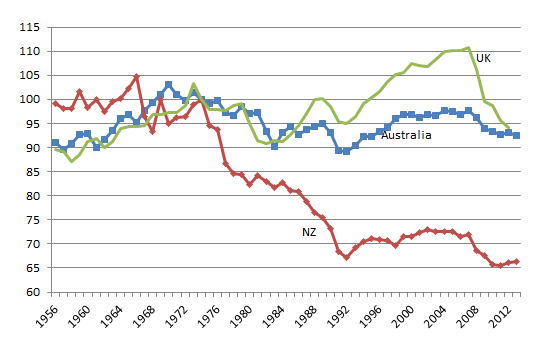
Source: Computed from OECD Stat Extract and The Conference Board, Total Database, January 2014, http://www.conference-board.org/economics
15 May 2015 Leave a comment
in environmental economics, global warming, politics - New Zealand Tags: climate alarmism, conjecture and refutation

15 May 2015 Leave a comment
in applied welfare economics, economics of love and marriage, gender, labour economics, labour supply, occupational choice, politics - Australia, politics - New Zealand, politics - USA, population economics, welfare reform Tags: child poverty, economics of the family, family poverty, marriage and divorce, single mothers, single parents
CHART: Black Illegitimacy Rate Went from < 20% in 1950 to 75.2% in 2010. Has Obama ever mentioned that? http://t.co/1UBUQ5aLRi—
Mark J. Perry (@Mark_J_Perry) May 12, 2015
Quotation of the Day from Charles Murray http://t.co/Y8W6xGjRPO—
Mark J. Perry (@Mark_J_Perry) May 12, 2015
15 May 2015 Leave a comment
in development economics, economics of regulation, environmental economics, growth miracles, politics - Australia, politics - New Zealand, politics - USA, urban economics Tags: green rent seeking, housing affordability The fatal conceit, land use regulation, offsetting behaviour, RMA, The pretence to knowledge, unintended consequences, urban planning, zoning
15 May 2015 Leave a comment
in health economics, politics - Australia, politics - New Zealand, politics - USA Tags: public health expenditure, welfare state
14 May 2015 Leave a comment
in constitutional political economy, politics - Australia, politics - New Zealand, politics - USA, Public Choice Tags: activists, civil disobedience, Leftover Left, protesters, street politics
Public disorder and rioting by a large leads to a law and order response among the public and a hardening of social attitudes against whatever the desired social reform might be when it is tainted by civil disorder.
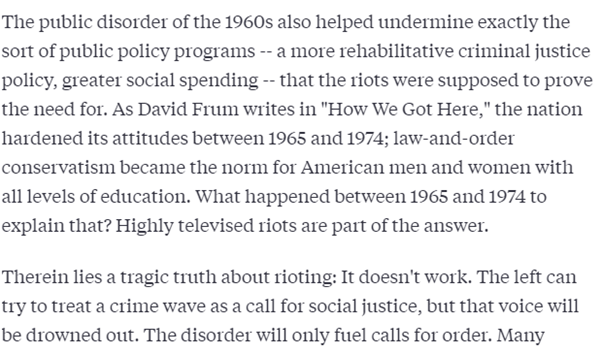
The Left, the Green Left and the watermelons in particular want to believe that street protests change things. They have to validate their youthful offences against public order.
Sadly, no; sadly for them but not for the law-abiding rest of us who resolve our differences by trying to persuade each other and elections.
The law-abiding rest of us believe in democratic equality. Your vote counts as much as mine in a democracy with free speech. The only way you can change my vote is by free speech, not by public disorder, threats and intimidation and taking the law into your own hands.
Celebrating humanity's flourishing through the spread of capitalism and the rule of law
Celebrating humanity's flourishing through the spread of capitalism and the rule of law
Celebrating humanity's flourishing through the spread of capitalism and the rule of law
Celebrating humanity's flourishing through the spread of capitalism and the rule of law
Celebrating humanity's flourishing through the spread of capitalism and the rule of law
A History of the Alt-Right
Econ Prof at George Mason University, Economic Historian, Québécois
Celebrating humanity's flourishing through the spread of capitalism and the rule of law
Scholarly commentary on law, economics, and more
Beatrice Cherrier's blog
Celebrating humanity's flourishing through the spread of capitalism and the rule of law
Celebrating humanity's flourishing through the spread of capitalism and the rule of law
Celebrating humanity's flourishing through the spread of capitalism and the rule of law
Why Evolution is True is a blog written by Jerry Coyne, centered on evolution and biology but also dealing with diverse topics like politics, culture, and cats.
Celebrating humanity's flourishing through the spread of capitalism and the rule of law
A rural perspective with a blue tint by Ele Ludemann
DPF's Kiwiblog - Fomenting Happy Mischief since 2003
Celebrating humanity's flourishing through the spread of capitalism and the rule of law
The world's most viewed site on global warming and climate change
Tim Harding's writings on rationality, informal logic and skepticism
A window into Doc Freiberger's library
Let's examine hard decisions!
Commentary on monetary policy in the spirit of R. G. Hawtrey
Thoughts on public policy and the media
Celebrating humanity's flourishing through the spread of capitalism and the rule of law
Politics and the economy
A blog (primarily) on Canadian and Commonwealth political history and institutions
Reading between the lines, and underneath the hype.
Economics, and such stuff as dreams are made on
"The British constitution has always been puzzling, and always will be." --Queen Elizabeth II
Celebrating humanity's flourishing through the spread of capitalism and the rule of law
Celebrating humanity's flourishing through the spread of capitalism and the rule of law
WORLD WAR II, MUSIC, HISTORY, HOLOCAUST
Undisciplined scholar, recovering academic
Celebrating humanity's flourishing through the spread of capitalism and the rule of law
Res ipsa loquitur - The thing itself speaks
In Hume’s spirit, I will attempt to serve as an ambassador from my world of economics, and help in “finding topics of conversation fit for the entertainment of rational creatures.”
Researching the House of Commons, 1832-1868
Articles and research from the History of Parliament Trust
Reflections on books and art
Posts on the History of Law, Crime, and Justice
Celebrating humanity's flourishing through the spread of capitalism and the rule of law
Exploring the Monarchs of Europe
Cutting edge science you can dice with
Small Steps Toward A Much Better World
“We do not believe any group of men adequate enough or wise enough to operate without scrutiny or without criticism. We know that the only way to avoid error is to detect it, that the only way to detect it is to be free to inquire. We know that in secrecy error undetected will flourish and subvert”. - J Robert Oppenheimer.


Recent Comments