How much oil, gas and coal do we need to leave in the ground? http://t.co/LQwLzkSLoO pic.twitter.com/a77co0xbez
— FiveThirtyEight (@FiveThirtyEight) January 10, 2015
Not very likely alert: How much oil, gas and coal do we need to leave in the ground?
14 Jan 2015 Leave a comment
Why is anybody still living in East Germany (or New Zealand)?
14 Jan 2015 1 Comment
in economic history, macroeconomics, politics - Australia, politics - New Zealand Tags: East Germany, Germany, immigration, Trans-Tasman income gap
When I pointed to Jennifer Hunt’s so titled paper freshly released in 2000 on why does anyone still live in East Germany, none of my New Zealand colleagues understood the parallel with their own country.
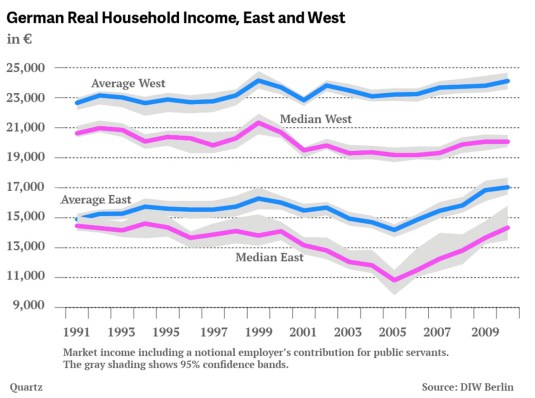
The wage gap between East and West Germany is about the same as the wage gap between Australia and New Zealand.
- East Germans have the advantage of being able to getting their car to go to the west. Some do commute from the east to jobs in the West; and
- New Zealanders have to get into a plane and commuting done a daily basis is really out of the question – the air flight time alone is three hours.
There are in fact bigger language, or more correctly dialect differences between Germany than there are across the Tasman Sea between New Zealanders and Australians. Educational standards are similar between New Zealanders and Australians.
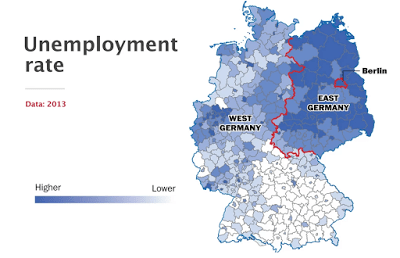
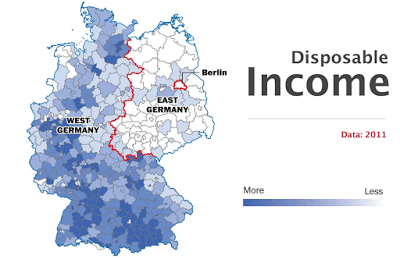
In 1997 GDP per capita in East Germany was 57% of that of West Germany, wages were 75% of western levels, and the unemployment rate was at least double the western rate of 7.8%.
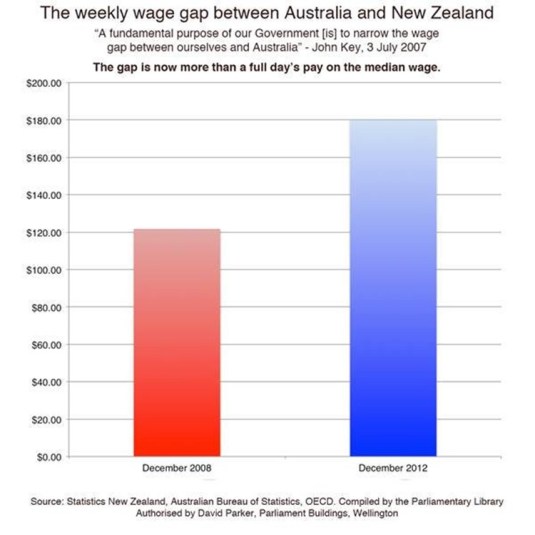
The wage gap across the Tasman between New Zealand and Australia is about one third. Wage gaps between East and West Germany and between Australia and New Zealand are about the same.
Australia and New Zealand have a single integrated labour market. Any New Zealander Australian is free to work in the other country.
New Zealanders are not eligible for social security benefits if they first arrived in Australia after mid-2001. Prior to 2001, New Zealanders have the same rights as Australians for social security benefits.
One would expect that if capital flows and trade in goods failed to bring convergence between East and West Germany, labour flows should respond, enhancing overall efficiency.
Same goes between Australia and New Zealand. About 35,000 New Zealanders used to move to Australia each year, but that’s recently dried up to about zero. Funnily enough, by the late 1990s net emigration from East Germany has fallen from high levels in 1989-1990 to close to zero.
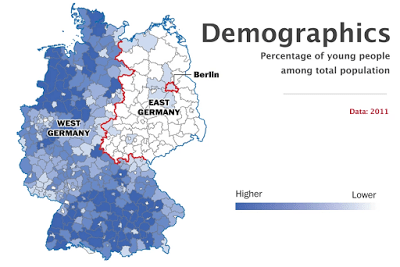
Jennifer Hunt found through her analysis of the eastern sample of the German Socio-Economic Panel for 1990-1997 that commuting is unlikely to substitute substantially for emigration.
Wage convergence between the East and the West was a main factor that stemmed immigration. The individual-level data further indicate that emigrants are disproportionately young and skilled, and that individuals suffering a layoff or non-employment spell are also much more likely to emigrate. This is all as predicted by the Roy model of immigration self-selection.
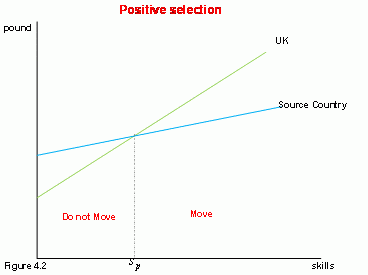
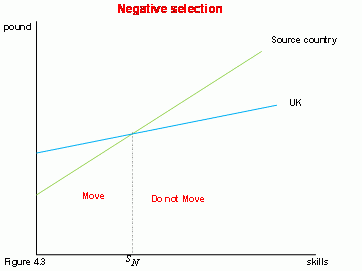
Like all human capital investments, both international and within country migration is based on the comparison of the present value of lifetime earnings in all available employment opportunities. Individuals compare the potential incomes and the destination country with the income in the home countries, and make the migration decision based on these income differentials (net of mobility costs).
What to do when the facts are against you
12 Jan 2015 Leave a comment
in liberalism, politics - New Zealand, politics - USA
Here’s what school lunches look like around the world – Vox
10 Jan 2015 Leave a comment
in economics of education, health economics, politics - New Zealand, politics - USA Tags: School lunches

/cdn0.vox-cdn.com/uploads/chorus_asset/file/2915604/SG1.0.jpg)
/cdn0.vox-cdn.com/uploads/chorus_asset/file/2915660/SG7.0.jpg)
/cdn0.vox-cdn.com/uploads/chorus_asset/file/2915614/SG4.0.jpg)
/cdn0.vox-cdn.com/uploads/chorus_asset/file/2915628/SG5.0.jpg)
/cdn0.vox-cdn.com/uploads/chorus_asset/file/2915632/SG8.0.jpg)
/cdn0.vox-cdn.com/uploads/chorus_asset/file/2915640/SG9.0.jpg)
President Obama and his support for charter schools
09 Jan 2015 Leave a comment
in economics of education, politics - New Zealand, politics - USA Tags: charter schools, School choice
Bizarro lefties alert: The Racist History of the Charter School Movement
09 Jan 2015 1 Comment
in discrimination, economics of education, human capital, politics - New Zealand, politics - USA, survivor principle Tags: chartered schools, Leftover Left, School choice
The unthinking opposition to charter schools has reached new depths with SaveOurSchoolsNZ sharing The Racist History of the Charter School Movement.
This article relates the founding of charter schools and school choice to the opposition of the Democratic party to the desegregation of schools in the late 1950s in the southern States of America.
In Prince Edward County, Virginia, one of the five cases decided in Brown v. Board of Education (1954), the Democratic Party government threatened to close the public school system and transfer the assets to private hands to avoid school desegregation.
Naturally, the article, which was supposed to be recounting history was some accuracy and new insight, fails to mention that this racism was in the Democratic Party. That’s one dirty little secret to many. These Democratic party stalwarts were instead labelled segregationist whites.
The threat to close the public school system and transfer it to was never carried. From recollection, closure of the public school system to avoid desegregation may have been carried out in other southern states.
The current racism of the charter school movement is explained in this most bizarre way:
A 2010 report by the UCLA-based Civil Rights Project, “Choice without Equity: Charter School Segregation and the Need for Civil Rights Standards,” uncovers some troublesome facts in this regard. “While segregation for blacks among all public schools has been increasing for nearly two decades, black students in charter schools are far more likely than their traditional public school counterparts to be educated in intensely segregated settings. At the national level, 70 percent of black charter school students attend intensely segregated minority charter schools (which enrol 90-100 percent of students from under-represented minority backgrounds), or twice as many as the share of intensely segregated black students in traditional public schools.”
In the first decade of the 2000s, charter school enrolment nearly tripled; today around 2.5 percent of public school students are enrolled in charters.
Blacks are overrepresented in charter schools (32 percent vs. 16 percent in the entire public-school population), whites are underrepresented (39 percent versus 56 percent), and Latinos, Asians and American Indians are enrolled in roughly equal proportions in charters and traditional public schools. These snapshots mask considerable variation. In the West and some areas of the South, it appears that charter schools “serve as havens for white flight from public schools,” according to the Civil Rights Project.
Black Americans are fleeing the public school system in record numbers for charter schools because the public school system as failed them. The entire New Orleans school district is now chartered schools because the public school system was too slow to recover from Hurricane Katrina.

The three largest charter school movements are in New Orleans, Detroit and Washington DC. All three cities had public school systems that failed their predominantly black communities. The governments of New Orleans, Detroit and Washington DC are dominated by the black vote with black leadership in many leadership positions.
Charter schools must attract their students from the existing Schools. They must compete and compete successfully to survive and avoid closure.
Not one of these black students in a charter school is required to attend them. They enter by choice, often having to compete in lotteries because so many wish to go to chartered school. It is highbrow condescension to suggest that they and their parents don’t know what they’re doing when they attempt two enrol in a chartered school.

Many charter schools tend to target students with educational disadvantages. Not surprisingly, some get into different difficulty while many others succeed.

Chartered schools in New Zealand, known as partnership schools, were initiated by the ACT party but the bill in Parliament required the support of the Maori party to pass.
The Maori Party supported chartered schools in New Zealand because they wanted a better deal from Maori in the education system. Maori Party co-leader Pita Sharples said
“We have to try new things – and if they don’t work, ditch them,” he told reporters yesterday.
“This is about giving charter schools a chance, we have to see how it can work here.”
New Zealand Charter schools will be state funded but run by community, church or business organisations. They will be able to set their own curriculum and term times, and don’t have to hire registered teachers.
Maori Party president Pem Bird appeared before Parliament’s Education and Science select committee when the chartered school bill was in its committee stage as the spokesman for Nga Kura-a-Iwi, a group of 23 Maori immersion-schools.
Mr Bird told MPs the chartered schools bill will free schools from rules and regulations that prevent them from doing a better job for Maori children.
Maori and Pasifika groups are desperate to improve their children’s educational performance and many will want to set up partnership schools, he said.
Maori organisations will come in in big numbers, as will Pasifika. And the reason is simple: they want to be architects of their own futures and destinies … We’ve got to get with the fact that this is desperation for us.
Mr Bird said several Maori-immersion schools wanted to become partnership schools.
Sadly, I must say, the self appointed left-wing representatives of Maori and Pasifika want to keep them in a public school system that fails them for ideological reasons while they educate their own children in nice suburban schools.
The Labour Party in New Zealand had its second worst Party vote ever in the most recent 2014 general election.
The Green Party vote did not increase its vote in the 2014 election, despite the failings of the Labour Party and a hard left campaign by the Greens emphasising education and child poverty.
The Green Party vote was abysmal in working-class electorates and among Maori and Pasifika. Most of the Green’s party vote is from the educated middle-class in rich electorates.
No NZ government bailout for the Sky City Casino extension cost overrun
07 Jan 2015 Leave a comment
in politics - New Zealand, Public Choice, rentseeking Tags: corporate welfare, Sky City Casino
Socialism and the intellectuals – Thomas Sowell
06 Jan 2015 Leave a comment
in applied welfare economics, Marxist economics, politics - Australia, politics - New Zealand, politics - USA, Rawls and Nozick Tags: cowardice of intellectuals, Leftover Left, Thomas Sowell
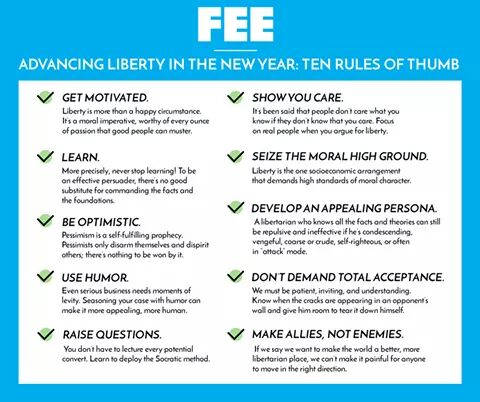

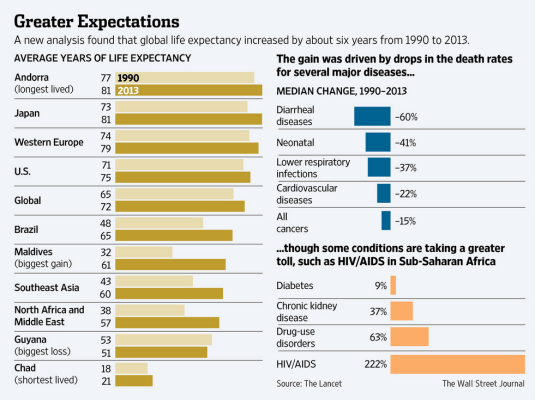

The dangerously futile crusades of the Left over Left
27 Dec 2014 3 Comments
in liberalism, politics - Australia, politics - New Zealand, politics - USA Tags: GMOs, Leftover Left, progressive politics
The SkyCity bailout: it is common for private sector mega-projects to fail
24 Dec 2014 3 Comments
in entrepreneurship, politics - New Zealand, rentseeking, survivor principle Tags: casino regulation, corporate welfare, SkyCity

SkyCity is sniffing around the New Zealand government for a $130 million bailout. The initial project estimate was $402 million for a convention centre and enlarged casino.

SkyCity was very clear when the convention centre deal was announced that it would be at no cost to either taxpayers or Auckland ratepayers. That is a clear assumption of the entrepreneurial risks – both the upside of high profits and the downside of cost overruns and losses.
The literature on mega-projects suggests that large engineering projects frequently fail to achieve their intended financial and operating objectives. Nine out of ten mega-projects have cost-over runs:
- Miller and Lessard (2000) studied 60 large engineering projects with an average size of $1 billion. Almost 40% of the projects performed very badly and were abandoned totally or restructured after a financial crisis.
- Merrow et al. (1988) found that four of the 47 megaprojects they studied came in on budget – the average cost overrun was 88%. Of the 36 projects that had sufficient data, 26 failed to achieve their profit objectives.
- Flyvbjerg et al. (2003) analyzed 258 large transport projects (toll roads, bridges, railroads, etc.). Cost overruns of 50% to 100% and revenue shortfalls of 20% to 70% were common.
Table 1 below gives more details on cost overruns in rail, bridge and road engineering projects overseas. Cost overruns averaging 27.6% were found with rail having much larger cost overruns than road or bridge construction.
Table 1: Inaccuracy of transport mega-project estimates
| Project type | Number of projects | Average cost escalation |
| Rail | 58 | 44.7% |
| Bridge | 33 | 33.8% |
| Road | 167 | 20.4% |
| All projects | 258 | 27.6% |
Source: Flyvbjerg et al (2003).
Cost over-runs are not the preserve of the public sector. Merrow (2011) found that over half of large-scale engineering and construction projects – off-shore oil platforms, chemical plants, metals processing, dams, and similar projects – had poor results: Billions of dollars in total overruns, long delays in design and construction, and poor operability and revenue shortfalls once completed.
Alchian (1950) illustrated the unreliability of cost estimation with the range of bids made in tendering processes. When contractors bid for the same project, they routinely disagree over its likely cost by margins of 20 percent. The contractors are predicting their own costs, about which they are knowledgeable, and they have an incentive to be truthful to win the initial tender. Initial cost estimates by engineers have margins of error of 25 percent (Alchian 1950).
Central to capitalism is the notion of profit and loss. Entrepreneurial endeavours that anticipated the matort well make a profit. The rest fall by the wayside.
SkyCity is a private investment that should stand or fall on the same criteria as any other business venture in New Zealand.
What should be asked by the taxpayer in all these business subsidies is what the value for money for their tax dollars is?
What is the problem that has been solved other than common garden business failure? Can this problem be solved by market process on its own at its own pace subject to hard budget constraints, competition in the market place, the threat of innovation at home and abroad, and continuous updating of the knowledge available to the entrepreneurial decision-makers by changes in prices and profits and losses. As Friedman said:
The strongest argument for free enterprise is that it prevents anybody from having too much power.
Whether that person is a government official, a trade union official, or a business executive, it forces them to put up or shut up.
They either have to deliver the goods, produce something that people are willing to pay for, are willing to buy, or else they have to go into a different business.
Losses and bankruptcies are fundamental to the success of the market economy. Losses are a clear signal that need to restructure, cut costs or go out of business. The paraphrase Mao, ‘Bankrupt one, educate a thousand’.
Corporate welfare, such as a bailout to SkyCity and at such an early stage in the investment postpones these difficult choices. As George Stigler explained:
One great invention of a private enterprise system is bankruptcy, an institution for putting an eventual stop to costly failure.
No such institution has yet been conceived of in the political process, and an unsuccessful policy has no inherent termination.
Indeed, political rewards are more closely proportioned to failure than to success, for failure demonstrates the need for larger appropriations and more power.
The fact that the government regulates part of SkyCity’s business because it is a casino is no case for a bailout. The purpose of casino regulation is to constrain the size of that industry, not help it grow.


Recent Comments