
Justice Thomas, a colour-blind Constitution and Brown v. Board of Education (1954)
31 Jul 2014 Leave a comment
How flexible is the New Zealand labour market
31 Jul 2014 1 Comment
in economics of regulation, labour economics, politics - New Zealand, unemployment, welfare reform Tags: 90 day trials, employment law, employment probation periods, employment protection, labour market regulation
The first chart below shows that NZ is the 4th most deregulated labour market for individual dismissals.
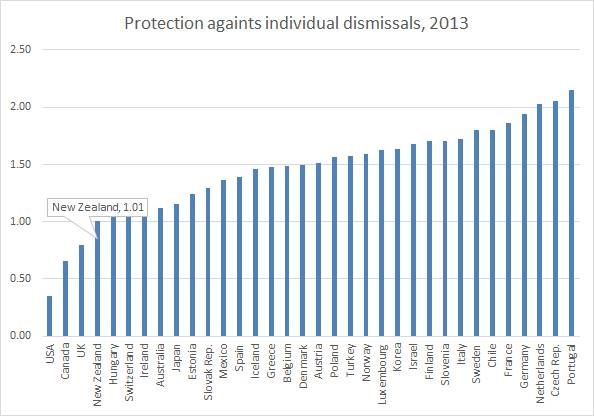
Source: OECD employment protection index
The next figure below shows that NZ is top of the world for deregulation of lay-offs and redundancies.
![clip_image002[7]](https://utopiayouarestandinginit.com/wp-content/uploads/2014/07/clip_image0027.jpg "clip_image002[7]")
Source: OECD employment protection index
The chart below shows that New Zealand is far more flexible than in Western Europe and is pretty near the USA in terms of people moving in and out of the unemployment pool every month with great ease.
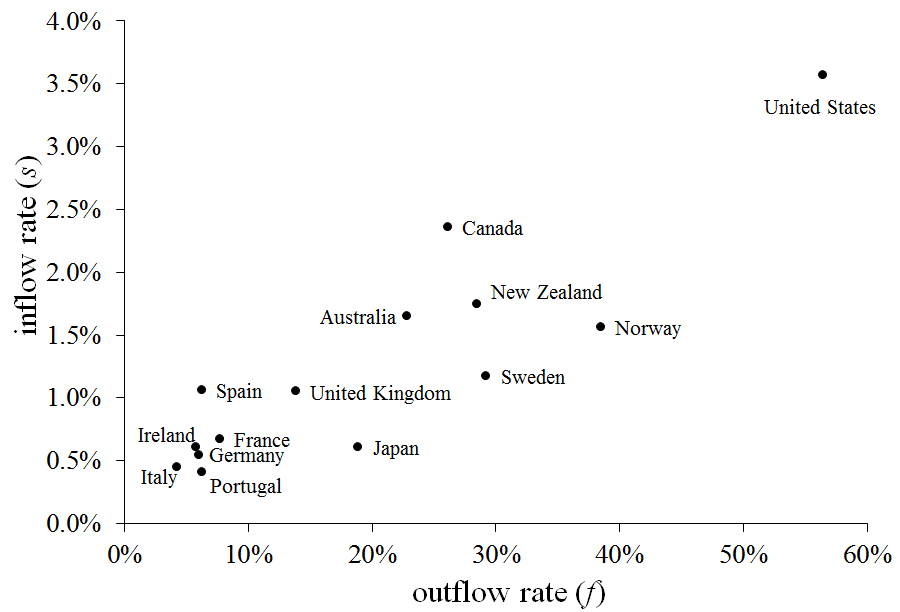
Source: Elsby, Hobijn and Şahin (2013).
There are very high outflow rates from unemployment among the Anglo-Saxon and Nordic economies. The economies of Continental Europe stand in stark contrast. Unemployment outflow rates in these economies lie below 10% at a monthly frequency.
A major labour market reform in recent years in New Zealand was introduction of the option of a 90 day trial for new employees, initially in small businesses and then in all businesses.
The UK recently extended its trial period from one-year to two-years. Trial periods are common in OECD member countries.
There is plenty of evidence to back-up the notion that increased job security leads to less employee effort and more absenteeism. Some examples are:
· Sick leave spiking straight after probation periods ended;
· Teacher absenteeism increasing after getting tenure after 5-years; and
· Academic productivity declining after winning tenure.
The MBIE research into the actual operation of 90-day trials was highly favourable in terms of increased employment, the hiring of riskier applicants and lower costs of ending bad job matches (about 15-20% of trials did not work out). These outcomes are the usual importance of a test drive argument for employment trial periods.
Interestingly, the MBIE research also found that some employers hired new employees on 90-day trials for positions about which these employers were uncertain might be profitable. But for the option of the trial period, these jobs never would have existed.
This suggests that in some firms, 90-day trials are a decisively cheaper alternative to hiring an employee and perhaps making them redundant later if the new position does not pay for itself. No one’s fault: the market just did not sustain the expansion in staff as expected.
The MBIE research shows that winners from 90-day trials are new labour force entrants, the unemployed and beneficiaries, migrants and labour force re-entrants such as mothers.
I kept note of an interesting press report adding to this where Hospitality New Zealand Wellington president Jeremy Smith said he had hired dozens of staff he would not otherwise have considered. Because of the transient nature of the hospitality industry, it was often difficult to check references so a trial period “levelled the playing field”.
The politics of ethnicity-based research in New Zealand
30 Jul 2014 Leave a comment
in applied price theory, discrimination, human capital, income redistribution, labour economics, labour supply, politics - New Zealand, population economics, Public Choice, rentseeking Tags: employment discrimination, inequality, Maori economic development, poverty, Simon Chapple, The Great Enrichment, The Great Fact
When Simon Chapple in 2000 wrote “Māori Socio-Economic Disparity”, which showed that disadvantage in New Zealand is more closely tied to age, marital status, education, skills, and geographic location than it is to ethnicity, broadly conceived, such as Māori ethnicity:
- He was summoned before the Māori Affairs Committee of parliament to defend his paper! His chief executive at the Ministry of Social Policy went along with him to defend what he wrote while employed as a senior analyst at the Department of Labour. Staff at his new ministry launched a petition to have Simon fired.
- The head of the Māori Affairs Ministry accused Simon of breaching the public service code of conduct.
Chapple also found that there are important differences in socio economic development by Māori self-identity. Those who identified only as Māori did worse than those that are identified as Māori and another ethnicity. Identifying only as Māori also correlated with living in rural New Zealand.
In terms of employment discrimination, employers would not know whether a Māori job applicant identified as only as Māori or also with another ethnicity, so discrimination is not a good explanation of Māori disadvantage because of this counterfactual. A major driver of Māori disadvantage, which is identifying on the Census form solely as Maori, is simply unknown to discriminating employers as a basis for discrimination in hiring and promotion.
There were editorials in the Dominion Post, which I cannot find online, and in the New Zealand Herald. The latter said:
The Government is being prodded to recognise that Maori deprivation has more to do with socio-economic factors than ethnicity.
This was the conclusion of a report by the Labour Department’s senior research analyst, Simon Chapple. Helen Clark might well have had that finding partly in mind when she referred to a lot of water having gone under the bridge since the Government first formulated legislation.
Mr Chapple said, in essence, that place of residence, age, education and skills had more to do with poverty than race. In areas such as South Auckland, Northland and the central North Island, there were poor Maori, but there were also poor Pākehā and poor Pasifika.
The Minister attacked him and the paper as well for contradicting the Minister’s claim during the election campaign that everything got worse for Maori in the 1990s.
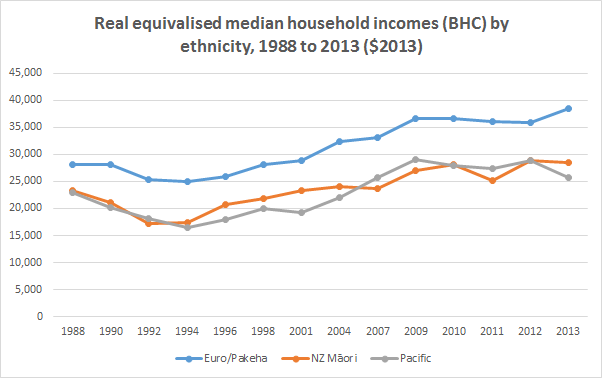
Real equivalised median household income rose 47% from 1994 to 2010; for Māori, this rise was 68%; for Pasifika, 77% (Perry July 2014)
See Karen Baehler’s Ethnicity-based research and politics: snapshots from the United States and New Zealand for more information and a comparison with the similar response to Daniel Patrick Moynihan’s The Negro Family: A Case for National Action in 1965.
About a quarter of Negro families are headed by women. The divorce rate is about 2 1/2 times what it is [compared with whites],” Moynihan said. “The number of fatherless children keeps growing. And all these things keep getting worse, not better, over recent years.”
Moynihan, now retired from the United States Senate, was a senior official in LBJ’s Labor Department in 1965. He wrote his report on a typewriter over a few weeks and had the publications office in the basement of the Labor Department print 100 of them, marked “For Official Use Only.”
- He warned about the breakdown of the African-American family where deprivation and disorganisation had formed their own vicious circle.
- Many civil rights leaders had labelled Moynihan’s report a subtle form of racism because of its unflattering portrayal of the black family (Wilson 1987).
- These accusations of racism helped make the breakdown of the family a taboo subject in social policy in the USA
see The Moynihan Report Revisited: Lessons and Reflections after Four Decades for a review by the best and the brightest in American economics and sociology on Daniel Patrick Moynihan’s prophetic warnings. Holzer says, for example:
Moynihan was extremely insightful and even prescient in arguing that the employment situation of young black men was a “crisis . . . that would only grow worse.”
He understood that these trends involve both limits on labour market opportunities that these young men face as well as skill deficits of and behavioural responses by the young men themselves.
More children are growing-up without a working father living in the home and glean the awareness that work is a central expectation of adult life (Wilson 1987, 1996).
Single-parent households increased from 13 per cent of all Māori households in 1981 to 24.4 per cent in the 2006 Census. In the 2006 Census, 70 per cent of Māori single parent households were on a low income compared to 15 per cent of other Māori one family households (Kiro, Randow and Sporle 2010).
Most of the skill gaps that are present at the age of 18 – skill gaps which substantially explain gaps in adult earnings and employment in all groups – are also present at the age of five (Cunha and Heckman 2007). There is much evidence to show that disadvantaged children have lower levels of soft skills (non-cognitive skills): motivation, persistence, self-discipline, the ability to work with others, the ability to defer gratification and plan ahead, etc. (Heckman 2008). Most of the skills that are acquired at school build on these soft skills that are moulded and reinforced within whānau.
When I started working on labour economics in 2007 I found that the labour economics of Māori was very narrowly written and stayed well clear of the minefield that Simon braved about how ethnicity does not matter that much to Māori social disadvantage.
Why New Zealanders support MMP
28 Jul 2014 Leave a comment
in constitutional political economy, politics - New Zealand, Public Choice Tags: MMP
Most people seem to give the same reason to me in conversations as to why they support the MMP voting system – Mixed Member Proportional representation.
The reason is profoundly democratic: their party vote always counts no matter where they live in the country or how safe or how marginal the local electorate might be.
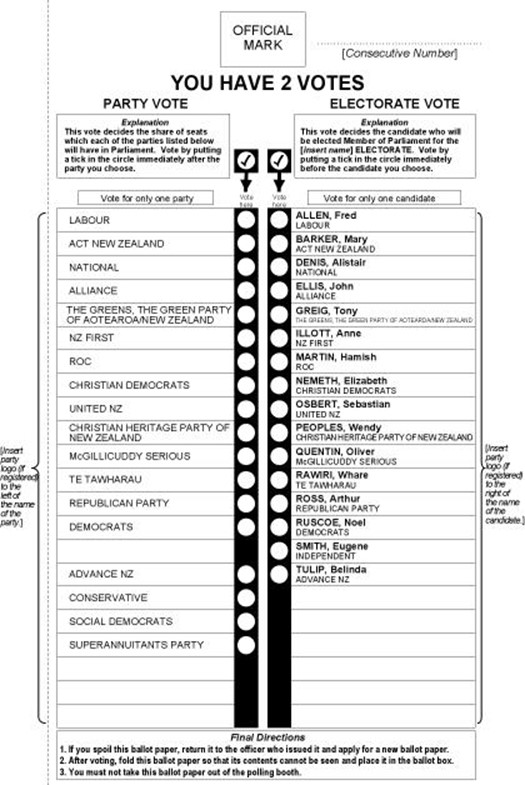
Under first past the post, it didn’t matter who you voted for if you lived in a safe electorate because the local MP of whatever political party would always be elected.
What is underplayed in these conversations is how close all elections are in New Zealand, and how likely it is that your vote might be decisive rather than just one of millions.
Under MMP, the last seat in Parliament is a contest between several parties. If anyone just gets a couple of dozen more votes, they get another seat.
In the current parliament of 121, the National Party Government has 59 seats, with the ACT party one seat and the United Future Party one seat.
One more seat for ACT or one less seat for the National Party would have made a big difference to the election outcome. ACT was only 45 votes short of getting that second seat in the 2011 General Election.
Note: Under MMP, the New Zealand House of Representatives is a mix of MPs from single-member electorates
and those elected from a party list, and a Parliament in which a party’s share of the seats roughly mirrors its share of the overall nationwide party vote. There is a minimum party vote threshold to get into Parliament. The party votes of those parties with less than 5% of the party vote do not count unless they win a constituency seat.
Household Incomes in NZ: trends in indicators of inequality and hardship 1982-2013
14 Jul 2014 Leave a comment
in income redistribution, politics - New Zealand Tags: The Great Enrichment
Real household income trends, 1982 to 2013 ($2013) before housing costs (BHC) and after housing costs (AHC)

Gini coefficient 1980 – 2015

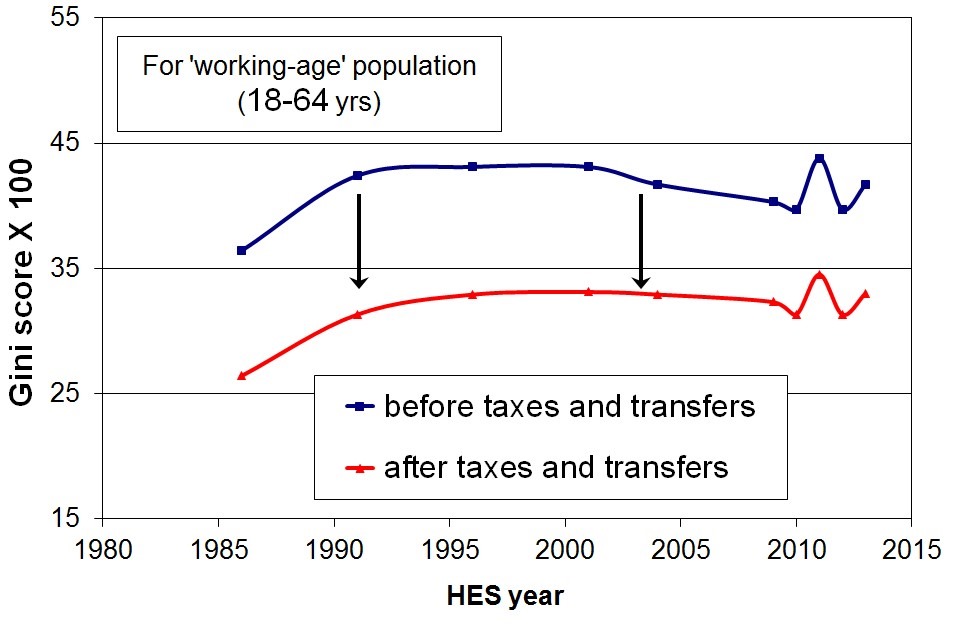
The tax and transfer system significantly reduces the inequality

the increases were 55% for Pakeha, 57% for Pasifika, and 64% for Māori since 1994.
The golden thread running through British justice
11 Jul 2014 Leave a comment
in economics of crime, law and economics, politics - New Zealand Tags: British justice, common law, presumption of innocence, rule of law


At least 20% of New Zealand workers are subject to occupational regulation
08 Jul 2014 Leave a comment
in applied price theory, applied welfare economics, comparative institutional analysis, David Friedman, economics of information, economics of regulation, entrepreneurship, industrial organisation, labour economics, law and economics, managerial economics, market efficiency, Milton Friedman, personnel economics, politics - New Zealand, Ronald Coase Tags: adverse selection, asymmetric information, blackboard economics, moral hazard, occupational regulation, screening, signalling
There are at least 98 regulated occupations in New Zealand covering about 20% of the workforce. In 2011, this amounts to 440,371 workers. The skills that are regulated range across all skill sets and many occupations:
- 49% of regulation is in the form of a licence;
- 18% of regulated work is in the form of licensing of tasks;
- 31% of regulated workers require a certificate; and
- 4% of regulated workers require registration.
There are 32 different governing Acts that regulated occupations in New Zealand with 55% of the workers subject to occupational regulation are employed in just five occupations:
- 98,000 teachers;
- 48,500 nurses;
- 42,730 bar managers;
- 32,733 chartered accountants; and
- 22,749 electricians.
The Health Practitioners Competency Assurance Act 2003 regulates 22 occupations and a total of 89,807 workers. The next best is the 10 occupations regulated by the Health and Safety in Employment Act 2002 which regulates an unknown number of occupations. The Civil Aviation Act 1990 regulates eight occupations and 19,095 workers, the Building Act 2004 regulates seven occupations and 21,101 workers and the Maritime Transport Act 1994 regulates six occupations and 20,500 workers. 12 of the regulated occupations are regulated under laws passed since 2007.
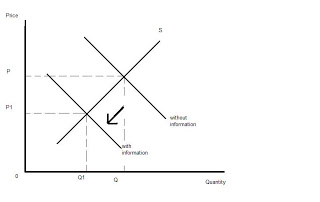
The purpose of occupational regulation is to protect buyers from quacks and lemons – to overcome asymmetric information about the quality of the provider of the service.
Adverse selection occurs when the seller knows more than the buyer about the true quality of the product or service on offer. This can make it difficult for the two people to do business together. Buyers cannot tell the good from the bad products on offer so many they do not buy to all and withdraw from the market.
Goods and services divide into inspection, experience and credence goods.
- Inspection goods are goods or services was quality can be determined before purchase price inspecting them;
- Experience goods are goods whose quality is determined after purchase in the course of consuming them; and
- Credence goods are goods whose quality may never be known for sure as to whether the good or service actually worked – was that car repair or medical procedure really necessary?
The problem of adverse selection over experience and credence goods present many potentially profitable but as yet unconsummated wealth-creating transactions because of the uncertainty about quality and reliability.
Buyers are reluctant to buy if they are unsure of quality, but if such assurances can be given in a credible manner, a significant increase in demand is possible.
Any entrepreneur who finds ways of providing credible assurances of the quality of this service or work stands to profit handsomely. Brand names and warranties are examples of market generated institutions that overcome these information gaps through screening and signalling.
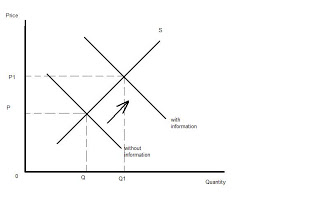
Screening is the less informed party’s effort, usually the buyer, to learn the information that the more informed party has. Successful screens have the characteristic that it is unprofitable for bad types of sellers to mimic the behaviour of good types.
Signalling is an informed party’s effort, usually the seller, to communicate information to the less informed party.
The main issue with quacks in the labour market is whether there are a large cost of less than average quality service, and is there a sub-market who will buy less than average quality products in the presence of competing sellers competing on the basis of quality assurance. This demand for assurance creates opportunities for entrepreneurs to profit by providing assurance.
David Friedman wrote a paper about contract enforcement in cyberspace where the buyer and seller is in different countries so conventional mechanisms such as the courts are futile in cases where the quality of the good is not as promised or there is a failure to deliver at all:
Public enforcement of contracts between parties in different countries is more costly and uncertain than public enforcement within a single jurisdiction.
Furthermore, in a world where geographical lines are invisible, parties to publicly enforced contracts will frequently not know what law those contracts are likely to fall under. Hence public enforcement, while still possible for future online contracts, will be less workable than for the realspace contracts of the past.
A second and perhaps more serious problem may arise in the future as a result of technological developments that already exist and are now going into common use. These technologies, of which the most fundamental is public key encryption, make possible an online world where many people do business anonymously, with reputations attached to their cyberspace, not their realspace, identities
Online auction and sales sites address adverse selection with authentication and escrow services, insurance, and on-line reputations through the rating of sellers by buyers.
E-commerce is flourishing despite been supposedly plagued by adverse selection and weak contract enforcement against overseas venders.
In the labour market, screening and signalling take the form of probationary periods, promotion ladders, promotion tournaments, incentive pay and the back loading of pay in the form of pension investing and other prizes and bonds for good performance over a long period.
In the case of the labour force, there are good arguments that a major reason for investments in education is as a to signal quality, reliability, diligence as well as investment in a credential that is of no value the case of misconduct or incompetence. Lower quality workers will find it very difficult if not impossible to fake quality and reliability in this way – through investing in higher education.
In the case of teacher registration, for example, does a teacher registration system screen out any more low quality candidates for recruitment than do proper reference checks and a police check for a criminal record.
Mostly disciplinary investigations and deregistrations under the auspices of occupational regulation is for gross misconduct and criminal convictions rather than just shading of quality.
Much of personnel and organisational economics is about the screening and sorting of applicants, recruits and workers by quality and the assurance of performance.
Alert entrepreneurs have every incentive to find more profitable ways to manage the quality of their workforce and sort their recruitment pools.
Baron and Kreps (1999) developed the recruitment taxonomy made up of stars, guardians and foot-soldiers.
Stars hold jobs with limited downside risk but high performance is very good for the firm – the costs of hiring errors for stars such as an R&D worker are small: mostly their salary. Foot-soldiers are employees with narrow ranges of good and bad possible outcomes.
Guardians have jobs where bad performance can be a calamity but good job performance is only slightly better than an average performance.
Airline pilots and safety, compliance, finance and controller jobs are all examples of guardian jobs where risk is all downside. Bad performance of these jobs can bring the company down. Dual control is common in guardian jobs.
The employer’s focus when recruiting and supervising guardians is low job performance and not associating rewards and promotions with risky behaviours. Employers will closely screen applicants for guardian jobs, impose long apprenticeships and may limit recruiting to port-of-entry jobs.
The private sector has ample experience in handling risk in recruitment for guardian jobs. Firms and entrepreneurs are subject to a hard budget constraints that apply immediately if they hire quacks and duds.
Blackboard economics says that governments may be able to improve on market performance but as Coase warned that actually implement regulatory changes in real life is another matter:
The policy under consideration is one which is implemented on the blackboard.
All the information needed is assumed to be available and the teacher plays all the parts. He fixes prices, imposes taxes, and distributes subsidies (on the blackboard) to promote the general welfare.
But there is no counterpart to the teacher within the real economic system
Occupational regulation comes with the real risk of the regulation turning into an anti-competitive barrier to entry as Milton Friedman (1962) warned:
The most obvious social cost is that any one of these measures, whether it be registration, certification, or licensure, almost inevitably becomes a tool in the hands of a special producer group to obtain a monopoly position at the expense of the rest of the public.
There is no way to avoid this result. One can devise one or another set of procedural controls designed to avert this outcome, but none is likely to overcome the problem that arises out of the greater concentration of producer than of consumer interest.
The people who are most concerned with any such arrangement, who will press most for its enforcement and be most concerned with its administration, will be the people in the particular occupation or trade involved.
They will inevitably press for the extension of registration to certification and of certification to licensure. Once licensure is attained, the people who might develop an interest in undermining the regulations are kept from exerting their influence. They don’t get a license, must therefore go into other occupations, and will lose interest.
The result is invariably control over entry by members of the occupation itself and hence the establishment of a monopoly position.
Friedman’s PhD was published in 1945 as Income from Independent Professional Practice. With co-author Simon Kuznets, he argued that licensing procedures limited entry into the medical profession allowing doctors to charge higher fees than if competition were more open.
Data Source: Martin Jenkins 2012, Review of Occupational Regulation, released by the Ministry of Business, Innovation and Employment under the Official Information Act.
The application of John Rawls difference principle to New Zealand
07 Jul 2014 Leave a comment
in applied price theory, income redistribution, politics - New Zealand, Rawls and Nozick Tags: difference principle, income distribution, John Rawls, Maori economic development, Pasifika economic development
An urban legend in New Zealand is that income inequality is going from bad to worse.
Since the mid 1990s to around 2011 there was a small net fall in New Zealand’s income inequality trend line in the graph for the Gini coefficient for the income distribution for New Zealand shows. inequality in New Zealand is similar to that in Australia, Ireland, Canada and Japan.
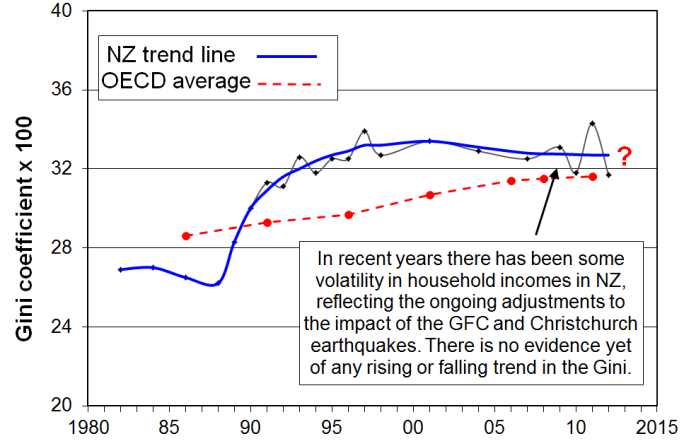
Source: Ministry of Social Development (2014)
Taxes and transfers have reduced inequality in New Zealand when measured by Gini coefficients, but the trend is been relatively stable for many years.
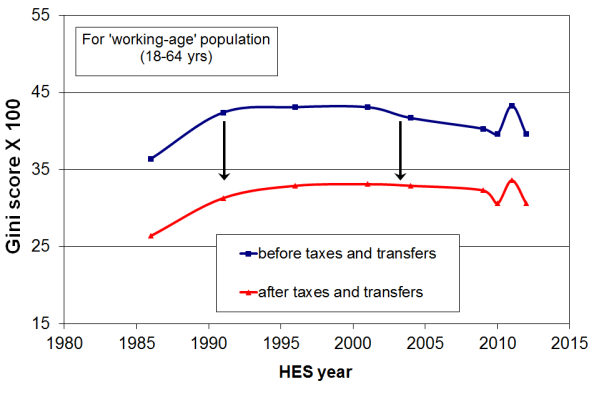
Source: Ministry of Social Development (2014)
Rawls pointed out that behind the veil of ignorance, people will agree to inequality as long as it is to everyone’s advantage. Rawls was attuned to the importance of incentives in a just and prosperous society. If unequal incomes are allowed, this might turn out to be to the advantage of everyone. Robert Nozick said that:
Political philosophers must now either work within Rawls’s theory or explain why not.
The groups that have been doing best in New Zealand have been Maori and Pasifika. In real terms, overall median household income rose 47% from 1994 to 2010; for Maori, this rise was 68%; for Pacific, 77%!
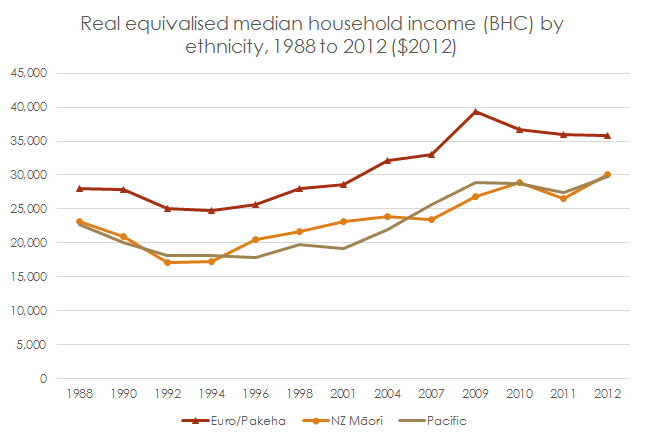
Source: Ministry of Social Development (2014)
The large improvements in Māori incomes since 1992 were based on rising Māori employment rates, fewer Māori on benefits or zero incomes, more Māori moving into higher paying jobs, and greater Māori educational attainment (Dixon and Maré 2007).
Maori unemployment reached a 20-year low of 8 per cent from 2005 to 2008. Labour force participation by Maori increased from 45% in the late 1980s to about 62% in the last few years.
Most of the remaining income disparities between Māori and non-Māori flow from differences in educational attainment and demographic and socio-economic characteristics including household composition (Chapple 2000; Maani 2004; Dixon and Maré 2007).
How much of the massive increases in incomes over the last 20 years spread throughout the entire community are you willing to give up for a little more equality? How much of your income will you donate to charity to lead the way?
.
The Reserve Bank Governor (2013) versus the Labour Party on whether its monetary policy upgrade will increase the inflation rate and destabilise the exchange rate
07 Jul 2014 Leave a comment
in inflation targeting, macroeconomics, politics - New Zealand Tags: exchange rate intervention, exchange rate targeting, inflation targeting
Attempts to keep the dollar from going “too high” would have ruinous domestic consequences as the Governor of the Reserve Bank explained last year:
If New Zealand decided to cap the NZ dollar, depending on where the cap is enforced, similar levels of intervention might be required as global foreign exchange turnover in NZ dollars relative to GDP is similar to that in Swiss francs.
The OCR would need to drop to zero first in order to eliminate the interest arbitrage motivation for NZ dollar inflows. Any attempt to retain non-zero interest rates by “sterilising” such massive intervention would be very difficult.
In effect therefore a Swiss type operation to cap the value of the NZ dollar through large scale FX intervention would also amount to quantitative easing. As I mentioned, this would be highly inflationary in the NZ context.
Graeme Wheeler, Governor of the Reserve Bank of New Zealand
20 February 2013
Sterilised interventions in the foreign exchange market are a fool’s errand
If exchange rate manipulation had any chance of working, the U.S. Fed, the Bank of England, the European Central Bank and the Bank of Japan would be all over it already. Their mutual efforts to depreciate their own currencies would cancel out.
Most central banks gave up on exchange rate interventions in the mid-1990s because attempts to manipulate exchange rates without loosening monetary policy rarely worked. Brute experience taught them that they were on fool’s errand.
These exchange rate interventions, known as sterilised interventions, become an independent source of exchange rate instability and invite counter-speculation by currency traders and hedge funds. Every hint that a central bank might intervene in the exchange rate invites currency speculation. As Milton Friedman said:
The central problem is not designing a highly sensitive [monetary] instrument that offsets instability introduced by other factors [in the economy], but preventing monetary arrangements becoming a primary source of instability…
By trying to move the value of the dollar, the Reserve Bank of New Zealand will add its own element of currency instability and invite counter speculation by currency traders and hedge funds. This is a dangerous game for a small Reserve Bank to play.

As stated by Paul Krugman in 1999 on the concept of the impossible trinity: free capital movement, a fixed exchange rate, and an effective monetary policy –
The point is that you can’t have it all: A country must pick two out of three.
It can fix its exchange rate without emasculating its central bank, but only by maintaining controls on capital flows (like China today); it can leave capital movement free but retain monetary autonomy, but only by letting the exchange rate fluctuate (like Britain – or Canada); or it can choose to leave capital free and stabilize the currency, but only by abandoning any ability to adjust interest rates to fight inflation or recession (like Argentina today or for that matter most of Europe).
Exchange rate manipulation by the Reserve Bank cannot alter the competiveness of exporters. The looser monetary policy will inevitably lead to higher CPI inflation that will erode any temporary advantage to exporters from the initial depreciation of the NZ dollar.
What did the Swiss do to keep their exchange rate down in the GFC?
Labour’s Monetary Policy Upgrade referred to the efforts of the Swiss National Bank to cap a massive appreciation of the Swiss Franc after 2009 and the Euroland sovereign debt crisis:
The Swiss have actively protected their currency from appreciating to the detriment of their tradeable sector (p.16)
 The Swiss National Bank stemmed the rise of Swiss franc by loosening their monetary policy as they say so themselves:
The Swiss National Bank has successfully maintained its exchange-rate floor against the euro, often through heavy nonsterilized purchases of foreign exchange (Swiss National Bank Annual Report, 2012, p. 34).
These non-sterilised exchange rate interventions were a loosening of Swiss monetary policy. The Swiss National Bank happens to be one of a number of central banks that conduct their monetary policies by buying and selling in the foreign exchange markets.
Labour’s aim of a positive external balance through a tightening of monetary policy is a repeat of the fool-hardy policies of the Hawke-Keating government in the late 1980s.
1988 witnessed a major monetary policy tightening in Australia. The tightening was motivated by a current account deficit rather than double-digit inflation:
- The inflation rate fell to below 3% in 1991.
- The current account did not change much as a result of the deep recession and 10%+ unemployment rate designed to bring it under control.
The current account deficit as a major policy problem was then quietly forgotten in Australia.
Three conflicting monetary policy objectives
The New Zealand Labour Party wants the Reserve Bank to do three impossible things before breakfast:
- Loosen monetary policy to bring the dollar down such as in Switzerland after 2009;
- Tighten monetary policy to reduce the current account deficit such as in Australia after 1988; and
- Loosen and tighten monetary policy as required to stay within the inflation target.
The best contribution of monetary policy to the competitive positions of exporters is low inflation.
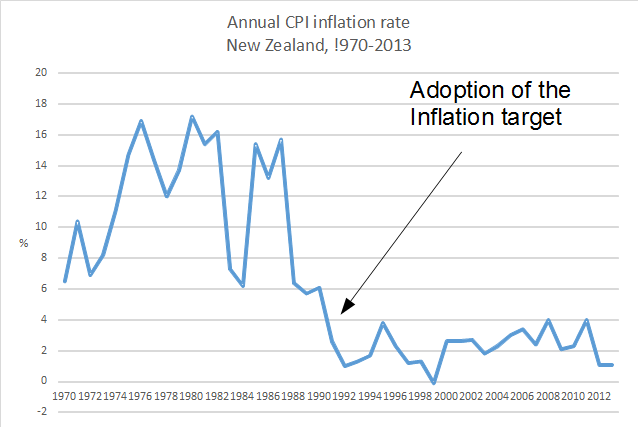
Inflation targeting removes monetary policy as in independent source of exchange rate instability. Attempts to manipulate the exchange rate undermines the inflation target that has been such a great success since 1989, and reduces the commitment of public policy to a stable, predictable business climate. Bordo and Humpage add:
…sterilised foreign-exchange intervention can sometimes affect exchange-rate movements, but sterilised intervention does not provide central banks with a mechanism for systematically altering exchange rates independent of their monetary policies.
Attempts to stabilise or undervalue exchange rates necessarily weaken a country’s control of its monetary policy and ultimately leave the real exchange rate unaffected.
What really matters?
Labour’s monetary policy upgrade is a distraction from the only game in town for the future prosperity of New Zealanders:
Productivity isn’t everything, but in the long run it is almost everything. A country’s ability to improve its standard of living over time depends almost entirely on its ability to raise its output per worker.
Paul Krugman
The Age of Diminishing Expectations (1994)
the beauty of proportional voting is that even if they don’t vote for you, you’ll probably still get in.
26 Jun 2014 Leave a comment
HT: Kiwiblog
The Greens want to ban… | Kiwiblog
10 Jun 2014 Leave a comment
in James Buchanan, politics - New Zealand, Public Choice Tags: Ban-it left, fatal conceit, meddlesome preferences, political correctness, pretense to knowledge

- Ban fizzy drinks from schools
- Ban fuel inefficient vehicles
- Ban all gaming machines in pubs
- Ban the GCSB
- Ban violent TV programmes until after 10 pm
- Ban feeding of antibiotics to animals that are not sick
- Ban companies that do not comply with a Code of Corporate Responsibility
- Ban ACC from investing in enterprises that provide products or services that significantly increase rates of injury or illness or otherwise have significant adverse social or environmental effects
- Ban commercial Genetic Engineering trials
- Ban field testing on production of GE food
- Ban import of GE food
- Ban Urban Sprawl
- Ban non citizens/residents from owning land
- Ban further corporate farming
- Ban sale of high country farms to NZers who do not live in NZ at least 185 days a year
- Ban the transport by sea of farm animals, for more than 24 hours
- Ban crates for sows
- Ban battery cages for hens
- Ban factory farming of animals
- Ban the use of mechanically recovered meat in the food chain
- Ban the use of the ground-up remains of sheep and cows as stock feed
- Ban animal testing where animals suffer, even if of benefit to humans
- Ban cloning of animals
- Ban use of animals in GE
- Ban GE animal food
- Ban docking of dogs tails
- Ban intrusive animal experimentation as a teaching method in all educational institutions
- Ban smacking
- Ban advertising during children’s programmes
- Ban alcohol advertising on TV and radio
- Ban coal mining
- Ban the export of indigenous logs and chips
- Ban the use of bio-accumulative and persistent poisons
- Ban the establishment of mustelid farms
- Ban new exploration, prospecting and mining on conservation land and reserves
- Ban mining activities when rare and endemic species are found to present on the mining site
- Ban the trading conservation land for other land to facilitate extractive activities on.
- Ban the further holding of marine mammals in captivity except as part of an approved threatened species recovery strategy
- Ban the direct to consumer advertising of pharmaceuticals
- Ban sale of chips and lollies on school property
- Ban any additional use of coal for energy
- Ban fixed electricity charges
- Ban further large hydro plants
- Ban nuclear power
- Ban further thermal generation
- Ban private water management
- Ban imported vehicles over seven years old
- Ban the disposal of recyclable materials at landfills
- Ban the export of hazardous waste to non OECD countries
- Ban funding of health services by companies that sell unhealthy food (so McDonalds could not fund services for young cancer sufferers)
- Ban healthcare organizations from selling unhealthy food or drink
- Ban advertising of unhealthy food until after 8.30 pm
- Ban all food and drink advertisements on TV if they do not meet criteria for nutritious food
- Ban the use of antibiotics as sprays on crops
- Ban food irradiation within NZ
- Ban irradiated food imports
- Ban growth hormones for animals
- Ban crown agency investments in any entity that denies climate change!!
- Ban crown agency investments in any entity that is involved in tobacco
- Ban crown agency investments in any entity that is involved in environmentally damaging oil extraction or gold mining
- Ban non UN sanctioned military involvement (so China and Russia gets to veto all NZ engagements)
- Ban NZ from military treaties which are based on the right to self defence
- Ban NZers from serving as mercenaries
- Ban new casinos
- Allow existing casinos to be banned
- Ban promotion of Internet gambling
- Ban advertising of unhealthy food to children
- Ban cellphone towers within 300 metres of homes
- Ban new buildings that do not confirm to sustainable building principles
- Ban migrants who do not undertake Treaty of Waitangi education programmes
- Ban new prisons
- Ban semi-automatic weapons
- Ban genetic mixing between species
- Ban ocean mineral extractions within the EEZ
- Ban limited liability companies by making owners responsible for liability of products
- Ban funding of PTEs that compete with public tertiary institutes
- Ban the importation of goods and services that do not meet quality and environmental certification standards in production, lifecycle analysis, and eco-labelling
- Ban goods that do not meet quality and sustainability standards for goods which are produced and/or sold in Aotearoa/New Zealand
- Ban new urban highways or motorways
- Ban private toll roads
- Ban import of vehicles more than seven years old unless they meet emission standards
- Ban imported goods that do not meet standards for durability and ease of recycling
- Ban landfills
- Ban new houses without water saving measures
- Ban programmes on TVNZ with gratuitous violence

via Kiwiblog
Can New Zealand blame its small size for its economic woes?
24 May 2014 Leave a comment
in geography, macroeconomics, politics - New Zealand Tags: income gap, New Zealand, relative economic performance
The median national population size is not much more than New Zealand’s current population.
- Controlling for location, Easterly and Kraay (2002) found that smaller states were richer than other states in per capita real GDP.
- Rose (2006) reviewed the impact of size on the level of income, inflation, material well-being, health, education, and the quality of a country’s institutions and found that small countries are more open to trade than large countries, but are not systematically different otherwise.
As I argued in my previous post on distance, New Zealand were prosperous from the time of European settlement despite a small population and their great distance from the main markets of the world on each side of the Atlantic.
Of the ten richest countries in terms of GDP per capita, only four have populations above one million people (Alesina 2003). These countries are the USA (290 million people), Switzerland (7 million people), Norway (4 million people) and Singapore (3 million people). Of these four nations, two are below the global national population median of six million (Alesina 2003).
New Zealand’s population is similar and often larger in size than most of the richest countries in the world. Singapore and Hong Kong were initially far from the global Trans-Atlantic economic hubs before their respective development miracles unfolded in the mid and late 20th century.
Something must have happened recently for either small population size or distance to have become important when it was not important for most of the history of New Zealand. New Zealand has been on the same place on the map for all its history.

Transport costs on exports to England and the rest of Europe did not hold back New Zealand’s economic development in the 19th century and for most of the 20th century despite far more primitive and more expensive forms of transport.
New Zealand specialised in commodities that could be produced at a low cost because land and water was plentiful and exported them in bulk to large markets on the other side of the world because of falling transport costs. The invention of refrigeration in 1881 was a major boost to meat exports to England.
The main economic difference between smaller and larger nation-states around the globe is smaller nations are more open to international trade and foreign investment (Alesina et al. 2005).
In a world of freer overseas trade, small countries can extend the size of their markets by trade and sidestep many of the costs of small internal markets. As long as political borders do not greatly limit international trade, economic success is increasingly independent of national size (Alesina 2003; Alesina et al. 2000).
A leading economic advantage of large national size in more isolationist times was a large marketplace free of trade and investment barriers and fewer national borders and different legal systems to parry. As more nations open up to the world, the single market benefits of large size for a country start to melt away quickly (Alesina 2003; Alesina and Spolaore 2003; Alesina et al. 2000).
As countries become larger, administration costs and the growing heterogeneity in the political preferences of larger and more diverse populations counterbalance the benefits of size and scale (Alesina et al. 2003, 2004, 2006; Spolaore 2006). More nation-states and freer trade increase the degree that governments must compete for citizens and investment. Inter-jurisdictional competition increases the incentives for governments to adopt institutions and policies that promote efficiency and productivity and serve their peoples better (Friedman 2005).
Greens as heirs of the 19th century Tory radicals
08 May 2014 1 Comment
in libertarianism, political change, politics - Australia, politics - New Zealand, Public Choice Tags: 19th century British Tory Radicals, green voters
The Greens are no more than a reincarnation of the 19th century British Tory Radicals with their aristocratic sensibilities that combined strong support for centralised power with a paternalistic concern for the plight of the poor:
- 19th century Tory radicals opposed the middle classes and the aesthetic ugliness they associated with an industrial economy; and
- Like the 19th century Tory Radicals, today’s green gentry see the untamed middle classes as the true enemy.
Environmentalists have an aristocratic vision of a stratified, terraced society in which the knowing ones would order society for the rest of us.
Environmentalism offered the extraordinary opportunity to combine the qualities of virtue and selfishness
Many left-wingers thought they were expressing an entirely new and progressive philosophy as they mouthed the same prejudices as Trollope’s 19th century Tory squires: attacking any further expansion of industry and commerce as impossibly vulgar, because it was:
ecologically unfair to their pheasants and wild ducks.
Neither the failure of the environmental apocalypse to arrive nor the steady improvement in environmental conditions because of capitalism has dampened the ardour of those well-off enough to be eager to make hair-shirts for others to wear.

The 19th century Tory radical’s disdain for the habits of their inferiors remains undiminished in their 21st century heirs and successors.
True to its late 1960s origins, political environmentalism gravitates toward bureaucrats and hippies: toward a global, little-brother government that will keep the middle classes in line and toward a back-to-the-earth, peasant-like localism, imposed on others but presenting no threat to the inner city elites’ comfortable middle class lives.
Unlike most, green voters tend to be financially secure and comfortable enough to be able to put aside immediate self-interest when imposing their political opinions.
The rising Green vote is a product of increasing tertiary education. Green voters are typically tertiary educated or undergoing tertiary education.
Green votes are defined by what they studied at university: arts, society and culture, architecture and education. Professionally they tended to be consultants, or worked in the media, health or education. Theses jobs are heavily concentrated in tertiary disciplines that are focused on much more than just making money.
Greens are very well-paid inner-urban dwellers who make more use of public transport and have few religious convictions. They tend not to have children until their 30s, if at all, which makes them even richer and gives them lots more spare time to organise political activities and annoy the rest of us. Some of them still haunt campuses, churning out more arts graduates, but increasingly, green voters comprise a well-heeled professional group.
Greens are distinct from the typical Labor or National voter demographic but they support the the Green Party for social rather than economic reasons. Not unlike middle-class Catholics in the 1950s and 1960s who voted Labour.
How ironic that the green gentry—progressives against progress—turn out to be nothing more than nineteenth-century urbane conservatives. There is nothing new under the sun.
Big HT: http://www.city-journal.org/2010/20_3_american-liberalism.html
The Internet Arguing Checklist for Right-Wingers
06 May 2014 Leave a comment
in politics - Australia, politics - New Zealand, politics - USA Tags: infotopia, open society
- Say something offensive.
- Pretend statistics support your offensive statement.
- Claim liberal bias in the media.
- Claim there’s a liberal agenda.
- Offer up a conspiracy theory.
- Call your opponent stupid.
- Gloat about your accomplishments.
- Offer easily disqualified opinions.
- Create derogatory nicknames for opponents.
- Say science proves your point.
- Say science is limited when it conflicts with your point.
- When all else fails, Communism!
via Pox Vopoli: The Internet Arguing Checklist for Right-Wingers.
The Internet Arguing Checklist for Left-Wingers
06 May 2014 Leave a comment
in politics - Australia, politics - New Zealand, politics - USA Tags: infotopia, open society
- Skim until Offended
- Disqualify that Opinion
- Attack, Attack, Attack
- Disregard Inconvenient facts
- Make Shit Up
- Resort to Moral Equivalency
- Concern Trolling
- When all else fails, Racism!


Recent Comments