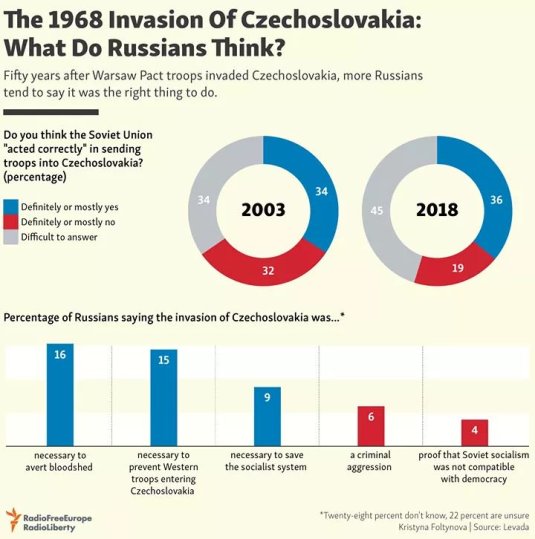
Russians and the Prague spring
24 Aug 2018 Leave a comment
in defence economics, war and peace Tags: fall of communism
Why Barbers have a Pole outside their Shop
23 Aug 2018 Leave a comment
in economic history, labour economics, occupational choice

Robert Lucas on the utopianism of most economic advisors
23 Aug 2018 Leave a comment
in applied price theory, applied welfare economics, comparative institutional analysis, economics of bureaucracy, history of economic thought, Public Choice, Robert E. Lucas Tags: The pretence to knowledge

Tough choice
23 Aug 2018 Leave a comment
in economics of regulation, environmental economics Tags: nanny state, The pretence to knowledge, unintended consequences

#OTD
23 Aug 2018 Leave a comment
in economic history, economics of information, economics of media and culture Tags: creative destruction

Behind on my #GMO blogging @greenpeace
23 Aug 2018 Leave a comment
in economics of information, economics of regulation, environmental economics Tags: anti-GMO movement, Anti-Science left

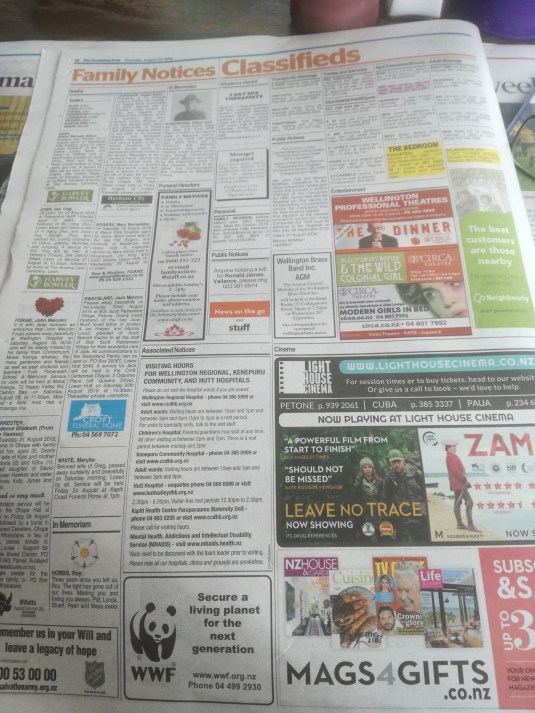
1 page of @DomPost classifieds! Rupert Murdoch once referred to the classifieds as a river of gold.
23 Aug 2018 Leave a comment
in economics of media and culture, industrial organisation, survivor principle Tags: creative destruction, legacy media
Hayek v. Rawls on Social Justice: Correcting the False Narrative
23 Aug 2018 Leave a comment

Matt Yglesias, citing an article (“John Rawls, Socialist?“) by Ed Quish in the Jacobin arguing that Rawls, in his later years, drifted from his welfare-state liberalism to democratic socialism, tweeted a little while ago
https://twitter.com/mattyglesias/status/1032410530173075456
I’m an admirer of, but no expert on, Rawls, so I won’t weigh in on where to pigeon-hole Rawls on the ideological spectrum. In general, I think such pigeon-holing is as likely to mislead as to clarify because it tends to obscure the individuality of the individual or thinker being pigeon-hold. Rawls was above all a Rawlsian and to reduce his complex and nuanced philosophy to simple catch-phrase like “socialism” or even “welfare-state liberalism” cannot possibly do his rich philosophical contributions justice (no pun intended).
A good way to illustrate both the complexity of Rawls’s philosophy and that of someone like F. A. Hayek, often regarded as standing on the opposite end of…
View original post 684 more words
2,600 graphs from the American Economic Review
23 Aug 2018 Leave a comment
in economics of information, economics of media and culture
Bari Weiss returns with a column on Asia Argento, Avital Ronell, #MeToo, and the Shoe on the Other Foot
23 Aug 2018 Leave a comment

I don’t know how anyone can find this new New York Times column by Bari Weiss objectionable, but I know they’ll try. (Click on screenshot to read it.)
The column is about two women who have been accused of sexual abuse. The first, Asia Argento, is an actor who was revealed to have paid $380,000 to buy the silence of a 17 year old boy (below the age of consent) with whom she apparently had sex. The ironic thing is that Argento was one of the main accusers of Harvey Weinstein in the #MeToo scandal. Argento was important in helping bring down Weinstein, and in calling attention to men’s use of power to leverage sexual mistreatment of women, but it turned out she herself had apparently committed sexual malfeasance.
Weiss’s column is balanced, pointing out that women, too, can be abusive, manipulative, and cruel. Yet at the same time she’s…
View original post 871 more words


Recent Comments