What % of each occupation needs a license or certificate in the USA?
23 Apr 2016 1 Comment
in applied price theory, applied welfare economics, economics of regulation, labour economics, labour supply, occupational choice, occupational regulation, Public Choice, rentseeking Tags: adverse selection, barriers to entry, moral hazard, occupational licensing, occupational regulation
The 2015 Current Population Survey in the USA added a question about whether you needed a licence or a certificate to practice your occupation. One in 4 Americans say they need a licence or certificate. 22.4% need a license and 3.1% need a certificate among employed over the age of 16 in the USA.
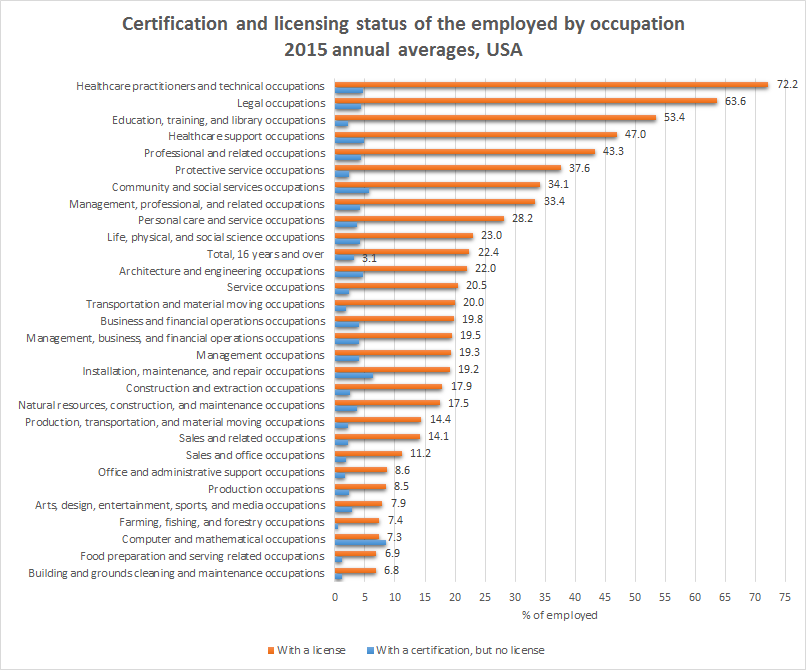
Source: Bureau of Labour Statistics, Labor Force Statistics from the Current Population Survey (2015), Certification and licensing status of the employed by occupation Table 5.
This estimate of 25% is less than the 30% estimated by Kleiner and Vorotnikov (2015) using a Harris Poll. Kleiner and Vorotnikov (2015) also found that some American states regulate twice as many occupations as others. This diversity in federalism strains any public interest explanation of occupational regulation.
Occupational regulation is more likely to be an issue for those who finished further education. It would have been better if the estimate by the Bureau of Labour Statistics was for adults and not have included teenagers.
The purpose of occupational regulation is to protect buyers from quacks and lemons – to overcome asymmetric information about the quality of the provider of the service.
The main issue with quacks in the labour market is whether there is a large cost of less than average quality service, and is there a sub-market who will buy less than average quality products in the presence of competing sellers competing on the basis of quality assurance. This demand for assurance creates opportunities for entrepreneurs to profit by providing assurance of quality.
Mostly disciplinary investigations and deregistrations under the auspices of occupational regulation are for gross misconduct and criminal convictions rather than the shading of quality.
The cost of starting a business in Europe and North America
18 Apr 2016 Leave a comment
in economics of regulation, industrial organisation, law and economics, politics - USA, property rights Tags: barriers to entry, Belgium, British economy, Canada, Denmark, doing business, France, Germany, Greece, Italy, Portugal, Spain
These measures including the full cost of starting a business. Not only are official fees included, the opportunity cost of the waiting times for various permits are issued are added as well.
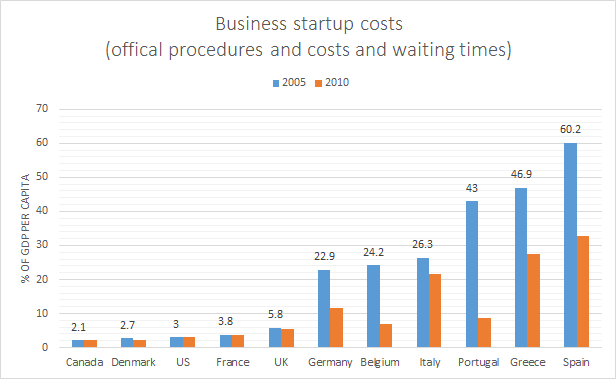
Source: Markus Poschke, Entry regulation: Still costly | VOX, CEPR’s Policy Portal (2011).
Note: The value of time is set to a business day’s output per day of waiting time at 22 business days per month.
Chiselling on the Closer Economic Relations agreement between New Zealand and Australia
10 Mar 2015 Leave a comment
in economics of media and culture, economics of regulation, politics - Australia, politics - New Zealand, rentseeking Tags: barriers to entry, closer economic relations, creative destruction, export pricing, free trade, Hollywood economics, price discrimination, protectionism, rent seeking
Back in the day, New Zealand television programming was sold cheaply into the Australian market. Many cultural and other products are exported into foreign markets and sold for whatever they can get above the price of shipping or digital transmission. What else explains all that rubbish on cable TV?
Under the Closer Economic Relations agreement that creates a single market between Australia and New Zealand, New Zealand made television programming content must be treated the same way as Australian content so it was included in their 50% local content rules for commercial television back from whenever I remember this story from. There was a Federal Court of Australia case that ruled that New Zealand television programming was Australian content programming for the purposes of the relevant media regulations because of Closer Economic Relations.

From the late 1990s, with revival of the New Zealand film and television industry, New Zealand content was starting to flood the Australian market, especially in the off-season in the summer when stations were looking for cheap content to fill a low ratings period.

Naturally, this Kiwi invasion did not please the rent seeking Australian television programme production industry and many a mendicant actor, writer and producer
Where there is a will, where there is a way: minimum quality standards are introduced into the Australian content rules defined by price – a price that happen to be above what the television stations used to pay for New Zealand made programming.
Is surge pricing by Uber another name for overtime and weekend pay
28 Jan 2015 Leave a comment
in applied price theory, economics of media and culture, economics of regulation, Public Choice, rentseeking, transport economics Tags: barriers to entry, compensating differentials, peakload pricing, taxi regulation, Uber

Uber is in strife of late for charging more at peak times - Uber calls it surge pricing. We don’t object paying more for a meal at a restaurant at dinner time rather than at lunchtime but the same people object to paying more for the taxi late at night where the driver must risk the dangers of solitary night-time work and picking up strangers who might have had a few too many.

Under Uber’s now-national policy, price surging is capped during disasters and states of emergency at the fourth-highest nonemergency surge seen in the previous two months.

We all expect to pay more for air tickets at peak times, such as school holidays and Christmas. Indeed, one reason we are able to delay booking is we know seats will be available because they are selling at a premium for those who booked late. Others who make their plans early quite enjoy getting the cheaper for early bird bookings.

Is surge pricing another name for over time and night and weekend pay? Union contracts provide for overtime pay, if you work more than the specified 8 hours a day.
The Holidays Act in New Zealand provides that if an employee works at the weekends, they are paid at 150% of the normal rate; and double party on public holidays. Not many employees object of this wage premium for work in it inconvenient times. Cafes and restaurants routinely charge of 10-15% price premium on public holidays to cover this overtime pay.

As would be expected under the theory of compensating differentials, there are wage premiums for jobs where the worker must work at inconvenient or unsocial times, in jobs with a greater risk of injury, or otherwise work more unpleasant than the average.

Viscusi estimated the wage premium for hazardous jobs to be rather large in the United States:
The extra pay for job hazards, in effect, establishes the price employers must pay for an unsafe workplace.
Wage premiums paid to U.S. workers for risking injury are huge; they amount to about $245 billion annually (in 2004 dollars), more than 2 percent of the gross domestic product and 5 percent of total wages paid. These wage premiums give firms an incentive to invest in job safety because an employer who makes the workplace safer can reduce the wages he pays.
Those who don’t like Uber’s surge pricing can always hail a cab. As I remember from American TV programmes, at peak times, prospective customers on the side of the road hail cabs at peak times with several fingers raised to indicate how much more than the standard fare, they are willing to pay.

There is nothing new under the sun. Uber’s app allows you to do the price bidding for a taxi on your cellphone rather than out in the cold
Israel Kirzner on the sole exception that justify competition laws and the regulation of network industries
14 Nov 2014 Leave a comment

Barriers to entry alert: do late entrants have a chance
22 Sep 2014 Leave a comment
in applied price theory, Austrian economics, economic history, entrepreneurship, industrial organisation, liberalism, technological progress Tags: Austrian economics, barriers to entry, creative destruction, Israel Kirzner, market process
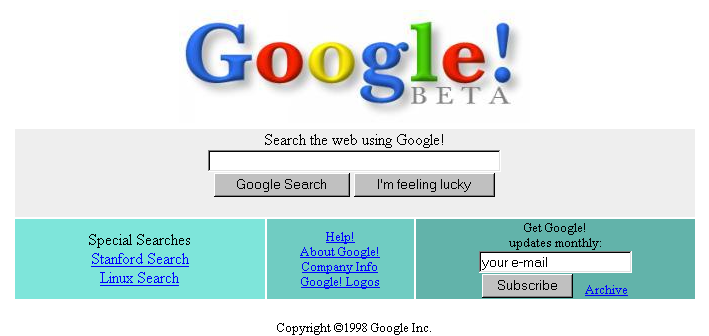
September 21, 1999 – Google came out of beta; the 17th search engine to officially enter the market.
Kirzner defines a competitive market as a market where no potential participant faces non-market obstacles to entry:
Following a long tradition in economics going back at least to Adam Smith, Austrians define a competitive market not as a situation where no participant or potential participant has the power to make any difference, but as a market where no potential participant faces nonmarket obstacles to entry.
(The adjective “nonmarket” refers, primarily, to government obstacles to entry; it is used to differentiate such obstacles from, for example, high production costs that might discourage entry. These latter do not constitute noncompetitive elements in a market; to be able to enter means to be able to enter a market if one judges such entry to be economically promising-it does not mean to be able to enter without having to bear the relevant costs of production.) That is, a situation is competitive if no incumbent participant possesses privileges that protect him against the possible entry of new competitors.
The achievements that free markets are able to attain depend, in the Austrian view, on freedom of entry, that is, on the absence of privilege.

 Utopia, you are standing in it!
Recent Comments