US Teen Pregnancy, Birth and Abortion Rates since 1972 http://t.co/mwR1U6WJg8—
Max Roser (@MaxCRoser) August 06, 2015
US Teen Pregnancy, Birth and Abortion Rates
16 Aug 2015 Leave a comment
in economic history, gender, labour economics, labour supply, politics - USA, population economics, welfare reform Tags: abortion, economics of fertility, marriage and divorce, single mothers, single parents, teen pregnancy
Population projections for the rest of this century
10 Aug 2015 Leave a comment
in development economics, economic history, population economics Tags: ageing society, demographic crisis, economics of fertility
Daily chart: India will surpass China as the world's most populous country in 2022 econ.st/1MKsSFu http://t.co/EBeGKsMCtp—
The Economist (@ECONdailycharts) August 05, 2015
Unwanted pregnancy rates and education
20 Jul 2015 Leave a comment
in applied price theory, applied welfare economics, labour economics, labour supply, occupational choice, politics - USA Tags: economics of fertility, economics of the family, single parents
Fertility is down everywhere
07 Jul 2015 Leave a comment
in development economics, population economics Tags: demographic transition, economics of fertility
The world is making less people en.wikipedia.org/wiki/Total_fer… | http://t.co/FlgwlrkUJO—
Charts and Maps (@ChartsAndMaps) April 04, 2015
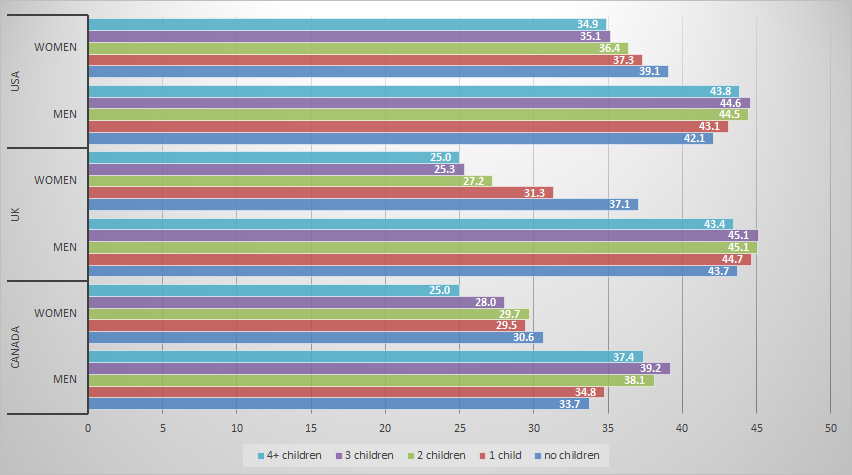
Average weekly working hours by gender and presence of children, Canada, UK and USA
07 Jul 2015 Leave a comment
in discrimination, economics of love and marriage, gender, labour economics, labour supply, law and economics Tags: economics of fertility, female labour force participation, household division of labour, marriage and divorce, maternal labour force participation
Figure 1: average weekly working hours for Current or Last Job(s) Held aged 20-54 by gender, 2004
Child poverty certainly didn’t go up after the 1996 federal welfare reforms
01 Jul 2015 1 Comment
in gender, labour economics, labour supply, poverty and inequality, welfare reform Tags: 1996, child poverty, economics of fertility, single mothers, single parents, taxation and the labour supply, welfare reforms
Working population poverty is unchanged despite declines in elderly and child poverty #PovertyIs http://t.co/i7O7dTEUg2—
Political Line (@PoliticalLine) June 19, 2015
P.T. Bauer on overpopulation
24 Jun 2015 Leave a comment
in development economics, human capital, labour economics, P.T. Bauer, population economics Tags: economics of fertility, endogenous growth theory, overpopulation, population bomb

.
Proportion of births out of wedlock, 2011, Anglo-Saxon countries
20 Jun 2015 Leave a comment
in gender, labour economics, labour supply, occupational choice, politics - Australia, politics - New Zealand, politics - USA, population economics Tags: economics of fertility, economics of the family, single mothers, single parents
Figure 1: Proportion of births out of wedlock, 2011, Anglo-Saxon countries
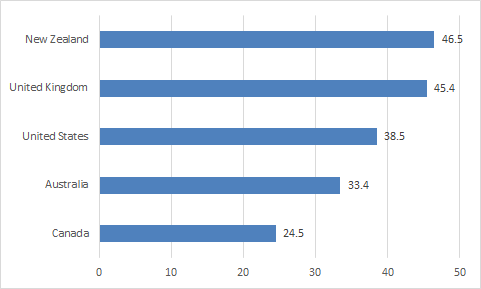
Source: OECD family database; no data for Ireland.
Japanese population has peaked and is now in rapid decline to 2050
27 Apr 2015 Leave a comment
in labour economics, labour supply, population economics Tags: ageing society, economics of fertility, Japan, labour demographics
Japan's projected population through 2050. #dataviz
Source: washingtonpost.com/blogs/worldvie… http://t.co/79DKF0mQTs—
Randy Olson (@randal_olson) January 06, 2015
The impact of religion on fertility rates
05 Apr 2015 Leave a comment
in economics of religion, population economics Tags: economics of fertility, family demographics
People with no religion have about 1 child less per woman than the religiously affiliated
researchgate.net/publication/27… http://t.co/mqGVk7GpyH—
Conrad Hackett (@conradhackett) April 05, 2015
Single parenthood in the USA by ethnicity
18 Mar 2015 1 Comment
in economics of love and marriage, gender, labour economics, occupational choice, poverty and inequality, welfare reform Tags: child poverty, economics of fertility, single parenthood, single parents

An International Look at the Single-Parent Family–where is New Zealand?
16 Mar 2015 1 Comment
in discrimination, economics of love and marriage, gender, labour economics, labour supply, law and economics, occupational choice, welfare reform Tags: economics of fertility, family demographics, labour demographics, single parents

The explosion in women’s professional education just after the pill became widely available
07 Mar 2015 Leave a comment
in discrimination, economic history, economics of education, gender, labour economics, labour supply, occupational choice, politics - USA Tags: economics of fertility, engines of liberation, female labour supply, gender wage gap, reversing gender gap, The Pill
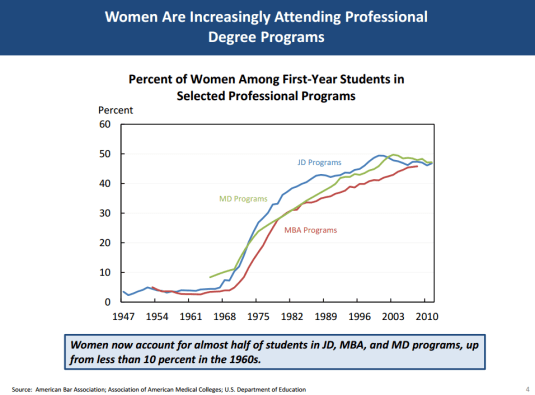
Source: whitehouse.gov


Recent Comments