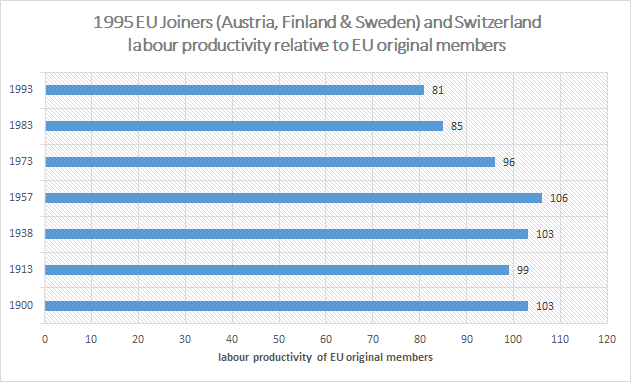
EU late joiners relative labour productivities @NickCohen4 @iainmartin1 @CapX
17 Jan 2016 Leave a comment
in currency unions, economic growth, economic history, international economics, macroeconomics Tags: Common market, customs unions, European Union, trading blocs preferential trading agreements
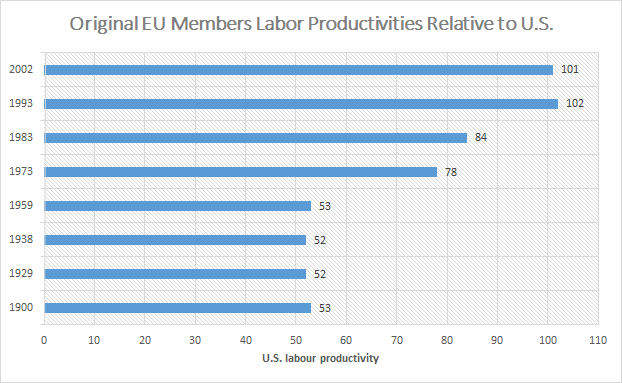
Original EU Labor Productivities Relative to U.S. @NickCohen4 @iainmartin1 @CapX
17 Jan 2016 Leave a comment
in currency unions, economic growth, economic history, Euro crisis, international economics, macroeconomics Tags: Brexit, Common market, customs unions, European Union, free trade agreements, preferential trading agreements
Source: Edward Prescott.
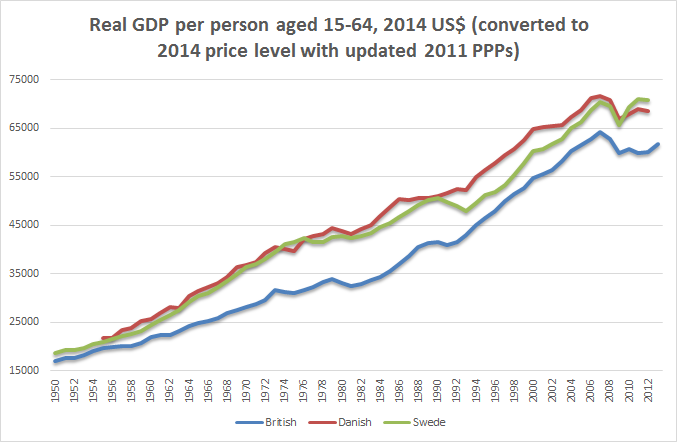
Real GDP per working age British, Dane and Swede 1950 – 2012, PPP
24 Sep 2015 Leave a comment
in economic history Tags: British disease, British economy, Common market, customs unions, Denmark, European Union, Margaret Thatcher, Sweden, Swedosclerosis
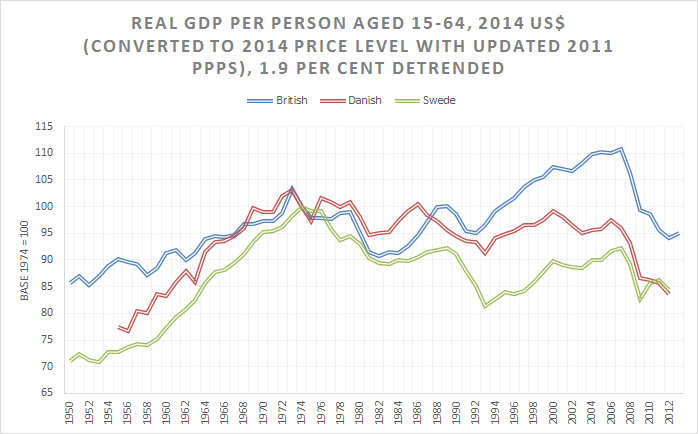
Source: Computed from OECD StatExtract and The Conference Board. 2015. The Conference Board Total Economy Database™, May 2015, http://www.conference-board.org/data/economydatabase/
The data is detrended at 1.9% per year – the trend rate of growth for the USA in the 20th century. A rising line means growth greater than 1.9% for that year, a falling line means growth of less than 1.9% for the year. A flat line is growth of 1.9% for that year.
Britain, Sweden and Denmark all grew quickly up until the 1970s in a period known as post-war catch up.In the 1970s and early 1980s, there was the British disease. The 1970s to the early 1990s was Swedosclerosis. There was a boom in the British economy subsequent to the economics of Mrs Thatcher.
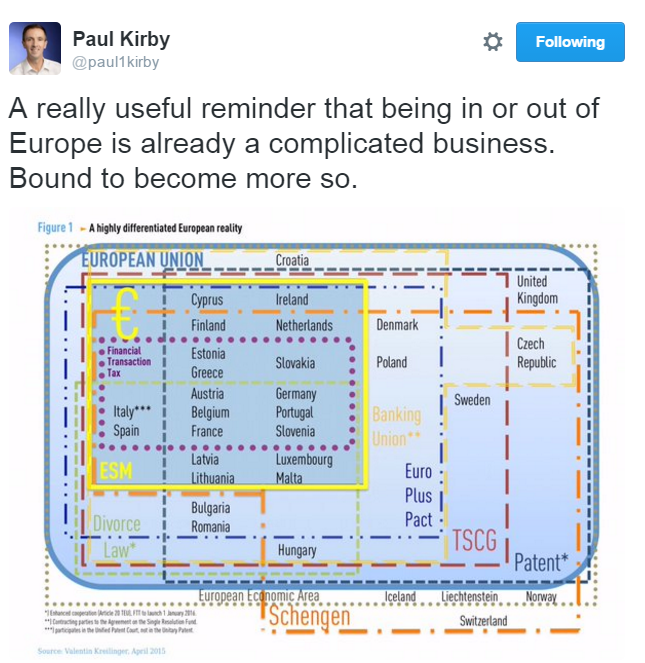
European integration explained in one easy chart
25 Jul 2015 Leave a comment
in currency unions, Euro crisis, international economics, macroeconomics Tags: Common market, customs unions, economics of immigration, EU, Euro, Euroland, European free trade area, European Union, free trade agreements, free trade areas, open borders, preferential trading agreements
AMAZING chart on European integration. One to pin to your office wall. Nice job by @Nic_Koenig delorsinstitut.de/2015/wp-conten… http://t.co/zZbOA29mYP—
Maxime Sbaihi (@MxSba) July 24, 2015
Who are the members of Euroland?
17 Jun 2015 Leave a comment
in currency unions, Euro crisis, macroeconomics Tags: Euroland, European Union
Since today is Europe Day, a look at which countries have and haven't adopted the Euro brilliantmaps.com/eurozone2015/ http://t.co/N8tGhBe8eN—
Brilliant Maps (@BrilliantMaps) May 09, 2015
Ease of doing business across the European Union is rather variable
22 May 2015 Leave a comment
in economics of regulation, law and economics, property rights Tags: ease of doing business, European Union
A list of the ease of doing business in Europe, due to sluggish legal systems. Our #Dailychart econ.st/1sFiEry http://t.co/aFm7cgw9dx—
The Economist (@ECONdailycharts) October 29, 2014
Maybe joining Euroland isn’t that bad after all
08 May 2015 Leave a comment
in business cycles, currency unions, development economics, Euro crisis, global financial crisis (GFC), growth miracles, international economics, macroeconomics, monetary economics Tags: Eastern Europe, Euroland, European Union, Eurosclerosis, transitional economies
#Dailychart: How "New Europe" has fared on its tenth birthday econ.st/1fwOg33 http://t.co/AvkCqHmzAf—
The Economist (@ECONdailycharts) May 01, 2014
Maybe the European Union membership isn’t that bad after all, especially if you’re a former Eastern Bloc country
24 Apr 2015 Leave a comment
in applied price theory, applied welfare economics, comparative institutional analysis, constitutional political economy, development economics, growth disasters, growth miracles Tags: European Union, transitional economies
A refugee boat from Libya
22 Apr 2015 Leave a comment
in Economics of international refugee law, law and economics Tags: European Union, Italy, Libya, refugees
Libyans are dying as they flee a mess that Britain helped create. It's time to help: specc.ie/1GMxFoc http://t.co/zyRgLFPZJ2—
Fraser Nelson (@FraserNelson) April 18, 2015
Equivalent of 5 passenger planes full of people have drowned last week alone amn.st/6010frwe #DontLetThemDrown http://t.co/bEIE2mpJIh—
Amnesty UK (@AmnestyUK) April 20, 2015
The rest of Europe can’t expect Germany to keep bailing them out
22 Apr 2015 Leave a comment
in Euro crisis, macroeconomics, population economics Tags: ageing society, European Union, Eurosclerosis, France, Germany, labour demographics
BofA-ML: Working age population projections, a serious problem for Germany http://t.co/eStgQePoVP—
Fabrizio Goria (@FGoria) March 30, 2015
The ease of enforcing contractual rights in Europe
11 Apr 2015 Leave a comment
in Euro crisis, law and economics, macroeconomics, property rights Tags: ease of doing business, European Union, Eurosclerosis, Greece, rule of law
Most of the EU is heavily reliant on Russian natural gas
02 Apr 2015 Leave a comment
in energy economics Tags: European Union, Russia, Ukraine crisis
Roberts Solow on the British disease and Eurosclerosis
21 Mar 2015 Leave a comment
in currency unions, economic growth, economics of regulation, Euro crisis, fiscal policy, job search and matching, labour economics, labour supply, macroeconomics Tags: British disease, Euroland, European Union, Eurosclerosis, Robert Solow
Europe’s Climate Fail
17 Mar 2015 Leave a comment
in environmental economics, politics - USA Tags: Carbon cap, carbon tax, carbon trading, European Union
Europe’s rate of decarbonization was essentially identical before and after the ETS was introduced. If the program has effects, decarbonization has not been detectable beyond historical business-as-usual rates.

HT: http://thebreakthrough.org/index.php/voices/roger-pielke-jr/europes-climate-fail
Recent Comments