What Donald Trump doesn’t understand about trade
08 Feb 2017 1 Comment
in applied price theory, applied welfare economics, international economics Tags: 2016 presidential election, comparative advantage, free trade
The Flow of International Trade
08 Jan 2017 Leave a comment
in international economics Tags: free trade
50% of @PaulineHansonOz @OneNationAus votes come from @AustralianLabor voters
22 Sep 2016 1 Comment
in constitutional political economy, politics - Australia, Public Choice Tags: 2016 Australian federal election, antiforeign bias, antimarket bias, expressive voting, free trade, globalisation, left-wing popularism, makework bias, rational irrationality, right-wing popularism
How can Pauline Hanson be an extreme right-winger if half of her votes come from people who 2nd preference the Australian Labour Party? This strong support for her populism has been well-known since she won the safest Labour Party seed in Queensland in the 1996 Australian Federal Election but is hardly ever mentioned by the media or her critics.
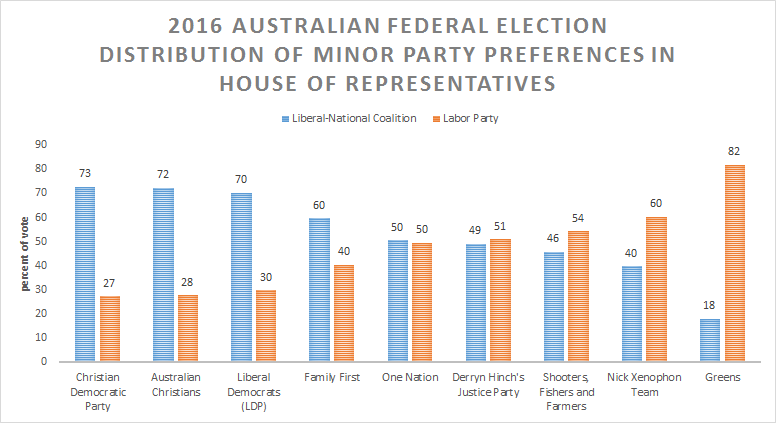
Source: Antony Green’s Election Blog: Preference Flows at the 2016 Federal Election.
It should be therefore no surprise that a lot of her views have popular support because she has support across the political spectrum. Not knowing that will means you will be not very good at combating her views which you simply do not understand where they come from.
Few of her supporters see themselves as extremists and will be insulted when you suggest they are. Listen here dummy is no way to win back votes of people who just voted for you recently.
Hanson’s support among Labour voters is increasing. Only 42% of her voters gave their 2nd preference to Labour in previous federal elections for the House of Representatives.
A pro-poor bias of trade in every country #TPPANoWay @Oxfamnz
26 Aug 2016 Leave a comment
in international economics Tags: free trade
Poor consumers spend relatively more on sectors that are more traded, while high-income individuals consume relatively more services, which are among the least traded sectors.

Source: Pro-poor bias of trade: New research on the expenditure channel | VOX, CEPR’s Policy Portal.
Milton Friedman Speaks – Free Trade: Producer vs. Consumer
27 Jul 2016 Leave a comment
in applied price theory, international economics, Milton Friedman Tags: free trade
@BernieSanders should be the @realdonaldtrump’s running mate
08 May 2016 Leave a comment
in applied price theory, applied welfare economics, international economics, politics - USA Tags: 2016 presidential election, comparative advantage, free trade, left-wing popularism, rational ignorance, rational rationality, right-wing popularism
What undergrads and @stevenljoyce need to know about trade @GreenCatherine
12 Apr 2016 Leave a comment
in applied price theory, applied welfare economics, development economics, international economics, job search and matching, labour economics, labour supply, macroeconomics, politics - New Zealand Tags: antiforeign bias, free trade, makework bias, Paul Krugman, protectionism, tariffs, trade policy
Minister for everything Stephen Joyce wrote some nonsense in the paper today about how trade agreements and more exports will mean more jobs:
I would like to make the point that trade access is hugely important for a small country like New Zealand.
Without fair and equal trade access we can’t sell as much of our goods and we get less for them. And that means fewer jobs.
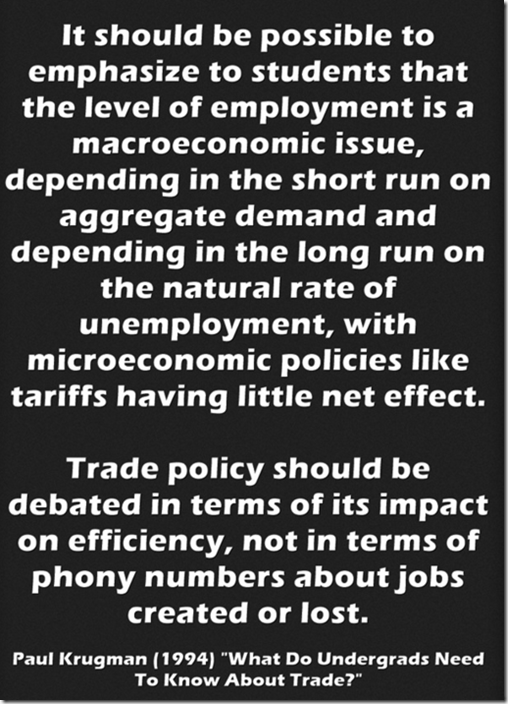
This make-work bias is as bad as those who oppose trade agreements on the grounds of an anti-foreign bias. Trade affects the composition of employment, not the number of jobs. Paul Krugman spent a good part of the 1990s trying to explain that to the general public and public intellectuals.
Explaining free trade to @realdonaldtrump @BernieSanders with the same biased, bought and paid for video
08 Feb 2016 Leave a comment
in applied welfare economics, international economics, politics - USA Tags: 2016 presidential election, free trade, left-wing popularism, rational ignorance, rational irrationality, right-wing popularism
#TPPANoWay @oxfamNZ @GreenpeaceUSA The Effects of Globalization
07 Feb 2016 Leave a comment
in applied price theory, applied welfare economics, development economics, economic history, growth disasters, growth miracles, international economics, Marxist economics Tags: customs unions, expressive voting, free trade, Leftover Left, ODA, preferential trading agreements, rational ignorance, rational irrationality, The Great Escape, The Great Fact, TPA, TPPA, Twitter left, Tyler Cowen
Why Does 1% of History Have 99% of the Wealth? @Oxfam #TPPANoWay
06 Feb 2016 Leave a comment
in development economics, economic history, growth disasters, growth miracles, history of economic thought, international economics Tags: capitalism and freedom, free trade, global poverty, globalisation, industrial revolution, international technology diffusion, technology diffusion, The Great Enrichment, The Great Fact, TPPA
Development & Trade: Empirical Evidence @DavidShearerMP @oxfamnz @TPPANoWay
29 Jan 2016 Leave a comment
in applied price theory, applied welfare economics, development economics, economic history, growth disasters, growth miracles, international economics, politics - New Zealand, politics - USA Tags: free trade, free trade agreements, preferential trading agreements, The Great Enrichment, The Great Fact, TPPA, WTO
@jeremycorbyn @BernieSanders oppose the one path to peace
04 Nov 2015 Leave a comment
in international economics, liberalism, politics - USA, war and peace Tags: British politics, capitalism and freedom, China, expressive voting, free trade, game theory, populists, rational ignorance, rational irrationality, Richard Cobden, World War I

Jeremy Corbyn is in trouble again, this time for describing World War I as pointless.
Corbyn has, for all his life, opposed the only means of securing peace either in Europe or anywhere else. He is against trade agreements, the European Union and NATO. Bernie Sanders is equally as misguided.
Corbyn and Sanders thinks you can make peace just by talking with people. Peace is made by trading with hostile countries to make them depend on you for their prosperity as well as yours. By growing rich through free trade, it’s in no ones interest to go to war or have poor relations with each other or each other’s friends.
Why do @NZGreens want NZ to lead the world by example on a carbon tax, but not unilateral free trade?
31 Jul 2015 Leave a comment
in David Friedman, environmental economics, global warming, international economics, Milton Friedman, Murray Rothbard, politics - New Zealand Tags: antiforeign bias, antimarket bias, carbon tax, carbon trading, climate treaties, expressive voting, free trade, global warming, left-wing double standards, Left-wing hypocrisy, New Zealand Greens, protectionism, rational ignorance, rational irrationality, unilateral free trade


NZ’s greenhouse gas emissions are high per person and unit of GDP but have fallen since 1990 oe.cd/10z http://t.co/f5BMLMvTjq—
OECD Publications (@OECD_Pubs) June 10, 2015
A lot of voters want to protect themselves from the scourge of lower prices
09 Jul 2015 Leave a comment
in industrial organisation, international economics, politics - Australia, politics - New Zealand, politics - USA Tags: antiforeign bias, antimarket bias, expressive voting, free trade, rational ignorance, rational irrationality, voter demographics
Who favors free trade?
(The affluent.)
nytimes.com/2015/05/28/ups… @BrendanNyhan http://t.co/kojmUWUtH0—
Justin Wolfers (@JustinWolfers) May 27, 2015
 Utopia, you are standing in it!
Recent Comments