Questions arise as to how the Labour Party will fund its Universal Basic Income after ruling out a tax rate of 50%. As Brain Easton said:
Many advocates put the UMI forward without doing the sums. Those who do find that the required tax rates are horrendous or the minimum income is so low that it is not a viable means of eliminating poverty. Among the latter are New Zealanders Douglas, Gareth Morgan and Keith Rankin.
The Labour Party’s background paper already has said that the Universal Basic Income proposed by the Morgan Foundation is insufficient because many beneficiaries and all retirees will be much worse off. They receive much more in income support under the existing welfare state and they would under a Universal Basic Income of $11,000 per adult as proposed by the Morgan Foundation.
The solution proposed by the Labour Party is a supplemental income transfers to ensure no one is worse under a Universal Basic Income. This will greatly increase the cost of a Universal Basic income in comparison to the Morgan Foundation proposals.
A series of questions come to mind that the Labour Party and its finance spokesman Grant Robinson must answer if they are to go anywhere with a Universal Basic Income;
Is not the point of a Universal Basic Income to replace the welfare state, not supplement it?
How will the Labour Party fund its Universal Basic Income plus the supplemental income transfers without introducing a $8 billion tax on capital income (including the family home) as in the Morgan Foundation’s proposals?
The Universal Basic Income proposed by the Morgan Foundation requires $13 billion in extra taxes ($8 billion from taxing capital and $5 billion from a 30% flat-rate income tax) so how much more to that will Labour need for a Universal Basic Income plus supplemental income transfers?
What is the maximum top marginal income tax rate that Labour will consider to fund a Universal Basic Income?
Will the Labour Party’s Universal Basic Income be funded by a flat rate income tax or a progressive income tax system?
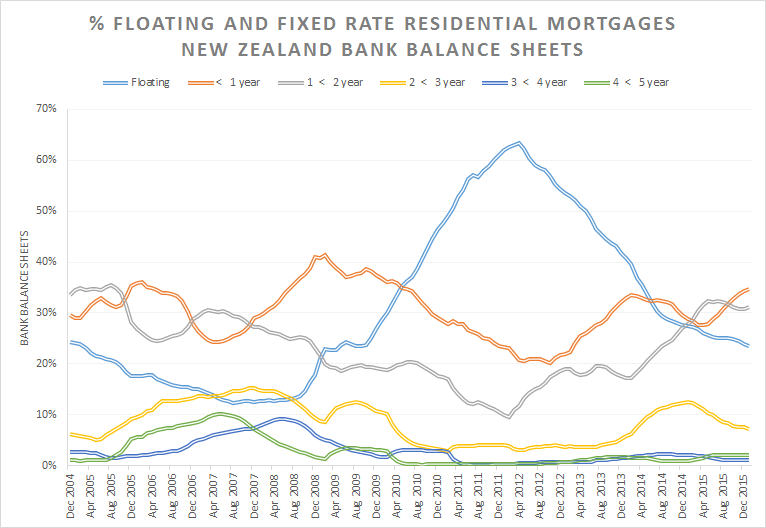
Despite the best efforts of the libertarian paternalists to sell the other people are stupid fallacy, ordinary New Zealanders are quite nimble at moving between fixed and floating rates depending upon their forecasts of the future of interest rates. Price controls on floating rate mortgages, as suggested by the New Zealand Labour Party, would make this more difficult, not easier.
I did not know so many people were on a fixed rate mortgage. Labour is risking its economic credibility on regulating the rates for a minority of mortgages.
Capped mortgages cannot be linked to the current official cash rate of the Reserve Bank of New Zealand because they are based on expected future interest rates over an up to 5 year span, not current interest rates.
An important motivation for going onto a floating rate is you can repay faster. Fixed rate mortgages have penalties for early repayment.
In consequence, price controls linking floating rate mortgages to the official cash rate of the Reserve Bank would benefit better off mortgagees expecting to repay quickly. A typical policy of the modern Labour Party.
Labour will free up density and height controls to allow more medium density housing and reform the use of urban growth boundaries so they don’t drive up section costs. This will curb land bankers and speculators.
Labour has struck at the heart of two major constraints on urban land supply New Zealand: restrictions on density and height of new developments, and much more importantly, the use of urban growth boundaries to drive up land prices. These proposed regulatory reforms could not be more welcome.
The other new element is changing the way we fund infrastructure for new developments. Currently those costs are either subsidised by the ratepayer or passed by the developer onto the price tag of a new home. That makes houses much more expensive. It also means they are paid off through mortgages at expensive bank interest rates.
Our new policy will see infrastructure funded by local government bonds, paid off over the lifetime of the asset through a targeted rate on the properties in the new development. This will substantially reduce the cost of new housing.
The reforms proposed by Labour to local government financing will reduce the financial burden on existing ratepayers of the local government funded infrastructure necessary to support new land developments.
These Labour Party reforms are fantastic because the main party on the left-wing of New Zealand politics has faced up to restricted land supply as a key reason behind housing unaffordability. I wonder what the New Zealand Greens will think of these major new reforms.
A few more sensible economic and fiscal policy announcements such as those today by the New Zealand Labour Party and it will start looking like a credible alternative government.
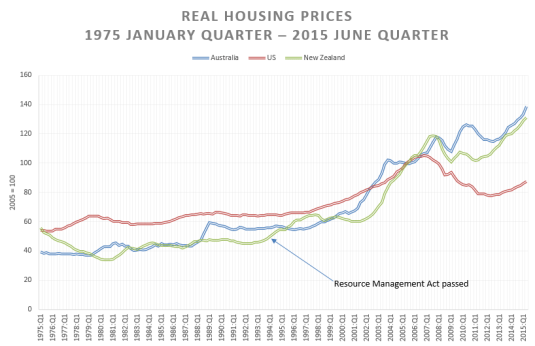
New Zealand housing prices were pretty stable until the passage of the Resource Management Act in 1993. After that, prices took off New Zealand and didn’t slow that much for the recession subsequent to the Global Financial Crisis.
American prices just had a bubble because of loose monetary policy by the Fed and loose lending criteria by banks at the behest of regulators. Real housing prices in the USA started to rise again last year after a dramatic fall.
Australian prices were rising steadily until about 2000 but then took off with a strong economy and the usual restrictions on land supply by local governments at the behest of the existing homeowners.
Rob Salmond has written a great blog this week on the ideological spectrum of New Zealand voters based on the New Zealand Election Study.
In the course of his blog he drove a tremendously big stake through the heart of the old left fantasy that if Labour or Greens goes left, a large block of voters not voting for them now or not voting at all (the missing million voters) will shake lose its false consciousness and follow you:
But “pulling the centre back towards the left” is massively, massively hard.
You win those people over by being relevant to them as they are, not by telling them they’re worldview needs a rethink. It is just basic psychology. Tell people they were right all along; they like you. Tell people they were wrong all along; they don’t.
And if you win a majority of centrists, you win. The New Zealand Election Study series records six MMP elections in New Zealand – the three where Labour did best among centrists were the three Labour won.
That’s another message from the academic study I quoted above – in Germany, Sweden, and the UK, the elections where the left did best among centrists were the elections where they took power. As their popularity among centrists declined, so did their seat share.
What is more disturbing for the old left fantasy of the missing million is voting for the Labour Party or Greens is correlated with ignorance rather than knowledge.
Furthermore, the more people know about economics, the less likely they are to vote for the left as Eric Crampton explains:
When they get to the polls, the ignorant are significantly more likely to support the Labour Party (4% increase in predicted probability for a standard deviation increase in ignorance) and significantly less likely to support the Green party (1% decrease in predicted probability) and United Future (0.5% decrease in predicted probability).
Understanding economics strongly predicted supporting National in 2005, which comes as little surprise: the National Party leader was former Governor of the Reserve Bank of New Zealand. A standard deviation increase in our “economic thinking” index correlates with a 5.7% increased probability of voting National, a 1.5% decreased probability of voting NZ First, and a slight decrease in the probability of voting United Future and Maori.
To make matters worse, Crampton found that joining political organisations does little to cure ignorance of politics or otherwise lead to a political awakening. Sometimes active political affiliation reduces ignorance, other times such organisational membership intensifies ignorance.
The New Zealand Labour Party would make a lot more progress in its opposition to private prisons if it would drop its ideologically blinkered opposition to privatisation. If it was to do that, it would have a much stronger case against private prisons.
That case would be based on the modern economics of industrial organisation and state and private ownership. In particular, the make or buy decision that any organisation, be they public or private must face when deciding whether to make a particular production input in-house or source it externally.
Labour’s current case against private prisons is a bunch of ideological clichés as it illustrated today in a post on Facebook by Jacinda Ardern. Her post was based on her speech in the House of Representatives:
Yes, part of that opposition is my view that no one should make a profit from incarceration, but it’s also about the complete fallacy that somehow a company like SERCO will do the job better.
The notion that no one should make a profit from incarceration is farcical. There are a whole range of private profit making suppliers of goods and services to prisons and prison officers draw a wage.
The case was state ownership, as well stated by Andrei Shleifer is no different than any other ownership decision taken by an organisation facing the inability to contract fully over hard to measure quality issues with the goods or services supplied to it.
Shleifer in “State versus Private Ownership” argues that you make in-house rather than buy in the market under the following conditions:
opportunities for cost reductions that lead to non-contractible deterioration of quality are significant;
innovation is relatively unimportant;
competition is weak and consumer choice is ineffective; and,
When should a government provide a service in-house, and when should it contract out provision? We develop a model in which the provider can invest in improving the quality of service or reducing cost.
If contracts are incomplete, the private provider has a stronger incentive to engage in both quality improvement and cost reduction than a government employee has. However, the private contractor’s incentive to engage in cost reduction is typically too strong because he ignores the adverse effect on non-contractible quality. The model is applied to understanding the costs and benefits of prison privatization.
The privatisation of prisons is at the margin of the case was state versus private provision of a good or service.
Labour forecloses this entire literature to itself and bases its arguments on ideology. Any other argument Labour makes are just talking points to a fixed ideological position.There is no give-and-take. When one argument is knocked down, Labour just looks for other arguments to defend the same fixed position.
The reason Labour forecloses this large economic literature on state versus private ownership and its application to private versus public prisons is embracing that literature would mean admitting that same literature makes a strong case for the privatisation of a number of other government services and state-owned enterprises. As Shleifer says in State versus Private Ownership:
Private ownership should generally be preferred to public ownership when the incentives to innovate and to contain costs must be strong.
The main argument, the best argument, against the privatisation of publicly provided services and state-owned enterprises is the dilution of quality once it is supplied privately. This risk of compromises and quality to enhance profits is higher when the privatisation is contracting back to government. Detailed contracts must be written to assure quality. As Hart, Shleifer and Vishny say:
Critics of private schools fear that such schools, even if paid for by the government (e.g., through vouchers), would find ways to reject expensive-to-educate children, who have learning or behavioural problems, without violating the letter of their contracts. Critics also worry that private schools would replace expensive teachers with cheaper teachers’ aides, thereby jeopardizing the quality of education.
In the discussion of public versus private health care, the pervasive concern is that private hospitals would find ways to save money by shirking on the quality of care or rejecting the extremely sick and expensive-to-treat patients. In the case of prisons, concern that private providers hire unqualified guards to save costs, thereby undermining safety and security of prisoners, is a key objection to privatization.
Our model tries to explain both why private contracting is generally cheaper, and why in some cases it may deliver a higher, while in others a lower, quality level than in-house provision by the government.
By basing the argument on the strengths and weaknesses of contracting over quality for specific services, Labour would have to drop its straight ideological opposition to privatisation and run on a case-by-case basis over the ability to successfully contract to assure quality.
That sounds far too much like becoming a Blairite – the horror, the horror if you are a Labour Party member in the 21st century concerned more about ideological purity than winning office and improving the lot of the people claim to you represent.
If it were to embrace the modern economics of state versus private ownership, Labour would have to agree with Hart, Shleifer and Vishny when they say:
the case for privatization is stronger when quality reducing cost reductions can be controlled through contract or competition, when quality innovations are important, and when patronage and powerful unions are a severe problem inside the government.
When the government cannot fully anticipate, describe, stipulate, regulate and enforce exactly what it wants and prisons are a good case this and has difficulty enforce in any contract with regard to quality assurance, it’s better to make it in-house as Hart, Shleifer and Vishny show.
A call to the barricades is not be very uplifting if based on incomplete contracting over service quality rather than the evils of capitalist profit. It is unfortunate that the Labour Party sacrifice the interests of those incarcerated in the prison system to its unwillingness to be denounced as a Blairite.
The case for private prisons is based on public prisons may have fewer incentives to keep costs down, including keeping costs down by skimming on quality to increase profits as Andre Shleifer explains:
Ironically, the government sometimes becomes the efficient producer precisely because its employees are not motivated to find ways of holding costs down.
The modern case for government ownership can often be seen from precisely this perspective. Advocates of such ownership want to have state prisons so as to avoid untrained low-wage guards, state water utilities to force investment in purification, and state car makers to make them invest in environmentally friendly products.
As it turns out, however, this case for state ownership must be made carefully, and even in most of the situations where cost reduction has adverse consequences for non-contractible quality, private ownership is still superior.
That is the twist in the tale for Labour. The case against privatisation is merely a balancing act requiring detailed scrutiny of the potential to successfully enforce contracts with private providers over quality assurance.
The case against prison privatisation is simply for the public sector as fewer incentives to weaken quality because this increases the bottom line of the contractor or salaries of management. It’s a trade-off between cost control and quality dilution. Publicly run prisons have fewer incentives to control costs, but they also have fewer incentives to deliberately cut corners on quality to increase dividends or managerial salaries .
There’s nothing new about the non-profit provision of goods and services in the marketplace. A whole range of non-profit firms emerged through market competition in situations where contracting over quality or trust was costly.
Most life insurance companies were initially mutually owned by customers. Because they were a non-profit firm, there were fewer avenues to run off with the premiums through excessive dividends.
Many private universities and private schools are run by charitable trusts as a way of quality assurance. Another way of quality assurance is heavy involvement of alumni through giving and sports to police the reputation of the university or school they once attended or want their children to attend.
An arguable case can be made against prison privatisation, based on sound economic principles as long as you’re willing to admit that in many cases privatisation is a good idea based on the same economic principles. That’s a bridge too far from the Labour Party in New Zealand.
Maybe the reason is Labour knows that although they may be able to make an arguable case against prisons privatisation, they may still lose to better arguments and, in particular, successful experiments in prison privatisation at home and abroad. Better to keep the debate away from evidence-based policy. This awkwardness in seeking out the best argument is due to the proclivity of Labour in opposition to repudiate the successes of its last time in office and look for reasons to make themselves even less electable by going left rather than going back into the centre.
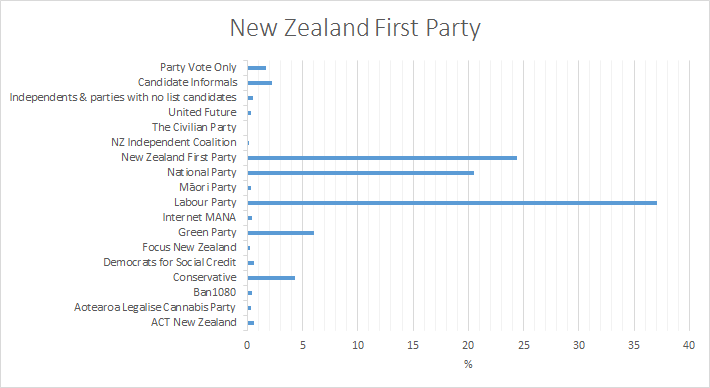
Figure 1: who won the electorate vote of New Zealand First party voters, 2014 New Zealand election
Source: Electoral Commission.
New Zealand First vote splitting data in Figure 1 suggests many more Labour voters vote New Zealand First than for the National Party with their electorate votes.
1/3rd of voters who gave their party vote to New Zealand First voted Labour with their electorate vote. This compares to one in five New Zealand First voters who gave their electorate vote to the National Party.
The Labour Party can win back some traditional Labour voters by borrowing populist policies from New Zealand First and its ageing leader such as prohibiting foreigners from buying New Zealand land.
Who mentioned Shane Jones?
In politics we don't pull our punches, unless you've got one of the world's best in town! http://t.co/Xiz2l36btg— Winston Peters (@winstonpeters) August 08, 2013
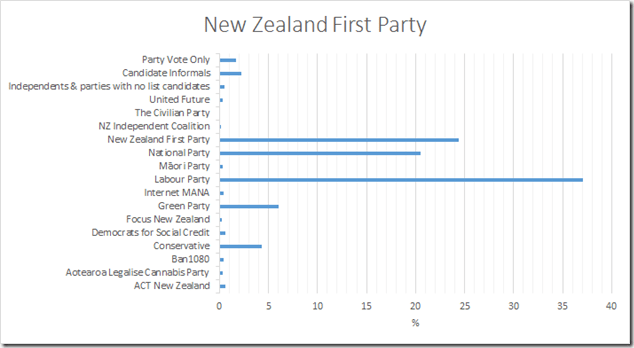
At the 2014 General Election 31.64% of all voters split their vote compared to 30.70% in 2011. Slightly over 80% of Labour Party and National Party voters give both their party vote and electorate vote to the same party.
Source: The Electoral Commission.
New Zealand First vote splitting data above suggests more Labour voters vote New Zealand First than National Party voters by a noticeable margin. 1/3rd of voters who gave their party vote to New Zealand First voted Labour with their electorate vote. This compares to one in five New Zealand First voters who gave their electorate vote to the National Party.
Source: The Electoral Commission.
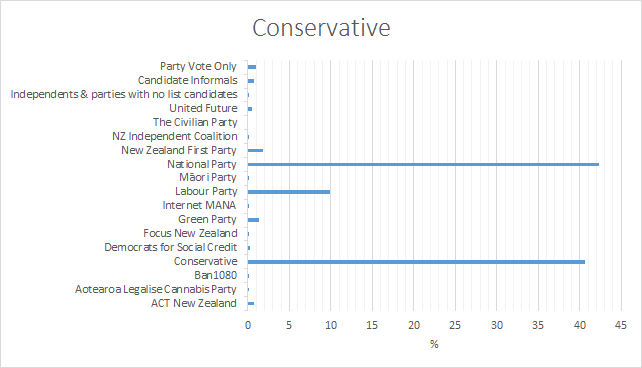
It’s a different story with the Conservative Party. A good 40% of Conservative Party voters give their electorate vote to National. This compares to a 10% split to the Labour Party.
The National Party has much to gain from the collapse of the Conservative Party as does fellow populist party New Zealand First. This split vote analysis does not throw much insight into how New Zealand First would benefit from a collapse in the Conservative Party.
If New Zealand First picks up a significant amount of the current party vote for the Conservative Party if the latter was to fold, New Zealand First will pick up one or two list seats in the next general election giving it the balance of power.
The only thing that could be said is the lack of Labour voters among Conservative Party voters suggest they are reluctant to support New Zealand First because in the past it has supported Labour Governments. The Conservative Party effectively promised to support a National Party Government.
A vote for the Conservative Party is a vote for a National Party government. A vote for New Zealand First is much more likely to see a Labour Government. That suggests to me that many Conservative Party voters are National Party voters at heart.
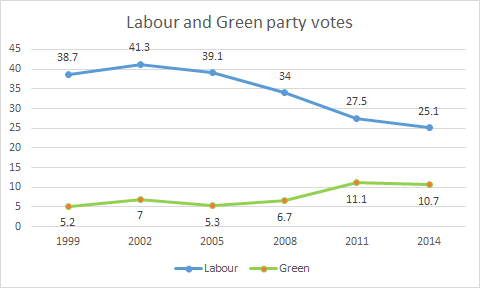
The New Zealand Greens have elected a new male co-leader. James Shaw is a first term MP who is supposed to consolidate and build the green vote from 10%. At the last election, the Greens were targeting a 15% party vote. Their vote fell from 11.1% to 10.7%.
I doubt that he can do it because much of the improvement of the Green vote since the 2005 election has been an expense of the Labour Party.
The Green vote was pretty sickly at 5-7% when the Labour Party was popular in government between 1999 and 2005. In the 2005 election, the Greens failed to reach the 5% party vote threshold necessary to win seats in Parliament on election night. It was only saved by absentee and postal votes that pushed its party vote up to 5.3%.
Maybe 30% of the Green vote, perhaps more, is made up of disgruntled Labour Party voters awaiting the call home. These disgruntled Labour voters will vote for the Labour Party again when it is fit for government.
Once there is a Labour–Green government in New Zealand, the Green vote faces the recurring theme that green parties lose a substantial part of their vote whenever they get into government such as happened federally in Australia and in Tasmania.
If the Greens go into government with about 7% of the party vote in the 2017 or 2020 New Zealand general elections, the Greens face the real prospect of of being voted out of Parliament completely in the 2023 New Zealand general election if their vote drops below 5%.
James Shaw happened to run for the Wellington Central electorate in the 2014 general election. He did not ask for the electorate vote in that election. Only the party vote.
Wellington Central has one of the highest green party votes in New Zealand. The Green party vote is 2000 more than Labour’s party vote in Wellington Central although the National Party won the party vote with 14,000 party votes.
Given the fact that the Greens may dropped below 5% by 2020, James Shaw would be wise to try to win Wellington Central in 2017 as a safety margin. If a party wins electorate seat under MMP, their party vote counts towards winning list MPs even if they win less than 5% of the party vote.
To add a twist to the tail, the deputy leader of the Labour Party, Grant Robertson, is the sitting member for Wellington Central with a margin of 8000 votes. If the current leader of the opposition fails at his job, Grant Robertson is his natural replacement.
There’s not much room at the top of the Labour Party list for defeated electoral seat candidates because of the last election Labour’s party vote was so low that it was only eligible for five list MPs. The last of these was the current leader of the opposition prove wasn’t even elected on election night but got back into Parliament on postal and absentee votes.
To complicate Grant Robinson’s golden parachute even further, the Labour Party has a policy that 50% of its caucus should be female by 2017 and the party list should be drawn up with that gender quota in mind. Grant Robertson may be a victim of this policy if he does not win Wellington Central.
More than a few careers hinge on the election of James Shaw as male co-leader of the Greens including the very survival of his party. It would be a tight race, but James Shaw could win Wellington Central.
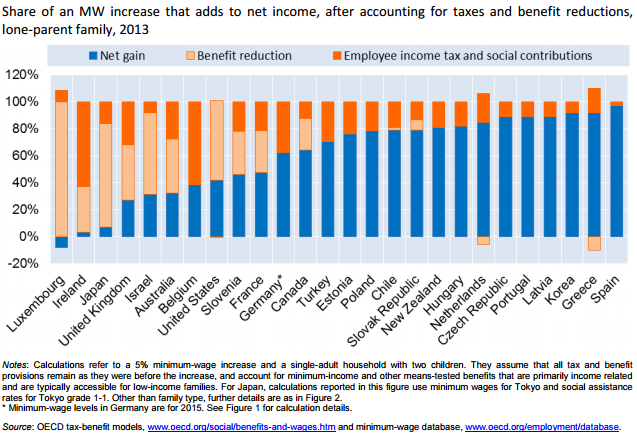
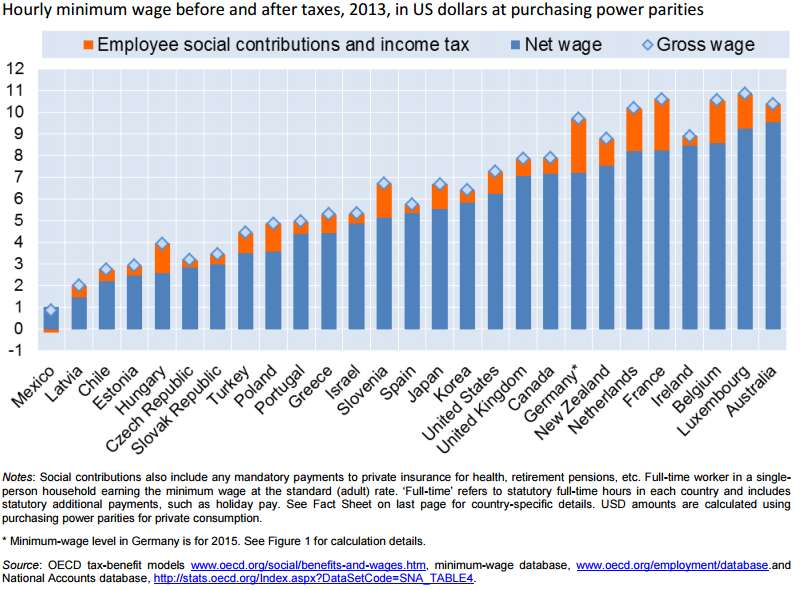
An OECD chart that shows New Zealand parents only need to work a little over 40 hours a week on the minimum wage to lift a family out of poverty in New Zealand.
The figure above shows that a lone parent with two children needs to work about 25 hours a week stay out of poverty in 2013 in New Zealand Once taxes are taken into account as well as additional family benefits such as in-work tax credits. New Zealand is one of the easiest places in the world to get out of poverty by working part-time for a sole mother.
The figure above from the OECD shows that New Zealand couple with two children needs to work about 40 hours a week to stay out of poverty. Of course, what is poverty depends on the definition of the poverty line and in this case by the OECD, it is defined as 50% of the median wage after taxes and family benefits. Another common definition of poverty is earning less than 60% of the median wage
The minimum wage is $14.75 per hour in New Zealand while proposals for a living wage in New Zealand are now $19.25 an hour. The Labour Party wants to increase the minimum wage to $15 per hour.The Greens want to increase the minimum wage to the living wage.
Sustained full-time employment of sole parents and the fulltime and part-time employment of two parents, even at low wages, are sufficient to pull the majority of children above most poverty lines, given the various existing tax credits and family supports.
The best available analysis, the most credible analysis, the most independent analysis in New Zealand or anywhere else in the world that having a job and marrying the father of your child is the secret to the leaving poverty is recently by the Living Wage movement in New Zealand.
According to the calculations of the Living Wage movement, earning only $19.25 per hour with a second earner working only 20 hours affords their two children, including a teenager, Sky TV, pets, international travel, video games and 10 hours childcare. This analysis of the Living Wage movement shows that finishing school so your job pays something reasonable and marrying the father of your child affords a comfortable family life.
The OECD’s analysis also showed that incentives for New Zealanders to work more and earn more is better than in most countries in terms of what happens if they earn a wage increase.
In New Zealand, when there is a 5% minimum wage increase, four percentage points of that wage increase actually stays in the hands of the worker.
In some countries such as Australia, the USA and UK, 60 to 80%of the minimum wage increase is gobbled up in reductions in benefits and taxes. At the same time, the minimum wage increase makes it less profitable for your employer to retain you so your job is more at risk.
The only explanation I have for why the Labour Party, NZ Greens and the living wage movement don’t highlight the success of the existing minimum wage in reducing family poverty in New Zealand is mass kidnappings.
But for these abductions most fowl, I’m sure the Labour Party, NZ Greens and the living wage movement would be dancing in the street celebrating successes of capitalism and freedom in New Zealand in keeping families out of poverty through the minimum wage.
The go left young man, go left strategy is a view of many in the Labour Party in New Zealand, Australia and the UK is if they present hard left policies to the electorate, they will mobilise many more votes from people who are currently don’t vote or who are mysteriously parking their vote with the Tory party or other centre parties.
Michael Foot’s attempt at to get out shy Labour voters with a hard left campaign in the 1983 British general election, which lead to his manifesto earning the title the longest suicide note in history.
The eight foot high stone monolith Ed Miliband planned to erect in the garden of number 10 Downing Street, if he could get planning permission, was dubbed the heaviest suicide note in history.
The New Zealand Labour Party went left at the 2014 general election and for its troubles earned its lowest party vote since the party was founded in 1919.
Central to the strategy of the New Zealand Labour Party in the 2014 general election was mobilising non-voters in their working-class electorates.
The median voter theorem be dammed! The New Zealand Labour Party in the 2014 general election honestly believed that hard left policies would induce these non-voters to vote.
These non-voters are called the missing million by the New Zealand left . Almost one million people did not vote in 2014; 250,683 were not enrolled, while 694,120 were enrolled but did not turn out to vote. Many of these voters were thought to be just parking their vote pending the arrival of true believers to lead the Labour Party if the Left over Left is to be believed! Many of these non-voters are younger voters who generally are more likely to vote left.
The Internet – Mana party also spent an immense amount of the $4 million donated by Kim.com in trying to turn out to the youth voter as well.
Chris Trotter was wise and prophetic on go left young man, go left and the shy Labour voters will come:
[T]he Left has been given an extraordinary opportunity to prove that it still has something to offer New Zealand …..
If Cunliffe and McCarten are allowed to fail, the Right of the Labour Party and their fellow travellers in the broader labour movement (all the people who worked so hard to prevent Cunliffe rising to the leadership) will say:
“Well, you got your wish. You elected a leader pledged to take Labour to the Left. And just look what happened. Middle New Zealand ran screaming into the arms of John Key and Labour ended up with a [pitiful] Party Vote …
So don’t you dare try peddling that ‘If we build a left-wing Labour Party they will come’ line ever again! You did – and they didn’t.”
Be in no doubt that this will happen – just as it did in the years after the British Labour Party’s crushing defeat in the general election of 1983. The Labour Right called Labour’s socialist manifesto “the longest suicide note in history” and the long-march towards Blairism … began.
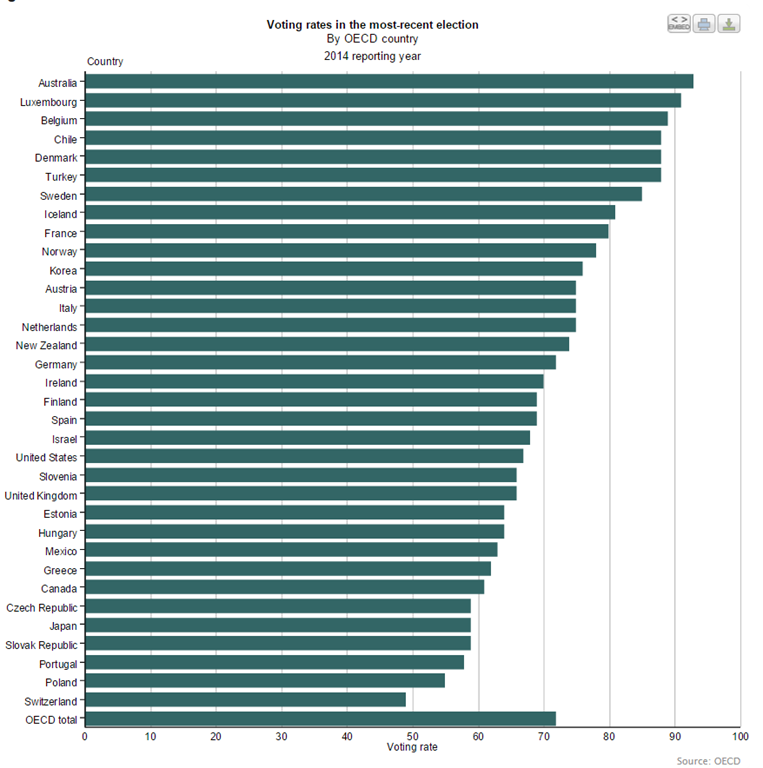
The most obvious flaw in the missing million and non-voter argument where they are waiting for true believers to offer hard left policies is a countries with much higher rates of voter turnouts and compulsory voting are not more likely to have left-wing governments.
There is much more evidence of shy Tory voters rather than shy Labour voters.
Shy Tory votersis a name invented by British opinion polling companies in the 1990s. The share of the vote won by the Tories in elections was substantially higher than the proportion of people in opinion polls who said they would vote for the party.
The final opinion polls gave the Tories between 38% and 39% of the vote – 1% behind the Labour Party. In the final results, the Conservatives had a lead of 7.6% over Labour and won their fourth successive general election.
Because of this turnout of shy Tory voters, the Tories won 3 million more votes than the Labour Party. This 14 million votes was more votes than they or any other British political party is ever won in a British general election, breaking the record set by Labour in 1951.
In a subsequent marketing research port, it was found a significant number of Tory party supporters refusing to disclose their voting intentions both the opinion poll companies, and exit polls.
This shy Tory factor is so large that opinion poll companies attempt to account for it in the weights they assign in their opinion polls surveys.
One of the explanations behind the turnout of the shy Tory vote in the 2015 British general election was a fear that a Labour Party minority government would be be holding to the hard left Scottish nationalists.
A number of British media commentators talked about running into many ordinary people expressing that very fear and they were undecided voters. About 20% of British voters were undecided on the eve the election, which is an unusually high amount.
Ironically, Neil Kinnock, the British Labour Party leader in the 1992 election, warned of a shy Tory factor a few days before the current British general election.
Tony Blair was much blunter a few months before the British general election about the relevance of the median voter theorem to British politics and the future of the British Labour Party. The most electorally successful politician in Labour history said that May’s general election risks becomes one in which a
traditional left-wing party competes with a traditional right-wing party, with the traditional result.
Asked by the Economist magazine if he meant that the Conservatives would win the general election in those circumstances, Mr Blair replied: “Yes, that is what happens.”
Many of your drinks will be prompted by variations on this perennial theme. Labour accepted the austerity narrative. Labour weren’t green enough. Labour weren’t radical (which has somehow come to be used as a synonym for left-wing).
Given that the last time Labour won an election without Tony Blair was 1974 it’s hard to believe people still think the answer is to move left. But people still do. I sort of love these people for their stubbornness. But I don’t want them picking the next leader.
The shy Tory vote stirred by the fears of a hard left government happened in the 2014 New Zealand general election. On the Monday night for the election that Saturday, the Internet – Mana party board had an hour of television for their Moment of Truth. This included Edward Snowden beamed in from Moscow put forward a whole range of bizarre conspiratorial theories about NASA surveillance of New Zealand and analysis by base in Auckland.
David Farrar reported that in Tuesday night opinion polling, the National party’s party vote rose from 44% to 47%. In the subsequent general election that Saturday, the national party led all night for the first time. It won as many votes as it did in the previous election when it was expected to lose votes because the national party government was going into its third term.
One reason for shy Tory voters is expressive voting. People obtain more sense of identity by proclaiming themselves to be a left-wing voter than they do from saying that they are a right-wing voter.
The expressive aspect of voting is “action that is undertaken for its own sake rather than to bring about particular consequences” (Brennan and Lomasky 1993, 25). There is almost never a causal connection between an individual’s vote and the associated electoral outcome. Hence, a vote is not disciplined by opportunity cost.
With no opportunity cost of how you vote in terms of deciding the outcome, people vote expressively to affirm their identity. Voting is about who and what you boo and cheer for and how you present yourself to the world.
Through the fatal conceit and the pretence to knowledge, a left-wing vote allows people to identify with doing good and changing the world for the better. No point in voting that way if you don’t go around thumping your chest proclaiming yourself as doing good for others by voting Left including telling the truth to polling companies.
Why Evolution is True is a blog written by Jerry Coyne, centered on evolution and biology but also dealing with diverse topics like politics, culture, and cats.
“We do not believe any group of men adequate enough or wise enough to operate without scrutiny or without criticism. We know that the only way to avoid error is to detect it, that the only way to detect it is to be free to inquire. We know that in secrecy error undetected will flourish and subvert”. - J Robert Oppenheimer.











 Utopia, you are standing in it!

Recent Comments