Average effective retirement ages by gender, USA and UK, 1970 – 2012

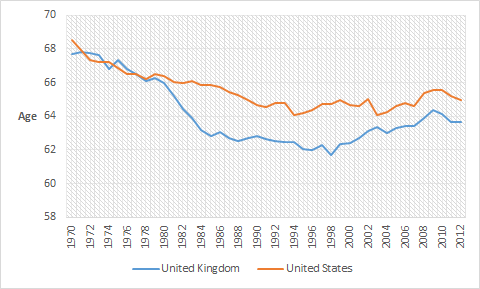
Figure 1 shows a divergence in the 1970s where there is a sharp increase in the average effective retirement age for men in the UK over a short decade. After that, British retirement ages for men started to climb again in the late 1990s. Figure 1 also shows that the gentle taper in the effective retirement age for American men stopped at the 1980s and started to climb again in the 2000s.

Figure 1: average effective retirement age for men, USA and UK, 1970 – 2012, (five-year average)

image

Source: OECD Pensions at a Glance.

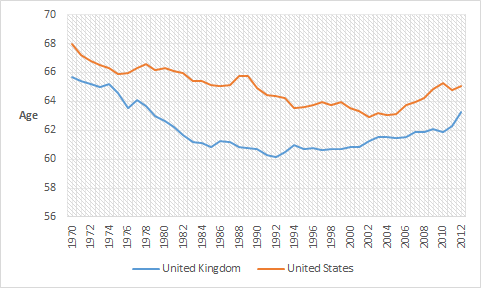
Figure 2 shows similar results to figure 1 for British and American women. That is, falling effective retirement ages  for both British and American women in the 1970s and 1980s followed by a slow climb again during the 1990s.

Figure 2: average effective retirement age for women, USA and UK, 1970 – 2012, (five-year average)

 image

Source: OECD Pensions at a Glance.

Bankrupt Greece spends 17.5% of its GDP on pensions

A country that spends nearly a fifth of its GDP on old-age pensions with surprisingly few people over the age of 55 working should not be surprised when it finds itself in financial difficulty.

The age composition of the US labour force

New Zealand national labour force projections – the invasion of the 65+ worker

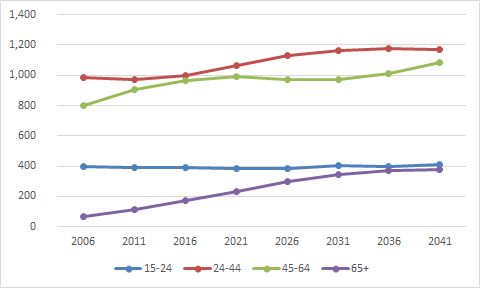
Figure 1: National labour force projections by age group, 2006-2041

image

Source: Statistics New Zealand, cyclical migration scenario

Not that many years time, about 2035, there will be almost as many workers as there are young workers – those between 15 and 24. About 400,000 workers in each age bracket.

Not that long ago all, in the early 1990s, there were about 25,000 workers in New Zealand were over 65 – they could fit in a football stadium. Soon, they will equal the population of the national capital: Wellington.

Workers aged 65+ moved from accounting for 1.5 per cent of workers in 1991 to 5 per cent in 2011 and 9 per cent in 2021!

The desired ratio of older and younger workers

The large accumulation of firm and industry-specific human capital of older employees can be more in demand in some jobs than others (Lazear 1998).

The pace of technological change in a particular industry influences the role of different ratios of older and younger employees to the most profitable way to develop human capital within a given firm (Lazear 1998).

Recruitment, on-the-job training, and learning by doing are alternative methods of acquiring and accumulating human capital. The relative profitability of each method of developing and renewing human capital will depend upon whether internal or external sources are the cheaper suppliers of new human capital to the firm.

When technological change is rapid, knowledge of the new technology is often embodied in the formal education and recent job experiences of new entrants into the workforce and younger up-and-coming workers (Lazear 1998).

In industries with more rapid technological progress, the departure of older workers is less of a capital loss to employers. Employers may have fewer incentives to accommodate phased retirements if human capital rich replacements are available. These younger recruits may be embodied with the latest knowledge of new technologies through their formal education and schooling and their previous job experiences.

The amount of skills learnt on the job relative to formal education is important to the desired ratios of older and younger employees.

When on-the-job skills are important to the success of the firm, there is a great need for teachers to pass on these skills. Older experienced employees will be greatly valued as repositories of firm-specific human capital and as teachers to new employees (Lazear 1998).

When formal education acquitted outside the workplace is the more important way in which employees learn their skills, it will be less important for employers to invest in accommodations that retain older employees as teachers.

The extent to which the firm’s operations and customers are more idiosyncratic is important to the ratio of ratio of older and younger employees that is best for human capital accumulation (Lazear 1998).

Again, senior workers are more likely to have this special knowledge and act as teachers to recruits when the firm’s operations and customers are more idiosyncratic relative to other firms (Lazear 1998). Employers will be more reluctant to see older employees quit if they act as teachers to recruits in the ways of the firm.

An employer has less concerned if older employees plans to leave if the firm’s preferred ratio of younger to older employee is not harmed. In some cases, older employees are valued as teachers and repositories of knowledge. In other cases, staff turnover can be an opportunity to inject fresh blood (Lazear 1998). It is all in the operational particulars of each firm, the importance of on-the-job training versus formal education, and the pace of technological change in the industry.
Next Newer Entries

Bassett, Brash & Hide

Celebrating humanity's flourishing through the spread of capitalism and the rule of law

Truth on the Market

Scholarly commentary on law, economics, and more

The Undercover Historian

Beatrice Cherrier's blog

Matua Kahurangi

Celebrating humanity's flourishing through the spread of capitalism and the rule of law

Temple of Sociology

Celebrating humanity's flourishing through the spread of capitalism and the rule of law

Velvet Glove, Iron Fist

Celebrating humanity's flourishing through the spread of capitalism and the rule of law

Why Evolution Is True

Why Evolution is True is a blog written by Jerry Coyne, centered on evolution and biology but also dealing with diverse topics like politics, culture, and cats.

Down to Earth Kiwi

Celebrating humanity's flourishing through the spread of capitalism and the rule of law

NoTricksZone

Celebrating humanity's flourishing through the spread of capitalism and the rule of law

Homepaddock

A rural perspective with a blue tint by Ele Ludemann

Kiwiblog

DPF's Kiwiblog - Fomenting Happy Mischief since 2003

The Dangerous Economist

Celebrating humanity's flourishing through the spread of capitalism and the rule of law

Watts Up With That?

The world's most viewed site on global warming and climate change

The Logical Place

Tim Harding's writings on rationality, informal logic and skepticism

Doc's Books

A window into Doc Freiberger's library

The Risk-Monger

Let's examine hard decisions!

Uneasy Money

Commentary on monetary policy in the spirit of R. G. Hawtrey

Barrie Saunders

Thoughts on public policy and the media

Liberty Scott

Celebrating humanity's flourishing through the spread of capitalism and the rule of law

Point of Order

Politics and the economy

James Bowden's Blog

A blog (primarily) on Canadian and Commonwealth political history and institutions

Science Matters

Reading between the lines, and underneath the hype.

Peter Winsley

Economics, and such stuff as dreams are made on

A Venerable Puzzle

"The British constitution has always been puzzling, and always will be." --Queen Elizabeth II

The Antiplanner

Celebrating humanity's flourishing through the spread of capitalism and the rule of law

Bet On It

Celebrating humanity's flourishing through the spread of capitalism and the rule of law

History of Sorts

WORLD WAR II, MUSIC, HISTORY, HOLOCAUST

Roger Pielke Jr.

Undisciplined scholar, recovering academic

Offsetting Behaviour

Celebrating humanity's flourishing through the spread of capitalism and the rule of law

JONATHAN TURLEY

Res ipsa loquitur - The thing itself speaks

Conversable Economist

Celebrating humanity's flourishing through the spread of capitalism and the rule of law

The Victorian Commons

Researching the House of Commons, 1832-1868

The History of Parliament

Articles and research from the History of Parliament Trust

Books & Boots

Reflections on books and art

Legal History Miscellany

Posts on the History of Law, Crime, and Justice

Sex, Drugs and Economics

Celebrating humanity's flourishing through the spread of capitalism and the rule of law

European Royal History

Exploring the Monarchs of Europe

Tallbloke's Talkshop

Cutting edge science you can dice with

Marginal REVOLUTION

Small Steps Toward A Much Better World

NOT A LOT OF PEOPLE KNOW THAT

“We do not believe any group of men adequate enough or wise enough to operate without scrutiny or without criticism. We know that the only way to avoid error is to detect it, that the only way to detect it is to be free to inquire. We know that in secrecy error undetected will flourish and subvert”. - J Robert Oppenheimer.

STOP THESE THINGS

The truth about the great wind power fraud - we're not here to debate the wind industry, we're here to destroy it.

Lindsay Mitchell

Celebrating humanity's flourishing through the spread of capitalism and the rule of law

Alt-M

Celebrating humanity's flourishing through the spread of capitalism and the rule of law

croaking cassandra

Economics, public policy, monetary policy, financial regulation, with a New Zealand perspective

The Grumpy Economist

Celebrating humanity's flourishing through the spread of capitalism and the rule of law

International Liberty

Restraining Government in America and Around the World