
Bubbles and crash without news
17 Nov 2019 Leave a comment
in applied price theory, economic history, entrepreneurship, financial economics, industrial organisation, survivor principle Tags: efficient markets hypothesis, rational expectations
Only rational expectations macroeconomics can explain self-fulfilling crises
01 Nov 2019 Leave a comment
in applied price theory, budget deficits, business cycles, currency unions, economic growth, economic history, economics of bureaucracy, economics of information, Euro crisis, fiscal policy, global financial crisis (GFC), great depression, great recession, macroeconomics, monetary economics, Public Choice Tags: Euroland, rational expectations, sovereign defaults

Thomas Sargent on rational expectations and the effect of taxes
08 Sep 2019 Leave a comment
in economics of information, fiscal policy, macroeconomics, Public Choice, public economics Tags: rational expectations, taxation and entrepreneurship, taxation and investment

V.V. Chari testifies on the information assumptions of modern macroeconomics and the risk of financial crises
03 Sep 2019 Leave a comment


Did fiscal austerity in 2010 have credible academic support?
05 Aug 2015 1 Comment

#Greece austerity gauge. Greek government spending has fallen 20% since 2008. In UK and Italy it's up. #GreekCrisis http://t.co/WMQBxxVFqq—
RBS Economics (@RBS_Economics) July 07, 2015
One measure of the scale of austerity in Greece…and other advanced economies. http://t.co/PxCLagdd3L—
RBS Economics (@RBS_Economics) July 06, 2015
The employment level in #Greece is back to where it was in 1985. It's the equivalent of the UK losing 6 million jobs. http://t.co/AAWHMEFwfK—
RBS Economics (@RBS_Economics) July 06, 2015
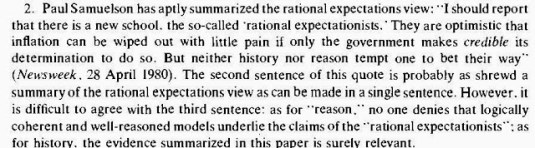
The shrewdest summary of rational expectations economic policy was by Paul Samuelson
02 Feb 2015 Leave a comment
in business cycles, fiscal policy, inflation targeting, macroeconomics, monetary economics Tags: new classical macroeconomics, Paul Samuelson, policy credibility, rational expectations, regime uncertainty, Stephen Williamson, time inconsistency, Tom Sargent
Why is Austrian business cycle theory held to such a high-bar?
14 Jul 2014 Leave a comment
in Austrian economics, macroeconomics Tags: Austrian business cycle theory, Murray Rothbard, rational expectations
I find it surprising that so many concentrate on rational expectations when discussing Austrian business cycle theory (ABCT). Is Austrian business cycle theory the only modern business cycle theory that must reach such a high bar?
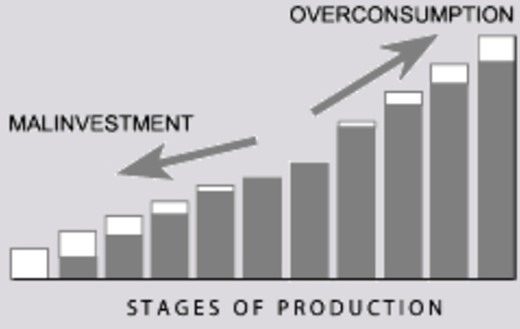
Many modern business cycle theories build on information costs and learning and explain that people make forecasting errors because of noisy information, and repeated monetary shocks keeping up this confusion.
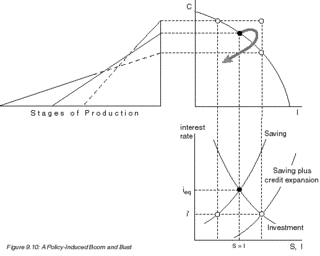
A good general explanation of misperceptions theories of business cycle is in Alchian and Allen (1967), which Murray Rothbard called a brilliant textbook. The business cycle is not based on money illusion or on systematic mistakes.
People take time to acquire the necessary information to interpret what has shocked the economy and what these changes mean for them. Additional shocks complicate this learning so there are more errors and confusion continues to affect market choices. Learning is neither instantaneous nor is the requisite information free to collate. People must make do with the incomplete knowledge they have and make choices about market signals that might be spurious or be meaningful signs of change.
Mises, Hayek, and Rothbard all noted in the collection edited by Garrison, for example, that a one-shot monetary shock would be soon uncovered by entrepreneurs, the malinvestments quickly reversed, and the boom would bust. Monetary shock after monetary shock require repeated entrepreneurial revisions and it will take a long time for entrepreneurs to catch up. This is also in Alchian and Allen.
Rothbard (MES pp. 1002-1005) discusses one-time versus repeated and increasingly large in size monetary shocks as the basis for booms and the reasons for the on-going deception of entrepreneurs. The shocks must increase in size to keep injecting more unanticipated noise into monetary and entrepreneurial calculations.
ABCT proposes a more complicated signal extraction problem than in say the Lucas-Phelps islands model. Dispersed and slowly unfolding information must be produced as each new monetary shock ripples its own unique way across the economy, passing through different hands each time. Only slowly does the requisite knowledge about the relative prices effects of each new monetary shock emerge as the result of market interactions and become open to entrepreneurial discovery.
What is perhaps dismissed too easily by Rothbard (but not Mises) is that under a gold standard, increases in the output of gold mining can be well forecasted by entrepreneurs. Rothbard’s best ground is when he notes that "the credit expansion tampered with all their [entrepreneurs’] moorings." A stop-go monetary policy is by definition unpredictable. Gold output fluctuations are irregular but usually small. A unique contribution of ABCT is that the longer the boom, the deeper the bust.
 Utopia, you are standing in it!
Recent Comments