Johan Norberg – Swedish Myths and Realities
08 Aug 2018 Leave a comment
in applied price theory, comparative institutional analysis, economic growth, economic history, economics of regulation, entrepreneurship, income redistribution, industrial organisation, international economics, labour economics, labour supply, macroeconomics, Public Choice, public economics, survivor principle, welfare reform Tags: Sweden
You have to play your cards badly to be deported from Sweden, much less serve two years in prison.
01 Aug 2018 Leave a comment
in economics of crime, Economics of international refugee law, International law, law and economics Tags: regressive left, Sweden

The Myth of Scandinavian Socialism
17 Feb 2018 Leave a comment
in applied price theory, comparative institutional analysis, constitutional political economy, history of economic thought, industrial organisation, Marxist economics Tags: Sweden
Why is the Swedish gender wage gap so stubbornly stable (and high)?
06 May 2017 Leave a comment
in discrimination, gender, human capital, labour economics, labour supply, occupational choice Tags: economics of fertility, female labour force participation, gender wage gap, maternity leave, preference formation, statistical discrimination, Sweden, unintended consequences
The Swedes are supposed to be in a left-wing utopia. Welfare state, ample childcare and long maternity leave but their gender wage gap is almost as bad as in 1980. They must be a misogynist throwback.

Maybe Megan McArdle can explain:
There are countries where more women work than they do here, because of all the mandated leave policies and subsidized childcare — but the U.S. puts more women into management than a place like Sweden, where women work mostly for the government, while the private sector is majority-male.
A Scandinavian acquaintance describes the Nordic policy as paying women to leave the home so they can take care of other peoples’ aged parents and children. This description is not entirely fair, but it’s not entirely unfair, either; a lot of the government jobs involve coordinating social services that women used to provide as homemakers.
The Swedes pay women not to pursue careers. The subsidies from government from mixing motherhood and work are high. Albrecht et al., (2003) hypothesized that the generous parental leave a major in the glass ceiling in Sweden based on statistical discrimination:
Employers understand that the Swedish parental leave system gives women a strong incentive to participate in the labour force but also encourages them to take long periods of parental leave and to be less flexible with respect to hours once they return to work. Extended absence and lack of flexibility are particularly costly for employers when employees hold top jobs. Employers therefore place relatively few women in fast-track career positions.
Women, even those who would otherwise be strongly career-oriented, understand that their promotion possibilities are limited by employer beliefs and respond rationally by opting for more family-friendly career paths and by fully utilizing their parental leave benefits. The equilibrium is thus one of self-confirming beliefs.
Women may “choose” family-friendly jobs, but choice reflects both preferences and constraints. Our argument is that what is different about Sweden (and the other Scandinavian countries) is the constraints that women face and that these constraints – in the form of employer expectations – are driven in part by the generosity of the parental leave system
Most countries have less generous family subsidies so Claudia Goldin’s usual explanation applies to their falling gender wage gaps
Quite simply the gap exists because hours of work in many occupations are worth more when given at particular moments and when the hours are more continuous. That is, in many occupations earnings have a nonlinear relationship with respect to hours. A flexible schedule comes at a high price, particularly in the corporate, finance and legal worlds.
Why no progress on the gender wage gap in @SenSanders’ favourite countries
02 Feb 2017 Leave a comment
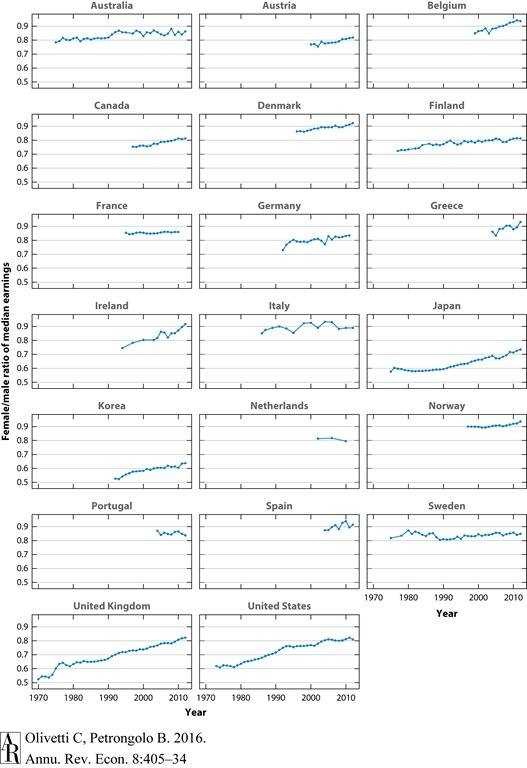

Johan Norberg – Nordic Gender Equality
10 Aug 2016 Leave a comment
in discrimination, economics, gender, labour economics Tags: gender wage gap, glass ceiling, Norway, Sweden
College and post-graduate wage premium in the English speaking countries, France, S. Korea, Finland, Denmark, Norway and Sweden
31 Jul 2016 Leave a comment
in economics of education, human capital, labour economics, occupational choice Tags: Australia, British economy, Canada, College premium, Denmark, education premium, Finland, France, graduate premium, Ireland, Korea, Norway, post-graduate premium, Sweden
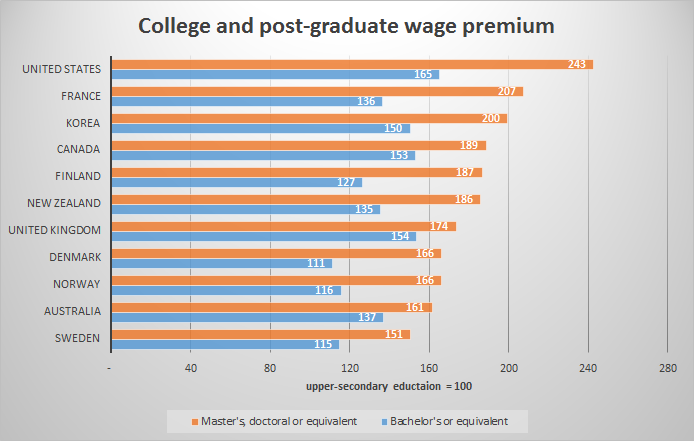
Source: Education at a Glance 2015, section 6.
The Nordic Gender Equality Paradox
30 May 2016 Leave a comment
in applied price theory, discrimination, gender, labour economics Tags: Finland, gender wage gap, glass ceiling, Norway, Sweden
The Swedish tax mix as a percentage of GDP since 1965
21 Mar 2016 Leave a comment
in economic history, public economics Tags: growth of government, size of government, Sweden
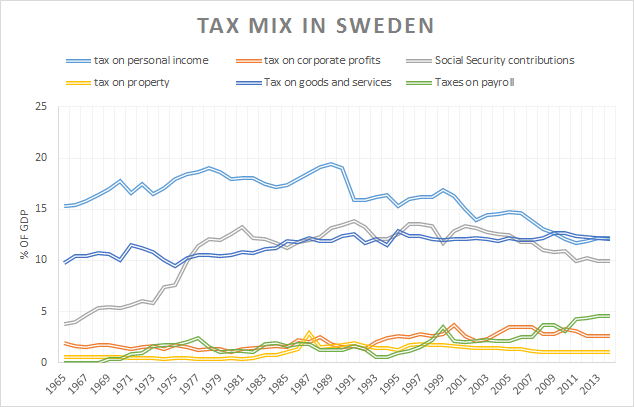
Source: OECD Stat.
% employees working more than 50 hours per week in the USA, UK, Japan, France, Germany, Canada, Italy, Australia, New Zealand, Denmark and Sweden
10 Mar 2016 Leave a comment
in labour economics, labour supply Tags: Australia, British economy, Canada, Denmark, France, Germany, Japan, Sweden, taxation and labour supply, working hours
Them Continentals certainly are a bit work-shy especially the Nordics. All of them are pretty much afraid to put in a long week. Then again they do face rather high taxes on labour so what would you expect? The Japanese are still working themselves to death.
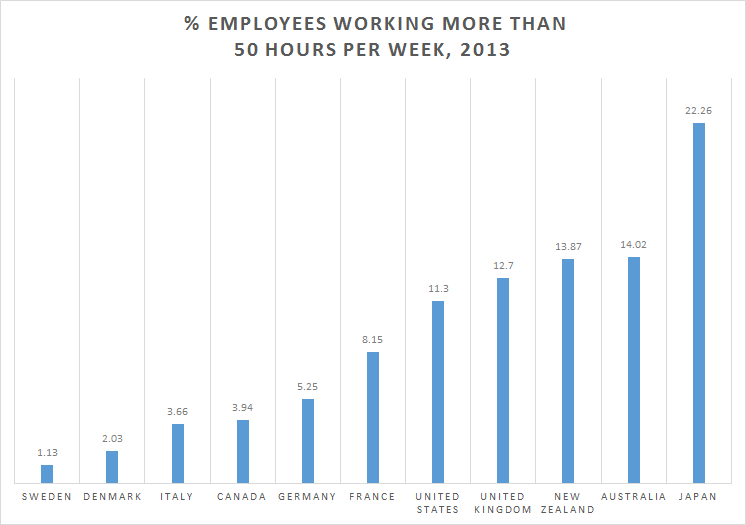
Data extracted on 09 Mar 2016 22:25 UTC (GMT) from OECD.Stat – OECD Better Life Index 2015.
Effective marginal tax rates on single and dual earner families in the USA, Britain, France, Germany, Canada, Italy, Sweden, Denmark, Australia and New Zealand
05 Mar 2016 Leave a comment
in economics of love and marriage, fiscal policy, gender, labour economics, labour supply, law and economics, politics - Australia, politics - New Zealand, politics - USA, public economics Tags: Australia, British economy, Canada, Denmark, effective marginal tax rates, family tax benefits, family tax credits, France, Germany, in-work tax credits, Italy, poverty traps, rational irrationality, social insurance, Sweden, taxation and labour supply
Some countries including New Zealand and Australia do not give ordinary families much of an incentive to earn more. Effective marginal tax rates on low income families is one of the few times that the Left discovers supply-side economics.
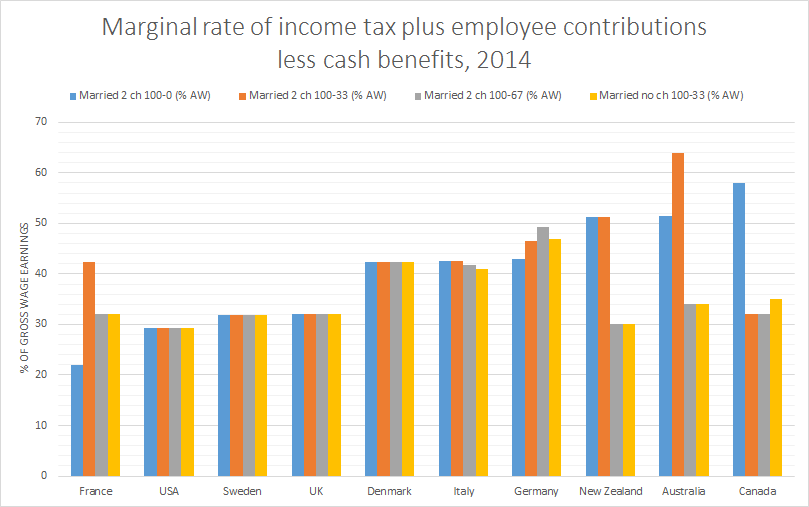
Source: Taxing Wages 2015 – OECD 2015.
Income tax plus employee Social Security contributions less tax benefits by family structure in the US, Britain, Canada, Germany, Italy, Denmark, France, Sweden, Australia and New Zealand
05 Mar 2016 Leave a comment
in fiscal policy, politics - Australia, politics - New Zealand, politics - USA, public economics Tags: Australia, British economy, Canada, Denmark, family taxation, France, Germany, Italy, social insurance, Sweden, taxation and labour supply
Those sensitive and caring northern European welfare states do tax families rather heavily even after accounting for family cash benefits.
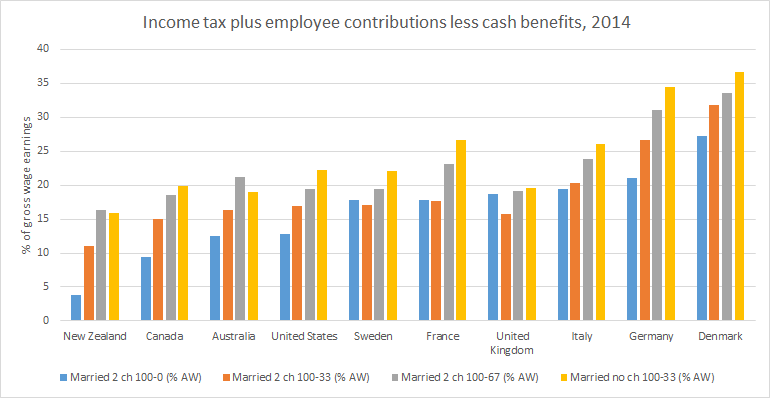
Source: Taxing Wages 2015 – OECD 2015.
 Utopia, you are standing in it!
Recent Comments